

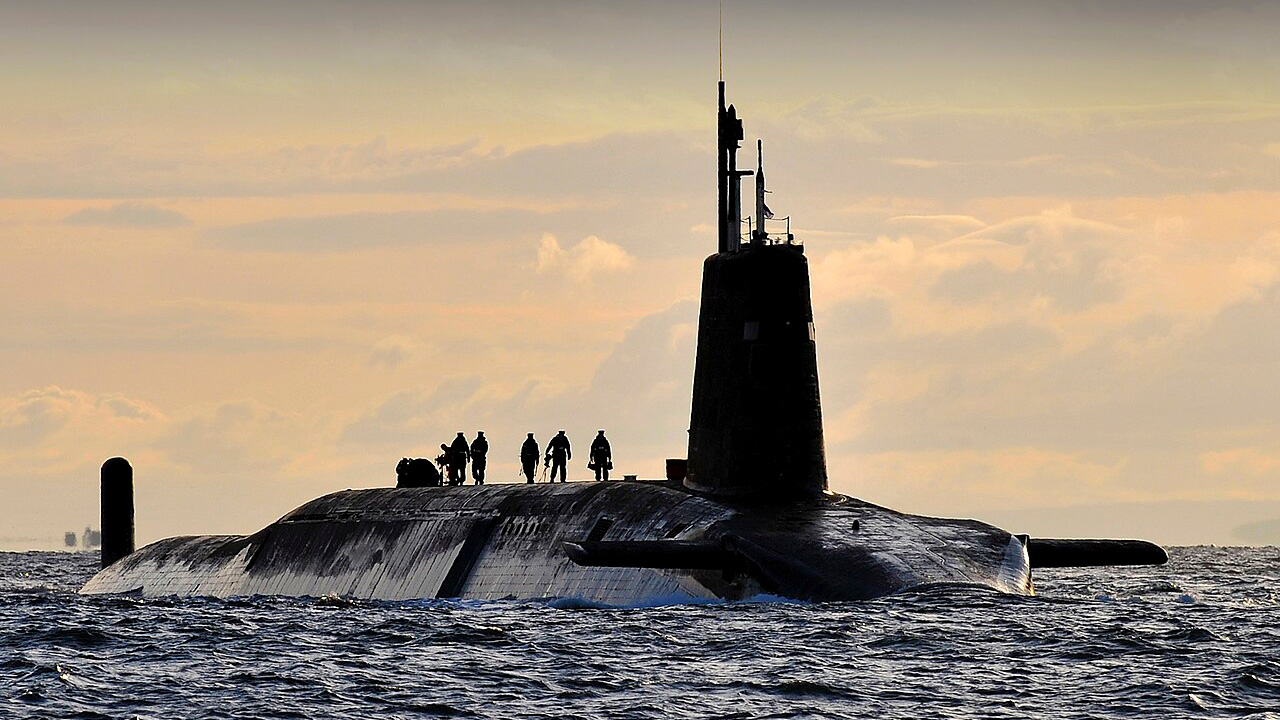
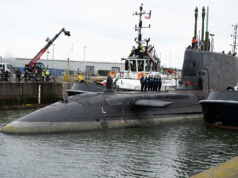
When a Vanguard-class submarine returned to Faslane this week after around 205 days at sea, it was a testament to the endurance and dedication of the crew. However, the more uncomfortable story is what recent record-breaking patrol lengths actually say about the state of Britain’s nuclear enterprise, and it isn’t a flattering picture.
Maintenance periods have lengthened significantly, which has forced patrols to extend in order to sustain the Continuous At Sea Deterrent. The arithmetic isn’t complicated here: if one boat is stuck in a delayed refit for longer than planned, the boats that are still operational have to stay out longer to cover the gap.
This is partly because ageing submarines become harder and more expensive to maintain, with unplanned defects becoming more frequent and the schedule margin for everyone else getting thinner as a result. For example, HMS Vanguard’s deep maintenance and refuelling overran by four years, which, again according to the Nuclear Information Service, pushed back the planned maintenance of HMS Victorious and generally piled more pressure onto the other boats, cascading through the whole programme.
Alongside this, the force has been dealing with well-documented industrial constraints, including shortages of nuclear-qualified engineers and delays to infrastructure upgrades, all of which reduce the capacity to turn boats around quickly enough. Extended patrols also make it harder to recruit and retain people, so experienced submariners leave after record-length deployments and take years of institutional knowledge with them, which makes the next maintenance period harder still.
What’s being done?
First Sea Lord General Sir Gwyn Jenkins visited Faslane in January 2026 to launch the Submarine Maintenance Recovery Plan, saying that “submarine maintenance throughput needs to drastically improve” and calling for “a radical engine for change in the middle of our enterprise.”
In the short term that’s meant creating deployable engineering workshop space at Clyde using containerised facilities, adding around 90 square metres of additional workshop capacity fairly quickly, alongside further temporary facilities at an undisclosed location elsewhere.
The plan also tries to address a structural problem where multiple teams were working on different parts of the issue without enough authority or resources to actually fix the system as a whole.
Looking further out, the Clyde 2070 infrastructure programme, formally launched in July 2025, is focused on modernising Faslane over the long term to support the Dreadnought class and eventually SSN-AUKUS submarines, with £250 million committed over the first three years of what is expected to be a multi-decade effort.
The Ministry of Defence recently confirmed that the Royal Navy’s long-planned additional fleet docking capability is now formally being delivered through Programme Euston, with the aim of providing new out-of-water engineering capacity at HM Naval Base Clyde in the early 2030s. In a written parliamentary answer, Defence Minister Luke Pollard said Programme Euston is the Navy’s solution to the requirement for additional fleet time docking, a capability seen as increasingly critical to sustaining the UK’s submarine force.
“Programme Euston is the Royal Navy’s solution to Additional Fleet Time Docking Capability,” Pollard said. “The programme aims to deliver a resilient out of water engineering capability at HMNB Clyde by the early 2030s.”
He added that the next major milestone will be the submission of a Programme Business Case in mid-2026, after which timelines will continue to be reviewed through the Ministry of Defence’s major programmes portfolio. The department declined to provide more detailed delivery schedules, citing commercial and operational sensitivities.
The biggest long-term fix is probably the Dreadnought class itself, which is designed from the outset with the lessons of the Vanguard era in mind and is intended to be easier to sustain, with modern infrastructure and a trained workforce ready to support it when it arrives. A new Trident Training Facility Extension opened at Faslane in March 2026, ahead of schedule, which will train up to 130 Royal Navy submariners for each of the new boats, with the first intake expected later this year.
Whether the recovery plan delivers improvements quickly enough to meaningfully shorten Vanguard-era patrols before the class retires is probably the critical question hanging over all of this.
The long-term solutions carry their own risks though. One of the main causes of the current pressure traces back to a decision made in 2010, when the Cameron government delayed main gate approval for the Successor programme by five years, reportedly saving around £750 million in the short term while adding costs running into billions over the longer run and leaving the submarine force under growing strain throughout the 2020s.
The Clyde Infrastructure Programme itself holds an Amber delivery confidence rating, reflecting ongoing problems with resource availability and inflation, and balancing infrastructure work with live submarine operations at the same site is a significant logistical challenge in itself, as is attracting and keeping people with the right expertise in nuclear operations and project management.
The same workforce and capacity pressures that have pushed patrol lengths to record levels are bearing down on the programmes that are supposed to fix them, and while the recovery effort is real and the investment is substantial, the margin for further slippage is pretty thin.





All those responsible for this sad state of affairs are probably retired and living a comfortable life without a care now.
David Cameroon… I actually give him a good shake at being oneof worst PMs in history.
Something like this the ball starts with the military, specially the Royal Navy and 1SL.
I’ve gained $17,240 only within four weeks by comfortably working part-time from home. Immediately when I had lost my last business, I was very troubled and thankfully I’ve located this project now in this way I’m in a position to receive thousand USD directly from home. Each individual certainly can do this easy work & make more greenbacks online by visiting
following website—.,.,.,..—>>> PayAtHome1.Com
Convenient of you to forget that it was a conservative/lib dem government in 2010 not just a conservative government. The delay by 5 years covers the exact time that the libs were in power along side them. The planed nuclear power stations were also binned. It was the price demanded by nick clegg and the Lib Dem’s.
Really we are blaming the minority party that would have had almost zero say… that’s convenient.
They were king makers, they said so themselves. Labour and the conservatives needed them to form a coalition. They talked to both parties. If you think they didn’t extract a price in policy you are naive.
Funny thing, I’m actually a very long time member of the LDs, and did a lot of campaigning, I knew one of the the leaders of the LDs and one of their ministers.. and had some conversations about this as a pissed off member who did not agree with going into government…so I do know what they got and what they compromised on.. and defence was not in the mix that was all Conservative lead austerity and the Lib Dem’s sucked up austerity for what the leadership thought were valid compromises…
So the core of what the LDs got and what they compromised on.
The things the LDs forced:
1)Electoral Reform: The top priority was a referendum on changing the UK’s voting system… that back fired.
2) Income Tax reform: raising the tax free band
to benefit low-paid workers. That is massive that nobody every gives them credit for as the Conservatives were only interesting in deficit reduction.
3) Pupil Premium to channel extra funding to disadvantaged students in schools.. this was to try and offset the carnage that was the destruction of surestart and other programmes to deficit reduction.
4) Civil freedoms, so Measures to reverse erosion of civil freedoms under the previous Labour government, including scrapping identity card act 2006 and the National Identity register, and the ContactPoint database. As soon as the Lib Dem’s left government the conservatives started piling back attacks on civil freedoms.. both conservatives and labour have been centralising power and intelligence.
5)Environmental Policies.. countered by austerity
What the Conservative Party forced
1) Tuition Fees
2) Deficit Reduction: the Conservatives required and forced the reduction in the structural deficit with the main burden placed on spending cuts rather than tax increases. This lead to austerity a pure conservative goal… NOT a Lib Dem one.
Nuclear Power and this is where the Conservatives were correct, They forced the Lib Dem’s to a process where they could formally oppose new nuclear construction while remaining in government.
In the End austerity and the religion of deficit reduction over everything was ONLY a Cameron Osbourne dogma and they burned a hell of a lot of armed forces capability on that pyre.. it was not a LD pyre.. the LDs had zero intention or interest in austerity or burning the armed forces in it… so you can try and diver from Cameron and Osboure if you like.. but if it’s not related to increasing the lower tax threshold, a bit of funding for disadvantaged school kids. So reducing of government data collection or the referendum on voting reform.. it’s not on the LDs…. But what is on them is agreeing to be the junior partner.. in that they are guilty.
Being in maintenance for 4 years seems ridiculous enough to me, but overrunning by 4 years? 7 Years on maintenance? It “only” took 6 years to build!
Once the reactor is hot some things take a lot longer.
There are always growing issues with running boats well beyond their intended lifetimes.
Nuke ships are not like conventional ships. What’s being described above sounds a lot like a USN ‘RCOH’ (Refuelling and Complex Overhaul) period. In this period, they will cut a hole in the boat’s pressure hull to access the reactor vessel. They’ll put a structure above that hole to safely remove the spent fuel. This is not an effort for the faint of heart due to the dangers involved. The reactor must be shut down for a fairly long period of time before you can even START the effort because the fuel is still insanely hot due to latent heat from the reaction. Since the whole ‘replace the fuel’ thing is already taking ages, most services who own nuke boats basically defer a pile of maintenance until its time for the refueling so they can do both at once. A Nimitz class might see the cats completely stripped out and rebuilt during this time. Several have had the entire main mast and portions of the island removed and replaced (major structural work).
So, while a QE can go in and out of maintenance every few months to take care of the little nits that develop, Charles De Gaulle and Nimitz defer those things because they’re going to be laid up and cut open for YEARS anyway doing refueling. Thus, the refueling becomes a cluster of all kinds of structural, electrical, and hydraulic maintenance along with massive systems upgrades. Some of this stuff comes with unforeseen consequences that add delays and unforeseen costs.
The rise of ‘life of ship’ reactor cores should see nuke ships moving closer to the normal maintenance practices, but the Vanguards are still stuck in the past.
Only Vanguard received an additional refuelling which was done as a precaution. However it’s been ascertained that the other three don’t need it for the service life extension fortunately.
Vanguard had an issue with its reactor that was not precautionary at all. You do not sit alongside for 8 years with that.
Really?
The USS Boise has spent a decade alongside (a third of its career) and after $800million is only 22% through her maintenance.
Now to be scrapped after completion has ballooned to $3billion.
Remember Covid? That had a big impact on the speed of refit work. Social distancing, Limited workforce available on site etc.
Vanguard had an issue with its reactor that was not precautionary at all. You do not sit alongside for 8 years with that. Yeah covid… That was a good one
Really?
The USS Boise has spent a decade alongside (a third of its career) and after $800million is only 22% through her maintenance.
Now to be scrapped after completion has ballooned to $3billion.
Refuelling a nuclear reactor and doing work on systems that are essentially lethal to life…
You should look up the state of the USS Boise if you think thats bad…
It seems to me that in this country for the last 30 years since blair we are run by idiots who i wouldnt trust to run a bath !!!!!!
@George one of your best articles.
It really says something that Starmer is greeting each boat as it comes back.
Oddly, it says something about his priorities but it also implicitly states and acknowledges the massive sacrifices the crews are making in less than ideal conditions.
Yes it does say something… once is a photo opportunity.. the second time is because you actually mean it.
He may be a bit shite but I think he is an individual who respects service.
I think he does respect service.
But I also think this is actually very, very worrying.
Navy outlook states that the issue with the submarines is being caused because one boat has sat along side for 19 months (it doesn’t say which boat)
Does any know what the issue actually is and what boat it is outside the rotation for so long.
PS I don’t need the usual daily Mail conspiracy crap about swapping spare parts between nuclear submarines being the issue. Just want to know if anyone has any actual information that can be shared legally obviously.
Much respect to the crew and their families, thank you.
Would it not be better for future generations if we could turn the mistakes of previous politicians into morality tales. It would be extremely useful if we couild bring Cameron, Osbourne and Hammond to account and remove any hnours or peerages as punishment for making bad decisons. It would serve to frighten the next generation of politicans into something resembling competence.
The austerity government stored up so so many problems …….it will take years to undo most of them, if it is even possible.
Let’s polling from Sky News, 70% of people want to see more defence spending but only 30% want any cuts to pay for it and even less want tax rises.
Politicans are just the symptom. It’s the public that’s the problem.
Jim I don’t think so. Politicians listen to themselves and the small group of people who support and fund them. Conservative politicans of the Cameron era would rather listen to Stonewall than their members.
Actually I rather think that politicians despise the public. I think politicians would rather the public just shut up and allowed them the freedom to follow their own obsessions. There has been no direct linkage between what politicians do and what the public wants for a number of years.
I cant seem to remember the clamour from the public to divert money from Defence to foreign aid or their demand for uncontrolled mass immigration or the the population’s furious insistence that crossdresser criminals need to be jailed in women’s prisons.
🤣
Jim i think the public would be more amenable to tax rises for defence if they saw that big visible efforts were being made to economise elsewhere. We all know the areas im talking about and im not going to list them here but suffice to say people want to see that their tax increase is actually being spent on defence and not pissed away into a benefits and NHS black hole.
I quite like the idea of your first sentence. Let’s start with stripping Blair of his knighthood, and jailing him for the spying operation on UN security council members that he ordered GCHQ to do, and the subsequent illegal invasion of Iraq. That should give him life without parole.
Hi folks hope all is well with you
Hopefully the maintenance can last until we have the Dreadnoughts, or at the very least the first of class ready before the planned commission. Still all credit to the magnificent professional crews of those subs, great work and thank you for keeping us safe.
Also, have any of you seen the article in Telegraph that Rachel Reeves is considering a form of war bonds to increase the defence budget? I would support such a bond only on the provision that the illegal migrants are stopped and we don’t spend a penny more on keeping them at our expense. What a saving that would be!
Cheers
George
🤣
Hi George.
Yes, I saw a headline about Bonds but could not access it.
I have asked this again and again – why on earth does anyone think that “stopping the immigrants” is going to be cheap, let alone *save* money??
America is spending *$85 Billion* on ICE. That’s the same amount we spend on the entirety of our defence. To replicate that here (scaled for population), we would need to spend four times the amount spent on immigrant housing, (a fifth of our entire defence budget). And we all know how effective ICE has been.
If there is some magical cheap solution, please make everyone aware!
200+ days locked in a box under the sea.. that’s hard yards, full. Respect and thanks.
The UK decided that they wanted to play around with the reactor… If they would have just stuck with the original us reactor zero issues. But we have to remain independent allegedly. I feel so bad for those poor bastards that have to go on a patrol like that
Make your mind up, first you claim to be American, now British.
Which is it, Ivan? 😂
I’ve gained $17,240 only within four weeks by comfortably working part-time from home. Immediately when I had lost my last business, I was very troubled and thankfully I’ve located this project now in this way I’m in a position to receive thousand USD directly from home. Each individual certainly can do this easy work & make more greenbacks online by visiting
following website—,,,,,,,,,,,,…—>>> JobatHome1.Com
This continuous at sea deterrence is taking a toll on people. budgets and the RN. Is it really essential to be at sea 24 / 7 / 365? Why not be ready to deploy at 24 / 48 hour notice? You do not inform your adversaries when and where the boats are just be ready to go rather than doing such long patrols under the sea. It may also help with a couple more of the Astute boats being available and at sea rather than along side.
It really is essential to have the deterrant at sea at all times. You don’t get 24/48 hours notice of a nuclear strike.
I’ve done some uncomfortably long patrols but nothing like these deterrent patrols. I do think we it’s time that those responsible were held to account for there negligence. I know that’s wishful thinking but we are in this state where our CASD is under genuine risk of failure. The crews must be utterly exhausted and i wonder what moral is like. At least on an SSN we were often doing very exciting stuff to break up the 9-10 weeks of an average patrol.
I think if we are honest the Nuclear deterrent renewal was delayed so long because it was always unaffordable within the existing budget. The net effect of the delay just made it more unaffordable, as unpalatable as it is to say, we just cannot and could not afford the Nuclear deterrent. The knock on effect of it being the wholesale cuts to conventional forces, we still haven’t seen the worst of the cuts yet. Yes there is an aspirational goal to get to 3.5% of GDP which would stem the cuts but it certainly won’t give us the fantasy fleets so many propose. The boats and upgrades to AWE have taken large chunks out of the MOD conventional forces budget. How this Tempest or 12 SSN-A are going to be paid for is for the fairies. Reality is very different from will. We have already seen the Type 26 order effectively cut to 5 and with any Ukraine peacekeeping forces costs also coming from the existing MOD budget, things are clearly going to get worse not better. We can’t get away from the ingrained view there is no votes in defence, it is pervasive across both sides of the aisle. It is no wonder the DIP is constantly being kicked down the road.