

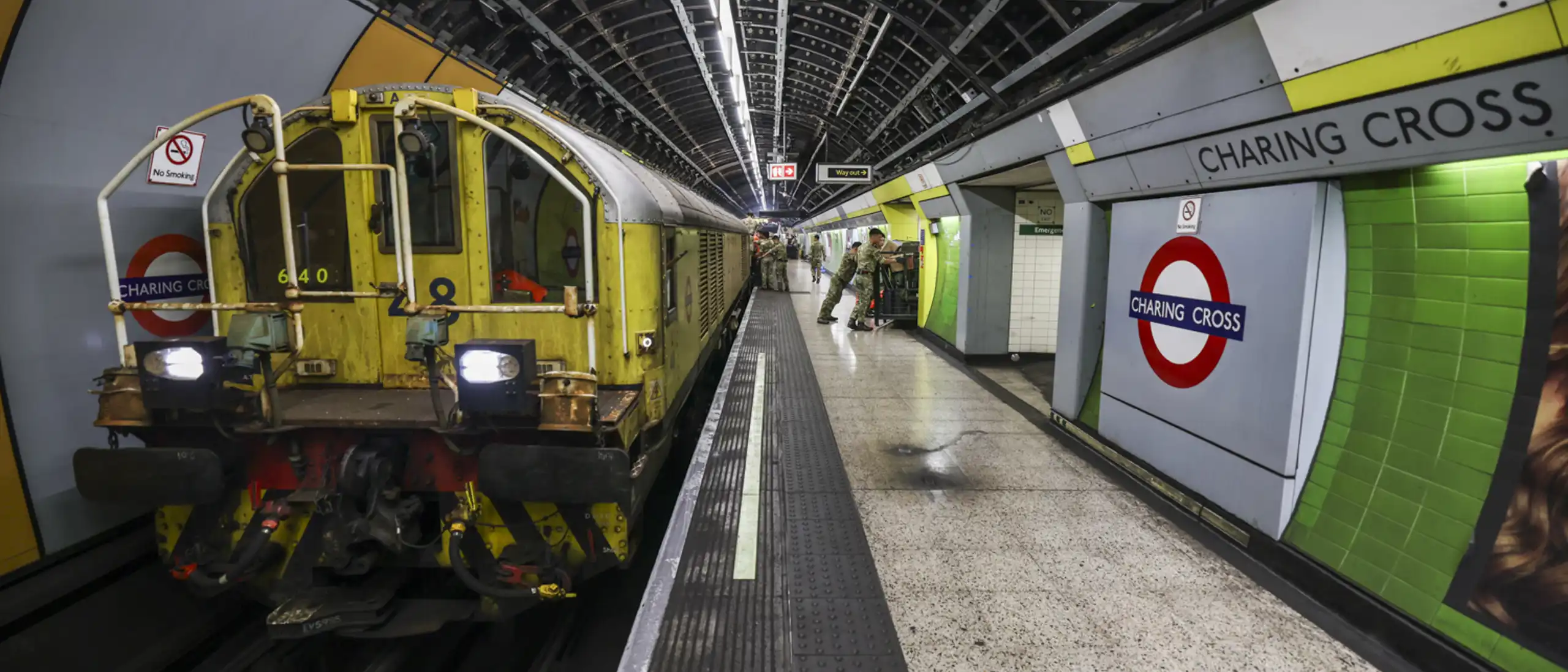
Hundreds of British Army soldiers have been running a major NATO command post exercise from a disused platform at Charing Cross Underground Station in central London.
Exercise Arrcade Strike, run by the Allied Rapid Reaction Corps, tested the ARRC’s ability to plan and command large-scale military operations involving around 100,000 personnel drawn from the UK and its NATO allies. From the underground location, the headquarters coordinated activity across land, sea, air, space and cyberspace in a fictional scenario set in 2030, a timeline military planners have identified as a period of heightened risk.
The choice of an underground location was deliberate. A senior commander on the exercise explained that the shift away from traditional above-ground command posts reflects hard lessons from modern conflict. “We have moved from operating in tents and open environments, to commercial buildings, to aircraft hangars, and now to underground locations. Operating below ground significantly reduces our signature, makes us harder to find, and improves our chances of surviving attack.” Russian long-range missiles, drones and electronic surveillance are all capable of detecting and striking a conventional command post within minutes.
General Chris Donahue, Commander of NATO Land Command and US Army Europe and Africa, was direct about the stakes. “A fully enabled Strategic Reserve Corps able to fight and win wars, led by the UK, is not optional. It is essential.”
Up to 500 staff worked in the tunnels, processing more than ten terabytes of data daily. A key enabler was Project Asgard, an AI-powered headquarters platform pulling in data from sensors, satellites and intelligence feeds to support faster decision-making. The Corps commander said the headquarters would “rely on data analytics and AI to ingest, fuse and visualise that data so the staff and I can make good decisions, at the pace of relevance.”
Exercise Arrcade Strike also served as the launch platform for 9 Deep Recce Strike Brigade, the British Army’s newest formation. The unit is designed to find and engage enemy forces at long range, commanding surveillance drones, rocket systems firing to 150km, and one-way attack drones with ranges out to 600km.
The logistics of establishing the command post required considerable ingenuity. Major Joe Harris, Officer Commanding 14 Squadron RLC, described moving all equipment via unmarked civilian vans to Ruislip in the early hours before transferring it onto a specialist Transport for London engineering train and bringing it directly to the Charing Cross platform. A week of construction followed, with 22 Signal Regiment installing communications networks throughout. The team also developed a barcode scanning system to track personnel underground, an innovation Harris suggested could have real-world operational applications.
Personnel maintained cover throughout. Corporal Ismaila Ceesay, an information management specialist from Stratford in east London, described arriving in civilian clothes and changing into uniform only after passing through secure barriers. “I’ve reached into my London roots and adopted a London look to blend in like a local, so no one can suspect I’m anything but a commuter going to work,” he said. Drawing a historical parallel, he noted: “Winston Churchill was hidden underground in London in the Second World War, so it’s nothing new. It worked for him.”
Major Jess Wood, Chief of the Joint Air Ground Integration Centre, said the location had proven its worth. “Underground offers good protection and is very adaptable, so we are able to deliver our frontline from a range of locations. It doesn’t matter where we are based to achieve effect.” The secrecy was not without its lighter moments. “Someone stopped me on my way into work and asked how to get to Heathrow yesterday,” she said.
The ARRC intends to continue rehearsing the underground model across the UK and Europe over the next two years, working toward a fully mission-capable Strategic Reserve Corps by 2030.









Ridiculous, Putin has a bunker in a mountain and Donald Trump has a ball room to hide under and our army is forced to use a Tube Station. What’s the country coming to, quick someone call the Daily Mail 😀
I’ve gained $17,240 only within four weeks by comfortably working part-time from home. Immediately when I had lost my last business, I was very troubled and thankfully I’ve located this project now in this way I’m in a position to receive thousand USD directly from home. Each individual certainly can do this easy work & make more greenbacks online by visiting
following website—.,.,.,.,.—>>> JobatHome1.Com
We literally designed tube stations to be used as HQ’s back in WW2 though?
Goodge Street, Down Street as two examples.
British Museum was MoD for a time as well.
So after the Cold War, many subterranean locations were closed, sold off, abandoned.
Some HQs moved to the surface, I’d read that “the hole” at Northwood wasn’t used as much. Do recent developments signal a reversal, as implied by the commander in the article?
If so, there will need to be a lot of money spent refurbing these places.
Others remained in their underground abodes, such as the NADOC and the CRC at Boulmer.
Interestingly, first official direct reference to 9 DRSB I’ve seen, I heard of this new formation a few weeks ago.
We now have 3 such DRSB, 1 3,9, all, as far as I’m aware, without a single new RA Regiment to add to these Brigades, but splitting up the already sub par ORBAT of the RA. Hope this improves.
9 DRSB as I understand it acts as a Corps Brigade for ARRC, leaving 1 and 3 for 1 and 3 Divisions.
Article says “firing rocket systems out to 150km.” MLRS ER?
Which rocket system? Unless musical chairs has happened yet again, the 2 regular MLRS Regiments, 26RA and 3 RHA, are allocated to 3 and 1 DRSB.
I’d read of rumours of the re establishment of 39RA, an old MLRS Regiment, forming a third regular MLRS formation. So I assume this is confirmed and that the new Regiment will be part of 9 DRSB. That seems to fit with the published plan to expand launchers to 76, with 8 Fire Batteries. Assume new Regiment has 2 Fire Batteries, as do 26RA and 3 RHA, making 6, plus 2 from the Army Reserve, 101RA.
Reference to surveillance Drones suggests the Find Group of FAT has also rebrigaded.
Underground London is one of my main interests, not the London Underground as such, but the other tunnels and underground locations. Interestingly, while the current DCMC ( Pindar ) was being built, it was suggested that the MoD had briefly used Kingsway, the old TE under Holburn and Chancery Lane Tube station, as the DSC on the 5th? floor of MB was so vulnerable. So this has a precedent.
Both DCMC and Kingsway could be reached using the old Post Office, now BT, deep level cable tunnels, which criss cross London and link directly to the Whitehall government tunnels a few hundred yards, if that, south of Charing Cross. These tunnels are subjects that need an article in themselves, but what peaked my interest with the use of the disused area of Charing Cross tube for this exercise is that one of the access points to the deep level is reported to be located there, in old storage areas.
The ARRC HQ thus has use of various egress points in emergency, not just from the station above or in using Engineering trains.
Hi Daniele
Interesting about the DRSB formations, I was wondering how the British Army would integrate and deploy drones. So which formations get the smaller drones? The lessons from Ukraine are seen as straight forward by many but I have been thinking about them for awhile now and I think the lessons are more complex than many might think.
Fundamentally, drones have changed the nature of warfare, everyone accepts that, but I suspect their effectiveness is influenced by how the battlefield is ‘shaped’. The situation in Ukraine is that the battlefield started off as a highly fluid and dynamic situation until poor planning by the Russians and effective partisan tactics by the Ukrainians stalled and then forced the Russians to withdraw in many areas. The next phase saw very effective use of anti tank weapons, such as NLAW, expose weaknesses in the Russian arm. Then came minefields as everyone expected the Ukrainians to mount a large counter offensive, but the battlefield stagnated instead. Since then both sides have made increasingly effective use of drones which have come t dominate the battlefield.
I wonder if the stagnated battlefield actually played into the the hands of the drone warfare tactics by lining up the two armies in relatively static positions. So I wonder if a fast moving battlefield would generate a different form of drone warfare. We should also think about satellite denial as well.
Cheers CR
Hi mate.
Indeed.
Smaller Drones, I’m not sure, depends. The usual Drone operators are 47 RA for the bigger UAS ( which is Watchkeeper being replaced by whatever comes with Corvus) and 32 RA, which uses the smaller UAVs.
You then have the really small Drones used by the Infantry.
I’d hope the Cavalry use them as well, if not, why not?
If we are talking FPV Drones, not just recc types, I don’t know the scale of use or distribution, Platoon, company level, I do not know.
The bigger OWE Strike Drones I have mentioned here several times, including photos of their use in the field documenting visits from the CGS. Distribution, and who, again I don’t know, assume the Royal Artillery.
The lack of info is frustrating, even at the height of the Cold war the BAOR was well documented, now, ambiguity and obscurity.
Which as J often says, isn’t a deterrent at all.
Thanks Daniele,
The questions you pose strike me as the important ones as drones have had considerable impact on the contact battle. They are effectively artillery in the hands of the infantry, guided artillery at that..! with ISR capability thrown in just for good measure. Kinda poses a few of questions don’t it? And it has to be said that the Ukraine War is a very particular kind of war and the next one will likely be different..!
Thanks again for your great post.
Cheers CR
Cheers my friend.
Both 47 and 32 RA currently sit under 1st Aviation Brigade, with Apache’s and Wildcats, so given 9 DSRB’s remit I’d go with them being moved from 1 Aviation to 9 DSRB. Makes more sense to be honest.
Ah Dern, good to see you, been a while.
I hoped you’d be able to comment on any of this.
Thanks Dern,
Nice to hear from you. I was wondering where you were just recently.
Cheers CR
Hi Daniele, Sky news had an article on this recently, in it, they referred to the military deploying equipment and armaments on the exercise they didn’t yet have..
Hi mate.
Yes, I read something similar.
Hi Posse, you wrote: “Sky news had an article on this recently, in it, they referred to the military deploying equipment and armaments on the exercise they didn’t yet have..”
This was a CPX, so there were no field units on the ground. In such a planning exercise it would make sense to wargame the move of Boxer MIV units and Boxer artillery regiments rather than to wargame nothing!
I think it would definitely be a good idea to spend some infrastructure allowance and refurbish as many of these places as possible.. im not so sure about publicising how they did it (2wks, civvi vans, TfL trains, etc).
Time for The Boring Company to bore some inexpensive tunnels for a Corregidor type underground complex under disused parts of existing bases. Bore the tunnels deep enough that they are hard to hit even using penetrator bombs and impossible for drones to spot. Prufrock is not seeing enough use in the US, ship it over to the UK.
Seriously, though, underground in the Underground sounds like a good idea to have in your back pocket but let us hope it never comes to this.
Just as an aside, Sweden whihc seems to take surviving as a nation more seriously than we do has around 64,000 harder underground shelters including entire hospitals and facilities that can house 20,000 people in one bunker. All the bunkers have air filtration as a well as the ability to function as nuclear biological and chemical protection not just physical blast, they have power and supplies in place. The whole biu]unker network is being
Upgraded with new generators and air filtration systems, with a 48 hour stand up window for the whole system, it has a capacity for around 7 million people to shelter in place and for civil defence activities to keep running.
The UK plan seems to be for everyone apart from a few senior political leaders to die and for no civil defence actives too be undertaken.
Civil Defence? The parties are too busy trying to save their own necks, get one over the opposition, or derail Reform, who exist due to their own behaviour.
No time for stuff like that!
I wonder if anything at all moved after the CDS comments last year?
Daniele, what is ‘9 Deep Recce Strike Brigade’, the British Army’s newest formation? Launched with just about zero publicity. Is it merely 1 Deep Recce Strike Brigade renumbered?
Hi Graham.
No!! It is another “new” DRSB.
First we had 1 DRSB, as you know.
Then, again not widely publicised, 3 DRSB was formed, taking a chunk of 1 DRSBs units as a result.
The two units then swapped IDs, the original Brigade became 3 DRSB, to align with it’s parent Division, 3 UK Division.
Which allowed the “new” DRSB, 1 DRSB, to be the DRSB for 1 UK Division.
So both Divisions have a DRSB.
I learned recently that a third DRSB has been formed, 9 DRSB, which will sit in ARRC as a sort of Corps Artillery Brigade. Apparently, it just replaces the Multi National Field Brigade HQ – source UKAFC on X.
A third MLRS Regiment will stand up and fall under this Brigade, a reformed 39RA, the original MLRS Regiment of old.
So all 3 of the DRSBs will have their own Deep Fires MLRS Regiment.
The usual caveats remain, often glossed over.
Who carries out Recc for 9 DRSB?
Where are the CS Logistics Regiments and other CSS for the existing DRSB, never mind the formation of two others, without robbing other units ORBAT?
And the biggest pinch point, ISTAR. As you’ll know, 5 RA remains our only dedicated Regiment in that regard, assisted by the 2 UAV Regiments, 32 and 47 RA.
So will be interesting and amusing how the Army square that 3 ways.
Perhaps 9 DRSB becomes a multi national staffed Bde in their case?
Apparently, the OWEs are also going to 9 DRSB, again, details not available to me yet.
Thanks Daniele for explaining all the DRSB stuff….and you study this stuff as an enjoyable hobby?!
It is total blx – just like rearranging the deck chairs on the Titanic.
Why is the army doing these reorgs piece-meal rather than as a full comprehensive study? CGS has been in post 2 years -perhaps he needs to commission a full Orbat study before he moves on, as a legacy. Perhaps you could give him your telephone number!
Hi Graham.
Ha! Thanks. I do indeed, and for the RN, RAF, and MoD as well, and as much of the UKIC that’s possible to piece together.
It is blx! My own cynical view is that they like to hoodwink people, including themselves, with all these Brigades. An impressive list on paper, unless you know the orbats for each and the gaping holes papered over.
Interestingly, was looking up NORTHAG the other day and the orbat of your old lot, 24 Infantry Bde.
‘Exercise Arrcade Strike, run by the Allied Rapid Reaction Corps, tested the ARRC’s ability to plan and command large-scale military operations involving around 100,000 personnel drawn from the UK and its NATO allies’.
Why would a Corps have as many as 100,000 personnel?
Quite a Corps!