

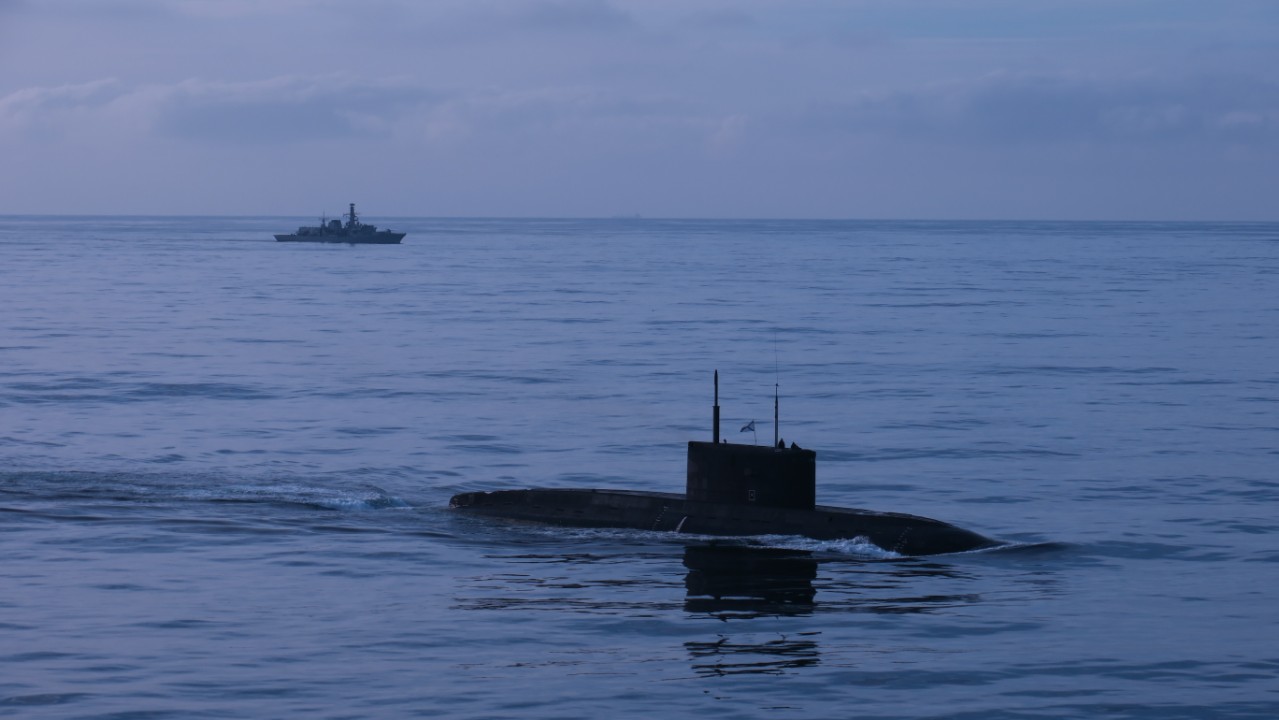
Denmark’s military intelligence service says there is a low but growing risk that Russia could carry out a limited military attack against one or more NATO countries bordering Russia, potentially within the coming months and even while the war in Ukraine continues.
In a new unclassified assessment of the threat from Russia, the Danish Defence Intelligence Service said Moscow had become more willing to take risks and was expected to intensify its hybrid campaign against NATO and the West. The service pointed to sabotage, destructive cyber attacks and drone activity in Europe, while saying Russian forces had also behaved increasingly aggressively towards NATO military units in the Baltic Sea region.
The assessment said: “There is a low but growing risk that Russia will launch a limited military attack against one or several NATO countries bordering Russia. This could happen even if Russia continues the war against Ukraine and has not built the military capabilities necessary to wage a regional war.”
Danish intelligence said such an attack would be a “desperate move” and could be intended to divert European resources away from Ukraine or create divisions within NATO over how the Alliance should respond. One scenario set out in the assessment involves isolated long-range strikes against infrastructure used to support Ukraine, followed by a Russian claim that weapons entered NATO territory because of Ukrainian jamming. Another possibility identified by the service is a false-flag attack using Ukrainian-made drones.
The assessment also considers the possibility of Russia deploying a small number of troops, potentially without national insignia, into a NATO country bordering Russia. Danish intelligence said such an operation would probably be preceded by a build-up of regular Russian forces near the border to prepare for a possible NATO response, a process it assessed would take several months and be difficult to conceal.
At the same time, the service said it had seen no indications that Russia was preparing an outright invasion of a NATO country and judged such an attack to be highly unlikely. It estimated that Moscow would need at least six months to prepare and assemble the forces necessary for an invasion, while warning that the possibility could no longer be completely ruled out.
The report said Russia would probably contemplate limited military action only if Moscow believed it would not trigger a collective NATO military response. It added that Russia was likely uncertain about where that threshold lies, particularly if it assessed that the United States could not or would not support European NATO members in a conflict.
Danish intelligence also expects Russia to increase the frequency and severity of hybrid attacks against Western countries. It said recent Russian activity had increasingly moved beyond attempts to create fear or reduce public support for Ukraine and towards directly interfering with military assistance, including sabotage against defence companies and railway transport carrying military equipment.
The service said future activity could include destructive cyber attacks capable of disabling critical public functions and sabotage carrying a high risk of casualties. It also cited a warning by Denmark’s domestic security service that Russia was planning and preparing sabotage against defence companies on Danish territory.
The updated assessment retains timelines published by Danish intelligence in February 2025 under a separate set of assumptions, including an end or freezing of the war in Ukraine, continued Russian military expansion and insufficient Western rearmament. Under those conditions, the service assessed that Russia could be capable of fighting a local war against a neighbouring country within around six months, pose a credible regional threat to several Baltic NATO members within two years and be ready for a large-scale European war within around five years.
Danish Foreign Minister Lars Løkke Rasmussen described the assessment as “deeply concerning”, saying: “Russia will escalate hybrid attacks, and low but increasing risk of limited attacks against NATO countries. We will not let ourselves be intimidated, but will continue support for Ukraine, pressure on Russia, and European rearmament.”







Why?
It would happen only as an act of desperation, but would have some logic politically internally. One scenario is a limited excursion into a Baltic State, little green men supported most like, forcing a NATO response knowing NATO’s would not venture into Russian territory. Any such border conflict could then with total control of the media be presented as a NATO attack on Russia, a serious provocation blah, blah, blah. This would help them pass a semi or full mobilisation to use in Ukraine.
This war is not going to stop:
Putin wants Ukraine, Moldova and the Baltic States within the Russian Federation, a new iron curtain from Kaliningrad to Odessa:
‘While the 9th Directorate of the FSB’s Fifth Service Department for Operational Information prepared for the occupation of Ukraine from July 2021, the 11th Unit of the Department for Operational Information, responsible for Moldova, was assessing plans for the next round of operations under the direction of Major General Dmitry Milyutin. In November 2020, the FSB’s strategic objective in Moldova was to bring about ‘The full restoration of the strategic partnership
between Moldova and the Russian Federation’ (Operation Z: The Death Throes of an Imperial Delusion, Dr Jack Watling and Nick Reynolds)
‘Russia’s ambitious plans to exert its influence in the Baltic states of Estonia, Latvia and Lithuania…were drafted by the Russian Presidential Administration’s Directorate for Cross-Border Cooperation…for the creeping annexation of Belarus and the toppling of Moldova’s pro-Western government. Despite its benign name, the Directorate for Cross-Border Cooperation is staffed by Russian intelligence officers from the three main spy services, the FSB, SVR and GRU, respectively representing the domestic, foreign and military agencies. The directorate’s real agenda is bringing nations back into Russia’s sphere of influence.’
(Delfi Estonia, Sweden’s Expressen, London-based Dossier Center, Latvia’s Re:Baltica, Lithuanian public broadcaster LRT etc.)
Why?
‘in 15 years, there may be 22 million fewer Russians. I ask you to think about this figure: a seventh of the country’s population. If the current trend continues, the nation’s survival will be in jeopardy…’ Putin 2000
‘the Russian authorities proudly announced numbers almost twice as high at 5.3 million, among them 738,000 children, thus showing their pride in the forced displacement of millions of Ukrainians and simultaneously articulating their hidden desire: millions of new potential citizens.’ (Russia’s War Is a Failed Answer to Its Demographic Crisis, Sasha Talaver)
Madness? Undoubtedly…but then so was the invasion of Ukraine.
‘…deputy director of Estonia’s intelligence service, thinks the plans feature exactly the same kind of delusional thinking and hubris, predicated on poor intelligence and false premises, that led Russia to believe it could quickly sack Kyiv over a year ago. “Knowing how the Russian regime operates,” he said, “I can say that the employees there have a habit of lying to their bosses because the bosses don’t like to receive unvarnished accounts of the real situation. If you provide them with embellished stories, you will live in an illusion. The Russian system is built on everyone bluffing.”
Britain is now hiding behind Ukraine, Poland and Germany, distracted, obsessed with Pooterish objectives of regional devolution, net zero, incapable of securing even our own borders.
There is a real, very real and imminent threat here to what is left of our sovereignty in both domestic and foreign policy…
That is why national security is the first duty of government.