

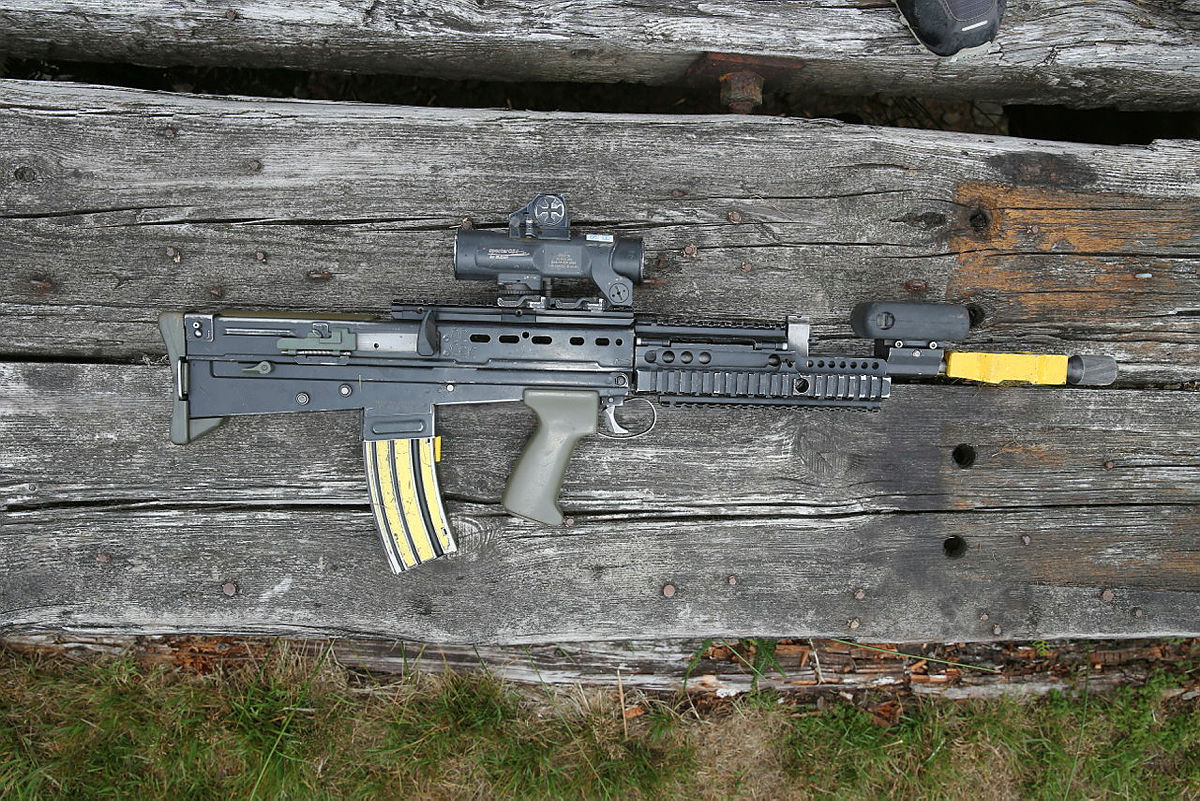
The programme to replace the SA80 family of weapons carries an estimated value of £2 billion including VAT, and the contract is expected to run from July 2029 until the end of March 2045, according to a contract notice published by the Ministry of Defence.
The notice, issued by the National Armaments Director Group on 23 October, announces an industry day for Project GRAYBURN, which is considering the future replacement of the SA80 and the provision of associated small-arms capability for defence as a whole. The estimated value excluding VAT is given as £1,666,666,666.67, and the tender notice itself is not expected until 2 July 2027.
The notice states that the authority “is at an early stage of developing the requirement and is using this engagement to inform its understanding of the market and potential delivery approaches”, and that “the scope and approach to any future procurement remain subject to further development and approval.”
It adds: “This notice does not constitute a call for competition, an invitation to tender or a commitment by the Authority to commence a procurement. The Authority has not selected a preferred procurement route, delivery model, supplier, product or contractual structure.”
Maria Eagle, then Minister of State for Defence, told Parliament in April 2025 that “due to the current phase of the project, we are unable to provide a formal cost estimation yet”, and said a figure would follow once the scope, timeline and complexity were confirmed. A senior defence official told reporters in July this year that the programme “is funded” while adding “I don’t think we’ve got the specific line in the document”, referring to the Defence Investment Plan, as this publication reported at the time. The notice now puts a number on it.
The dates have moved as well, and a procurement pipeline notice issued by Defence Equipment and Support in January gave indicative contract dates of 2028 to 2045 and carried no value, and this publication reported then that those dates were notional and should not be taken as a commitment to enter production at that point. The start has moved to July 2029, and a date has been attached to the tender notice for the first time.
The life of the weapon being replaced has stretched over the same period. Ministers gave the L85A3’s projected out of service date as 2030 through 2025 and into this year, including when Eagle told Rebecca Paul, the Conservative member for Reigate, that “the L85 rifle (‘SA80’) will be replaced over the coming decade through Project GRAYBURN”. By July officials were saying the rifle is expected to remain in service into the early 2030s. A contract starting in July 2029 and running to 2045 leaves the existing weapon carrying the load into the period the replacement is being delivered.
The January notice set out five planned variants, likely built on a common lower receiver: a standard dismounted close combat rifle to replace the SA80A3, a short dismounted close combat variant, a personal defence weapon to replace the L22 carbine, a generalist rifle to replace the SA80A2 and a cadet rifle to replace the L98. Requirements listed in that notice included United Kingdom manufacture to strengthen sovereign supply chains, a possible long-term strategic supplier relationship covering delivery, support and spiral development, the ability to defeat current and emerging adversary body armour, day optics as standard with rapid acceptance of in-line night vision systems, signature reduction on selected variants and reliability across all climatic and environmental conditions.
Luke Pollard, the Minister of State for Defence, confirmed in January that the programme covers the whole dismounted close combat weapons portfolio, from pistols to machine guns, and said it is “desirable for the project to create skilled employment in the UK” in line with the Defence Industrial Strategy. Answering Ben Obese-Jecty in February he said the department has “set clear expectations that Project Grayburn will be manufactured in the UK to enhance sovereign industry”, while “there is currently no specific definition for the future export potential of Project Grayburn.”
The industry day will be held as a hybrid event, with organisations attending in person or over Microsoft Teams, and each will be offered a single one-to-one session of no more than fifteen minutes. Attendance is by invitation only, organisations must register by five o’clock on 30 October, and the department intends to confirm attendance by 6 November. The engagement deadline is 27 November. The notice flags the opportunity as particularly suitable for small and medium-sized enterprises, and the one-to-one sessions will not be used to evaluate or down-select suppliers or solutions.
The SA80 entered service in the 1980s and has been through two major upgrades, the A2 rebuild carried out by Heckler & Koch and the A3 configuration that brought a new upper receiver and mounting arrangements. The calibre of the new weapon remains open, with performance, interoperability with allies and technological complexity among the factors under consideration, and approvals will run through the Combined Operational Effectiveness and Investment Appraisal process.
The project takes its name from Lieutenant John Grayburn of the 2nd Parachute Battalion, who was awarded a posthumous Victoria Cross for his actions at the Arnhem road bridge in September 1944.






Rumour (from the inside) has it that Sig has already been discounted because they won’t fulfil U.K. sovereign manufacture requirement.
Having watched BFBS news on the SIG weapon there is no way that a factory like they have could be set up here for the amount we would want! Saying that they could fill our requirements quite quickly if ordered.
Is that American or Swiss SIG? American SIG has an appalling track record in the last few years, the last thing we need is guns that go off when you drop them.
British don’t drop their weapons !
Clumsy recruits do
Yeah ok i’ll give you that 🙂
Genuinely couldn’t be happier. If it does come down to uk manufacturing footprint fn or beretta might clinch it, which i would be pretty happy with aswell as they both seem to be future proofing there offers for high pressure rounds compared to the others.
Hk has had some issues with mass production quality and likes to stay in usa or germany mass manufacturing wise, plus the 416 is a heavy expensive bit of kit and from what ive seen they haven’t been focused on adapting it to high pressure rounds or intermediate calibres.
Of note apparently the fn arka has been doing well in the socom hicar trials and gisele is already out.
We have ‘sovereign’ control whilst the order is being manufactured in a uk factory. when production ends, skilled labour laid off, factory over. Whilst I like Made in Britain idea, unsure if this is the right project.
The timescale is interesting…
The cost depends whether we are bringing small arms ‘at scale’, not neich like Accuracy International, back to the UK.
If it’s an off the shelf procurement from an established supplier, it will obviously be cheaper.
However, bringing the capability back to the UK is vital in my opinion. I would suggest Fn are in the strongest position with an established UK base and an excellent rifle on offer.
As I keep saying the ultra necessary small and medium projects like this are remorselessly squeezed in the vice of the every cash hungry mega projects.
The other issue I see is what happens when the manufacturing is complete? What does the factory then do . There only so many spare parts you can make
If delivery starts in 2029 and finishes in 2045, maybe the then 16 year old ones will need replaced or overhauled at that point?
Or indeed maybe a whole new design will be introduced to again gradually roll out?
Either way, a 16 year programme is a lot of future visible workload for a business, and it could lead to export sales too.
If they are serious about war footing, shouldn’t there be a rapid build up of 100,000 weapons that can be handed to conscripts, or do they hope that in an emergency workshops can churn out Sten guns?
Same for body armour, NvGs, radios, all the kit needed if there was a need to equip casualty replacements
A cynic would say there is other motive. This war footing just a drive to drive us closer/ into the EU by stating that Putin could invade.
Not sure wider public are convinced.
You have to take a step back and look at Defence estate and the stored equipment available.
The reality is, we divested ourselves of the ability to rapidly expand the Army at the end of the cold war, as it was no longer required!!
Successive defence reviews from Options for Change, to Front line first, cut defence estate, storage of War reserve equipment, firearms etc, as easy low hanging fruit for cuts.
Today we have the ability to mobilise, arm, equip and house reserves, both active and ‘selected’ reserve list personnel.
Anything above mobilising 40,000 ish people and we have no equipment, weapons, or places to put them.
We would likely have to requisition suitable estate and receive equipment and weapons from the US, if we were forced to mobilise quickly.
All hopefully on China , Iran and Russia not syncing actions. The US might not be willing to divert as much as hoped.
Used Bradleys , Humvees, Spare JLTV and older model M1, palladin might make a semi decent force though.
Very true, if Uncle Sam mobilised, he would be issuing all the above to his drafted minions….
We might get old uniforms, web equipment and stored M16A2’s, M4’s ect , if we needed to conscript an additional 100,000 + rapidly.
USA seems to be doing the syncing for them.
All we need is Trump to start running his mouth about annexing Taiwan to “get those beautiful chips” and we might find ourselves indirectly at war with all three.
John, you are perhaps optimistic to think that we could ‘mobilise, arm, equip and house reserves, both active and ‘selected’ reserve list personnel’. To be army-centric…
What numbers are we talking about…up to 35,000? We can house 73,000 regulars (albeit some live in their own owner-occupied or commercially rented property, but lets not get distracted by details). Could we house 35,000 more? Where? In tents on Salisbury Plain?
I hear that many light role AR Infantry battalions have no vehicles.
I would think at a push 35,000 mate and we would be top and tailing bunks adding any more.
This ‘utter shite’ about conscription, 100,000 more added and they would be issued overalls to wear and billed in budget hotels with bread knives tied to broom sticks.
The MoD have spent years disposing of defence estate and selling off all the stored equipment.
Let’s see if an opportunity to store 50,000 + L85 A3’s is taken when Grayburn delivers it’s replacement. I bet they simply destroy them!
You can buy a lot of battlefield rifles for £2 billion (including VAT)
Sovereign production is key, the UK must have the ability to chutn out weapons at scale if war required it.
Rough estimate is around 250,000 rifles for this sum of money, including tooling and production site costs.
True, but rather a lot less when you factor in Pollard is quoted in the article as saying it’s for everything from pistols to machine guns.
The main rifle is what everyone is talking about, obviously. But if we’re getting SAW/minimi replacements, possibly GPMG too, plus miscellaneous pistols then that £2B doesn’t go as far… I’m hoping that they don’t decide to include the rest of the ‘in between ‘ support weapons in there, like DMRs, marksman rifles, GMGs and Carl Gustav’s if we still have them. That brings less and less bang for buck…
Read the article: the 2 billion includes VAT.
The US is spending about £6,000 – £6,500 per M7 assault rifle. Might we build a good foreign weapon under licence?
Sixteen years for a new rifle etc? According to W.S. we’ll be at war in 1000days.🤔
No, expected to be in service and supported under the contract between 2029 and 2045.
Lucky we already have one of the best rifles in the world then.
Speaking of cost savings this seems like an easy one. Assault rifles are a matured technology. It’s not going to be an enormous difference which flavour of 5.56mm AR-15 derivative you buy but you can get plenty for 1-2k with all the bells and whistles, so why is it apparently costing £20k per rifle?
I get the priorities around domestic production and indigenous designs but at the end of the day if it costs 10x as much as buying off the shelf, then you are getting a tenth of the capability for the same budget. There’s got to be a reasonable compromise.
If the aim is to deliver@ 250,000 rifles, the cost inc VAT is £8000 per unit. Seems very high for a bulk order.
£2bn ($2.7bn) cost is probably below what the USA Army is paying for the SIG: “SIG Sauer secured a multi-billion dollar framework contract (up to a $4.5 billion to $4.7 billion ceiling) to supply up to 250,000 total weapons (including the XM7 rifle and XM250 automatic rifle) over 10 years. Individual per-unit acquisition costs fluctuate based on batch sizes, initial delivery orders (such as an initial $20.4 million order), and accompanying optics or suppressors rather than a single fixed retail price.”
Remember that your calculated unit price of c.£8000 will include sales overheads, licencing, a profit margin, meeting UK specific equipment’s (including manufacturing location), 16 years of support, spares, repairs, and the almost inevitable upgrade kits. VAT and other taxes are probably on top of the £2bn.
Hopefully – unlike the SLR – a large number of replaced SA80s will be put in storage, just in case.
Indeed. The SigSauer contract involves production of new 6.5mm ammunition. The requirement in the UK notice for effectiveness against current and emerging body armour suggests we too may be moving away from 5.56 mm.
If we stick with 5.56 mm, there should be several relatively affordable options.
I believe it also includes the extremely advanced rifle scope that automatically adjusts for range/wind and it includes the M-249 replacement (i cant remember the name of it but ive seen some videos and it looks extremely impressive).
We did store L1A1’s, large numbers of them, not just stored but rebuilt in a late 80’s F.T.R programme carried out by Parker Hale, that placed rifles into store in ‘excellent’ fully refurbished condition.
We then sold them off, or donated them to friendly countries etc.
Today we have no reserves to speak of. Today a mobilisation of any significant number would rely on Uncle Sam ‘very’ heavily to provide just about everything.
The MCX spear (civvy version) is as low as £3,000 in US gun stores (average price is £ 3,999.99). It’s the civvy version of the new US XM7.
I would expect the British government could knock over 50% off that price, then add the cost of the sights. Why not try and do a deal with the US where the UK’s order is tagged on to the US order as a FMS?
Peter, £8,000 per unit is a lot. However the all up figure surely covers ancillaries such as bayonet, multiple mags, sling, special sight etc as well as STTE, Publications, Initial training, spares for 2 years….etc etc.
I would like to see at least £1,000 off that price.
So they want a weapon that isn’t governed by US ITAR, probably uses existing 5.56 ammunition and work with a company which is open to manufacturing here in the UK !
Sometimes I just wonder why we just insist on repeating the same set of trials that every other country carries out to compare exactly the same candidates and a lot of the time end up with same solution (and sometimes the same problems with manufacturers).
IMHO any non US firm that can produce a non AR based 5.56 weapon that they then manage to sell to the US Armed Forces and the French as well has to be building a damn good weapon and at a fair price.
So why not JFDI and pick the FN SCAR ? We have a long history of cooperating with FN and I’ve never met any old soldier who didn’t regret moving from the L1A1 to the SA80.
Bet that old soldier never had to hump 7.62 ammo up a mountain in Afghanistan 😀
Well if it was down to me, it would be the latest version of the Steyr AUG (much improved over the original) , but in 6mm Arc & built in Britain.
Just came up a chart of 22 countries with more industrial robots per 10000 workers. Source IFR 2025
Leader by a wide margin S. Korea 1220
Last on the 22 list is China with 166
15 of the 22 countries on the list are European,
Germany with 449, Italy 237, France 195 and Spain with 183 are the large Euro population countries in the list.
UK is not on the list.
Have you ever come on here and said anything positive about the UK ?
@Simon A lot of us are incredibly down in the dumps about the state of Britain in general. We just got rid of a prime minister who seemed to hate the lot of us, now we’ve got one whose response to the cost of living crisis is to palm us off onto Google maps.
I accept a lot of us can be accused to toxic negativity, but pushing facts aside and, nearly as bad, toxic positivity (not accusing you of the latter) are not exactly helpful at the moment.
Now if you could say “That might be true, but this is what we are improving to counter that…” that would be another thing, but unfortunately, not something anyone can do right now.
In the case of this person though, he claims to be in Portugal and I am not sure he claims to be British ether
Ah, right, I get you. There is a metric ton of anti-British negativity around at the moment and I have seen stuff elsewhere that I thought sounded like it might be deliberate agitating, so I defer to your experience with the users of this forum.
I just wish there were some serious positives to hold onto at the moment about our nation’s defence.
Yes, i always praised CAMM missile(and their insertion in T45) and the carriers – except for their lack of self defense – there is no more to praise that i can remember atm. Yes i am Portuguese.
No he doesn’t, he currently claims to be Portuguese. Obviously Portugal being the military powers house it is he spends all his time on a uk defence website 😀
Well we supplied the Portuguese class trawler to the Royal Navy in WW2…
Hardly surprising given the uk’ is the world largest service exporter and our major manufactured goods are aerospace and pharmaceuticals, neither of which are conducive to robots.
If you look at the list of countries with lots of robots per head most are pretty poor by industrial standards so probably not a very good list to top.
The point is you cannot have defence without industry with enough size – critical mass- with enough poll of workers, engineers and managers.
Another was just how things change, the country that started industrial revolution today is this.
I suggest as we are seeing with Edgwing and Tempest that actually the most important part of the defence industrial base is design and technology. But even without theta the defence manufacturing base is a tiny part anywhere in the world compared to the rest of the economy. The UK’s defence industrial base is quite large relative to other countries even if manufacturing is a smaller part of our overall economy. The UK is the only country in the world outside the USA with two defence contractors in the top ten most valuable in the world.
You can no longer get car factories to build war planes or train builders to make tanks in a time of war, civilian industrial plant is largely useless for modern warfare.
Lets see.
UK has no capability building AFVs. So all British Armored top combat vehicles must be imported.
UK is taking a decade to build frigates. That is its current status of shipbuilding
UK contributes to US F-35, build Typhoon small numbers and started to develop Tempest an heavy combat aircraft, the picture is better than land and sea but there are no depth. There are no civilian aircraft being build.
UK has a somewhat better picture in missile which i now call the 4th force but lacking any ABM capability. Aster a limited capability in itself is French-Italian, CAMM is not ABM. i would say offensive missiles seem to look brighter in near future.
UK has no advanced land radar and naval radar search radar industry. Still has aircraft radar.
119 for the UK
The Smart Machines 2035 Strategy is a comprehensive 10-year roadmap commissioned by the UK Department for Science, Innovation and Technology (DSIT) and developed by the independent Robotics Growth Partnership (RGP).
The strategy addresses the UK’s persistent paradox: ranking 3rd globally in high-tier academic research quality for robotics, yet dropping to 24th globally in industrial robot density. Fully implementing the strategy aims to transition the UK from a research-only powerhouse to a deployment leader, potentially boosting Gross Value Added (GVA) by £150 billion by 2035
A personal view, the Fn ARKA is a front runner, looks to be an excellent rifle and Fn have a substantial UK footprint already, a dedicated small production facility wouldn’t be a massive push.
Rampant profiteering as usual.
Why we specify unobtainium parts and heat seeking ammo is beyond me.
Give everyone a P90 and some drones.
Not only would we be the first military to have Stargate guns, which in itself is better than any reason Labour or the MOD might come up with for not choosing it, the P90 might actually be highly useful for filling the air with bullets whenever drones are sighted.
We’re already becoming the Imperium of Man in terms of soul-grinding processes with no thought or logic in them; might as well take a leaf out of their book, and greet mass invasions by filling the air with so many bullets and explosives, nothing can survive.
The P90 is designed to kill your enemy, not to intimidate them..
The issue is, “We must have sovereign capacity” or whatever seems to be code for “This is gonna cost an enormous fortune” and sometimes also “It’s gonna lead us down a dead end and leave us with stuff no-one wants and we can’t get rid of”.
Does it really cost 2 billion quid to outfit a military as small as ours with a basic rifle? We could buy royal navy ships or buy F35s with that money. With so many troubling issues, shouldn’t we just buy what everyone else uses and invest the considerable savings into something we desperately need?
Project Grayburn is supposed to deliver 150,00-180,000 rifles from what I can gather. So assuming the higher 180,000 figure, this would work out as over £11,000 per rifle, which is high. £2k-£5k would be where we’d expect to fall for a rifle depending on spec.
What’s not clear is if that £2bn is supposed to include spare parts, scopes, night vision adaptors, training, updating logistics lines and armories etc.
What we do know is that it is supposed to be UK manufactured, so will involve setting up a whole new factory. I suspect that’s where the additional cost primarily comes from.
Thank you for clearly explaining it. I hope you’re right and the money is invested in spares, additional equipment and creating infrastructure, and doesn’t simply disappear into someone’s pocket, or turn into an additional £2bn overspend with delays and serious teething issues that delay the guns getting into service!
As the article points out the £2 billion is not an actual figure, it’s a department estimate for whole life costs over a period so it will include a lot.
We will be at war soon so don’t replace them just buy a couple of hundred thousand new British made guns and the bullets needed
These are the manufacturers that have so far submitted a bid for Project Grayburn and which militaries are using them:
• Beretta (Italy) NARP (New Assault Rifle Platform)
• CZ (Czech Republic) Bren 3 – Main users Poland, Czechs, Mexico, Hungary, Portugal, Romania and Ukraine
• Colt Canada C25 – Canada
• FN (Belgium) Arka / ARA – No military users yet!
• Heckler & Koch (Germany) HK416 – In service with France, Germany, USMC and Norway
• Heckler & Koch (Germany) HK433 – Upgraded 416, fixes a lot of the AR platform issues, such as no buffer tube, so you can fold the stock – Seen with Ukrainian forces
• Knight’s Armament Company KS-1 _ Some South Korean units and UK Army
• Sako (Finland) ARG / Sako M23 – Finland and Sweden
• SIG Sauer MCX Spear / MCX Spear LT – US Army in 6.8, UK RM
• SSS Defence (India) – M72, Sabre and Viper – Some Indian Units
Of the piston vs impingement rifles, the following are all short stroke piston operated:
Berretta NARP
CZ Bren 3
FN Arka
HK416
HK433
Sako ARG/M23 can be either
SIG MCX
SSS M72
Whilst only the Colt C25, keeps the AR’s gas impingement. You could also include the Sako, as it can be converted to either though not in the field I believe.
What are the pros and cons of piston vs impingement. The AR impingement method does make a lighter rifle, but only by a small margin. There are some that say it makes a more accurate rifle. As a short stroke piston places a force which tries to tilt the bolt carrier when it is being forced back against the spring by the piston. Which ultimately will cause more wear. From my point of view of having used both AR and HK platforms in operations, there is no noticeable accuracy difference and the wear only becomes noticeable after putting thousands of rounds down the barrel. Which may become a factor after 10 or 20 years worth of use.
By using a short stroke piston to re-cock the weapon after firing, will make the rifle slightly heavier. But it significantly reduces the chances of misfeeds and even misfires. Direct impingement will work happily 95% of the time all day long. However, its operation is directly related to how clean the propellent burns. If for example you have dodgy rounds supplied by Romania, as we did whilst in Afghan. The propellent doesn’t burn cleanly producing lots of carbon, and in this case tar residue. Which is forced down the return tube to the face of the bolt and bolt carrier. Which led to a number of feeding issues, predominantly misfeeding, requiring ether picking the round out of the eject port or detaching the mag to clear the spent cartridge and then requiring manual assist to force the bolt fully home to overcome the carbon/tar build up. This is fine when on the range, but not in the middle of a large contact, that the Canadian unit we were embedded in faced, who were using Colt C7s and C8s. My Team were using HK416s, that had the short stroke piston. Yes we faced the same issues with the crappy rounds. But we didn’t have the same problems with misfeeds or requiring manual assists, allowing us to stay in the fight rather than clearing the weapon.
For standard infantry, so long as you can guarantee the quality of the ammunition, a direct impingement AR platform will be fine. Plus if they don’t have quality ammo, have more hands on time and the built up knowledge on how to clear weapons faster. However, for someone who doesn’t get much range time, yet finds themselves in a contact or god forbid a fire fight, every second putting harm down range will be their priority. They cannot afford the time to clear or repeating to clear a mis-operating weapon. The rifle using the short stroke piston gives them more surety and reliability.
The HK416 which I know very well, surprisingly at least on paper, won the German Bundeswehr competition over the newer HK433. Not going in the legalities of why HK was chosen over Haenel and the Mk556. The 433 was an evolution of the 416 based on mixing in some G36 parts. Where they relocated the charging handle to the foregrip (ala SCAR) and removed the buffer assembly to a spring assembly under the bolt, similar to the SCAR. Thus allowing the rifle to have a folding stock. However the Bundeswehr opted for the tried and tested 416 over a more or less untested clean sheet design of the 433.
Thank you for your informative comment
Thanks
The 416 or Knights Armament would be my choice.
There is also a 5.56 SIG Spear that seem to be heavily used by US SOCOM units? Is only the 6.8 being offered?
My personal opinion is part of the reason the US is going to 6.8 is because robots are only going to increase on the battlefield and maybe that extra firepower could be useful against those? Even Russia is increasingly using small unmanned ground vehicles. So 6.8 may be more future proof… Ive seen testing videos of those rounds and its extremely impressive how effective they are against armour.
Interesting thought.
US is not going 6.8 and robots will need other weapon type.
Can of brake cleaner, bottle of a break-Free, tooth brush = happy days
£20k a rifle?
Are they they 24ct gold plated and diamond encrusted?
@£10k a pop (that’s Inc sights etc) that’s 200,000 units, the USMC pays less than $2k for its HKs so once again this looks expensive, unless it is for the full system and we are going to buy 400-500k units and store them or commit to 20k units per year for 20 yrs, at this point don’t bother with spares if that means an expensive parts inventory, just replace with new guns and have the infantry strip them down for their own spares if that’s cheaper. We need to get into the habit of consuming items in the military and not trying to make them last forever which has cost us a fortune and left us lagging behind as vendors know we are not consistent buyers.
Time to use abuse and buy new…
I think the price is to cover the cost of opening a factory, so if that is the requirement it won’t be anywhere near $2k…
We have to wait until the American’s decide on the N.A.T.O. calibre round.
5.56
Is the inertia choice, but Russia has introduced the 6.02×41 round in their latest assault rifle, so the US will not want to be outmatched. 6.8 Sig is too much & will be quietly dropped. My money is on 6mm Arc. US Navy Seals are using it & if that goes well, I can see other units adopting 6mm Arc.
Dern, missed on this forum for a while now, explained this well enough for me.
The KS1 and other boutique types are too specialised for the typical green army soldier and quite unnecessary.
What is needed is a good enough IW we can buy in bulk for the Infantry and lesser types for CSS units and vehicle crews.
KS1 and such are used by elite units.