

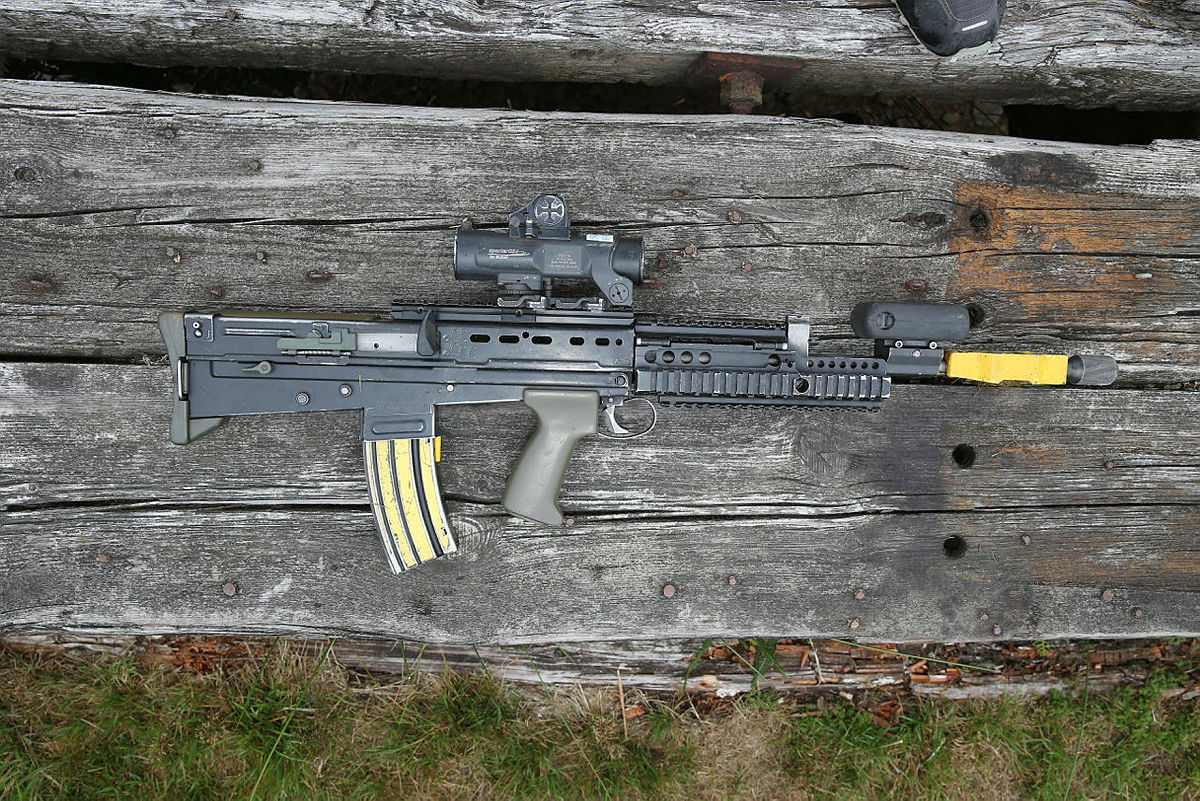
Project Grayburn, the programme to replace the British Army’s SA80 rifle, is funded despite not appearing as a specific line in the Defence Investment Plan.
The programme does not appear in the published document. Asked about its status, a senior defence official confirmed it remains funded. “Grayburn is funded. I don’t think we’ve got the specific line in the document, but the funding is there,” the official said, adding that the department does not yet have specific dates for the transition to a new weapon and that these would be set out over time.
The SA80 family has been the British Army’s standard individual weapon since its introduction in 1985. A bullpup design chambered in 5.56x45mm NATO, with the action set behind the trigger to keep overall length short, the rifle suffered well-documented reliability problems in its original L85A1 form before a major rework by Heckler and Koch in the early 2000s produced the L85A2.
The current L85A3 standard, introduced from 2018, added a new full-length upper receiver and handguard to improve accuracy and allow modern optics and accessories to be mounted, along with internal improvements. The weapon is expected to remain in service into the early 2030s.
Project Grayburn is intended to deliver the SA80’s replacement across the armed forces. The question put to officials also asked whether the current rifle’s service life would be extended, a point the answer did not directly address.
On the level of detail in the document more broadly, a senior defence official said the plan sets out four-year totals for major capability areas, with some broken down by year, and does not specify what the department will be procuring in five to ten years’ time in granular detail, on the grounds that technology is changing too fast. The UK has not manufactured a standard-issue service rifle at scale since SA80 production ended.











It will become to old we will extend until the next parliament as we need more information……etc etc untill the late 2030 as the A3 upgrade is fantastic etc.
Rather have something that would actually stop the opposing guy rather than bounce off.
They should delay this project until we have a better understanding of intermediate rounds like the 6.8mm. No point on spending hundreds of millions on a new 5.56mm weapon only to find out NATO standard is changing. The SA80 A3 is perfectly adequate and still enjoys a significant range advantage over any of the AR 15 based rifles being proposed without using higher chamber pressure.
No reason to rush into this.
I understand lefties won’t approve 😀
The NATO standard isn’t changing. France, Germany, Italy, Poland, Norway, the USMC and others have all recently brought new 5.56 service rifles into service.
The move is increasingly looking at more powerful 5.56mm cartridges with AP rounds rather than larger calibers as per the M7 and M8.
Exactly this, US Special Forces are looking at a hypervelocity round in 5.56mm, and are steering clear of the whole M7/6.8mm issue; I’m sure the round is called M885+, and that way they can just swap ammunition when required, instead of adopting a whole new rifle. We already have production capacity for 5.56mm, seems crazy to change it for a different calibre when we could just modify the line for a more powerful cartridge in the same calibre
They are indeed, on the basis that if they run out of their new Mach 6 bullets while out in the field then they can easily source traditional NATO 5.56 bullets to fire. The bullets exists it’s just a question of guns that than withstand the higher pressures. These new bullets will potentially make the 6.8mm obsolete before its even fielded in large numbers.
Minor nitpick, the HICAR solicitation refers to the new cartridge as M855A1+, not M885+, though I would imagine that’s a placeholder name and it will get its own unique M or Mk number if and when it enters service.
Not nitpicking, I appreciate the correction, although I stand by my original point!
Oh absolutely, I very much agree that HICAR and M855A1+ makes much more sense than the SIG XM8 and 6.8 Common, for all sorts of reasons.
Also NATO ammunition doesn’t change overnight. The FN FAL and G3 in 7.62 where in use decades after America went 5.56 with the M16. So even if the US adopts 6.8 or anything else, it doesn’t follow the rest of NATO will be in a hurry to follow.
A low priority for me.
I agree , the newer SA80 marks are meant to be quite good if a bit heavy talking to the people in the know , our armed force have much more
higher priorities.
The rifle is to be replaced by a space based drone operated form Mars.
In the grand scheme of things it’s small money compared to the headline items so I’m not surprised it wasn’t mentioned by name. I do wonder if this is the right time though, it might be better to let the US experiment more with alternative calibres and see what the mood is with NATO allies before making a change.
Britain & NATO, should follow US Navy Seals & buy rifles in 6mm Arc.
Exactly this, US Special Forces are looking at a hypervelocity round in 5.56mm, and are steering clear of the whole M7/6.8mm issue; I’m sure the round is called M885+, and that way they can just swap ammunition when required, instead of adopting a whole new rifle. We already have production capacity for 5.56mm, seems crazy to change it for a different calibre when we could just modify the line for a more powerful cartridge in the same calibre
Ignore me, replied to the wrong comment! Down with 6mm!
I don’t want to be there, when some one puts a super high pressure 5.56 in an old AR15. This is why 6mm Arc is a good idea . More capable than 5,56, but not as bat shit crazy as 6.8mm Sig.
This is now less relevant than ever – to be completely honest, I think we should keep SA80 for now.
Small arms must account for somewhere less than 1% of all casualties in Ukr.
We have reasonably okay rifle, and far more pressing needs right now.