

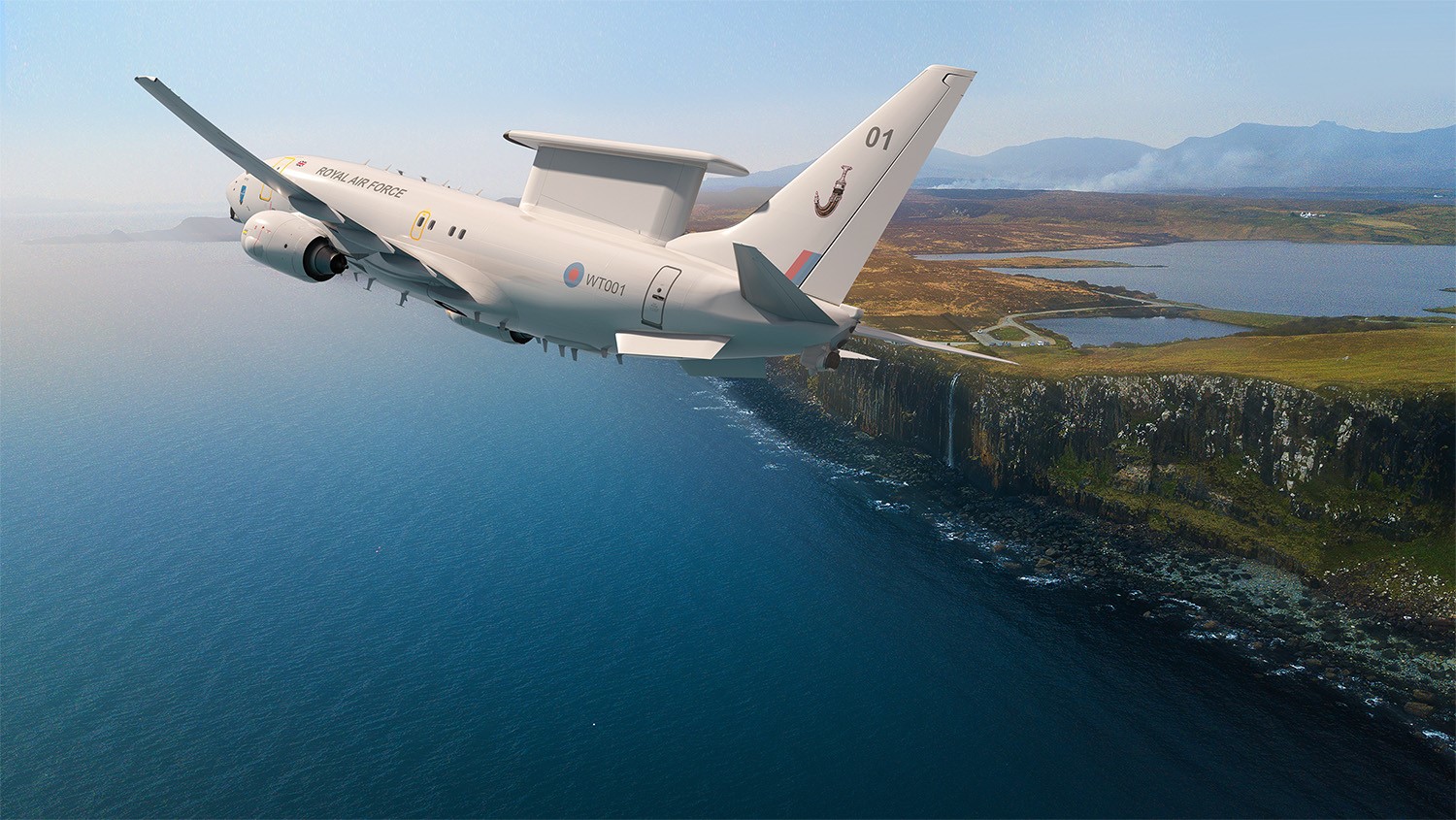
The RAF’s E-7 Wedgetail early warning programme has moved into its flight test phase, with the first aircraft now undergoing trials at RAF Lossiemouth, a second due to follow soon and a third still in modification, the Ministry of Defence has said.
The update was provided by the Minister for Defence Readiness and Industry, Luke Pollard, in response to a written question from the Labour MP for North Durham, Luke Akehurst, who had asked about the status of the RAF E-7 Wedgetail programme.
Pollard said that at the end of May 2026 the first aircraft had arrived at RAF Lossiemouth, where it would undergo “its full ground and flight test programme”. He said the second aircraft was “due to commence test activities soon”, and that “modification of aircraft three continues at STS Aviation in Birmingham”.
On support and infrastructure, the minister said the “sustainment contract was signed in March”, with activity now under way to ensure support systems and resources were available once the aircraft were in service. He added that the “infrastructure programme at RAF Lossiemouth is complete”, with “facilities fully delivered and training devices installed to enable force generation”.
The E-7 Wedgetail is a Boeing 737-based aircraft fitted with a powerful electronically scanned radar that lets it detect and track aircraft and other targets over great distances, directing fighters and coordinating the air battle in a role known as airborne early warning and control. It is intended to restore the capability the RAF lost when it retired its ageing E-3D Sentry fleet in 2021, leaving a gap in one of the most critical enablers in modern air operations.






We still need five of these, butfilling the gaps (and carriers) with the protector are will be a reasonable solution I think
https://www.twz.com/air/mq-9-getting-airborne-early-warning-radar-is-a-huge-deal
Absolutely criminal that this country was left with a sovereignty capability gap. Note the word sovereignty, I know in almost all cases our allies would provide cover, we just should not be relying on our allies all of the time.
No different to when they scrapped the Nimrod, and we waited years for Posidon to come along. Sold/scrapped all the Harriers just as we were getting two aircraft carriers leaving nothing to put on them, till the F35B’s came into service, and that’s just a couple of examples of how successive governments have left us exposed over the years.
The joys of the 2010 Camerloon cuts that really came home to roost.
Harrier had to go to try and keep Tonka.
Obvs Tonka then went and the Harrier gap made regenerating fixed wing skills with F35B all the harder.
Nimrod was cancelled because it was a £3.8 billion ( £6 billion in todays terms ) shambles and there were still considerable issues with it’s development, estimated to cost another £1 billion plus. The number of aircraft planned was cut in 2008 from 22 to 9 making it even more expensive. The Ninrod R1 had also been cancelled in 2008 in favour of Rivet Joint. Discussions on Poseidon started in 2011 and they were ordered in 2015/16.
They should never have tried to upgrade the Nimrod airframe. As good as it was in many ways, each airframe was unique, and bent. They probably should have developed a MPA based on a Airbus airliner airframe like P8. But the development costs would have been huge. 3 more P8s would be nice. But I can’t see it happening.
No, they should simply have joined Japan on their superior P1 maritime aircraft. Same P1 aircraft could also be adapted to carry the Wedgetail radars and control consoles. P1 is a more modern and better suited aircraft for both the maritime patrol and AWECs roles than the ancient Boeing 737NG
I don’t know enough about the P1 to make an educated comment about it.
As far as I recall it could shut engines off like Nimrod. And unlike P8, it is designed for low level ASW MPA operations from the start.
But, if the P8 is good enough for the USN it is certainly good enough for us!
But 9 are too few, as always.
Talking of P8, the RAF has been busy expanding the Squadron list again, No 203 Squadron reformed recently, simply the existing PLS, Poseidon Line Squadron getting a good rebranding.
Good to keep some history alive.
Absolutely crazy suggestion.
Based on the 737NG there will never be problems sourcing parts for the P8 or the skills to maintain it.
Whereas the Japanese Kawasaki P1 is a custom designed aircraft, with only 33 ever built. Worse, the F7 engines are also unique, designed specifically for this aircraft and not used on anything else.
The P1 would have been a maintenance nightmare.
Agreed. Another example of the UK trying to do much for too little, and trying to stay British, for the benefit of politics. From memory I think the P1 is in the same timescale as the P8 so rightly or wrongly we went American. Three would be very good but like you I suspect, I’m apprehensive about everything ahead of what I suspect might be a pointless D.I.P.
Absolutley agree Robert!
Geoff, spot on about Nimrod. Accordingly Ajax should be dumped as it fits exactly the same profile. MOD diesn’t learn it seems.
Sad but true. Apprently, there may be a Challenger 3 problem now as well?
From my understanding, the Nimrod problem was that every airframe was different. So each install was bespoke and expensive
Yep. All sorts of alterations over the years. A nonsensical and ill advised programme from the start. Something we seem to very “good” at.
The MRA4 should have been binned 10 years earlier. The project was a disaster.
In the case MR4a defence policy was to scrap entire capabilities and not slice bits off. I was serving at the time this happened and when the Canadians I was working with heard about it, jaws hit the floor. The Brits were considered “the best at what they did, how could they come to this decision?” The defence secretary at the time Dr Fox said publicly “we don’t need this capability the Russians no longer pose a threat.” This is the kind of idiocy we have been dealing with in the corridors of power for years.
Sorry, how long have these been in service with Australia?
approx 36 metres.
Let’s see if the DIP restores the 2 additional aircraft that were originally intended for the RAF. BUT, we actually need to see the DIP, if it ever appears.
Actual Total Required for 24/7/365 coverage of UK airspace :
=8 aircraft
-4 Planes for Airborne Rotations: Massive area requires 2 planes airborne simultaneously, swapping staggered shifts every 8 hours.
-2 Planes for Routine Upkeep: Daily fixes and safety checks pull planes from rotation.
-1 Plane for Deep Maintenance: Structural overhauls, offline for months.
-1 Plane for Crew Training dedicated to mandatory flight school and practice.
What about an allowance for war losses? Maybe lose 1 or 2 airframes if there is a missile/drone strike on Lossie. Reality probably 14 needed. Ain’t going to happen though
Not the whole thing but there should be a couple of spare radars around if they aren’t being used up on the two USAF E7 conversions?
Those two conversions exist specifically to find a use for those radars, they aren’t coming back.
Hi Lee, a 737 can do multiple trips a day and or stay in the air for many hours with inflight refuelling. 8 too many 5 is probably fine.
Sentry was 8, then 7, then 6, then 4 I think, then gone. Though I agree we’d all settle for 5 E7.
Pity we are only getting 3.
Remember, though. P8, E7, C17, Rivet, cannot be refuelled by the RAF. A poor state of affairs.
The UK originally bought 7 E3s alongside the French who bought 3 to more or less the same standard.
Ah, thanks, recalled 8, maybe that was an Air Staff requirement I read.
You’re forgetting these are based on commercial airliners. The number of take-off/landing cycles the military put them through are an order of magnitude below what a commercial operator expects in order to make a profit.
That’s quite a lot of wood working tools…
Well at least we still got none fully in service, so thats no change.
I read a article yesterday that suggested there was a problem with the gearbox for CR3 and there could be pushback of up to 2 years whilst they sort the problem out. You can add that to your list.
No difference to NMH . Puma removed from service 2025. First NMH planned around 2031-32 with IOC possibly 2033. 7 year capability gap ? Hence it isn’t really required and is a political move. If you want a medium lift go to a company that can deliver rapidly.
Bad planning, procrastination and waiting until one sysem is withdrawn/near withdrawn before looking for a replacement and not realising how long the replacement will take to get into service. It should be common sense that you start introducing replacements before you take things out of service, not after. There seems to be a collective stupidity among all parties when it comes to defence matters.
Couldn’t agree more, Rob. Unfortunately it’s what bureaucrats do well, and we get away with it peacetime, but come the Glorious Day… It all reminds me of ‘Yes, Minister’ but sadly it’s for real.
Lossiemouth, massive juicy undefended target! Our few eggs in even fewer baskets!
To easy to park everything in one lot. Hope they get more serious on GBAD. We’ve all seen on the news how easy it is to knock out undefended or under defended bases. Naval bases the same.
Currently though, Russia doesn’t have the capability to hit Lossiemouth with any accuracy or drones with the range and survivability to be lauched from Russia and survive all the NATO defenses they have to pass through long before they reach our shores. And we know when Russian subs put to sea as soon as they leave the wall if not before. Satellites/intelligence can pick up any activities before any sub or warship puts to sea.
About time we had some positive news regarding the wedge tail aircraft. If 3 is all we can afford so be it. This type of early warning roll will be carried out by either satellites and / or drones in a few years so……
The AWACS functions as air battle command and control which becomes even more important as the sensor network functions of 5th and 6th Generation aircraft becomes standard.
We already had the ignorance of Musk prevent USAF E7 in favour of his low earth orbit satellite network which tells you that he has no idea what AWACS actually do. There is no AWACS equivalent based on satellite technologies thought I’m sure he’d like $100Bn of taxpayers money to design, build, test, and deploy one.
Yes, SpaceX are rocket scientists but that’s not at all the same…
USAF should take the proven E7 design, and restrict their impulse to rebuild a mid-life upgrade into the build. Thus Congress would be confident in the price and delivery and not cut the project short because they lost confidence.
I have no expectation that the Wedgetail will last long in RAF service. It was hurriedly purchased in the unrealised expectation that dozens more would be bought by the USAF, NATO, etc. and that the UK would get huge economies from being just one member of a massive maintenance and support infrastructure. The cost of sustaining the force (£0.5 bn p.a.?) will now outweigh the operational benefits that just three aircraft can deliver. We either buy more (very unlikely) to spread the base sustainment cost, or sell them (as spares to Australia?) and invest in a mix of alternative platforms and technologies – from UAV’s to satellites.
🤡
Nonsense!