

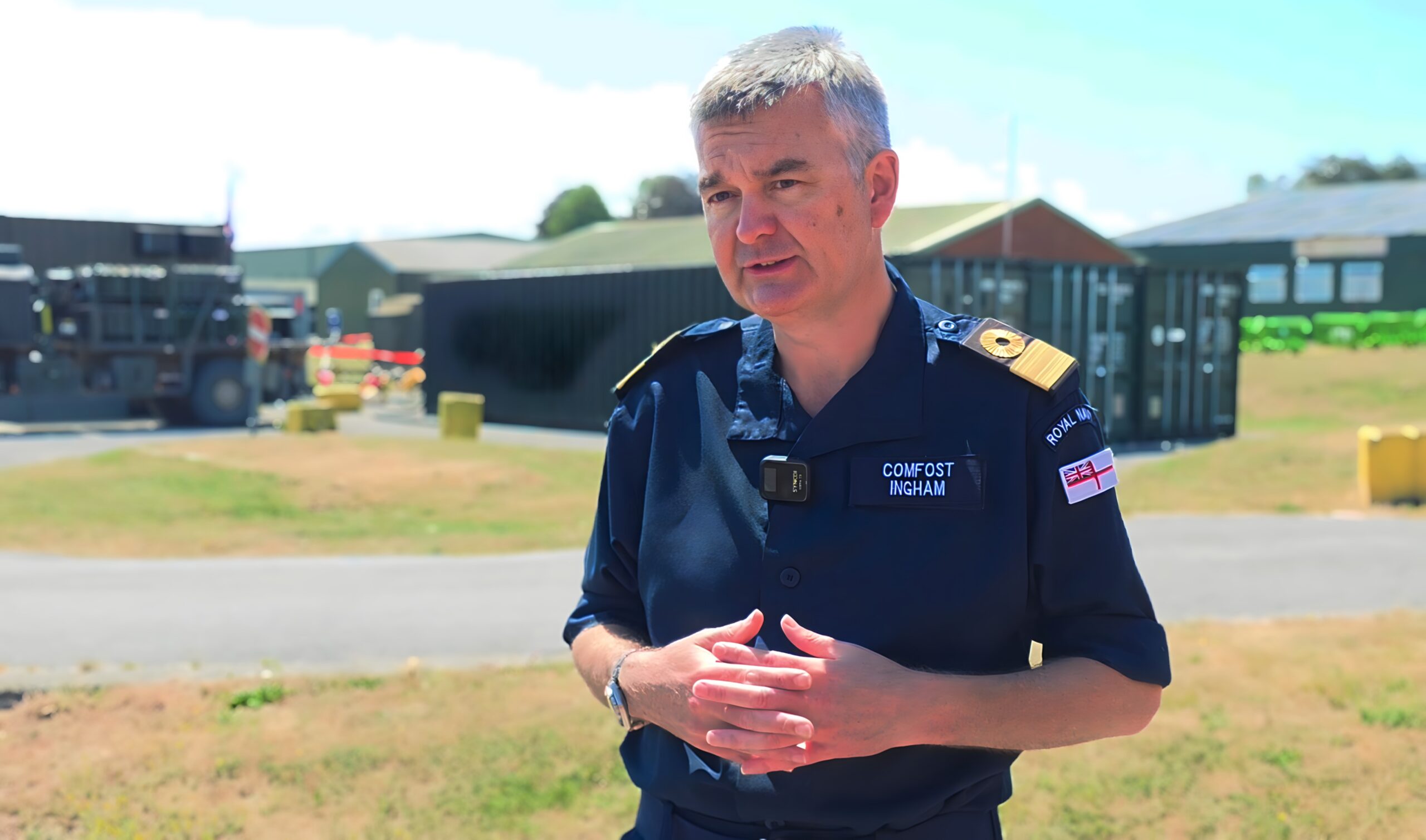
From the Thursday War to the rewind button: inside the transformation of FOST, the organisation that decides whether the Royal Navy is ready to fight
Ask a sailor of a certain vintage about FOST and you will hear about the Thursday War, the weekly battle that could decide whether a ship and her company were fit to deploy, delivered by assessors whose arrival on board was rarely an experience without anxiety.
The organisation still exists to answer the same question, though. “Fleet Operational Standards and Training is the collective training organisation for the Royal Navy,” Commodore Andy Ingham, otherwise referred to as COMFOST, told UK Defence Journal at Exercise Virtual Warrior, the Navy’s classified synthetic exercise opened to media for the first time.
“I have teams that cover assurance and training for our ships, our submarines, our task groups, and that provides evidence and assurance to operational commanders that ships, boats, submarines and task groups are safe to operate and, importantly, are effective warfighting units. I cover cradle to grave, from ships in build to ships on global deployments.”
From assessors to coaches
Almost everything about how that question is answered has changed, however, and Ingham, who rarely gives interviews, is frank about the scale of it. “FOST has changed an enormous amount in the last ten years. If I was to go back in time and lift somebody up and drop them into a ship doing training today, they would have no idea what was going on,” he said. “Part of that is to develop a more coaching, mentoring style. The old days, those that remember the Green Fowlies, FOSTAF coming on board to train. Now FOST is very much about coaching, mentoring, learning development, human factors. It’s a lot more about culture and how that feeds into leadership and developing a team.” The Green Fowlies, for the uninitiated, were the FOST staff in their green foul-weather jackets, whose arrival on a brow generations of ships’ companies learned to brace for.
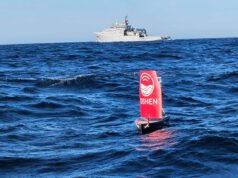
The feedback loop from the front line has tightened too, with lessons from live operations turned into training scenarios far faster than before, and at the sharp end of live training sits Sharpshooter, which Ingham describes as the biggest change of the decade. “It’s live firing on an instrumented range, and again I can dial up and dial down the complexity, but we use uncrewed target platforms to fly against the vessel, and they can operate under wartime safety conditions. That’s probably the biggest live change that FOST has introduced in the last ten years.”
The synthetic half of the journey
The other half of the transformation is the reason he was standing in a camp on Salisbury Plain. Virtual Warrior is the first exercise under the Navy’s new MCAST contract, the £25 million QinetiQ-delivered synthetic training system that went from signature to Initial Operating Capability in under a year, a pace he credits to a combined military and industry effort. Notably, he does not claim the Navy could not exercise virtually before, and his case for the contract is subtler than that. “We had the ability to deliver virtual exercises before MCAST,” he said.
“It wasn’t that we’d identified we’ve got a gap here in training delivery. We did have that, but by enabling the MCAST contract, that allows ownership of that journey.” His argument for the blend is practical rather than fashionable: there are things that can only be trained live, and there is a growing list of things that can now only be trained synthetically, so the future belongs to doing both at once. “Live virtual constructive training is the head mark, and Virtual Warrior is the first exercise under the new MCAST contract that is the stepping stone to that head mark,” he said. “It’s a really important exercise that really sets the marker for where we’re going.”
Asked what synthetic training gives him that the sea cannot, he offers two things: geography, since the scenario can be set anywhere in the world and the training audience immersed in it, this fortnight the High North in winter from a camp in a Wiltshire heatwave, and above all control. “You can dial up, you can dial down, you can make it more complex, less complex, and that makes my job as a training deliverer much easier to do. I can tailor the scenario much better,” he said. “Depending on the audience, if they’re doing particularly well, you can speed up the training objectives; if they’re struggling with a particular area, you can slow it down, you can repeat. Live training, you almost start, and then you’re on the journey and you’ve just got to get to the end. Synthetically, I can pause, I can speed up, I can rewind.”
The hardest problem sits in between
The deeper challenge, and what he calls the biggest lesson of exercises like this one, lies between the levels of training, because individual ships and submarines are trained as single units, task groups are trained as formations, and the connective tissue between the two used to grow almost by accident. “In the past it was almost an accidental benefit, because you had so many ships together in task groups conducting tier one training. But because they were a group, they were sort of accidentally learning the lessons of being in a task group. Now those two are very much separated, so it’s the bit in between, the melding in between, I think is the biggest lesson to draw out of exercises like this.” He is candid that the answer is not yet settled, saying his organisation is “still trying to understand what the blend is there between the live and the synthetic training” to bridge that gap.
Where it goes next is bound up with the fleet the Navy is building, and as the hybrid navy of crewed ships and uncrewed platforms takes shape under the Defence Investment Plan, Ingham is clear the balance will keep tipping the same way, with synthetic training becoming “much more important” still, a subject UKDJ explores separately. The Navy’s stated ambition is a training mix of roughly half live, half synthetic by around 2030.
The Thursday War taught generations of sailors that readiness is proven rather than asserted, and its successor keeps the principle while changing almost everything else, with one addition the old model never had until recently: for the first time, crews can stop the clock, wind back the battle, and fight it again.
Our interview with COMFOST will be available soon.


Translation:
We don’t have enough ships to conduct realistic at sea training
If we can do the training who cares if it is at sea or not.
In theory the next ten years should see the entire landscape of the RN change. Hybrid and all that sort of stuff.
It matters immensely – synthetic serials are play acting, nothing ever goes unintentionally wrong in the script
This would happen even if the Navy had 40+ Escorts. Times change. Technology changes. Some just want our Force’s to go back to 1985.
It is worse than 1939 in that we don’t have the ships. Imagine not being in a position to sink the Bismarck, yet sadly, that’s where we are today. By the magical date of 2030, we should hopefully be in a better position to effectively help the combined NATO surface fleet. Let’s just keep our fingers crossed until then.
Blimey, he’s done all right. Parks Nottingham on a rock and makes Commodore
It is worse than 1939 in that we don’t have the ships. Imagine not being in a position to sink the Bismarck, yet sadly, that’s where we are today. By the magical date of 2030, we should hopefully be in a better position to effectively help the combined NATO surface fleet. Let’s just keep our fingers crossed until then.
We are where we are. What I’m looking out for are decisions which move us into a better position.
One for the braid haters, another example of how the forces are reducing top brass. FOST, Flag Officer Sea Training, was a Rear Admiral before I recall, now only a 1 star.
It was indeed. If you ever received a ‘Positive Number 2’ (a superior chuck-up), it was signed (in green pen) by the Admiral himself. The Commodore is right, though; FOST has changed immeasurably since my day. Sadly, not for the better. “Now FOST is very much about coaching, mentoring, learning development, human factors. It’s a lot more about culture and how that feeds into leadership and developing a team.” – Well, the old way worked for years. Way before my time, as well. Tells you all you need to know. Training was declining rapidly way before I left in the very early 2000s.
Regrettably.
And a much bigger organisation to boot, like the rest of the diminished Royal Navy.
Can’t keep looking backwards. And presuming everything was better back in the day. It wasn’t. The quality of training across the board is immeasurable better today compared to 25 years ago.
Train like you fight becomes tick a box and go to the NAAFI
“Now FOST is very much about coaching, mentoring, learning development, human factors. It’s a lot more about culture and how that feeds into leadership and developing a team.”
So mollycoddling and promoting the woke agenda rather than just training people execute their role to the highest standard and giving a bollocking to those who need it ?
Hear Hear.