

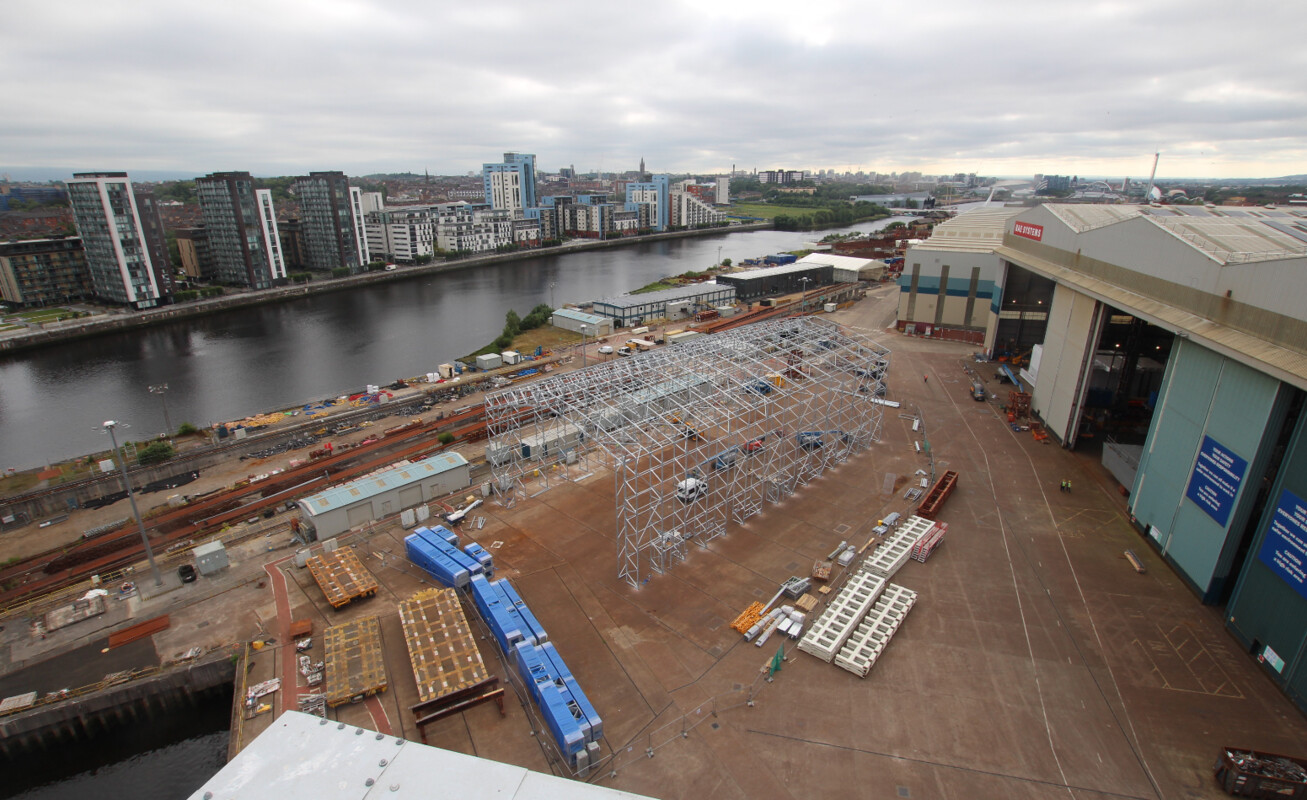
Construction has begun on a new £3.3 million paint facility at BAE Systems’ Govan shipyard in Glasgow, part of a modernisation programme worth more than £360 million across the city’s two yards as the company builds the Royal Navy’s Type 26 frigates, the company stated.
The 1,100 square metre fabric-covered structure, being built in partnership with Norwegian construction firm Hallgruppen, is large enough to paint four ship units at once and tall enough to take the biggest sections of the frigates, the bow and stern blocks. Moving painting into a dedicated facility frees up other areas of the yard to continue Type 26 production at pace, according to BAE Systems, with construction due to be completed later this year.
“The new paint facility is another important step in our continued investment in Glasgow’s shipyards, helping to modernise our infrastructure and improve production efficiency. By optimising the use of space at our Govan site, the facility will increase painting capacity and support the demands of our shipbuilding programme,” said Simon Lister, Managing Director of BAE Systems’ Naval Ships business, as quoted in the press release. “This investment strengthens our ability to deliver the Type 26 frigates efficiently, at pace and to the highest standards of quality. It reflects our commitment to continuously improving our shipbuilding capability and ensuring we remain well positioned to meet the needs of our customers, both now and in the future.”
The paint building joins a run of infrastructure investment on the Clyde, the centrepiece of which is the Janet Harvey Hall, the ship build hall opened at Govan last year that allows two Type 26 frigates to be constructed in parallel under cover. Alongside automation improvements, the company is introducing digital technology on the shop floor, including tablets and kiosk screens intended to streamline production processes.
The pressure on the yards is set to grow rather than ease, with eight Type 26 frigates on order for the Royal Navy and Norway having selected the class last year in a deal for at least five more ships, making efficient use of space and faster block throughput at Govan directly relevant to a programme that now stretches well into the 2030s. First-of-class HMS Glasgow is fitting out at Scotstoun and was powered up for the first time in December, with the class set to replace the Royal Navy’s anti-submarine Type 23 frigates, a transition given added urgency by the retirement of HMS Richmond and HMS Iron Duke confirmed earlier this week.
BAE Systems says the Type 26 will provide the Royal Navy with the most advanced anti-submarine warfare technology available, while offering the flexibility to adapt the ships’ role to tasks including transporting medical facilities and supporting humanitarian aid missions. Hallgruppen, established in 2015 and headquartered in Oslo with offices across Europe including the UK, is one of the continent’s largest contractors for engineered fabric-covered and steel structures, with buildings delivered in more than 86 countries.










Janet Harvey Hall finally appears on Google Maps.
The Engels – 2 Air Base is a critical, high-value Russian military installation located in Saratov Oblast, approximately 600 kilometres (370 miles) East of the Ukrainian border. It serves as the primary home for Russia’s long-range strategic bomber fleet. This base was severely hit this week by a massive Ukrainian drone strike that triggered large-scale fires and explosions across the facility
Engels – 2 is the primary base for the 121st Guards and 184th Heavy Bomber Aviation Regiments. The base hosts Russia’s premier long-range bombers, including the Tupolev Tu-160 (known as Blackjack by NATO) and the Tupolev Tu-95MS (known as Bear-H). Crucially, it is the only operating base for the Tupolev Tu-160. Russian forces routinely use aircraft operating from Engels to launch Kh-101 and other cruise missiles against Ukrainian civilian and energy infrastructure
In the early hours of Thursday, July 16, 2026, a swarm of low-flying Ukrainian drones targeted the base. Geolocated footage and YouTube monitoring channels confirmed several massive fires on the airfield. Residents in the twin cities of Saratov and Engels have reported a succession of powerful explosions lasting hours. The intensity of the defence response and falling drone debris reportedly triggered power outages, broken windows, and localized fires in surrounding civilian residential areas. While the airfield is confirmed to be ablaze, the exact extent of the damage to the strategic bombers, ammunition depots, or fuel infrastructure remains to be confirmed as of the time of writing. However, ground-level video and photos from local residents in Saratov and Engels have confirmed the strike. Open-source intelligence projects like Exilenova+ and the independent outlet Astra have successfully cross-referenced and geolocated this footage to confirm a large, active fire burning directly on the Engels-2 military airfield
Because of its immense strategic importance, Ukraine has repeatedly targeted Engels-2 to degrade Russia’s long-range strike capabilities. In December 2022 the first successful long-range drone strike damaged two Tu-95 bombers
In March 2025 a massive (“largest ever”) drone assault triggered secondary ammunition detonations and forced local evacuations.
In June 2025 drone strikes successfully ignited the “Kristall” fuel depot serving the airfield, destroying multiple fuel tanks.
Ah, should have started with “OFF TOPIC” soz
Nice to see you posting Interesting stuff though…. Maybe just do that sort of thing going forward ?
Maybe tone down the use of AI David?
Ahhh…… so now there will be a nice comfy facility to watch the Paint Dry.
Any Idea which year Glasgow will get all fighty ? She seems to be taking quite some time.
She’s be 18 years old and allowed on the front line in 2035
Also vessels 3 isn’t all put together yet. Worrying that by 5 years 1 month vessel 2 was already out into the dry dock yet vessel 3 at the same time period looks far behind. Not sure why BAE seems to be slowing down not speeding up
Weren’t BAE going to built Something similar at Barrow… Time BAE stared to look at building a new hall there..!
Perhaps BAES should look at expanding the Janet Harvey hall, either with a new facility to its right (looking at it) or by expanding the current build halls to the same dimensions and joining it up fully, or both if we are serious about getting a true manufacturing capability.
Babcock are investing in Rosyth and reaping the benefits, it would be good to see local government get behind BAES and make this a game changer for the workforce & productivity. The ability to build 6 ships side by side under cover would not only bring costs down, but improve working practices
Build 6 side by side and the sit will close in a few years lmao!
I really hope they can increase production to more than 1 per year! 1 per 9 months would be perfect, I wonder if they can do that with 2 spaces in the build hall or if they need to add a 3rd??