

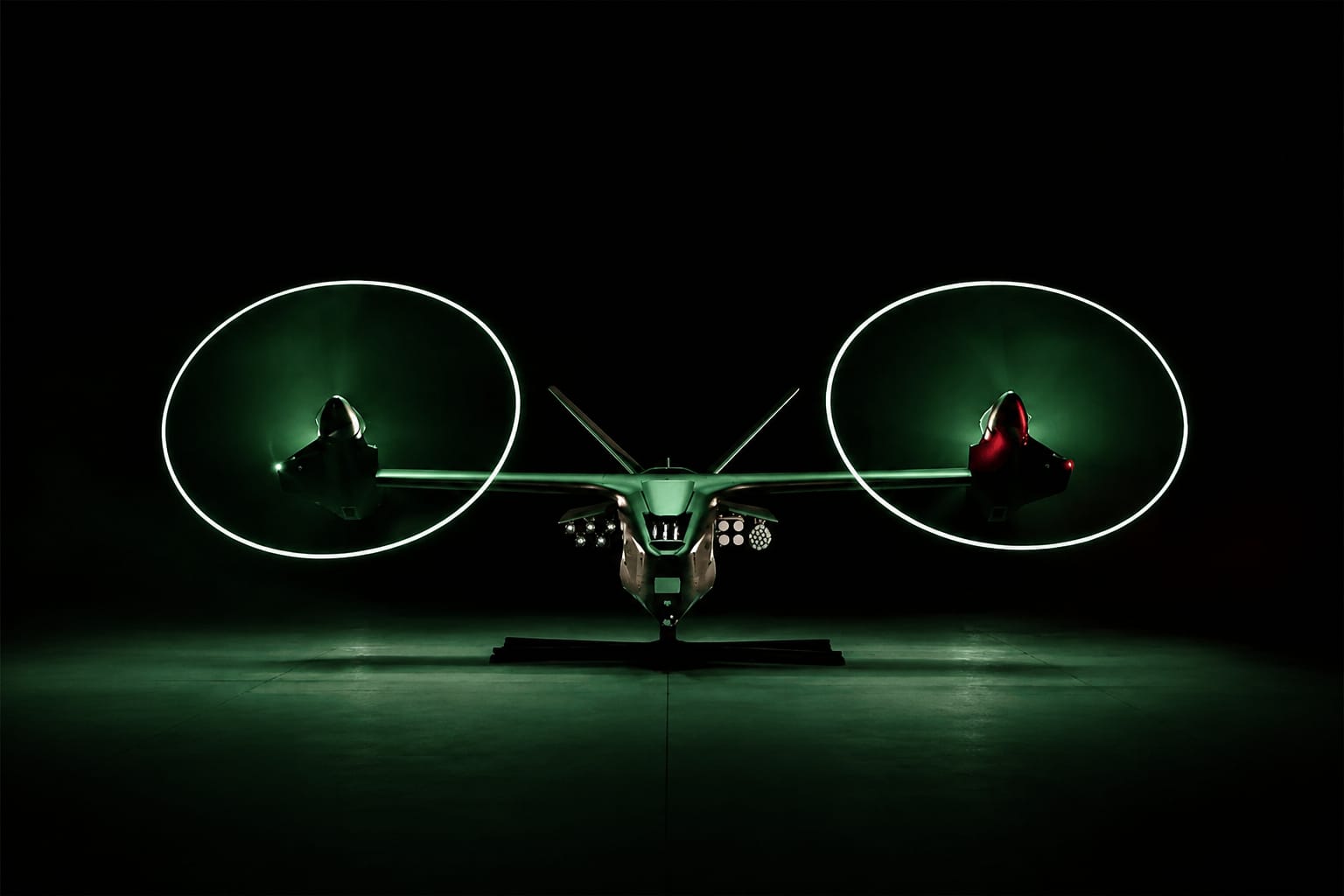
Anduril has unveiled Thunder, a Group 5 autonomous attack rotorcraft designed to fly alongside crewed attack helicopters and multiply their combat power, with the tiltrotor able to carry ten Hellfire-class missiles or seventy-six 70mm rockets and a first flight planned for 2027, the company announced today.
The aircraft is Anduril’s answer to what it describes as a near-surface domain rendered one of the most lethal places on the battlefield, where attack helicopters and their crews are increasingly held at risk by loitering munitions, cheap air defences and persistent surveillance, conditions the company argues have brought manoeuvre to a stalemate and point to a future for attack aviation driven by autonomy.
Thunder is designed to multiply the combat power and increase the survivability of current and next-generation crewed attack and assault aircraft, according to the company, teaming with piloted platforms rather than replacing them.
Thunder is the defence-specific variant of a dual-use platform co-developed with Archer Aviation, the electric air taxi firm, bringing the commercial VTOL sector’s work on electric propulsion and rotor design into defence. A series hybrid-electric powertrain and tiltrotor configuration combine vertical take-off and landing with efficient wingborne cruise, while variable-speed rotors reduce power demand and fuel burn in cruise and minimise acoustic signature during low-altitude ingress, according to the company. Anduril says the combination gives Thunder the range for global self-deployment, or alternatively the aircraft can be packed into a standard shipping container for movement by air, road, rail or sea.
The payload arrangements are set out in unusual detail for a product launch. Modular internal bays in the main body and nose can host precision munitions, air-launched effects, rockets, electronic warfare payloads, counter-drone effectors and cargo, with the main module configurable with ten air-to-ground missiles such as Hellfire, JAGM or Anduril’s own Barracuda-100M, sixteen launched effects such as the Altius-600, or seventy-six 70mm rockets, plus a further twelve counter-UAS effectors in the nose. Teaming is where the company pitches the step-change, with three Thunders paired with each Apache giving a Combat Aviation Brigade a threefold increase in available munitions without placing additional pilots in harm’s way, at a fraction of the cost of an equivalent crewed formation, according to Anduril.
The aircraft runs the company’s Lattice for Mission Autonomy software, which handles formation behaviours, separation management and flight logic so that pilots direct the aircraft through intent rather than managing it with a stick and rudder, and an onboard perception stack combining passive and selective active sensors with computer vision, map data and edge computing is intended to keep Thunder navigating and tracking threats when GPS, visibility and communications are degraded or denied. The company says the software fuses sensor and mission data across a formation into a common tactical picture, so the aircraft enhances the platforms around it rather than merely flying its own mission.
Anduril says multiple test flights with full-scale surrogate aircraft have already been completed, with Thunder’s first flight planned for 2027, and the dual-use baseline shared with Archer’s commercial work is presented as the route to the economies of scale and supply chains needed for affordable, large-scale production.
The launch comes weeks after the company won the production contract for the US Air Force’s Collaborative Combat Aircraft programme with its FQ-44, extending the autonomous teaming concept from the fighter force to attack aviation, and comes as armies including Britain’s absorb the lessons of a battlefield in Ukraine where the space just above the ground has proven as dangerous as Anduril’s pitch describes.


So basically, you can send 3 of these with a manned Apache, into the battlespace that has become a stalemate and deadly dangerous for the Apache ?
hmmmm.
An apache now needs an escort… sort of makes it pointless.
They can be 50 miles in front and still with.
Need to understand the capabilities of this kit, the cost and the numbers (in reality) before it can be judged me thinks.
So, not only does the Apache Pilot have to have two Independently swivelling Eyes but he now has to use three Gameboy Joysticks as well !
Where do I join up 😁
🙂
Apache Pilot will probably do little more than give permission to engage (or not). The rest will be done by the drone.
I think you would find it very boring. 🙂
As I understand the CCA for Apache, weren’t they talking about 30 airframes???
In a war situation, they would be sliced, diced and turned into scrap very quickly.
While CCA has to be part of the equation, what’s actually needed is extended range weaponry. Somthing like a booster equipped Spear 3, to give ground commanders the ability to strike targets 100 miles away.
Basically Apache and its drone, need much bigger teeth…
Yep. I think this is all going to turn into a trial and error exercise.
Too big and it costs too much plus if we lose it we lose the kit which goes with it.
Probably better building small stuff containing just a small quantity of kit. Cheaper to build – get more of them. When they are out there they just work together as a unit.
Right. Why do we need a £30 million helicopter plus a ‘drone gunship’ to do what Ukrainians do with a £20,000 drone?
I wonder what Project Nyx will come up with for the British Army.
We are getting a whole 24 of the things to “pair” each Apache, even though there are 50 Apache!
Too many Chiefs, not enough Indians.
24 isn’t enough to evaluate.
24,000 over the course of a conflict might be closer to the mark.
Only about 30 will be operational at any one time mate, of that, unless it was all out war with Ivan, I doubt we will deploy more than 16/18.
I know mate, and that is what HMG use as excuse for not buying enough, as more would be brought out in war.
Would be an interesting move if something like this is procured to replace Wildcat for the AAC. It won’t happen of course but would be intresting.
Menacing looking thing, Terminator Drones are here.
Looks expensive as well, if one can say such a thing by look alone??
It looks like a BMW of the skies.
Bugger…. no bloody Indicators and a Baseball cap wearing Chav at the wheel then….. init bro like that’s wot I Is sayin 😊
Sounds excellent. I can foresee these things actually replacing Apache, and crewed attack helicopters completely.
Anduril are definitely showing other companies up at the moment as they have released a number of demonstrators. I think their philosophy is get it built ASAP, so that the “pen holders” can actually see a product that is working, rather than a slidepack or an animation. Interestingly Anduril, are marketing the Thunder as both a civil and military aircraft. Intriguingly they are marketing it for the maritime roles, such as ASW and Patrol.
Anduril have not as yet released any specifications on the aircraft, apart from it can keep up with an Apache and match its duration. They have said it will be a hybrid aircraft, using a internal combustion engine that then powers two electric motors that drive the prop-rotors. But by all rights a tilt-rotor is a lot more efficient in forward flight than a helicopter. So its likely the Thunder will be held back by the Apache in this regard.
It does feel of late that HMG are getting a bit carried away with these drones I get the feeling the government wants to fight the next war on the CHEAP. Yes drones do have they place but I feel we are getting over reliant on theses platforms. For instance the the replacement for Type 83 , use a drone ship ?So if it’s way out in the Atlantic ocean and there’s a maintained issue of engine’s or technical, even if small it can’t function for the job role ? What then parachute men thousands of miles into an ocean waves to fix the problem .Don’t think so.
Out of curiosity has anyone tried putting an APS on an attack heli?
That said loading the 30mm cannon with fused ammo and converting it to an automated radar guided CIWS also seems like a fun idea.
I think James Bond had one once.
They have, but doesn’t come across as widely adopted. They do have the obvious ir counter measures.