

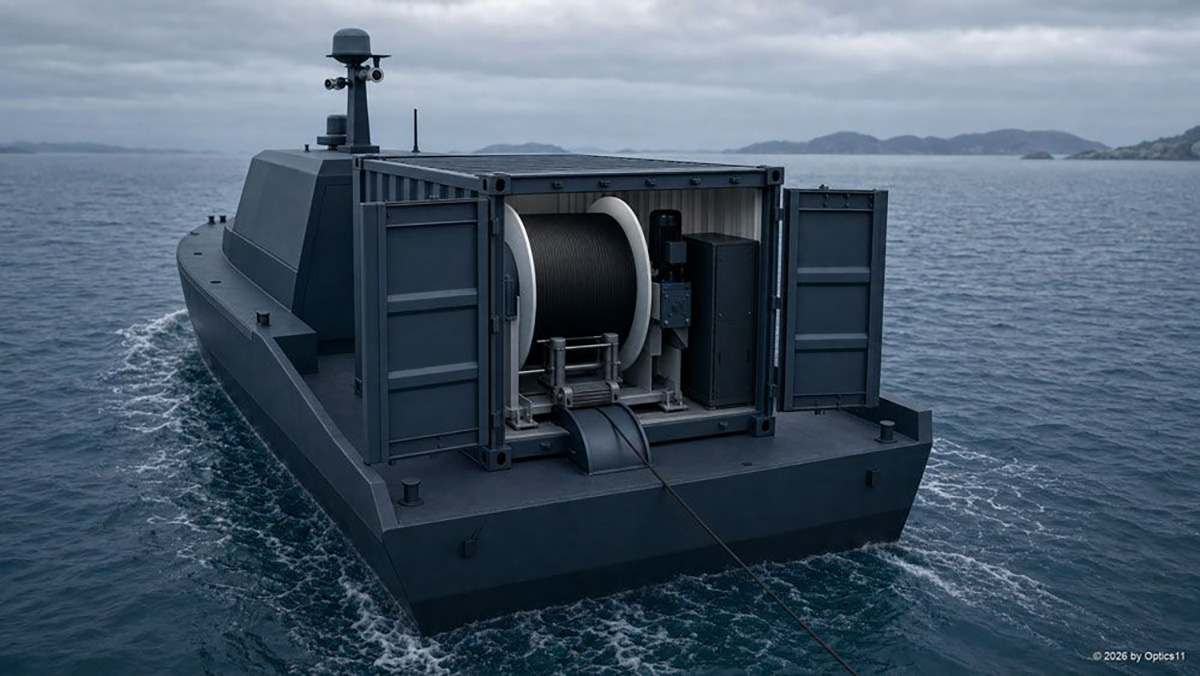
The Dutch Ministry of Defence has ordered containerised towed-array systems that can be rapidly deployed onto a wide variety of surface vessels, giving the Royal Netherlands Navy a way to add anti-submarine sensing to ships not originally designed to carry it, the company behind the technology has announced.
The order, placed with Amsterdam-based OPTICS11, covers the first systems under the Anti-Submarine Warfare In A Box, or ASWINABO, programme. It expands the firm’s OptiArray product line, a fibre-optic towed array that OPTICS11 says can be fitted to a broad range of existing crewed and uncrewed platforms rather than a small number of specialist warships.
Towed array systems have traditionally been integrated into a limited number of dedicated naval vessels. By adapting OptiArray into a portable, containerised system, OPTICS11 says navies can retrofit sonar sensing across many more vessels of opportunity according to operational need, an approach the company argues becomes more valuable as the use of maritime drones expands.
The order comes against a backdrop of growing concern over the security of subsea infrastructure. Autonomous underwater vehicles are becoming more capable, while cables, pipelines and other seabed assets have become targets for espionage, sabotage and hybrid warfare. Northern Europe in particular has had to contend with Russian shadow fleets and spy ships testing the limits of territorial waters.
Unlike conventional electrical towed arrays, which rely on powered electronics throughout the sensing chain, OptiArray is passive. OPTICS11 says this allows it to remain acoustically silent and immune to electromagnetic interference while capturing richer acoustic information, which the company says delivers earlier detection and more accurate target classification. Alongside delivery of the operational systems, the project is intended to establish the production, integration and validation capability needed to support future deployment at scale, with investment in manufacturing readiness and supply chain resilience.
Paul Heiden, CEO of OPTICS11, said:
“The underwater threat environment is evolving rapidly, but advanced threat sensing has traditionally been confined to a small number of specialist naval platforms. By containerising OptiArray, we’re making world-class detection faster, more flexible and cheaper. We want to set the standard for unmanned underwater and above-water drones, as our technology is a perfect fit for doing this: light, small, highly sensitive and very accurate. As critical subsea infrastructure becomes increasingly contested, prevention starts with detection.”
Lucas Leppink, Captain RNLN, Head of the Maritime Systems Department at COMMIT within the Dutch Ministry of Defence, said:
“With ASWINABO, the Royal Netherlands Navy will be able to equip its surface ships, unmanned surface vessels and any other vessel of opportunity with underwater surveillance capability, a game-changer for maritime security operations and undersea infrastructure protection.”
Founded in 2011 as a spin-out from Vrije Universiteit Amsterdam, OPTICS11 develops passive fibre optic sensing arrays which it says can detect and classify underwater targets up to 100 kilometres from shore. Its portfolio includes OptiBarrier, a seabed-placed system for persistent protection of ports, offshore wind farms and subsea cables; OptiArray, the towed array selected under ASWINABO; and OptiFender, a monitoring solution for high-voltage electrical infrastructure.


Looks good. Royal Navy please note.
I think that’s being covered under Project CABOT. ACUA Ocean has demonstrated this this premise, granted, the vessel only goes a few knots. And the premise has kind of been proven with other equipment like mine sweeping equipment.
Fair enough. I thought it seemed to be a little different but maybe not.👍
This sounds like an interesting development to supplement specialist capability and one presumes potentially applicable to various UK proposed and even existing platforms. Wonder how effective in practice it is in reality.
Sea Ltd in the uk has KraitArray which is very similar and already in testing for drones and small vessels.
👍
Not different from 80’s SURTASS
SURTASS as I understand it is slightly different because escort-level costs were invested in a small number of very large sonar platforms.
The SURTASS array alone weighs 18 tonnes, the cable reel weighs 11 and the total installation originally weighed 155 tonnes. Not something that could have been fitted in the stern of a T26.
IMO T92 should aim to be a mini-SURTASS carrying a sonar of similar size but simpler and cheaper than CAPTAS-4.
SURTASS was designed to be possibly deployed into oceanic fishing trawlers, in the end of the cold war stopped.
What a great bit of kit! This would be a good addition for the RB2s with the lack of ASW frigates.
Yes I know they are am OPV and no I am not trying to make them into one and add every weapon in existence! But just as a sensor platform they would be very useful step in for FRE duties while we transition to the hybrid navy and new frigates.
It’d definitely be worth considering! Could you still do vertical replenishment with this container on the rear deck?
Probably not, for VETREP the helicopter tends to hover only about 2 people high above the deck and having a container would mean a tiny margin for the wheels to be able to drop.
The lack of range also means it’s only really a self defence sensor on an escort, on a small USV it’s much more useful. I do wonder whether the ducting could be arranged for T31 from its under hangar ‘mission space’.
And for T31?
Or anything else that has not been cut or sold off yet.
Indeed my thoughts entirely, we need as much flexibility as we can get as wide as possible especially in the underwater realms which let’s be honest with cyber is going to be the major confrontational area in pre conflict with Russia and a vital one in any conflict itself. Using non frontline military vessels in home waters for tasks of this nature makes a massive potential difference to the effectiveness and use scenarios of our larger navy assets, especially the frigates.
Why put it on a T31. Surely the whole point is that it’s independent of warships. It’s simple cheap and you could have 5 of them (for example) in and around a carrier group. You could have other similar vessels with CAMM in a box for example. You might be able to replace the T31 altogether.
HMT will jump at that! Another 6 warships gone.
Hmm I wonder how small a vessel could take these?? Presuming remote operation if these could be placed on larger ocean trawlers then they could be used in ‘peacetime’ as an additional revenue stream for fishing fleets .. something to be done when quota means no fishing.. frees up the navy and potentially makes every large trawlers an anti sub capability.. now that would be a real headache for Ivan
Just a thought
For the thin line arrays the Navy has been testing, they can go on 11m surface boats, or the XLUUVs like Manta (9m) or the larger XV Excalibur (12m).
An excellent thought!
Hi Mark, you are right, as these are totally passive sonars unlike 2087/CAPTAS4 they work best in an offset array. Multiple sonars having their collective input put together in a single processor onboard the command ship. It’s probably the only way passive soars will be effective against modern submarines.
The air picture will work in the same way with four or five type 94’s having their radar data merged into a single picture by the command ship with the multiple offset radar returns providing higher fidelity on any track.
Then the purpose of the command ship becomes comms and computing. The T31 is well suited to this role being big and adaptable.
I know a lot of people on here are against this concept but I see it as exciting and the UK is very much at the forefront of this. With the UK having lots of smaller ship yards and one of the worlds top boat building industries along side our world leading capability in AI and autonomy we are well placed to take advantage of these changes and we might just end up setting up a world leading industry that can bring high tech skilled jobs to many deprived parts of the UK in a way that traditional shipbuilding never could.
Even more importantly we can rebuild the Royal navy into a full spectrum fighting force in a few years instead of waiting a few decades for the ship building program to catch up.
Careful talking positive Jim. People don’t like it. Only HMT bashing goes down well 😆
😀
I’m every optimistic about the prospects and capabilities of the UK despite what the trolls and main stream media want to make people believe about us.
**ever optimistic
Same here. Pointless dwelling on the past about what could have been/should have been done ect. Not good for the blood pressure.
Makes me glad when someone points out the capability of the UK to innovate and think out of the box. There is a campaign by certain parties to undermine our confidence and sometimes I think the government gets bogged down in committees and minutiae but when push comes to shove…
No its blindingly obvious a warship without ASW is just a target, so firstly you fit them to the T31 and then an OPV like our River 2’s. The T31 has space under the flight deck which may need to be enlarged to the stern. Not sure I haven’t seen an accommodation plan.
The possibilities of a River 3 is fascinating, as they could be very close to a workable small Corvette for littoral European waters.
I would love to see a River batch 3 with these fitted, a hanger for small recon drones (maybe a wildcat) and a 40mm gun for a slight uplift in self defence to supplement the frigate fleet taking on the duties the current RB2s are doing now. However, I think the most likely replacement for the rivers will be the common hull being purchased from Norway which appears to be a cheap civilian spec OPV for the MCM mothership.
Thats if the rivers get replaced at all.
Either way I could see this bit of kit being extremely useful and im hopeful the RN invest in something similar for the OPV/31s
My hope is that we dont lose our British Looking Warship look. Both the T26’s and R2’s have it. This may seem unimportant to some but to myself its all part of the RN. I’m OK with the T31’s as they are still the real deal somehow but lets stay British. Fighty and Fearless against all the odds! None of this FFBNW nonsense.
ICE ships on the Isle of Man have the Thames class 85m OPV design which is potentially a Rivers B2/3 lookalike.
Well as DM pointed out if you put sensors and weapons on drones and in large numbers you could eliminate the T31.
What we are faced with is the reality the we can produce highly effective drones cheaply and in quantity. The drone is suddenly expendable. Control could in theory come from anywhere in the world.
The black sea fleet has either been wiped out or is in hiding from these drones.
We cannot and will not under-estimate them.
You don’t fit them to the T31s. You fit them to USVs and fit the USVs to the T31.
Except the size of array a RIB-sized USV could carry is tiny, so we would be waiting for another few years for the first oceangoing USVs able to carry what are currently maintenance intensive towed arrays.
Mark B, “…You could have other similar vessels with CAMM in a box for example.”
That would be the Type 91, autonomous, uncrewed surface ship outfitted with missile silos to carry heavy weapons payloads, essentially functioning as a remote floating arsenal.
The Type 91 is well past the abstract idea phase; it is formally integrated into the UK’s future naval roadmap as a designated uncrewed missile carrier intended to enter service alongside the next generation of fleet units.
Yes but clearly the Dutch are gong for what is obviously the cheapest option. In theory you could put weapons in a box and winch it onto practically anything that floats. A fortune was probably spent deciding to call it the type 91 or whatever.
T31 has a question mark over it for modular sonar. The design includes a nebulous ‘mission space’ under the flight deck which has room for 6 containers, loaded through a flight deck hatch and then, I assume, moved to position with a rail system like SH Defence’s Cube. It also has a torpedo defence sonar which is trailed out of the stern. What is not known is how far aft within the stern the mission space is, or whether there is any scope to allow a small towed array to be passed from the space to a stern door to allow the T31 a measure of ASW capacity.
The Polish version operates CAPTAS 2 on a hull with the same dimensions.
Yes, but *our* T31s may not be able to be retrofitted, as there is already an open space under the flight deck the remaining structure is likely to be quite important for strength. Remember the base design for the whole family is Absalon with a huge vehicle deck running 2/3 of the length, but chopping stuff up after the design is in service tends not to be a good idea.
So how about a VLS version next ?
I’m sure we can afford to fit some Towbars to the T31’s 🤔
I was going to suggest you make the motorhome amphibious and fit a unit on the back, you could earn some extra income. I can see it now “Halfwit Of The High Seas”.
So I wonder if a smallish mission bay under the flight deck of new frigates should be incorporated so that a platform of this nature, but also with potential for other options too (especially for surface or underwater operation) should be considered, even if it effected the present mission bay set up thinking.
They already have it with the S2170 SSTD anti torpedo towed sonar which I think has similar dimensions. Probably not that difficult to combine the two capabilities into one.
T31 already has a mission space under the flight deck, but we don’t know whether it has access to the stern. If not, an atrocious lack of foresight.
Google search says there is a removable access door on the starboard side. Containers can be loaded at dockside, so doesn’t seem like something that can be used for towing
Yes, the hatch for loading them is visible just to starboard of the hangar door on the flight deck in pictures of HMS Venturer when she was floated off. The question is how far aft the internal spaces reaches, whether there are compartments between it and the stern.
Seems to be the way forward, ‘multi-option operational kits in a container’.
Considering how s**t the Russians actually seem to be at sea bed warfare (even our diminishing T23 fleet caught them last month) and how many sensors Europe has or will soon have in the North Atlantic it’s hard to see how the Russians can actually accomplish anything of value around European waters.
Europe and Canada are now deploying an immense array of SSK’s, SSN’s, ASW Frigates, MPA’s and range of sensors arrays that appear to make it impossible for the Russians to come south of the bear gap and that’s without the USN which also have a considerable capability in MPA’s and SSN’s.
Just hope there’s are current or near planned capabilities to tackle something of the order of Russia’s nuclear “Poseidon” torpedoes and the mothership subs thst carry them? These could be deadly sleeper torpedoes that sneak into this region and strike whenever wherever. Contamination of the engagement area would he horrendous.
Not sure if this is too secret to ask but would the West have nuclear tipped torpedoes? Like for like?
Not sure I get the logic of Poseidon, it’s essential a tactical weapon that can only be used in a strategic context. To use it, they would end up initiating MAD with a limited coastal first strike.
I can imagine a fleet of these sitting over critical sub sea node points feeding back to CCVs or similar. It would free up the more “upmarket” assets for more dynamic tasks.
Just a case of getting the right mix of high end and drone numbers for the hybrid fleet is the key part.
It is certainly the way navies are heading the cost and timescale to build high end warships is impossible to sustain even the Americans are struggling.
For medium sized navies like the RN it’s the only realistic option even though we would all love to have 30 powerfully high end ships.
Is there a “Torpedoes in a Box” available?