

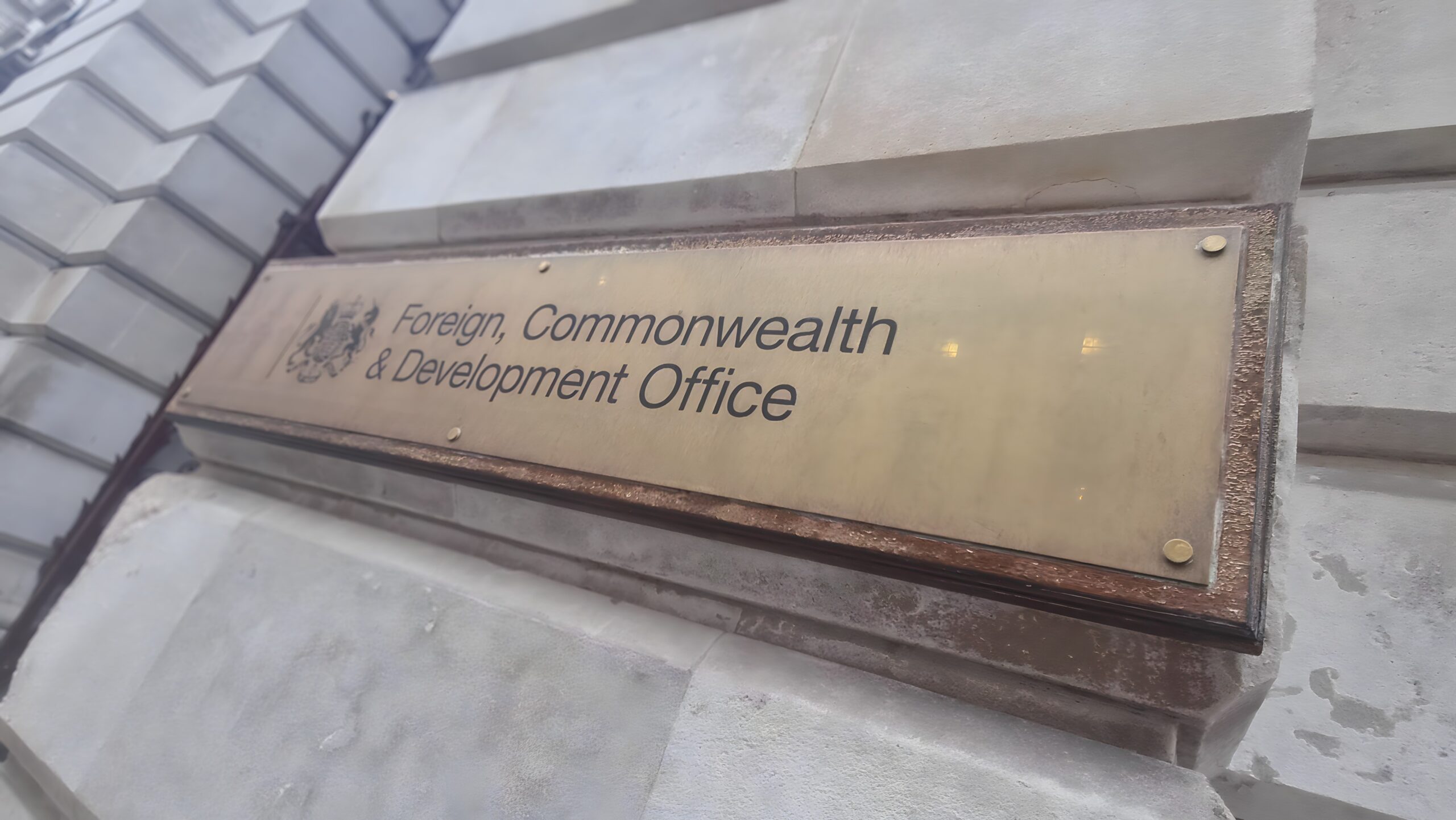
The UK has imposed sanctions on 19 individuals, companies, banks and vessels accused of supporting Russia’s war effort, including six banks and six oil tankers linked to Moscow’s so-called shadow fleet, the UK Defence Journal understands.
The latest measures were announced by Foreign Secretary Ed Miliband as part of his first major Russia sanctions package since taking office. According to the Foreign, Commonwealth and Development Office, the designations are intended to restrict revenue, financial services and access to materials used by Russia’s defence sector.
Six Russian banks have been added to the UK sanctions regime: Ozon Bank, Realist Bank, Teleport Bank, Bank Stavr, Commercial Bank Center-Invest and the State Specialised Russian Export-Import Bank. The government said the institutions were supporting Russia’s wartime economy.
The package also covers six tankers identified by their International Maritime Organization numbers and current names. They are Asteras, Perseas, Torvian, Visund, Zenturo and Arctic Express.
Western governments use the term “shadow fleet” to describe vessels employed to transport Russian oil while attempting to avoid sanctions, price caps and other restrictions imposed following the full-scale invasion of Ukraine in February 2022. Such ships are often associated with opaque ownership structures, frequent changes of flag or management, and limited links to established Western insurers.
Two companies connected with ship management and engineering, Frion Ship Management LLP and Northern Engineering Limited Liability Company, were also designated.
Four Russian businesses involved in importing tantalum and niobium have been sanctioned. The companies are Metallkomplekt, Nikom, Technolux and Promsiz. Both metals have industrial and defence applications, including use in specialist alloys, electronic components and equipment exposed to high temperatures.
The nineteenth target is Alexander Aleksandrovich Zhdanov. The government said the wider package was directed at individuals and organisations enabling Russia’s military activity and helping the Kremlin maintain revenue streams.
Foreign Secretary Ed Miliband said, as quoted in the press release: “Today’s new sanctions demonstrate the UK’s unwavering commitment to supporting Ukraine and bearing down on those propping up the Kremlin’s aggression.”
He added: “Ukraine’s fight is our fight. Those that threaten Ukraine’s freedom and democracy are a threat to Britain’s security at home. That’s why we will continue stepping up the pressure on Russia until a just and lasting peace has been reached.”
The announcement follows talks between Miliband and US Secretary of State Marco Rubio in Washington on 5 August. The FCDO said their discussions covered continued pressure on Russia and the relationship between Ukrainian, European and transatlantic security.
Miliband also joined the Prime Minister in Portsmouth during President Volodymyr Zelenskyy’s visit to the UK the previous week. During the visit, the government announced further support for Ukrainian drone capabilities.
John Healey said: “Our commitment to stand with the Ukrainian people is absolute.”
He continued: “That’s why we’re introducing new tougher sanctions to choke off the funds that fuel Putin’s illegal war and are targeting his shadow fleet. And the UK will continue to step up our action against Russia and its shadow fleet activity to protect our national security, our economy, and global stability.”
The government said it has sanctioned more than 500 individuals, organisations and vessels under the Russia sanctions regime during 2026. Since the regime was introduced, more than 3,400 individuals, entities and ships have been designated.
UK sanctions can include asset freezes, restrictions on access to British financial services, travel bans and prohibitions on providing specified goods or services. Their application depends on the terms attached to each individual designation.





Since the 2022 invasion of Ukraine, Western intelligence partners have tracked an escalating campaign of Russian hybrid warfare and grey-zone sabotage across the UK. The Kremlin frequently deploys “disposable agents” – often local criminals, gang members, or unwitting third-country nationals recruited via Telegram – to gain deniability. The specific UK infrastructure incidents, fires and outages that have been investigated for or reasonably linked to Russian state-backed sabotage include:-
Investigative tracking exposed that cyber units closely linked to Russia and China had penetrated the Sellafield nuclear site in 2023. They successfully implanted “sleeper malware”—latent malicious code designed to remain dormant until explicitly triggered by a hostile state to destroy or disrupt operations during a time of crisis.
A highly coordinated Russian intelligence ring spent late 2023 and early 2024 mapping out physical targets across London. This Wagner-directed spy ring conducting hostile physical reconnaissance, filming locations and planning arson attacks on multiple businesses in Mayfair. These targets included a wine shop and a restaurant owned by high-profile outspoken critics of Vladimir Putin.
In the summer of 2023, the UK Electoral Commission announced it had suffered a massive, sophisticated cyber-intrusion into its servers, exposing the data of up to 40 million British voters. While the government did not definitively name Russia in its immediate public security reports, GCHQ and Western intelligence partners attributed the infrastructure penetration directly to sophisticated Russian state-sponsored Advanced Persistent Threat (APT) groups
In April 2023, the UK National Cyber Security Centre (NCSC) issued an unusual urgent threat warning regarding Russian-aligned hacktivists and state cyber units deliberately targeting the operational technologies of UK critical national infrastructure – specifically water treatment and power grid systems.
On March 17, 2024, an unexplained explosion and subsequent fire broke out at the BAE Systems Glascoed facility in Monmouthshire, South Wales. This highly specific facility manufactures 155mm artillery shells and ammunition heavily supplied to the frontlines in Ukraine
While peaking in mid-2024, the successful Synnovis London Hospitals cyber-sabotage severe infrastructure attack was the culmination of network compromises built up by actors operating freely in Russia throughout the preceding months. A ransomware assault crippled Synnovis, a critical pathology firm providing blood testing and transfusion services to the NHS. The strike directly caused a physical crisis at major London institutions- including King’s College Hospital, Guy’s, and St Thomas’- resulting in more than 1,000 postponed operations
The East London (Leyton) warehouse arson (March 2024): This is the most definitive case of Russian state-ordered sabotage on UK soil. A massive fire tore through an industrial estate warehouse containing humanitarian aid, Starlink devices, and other non-lethal military equipment destined for Ukraine
The DHL depot fire, Minworth (July 2024): An incendiary device hidden inside a package spontaneously ignited at a DHL freight hub near Birmingham, causing a localized warehouse fire. Similar self-igniting parcels detonated in Germany and Poland around the same time.
South West Water / Parent Company Hack (August 2022): A Russia-linked ransomware gang (CLOP) successfully breached the computer networks of water companies supplying water to over 1.5 million people
Southern Water data breach (Early 2024): A Russia-linked ransomware group stole the personal and financial details of up to 500,000 customers.
Thames Water intrusions (Late 2024) – reports surfaced that the UK’s largest water company had its antiquated IT infrastructure repeatedly breached by state-sponsored actors from Russia, China, and Iran.
On March 21, 2025, a massive explosion and subsequent oil-fuelled fire at the high-voltage North Hyde substation in Hayes knocked out power to Heathrow Airport. The incident caused unprecedented travel chaos, grounding or diverting more than 1,300 flights and stranding 300,000 passengers. However, after an investigation doubt was cast on this incident as the transformers involved were over 40 years old
We can look at these incidents collectively and conclude – as many have – that they may well have been organised by foreign intelligence agencies. Probably Russian. It’s long past time that the Home Secretary Shabana Mahmood looked into these domestiv intelligence failures and ask MI5 why we are always reacting after the event rather than pre-emptively preventing them
Yesterday there was another suspicious outage of power to trains in the north.