

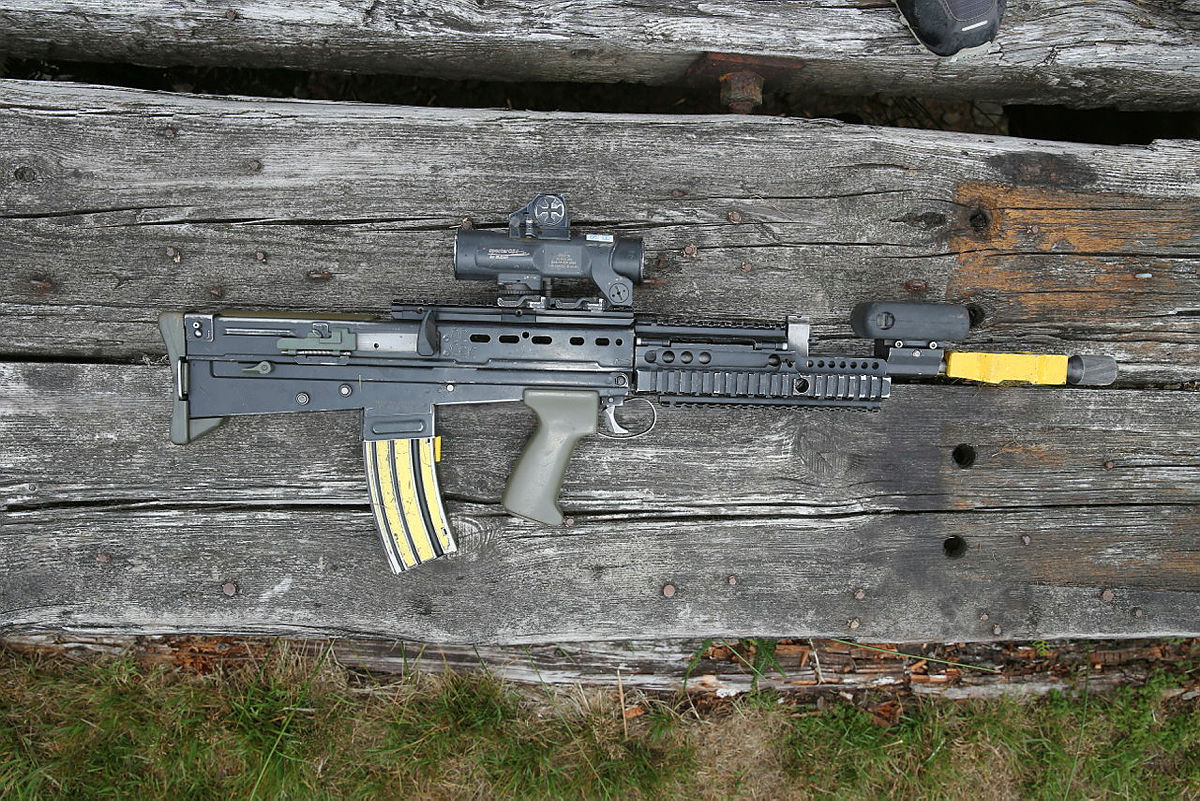
Project Grayburn, the programme examining a replacement for the SA80 family of weapons, is due to complete its concept phase in the second quarter of 2027, according to defence minister Luke Pollard.
Ben Obese-Jecty, the Conservative MP for Huntingdon, asked when a procurement route, delivery model, supplier, product and contractual structure would each be selected. Pollard replied: “Project GRAYBURN remains in its concept phase, which is due to complete in Q2 2027. Until then, the Authority is at an early stage of developing the requirement, scope and approach to any future procurement and these remain subject to further development and approvals. The preliminary market engagement will inform the Authority’s understanding of the market and potential delivery models for the project. The supplier, product and contractual structure will be subject to the delivery model chosen.”
The preliminary market engagement notice issued on 23 October put an estimated value of £2 billion on the work, including VAT, across a contract period from July 2029 to the end of March 2045. It said a tender notice is not expected until 2 July 2027.
The notice, published by the National Armaments Director Group, sets out plans for engagement with industry to help determine how the replacement programme might be delivered. The department has yet to select a preferred procurement route or contractual arrangement, with the requirements and scope remaining subject to further development.
Earlier procurement documentation outlined five proposed weapon variants, including standard and short-barrelled close combat rifles, a personal defence weapon to replace the L22 carbine, a general-purpose rifle to replace the SA80A2 and a cadet rifle to replace the L98. The programme is intended to address requirements across several categories of small arms used by British forces.
The eventual calibre remains under consideration. In November 2025, Pollard confirmed that the Army was examining the advantages and disadvantages of changing calibre, including the possible adoption of intermediate cartridges such as 6.8×51mm. The department has also identified the ability to defeat modern body armour as a requirement for the replacement capability.
British manufacture forms part of the programme’s stated industrial objectives. Pollard told MPs earlier this year that the Ministry of Defence had established expectations for Project Grayburn to be manufactured in the United Kingdom, with consideration also being given to potential export opportunities and the maintenance of specialist manufacturing expertise.
The SA80 family entered British military service in the mid-1980s, replacing the 7.62mm L1A1 Self-Loading Rifle as the Army’s principal infantry weapon. The original L85A1 underwent a substantial modification programme by Heckler & Koch, resulting in the L85A2, while a further modernisation programme introduced the L85A3 configuration from 2018. Changes included revised mounting arrangements, a new handguard and improvements to the weapon’s external finish and compatibility with optical sights.
The L85 is a gas-operated, magazine-fed assault rifle using a bullpup configuration, with its action and magazine positioned behind the trigger assembly. The arrangement allows a relatively long barrel to be accommodated within a shorter overall weapon. It is chambered for the NATO-standard 5.56×45mm cartridge and uses a detachable 30-round box magazine. According to published British Army specifications, the SA80 individual weapon has an overall length of 785mm, a barrel length of 518mm and a stated effective range of 400 metres.









geez louise! how long does it take to get a M4 variant?
I’m with you on that, it’s a fun FFS it’s not exactly hard to find a good reliable one.
BFBS news on YouTube has the FN Arka to play with!one selling point is they say they can have 90% of production in the UK.
Front runner Jacko, it has to be, an excellent rifle with a company that already had a UK footprint thanks to it’s purchase of Manroy a few years back and creating FnUK.
I would probably put a bet on that one….
Over thinking, over planning… ending up making the wrong choice
If there is one thing that should be piss easy it’s buying a new rifle.. but I suspect they will start having conniptions over the cal to choice.
Personally I blame the US for starting the soul searching trend by moving to a 6.8x51mm. I suspect they are going to regret it in the end with less rounds carried, serous barrel wear issues ( it’s a very high Chamber pressure of 80,000PSI vs NATO standard rounds 60,000psi ) the U.S. army testers complained of serous throat erosion after 2000 rounds .. ( which is pathetic) SIG dismissed that saying it’s good for 6000-10000 rounds..who do you believe your own solders or the company trying to sell you 100,000 rifles.. the U.S army believed the sales people… we shall see. Because that’s not all of it, that 80,000PSI also means it kicks like a mule, that’s not just a sore shoulder for the shooter to whinge about, it has real world issues as that’s going to fuck up most shooter sight picture and accuracy after shot 1.. so the U.S. has introduced the 6.8x51mm to move engagements out to 500meters for normal shooters,but the round has massive kick so normal shooter accuracy is going to go to shit after round one unless they can get the sight picture back, which takes time.. ( you want as flat a trajectory as possible for accuracy, but to maintain the sight picture you want as little recoil as possible.. it’s a delightful set of mutually exclusives)… and actually I’m not even sure what they hell they are really thinking with the sacrifice this round requires just to get an single accurate powerful shot out to 500 yards for a standard shooter.. cus that’s fuck hard even with very benign shooting dynamics ( prone, relaxed, not winded through running, with a firm steady base)..good for a sniper and very well trained marksman maybe.. your average shooter.. not so much.
Meh, the new ammo means the rest of us can draw on their stocks. Besides, I’m sure there’s enough talk and data about how far you engage troops with rifles and I thought the idea of 556 was meant to wound an enemy and by doing so, there’s three or four men that have to stop and carry their comrade out? Alas, the followup shots would end anyone if so desired.
The trouble with that theory is if you have an enemy who doesn’t give a flying stuff about casualties they just keep coming!
Back to 7.62 and the ‘Black Rod of Death’ I say😉
On a parallel track, not so long ago the talk was that as global populations are increasingly moving into city/urban areas, future conflicts would be more urban focused. In which case, infantry engagements would be at closer range as buildings and the remains of buildings act as cover/obstacles to line of sight. So then, is the longer range of the intermediate round necessary beyond designated marksmen teams?
And then there is the British Army’s age-old dilemma that it seemingly faces on the eve of every major conflict: do you want to introduce a new rifle chambered for a new calibre for which you have no stock when war is round the corner, or stick to the old calibre of which you have plenty of reserves you can draw upon?
I get your point but there are endless parameters and they also want local manufacturing and this might be a blocker for some models as for asking soldiers, this is important but there are question like “do you like Bullpup” that some do and some don’t and there are more important considerations, eventually IMO you see what is working for armies around the world try it in several units and have a go no go in after a trials period
Yes, but US Navy Seals have adopted the more reasonable 6mm Arc. That gives you 6.5 Creedmore reach, but in a 5.56 size rifle.
Yes they have, but even they are using the 6mm arc as essentially a long range shooter round not a standard adoption across the board.