

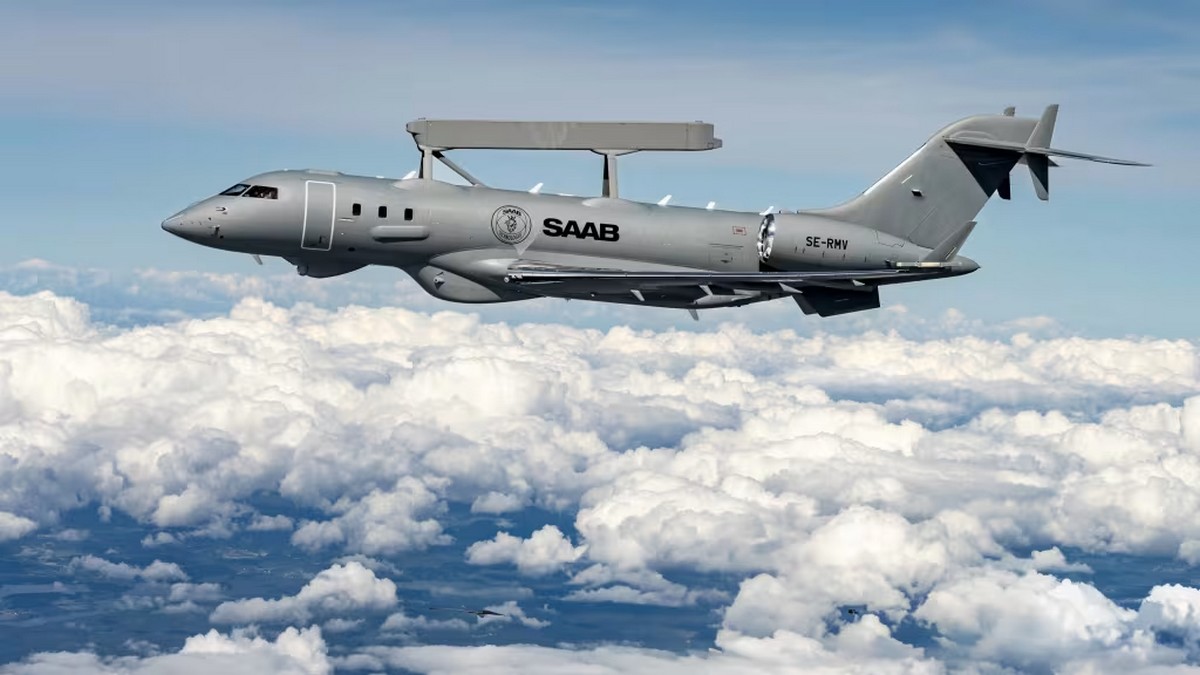
Saab has received an order for two GlobalEye airborne early warning and control aircraft from an undisclosed customer in the Middle East, with deliveries scheduled for 2030, the company stated.
The contract is valued at SEK 10.1 billion, equivalent to around £780 million at exchange rates on 27 July. Saab announced the order on 27 July but said it would not disclose further information about the customer because of national security considerations and the nature of the defence industry.
According to a Saab news update, GlobalEye provides airborne early warning and control across air, maritime and land domains using a combination of active and passive sensors.
The aircraft is based on the Bombardier Global 6000/6500 business jet family and carries Saab’s Erieye Extended Range radar in a distinctive structure mounted above the fuselage. Additional sensors are integrated to provide surveillance across several operating domains.
Saab says GlobalEye can detect and identify objects at long range while distributing information to other aircraft, ships, ground units and command centres. As with other airborne surveillance systems, detection performance varies according to factors including target characteristics, altitude and operating conditions.
Micael Johansson, President and CEO of Saab, said, as quoted in a news update: “This order underscores our commitment to providing customers with mission-proven, multi-domain AEW&C capability. The increasing international interest in GlobalEye reflects its effectiveness and reliability in modern air defence operations.”
The latest order adds another two aircraft to the international GlobalEye programme. The United Arab Emirates became the launch customer, initially acquiring the aircraft under its Swing Role Surveillance System programme before placing further orders.
Sweden has also selected GlobalEye for its future airborne surveillance fleet under the designation S 106. Stockholm ordered two aircraft in 2022, with options for additional examples, as part of plans to replace its Saab 340-based Erieye platforms.
Airborne early warning and control aircraft use their operating altitude to extend radar coverage beyond the horizon available to many ground and ship-based sensors. They can also act as command and control nodes, passing tracks and other information to combat aircraft, surface vessels and air defence units.
GlobalEye combines that role with maritime and ground surveillance functions. Saab has marketed the platform as a multi-domain system capable of maintaining a wider surveillance picture from a single aircraft, rather than concentrating exclusively on airborne targets.
The new Middle Eastern order follows continued international interest in airborne early warning systems as air forces seek to improve long-range surveillance, command and control, and coordination between different sensors and weapon systems. Saab said the two aircraft covered by the latest contract are due to be delivered during 2030. The company has not named the purchasing country and said no further information concerning the customer or the circumstances of the order would be provided.




Talking AWACS/ASCS, film on X of an RAF E7 in newly painted livery arriving at Boscombe Down yesterday.
Please sir, can we have more?
more! did you say more? 😀
Get your begging bowl out🥣
No!
Would half doz GlobalEye’s instead be alright? Why tie everything up in just 3 E7s. Unless we buy/co-crew those two US ones in build? Are those two spare radar sets still in the she looking for an airframe?
This is where the UK’s obsession with the very top end kit bites us in the backside.
I’ve no doubt that E7 is many times better than Global Eye….vut the E7 market is super small as not many countries have those kind of budgets.
Although when we ordered it, it was supposed to be very low risk and the modern equivalent of E3. Afterall, the Australians developed it and Turkey operates it, so it SHOULD have been easy and relatively low cost.
Yes but, the E-7 radar & systems have moved on since Australia & Turkey. A new E-7 now costs around $725m. Difficult to do exact comparisons but, you can probably get 2x Global Eye for one E-7, price wise.
SB,
Post Iranian conflict, one would envision every GCC state acquiring a fleet of Global Eye. Predict ENATO MIC will develop ME markets which rival, if not exceed, those of Uncle Sugar.
Wonder if it would be worth getting a few of these instead of another wedgetail or 2. The thought being not every deployment will require the full capability of a Wedgetail and essentially getting 2 for 1 would increase scope and availability.
I’d get rid of the E7s and just get a dozen GlobalEyes instead, then.
You’re right, its so much better having three whole E7 Wedgetails than 7-12 GlobalEyes.
Is this the same Middle East order or potential order that was announced earlier in the year? Or a different order? For the same ME customer or a different one?
It gets confusing when they don’t disclose who the customer is…
Off topic, UAE air force AW139s were flying over London yesterday. And a Super Stallion/King Stallion earlier in the week…