

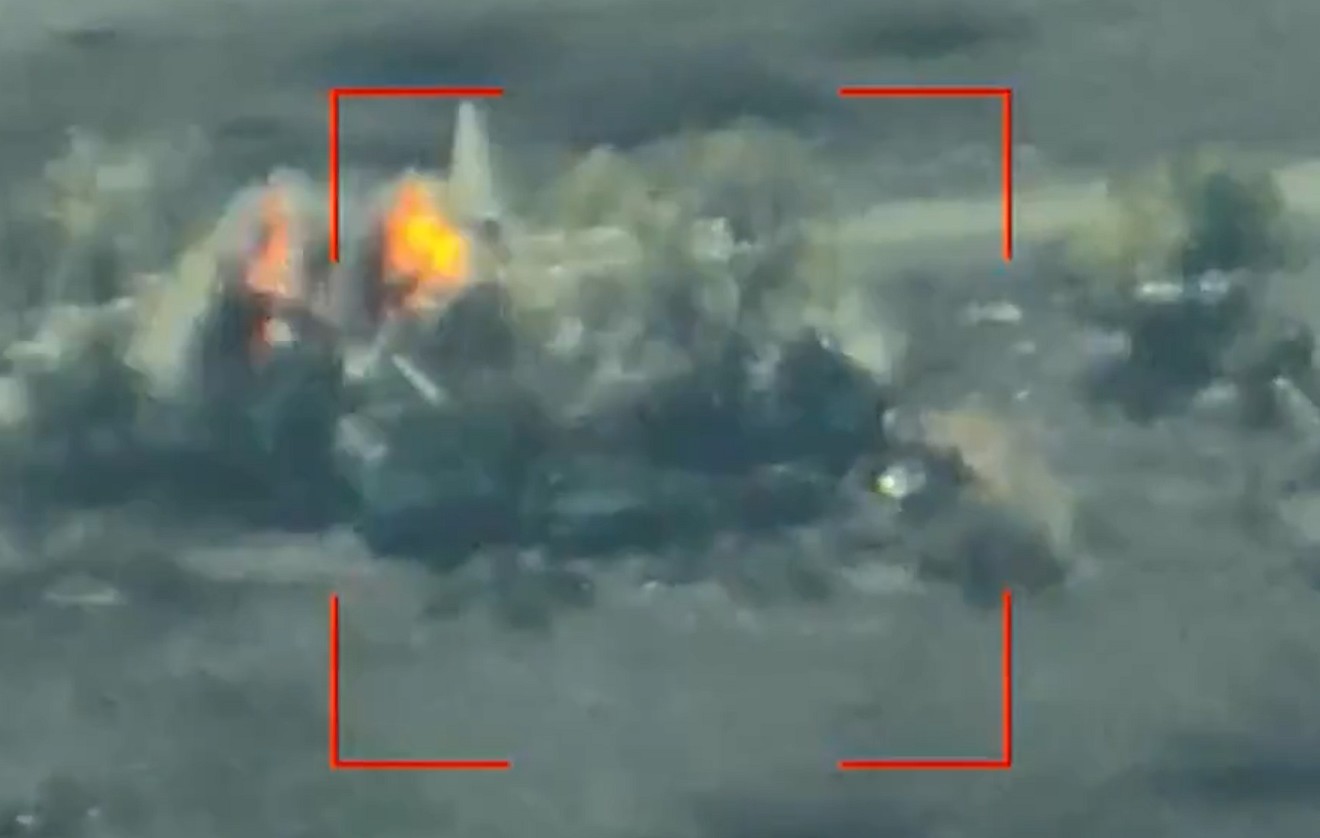
The Ministry of Defence has asked British industry to come forward with counter-drone jamming equipment for Ukraine, covering kit that can be worn by a soldier, fitted to a vehicle, carried by a drone or left in a fixed position on the ground, the department stated in a request for information.
The equipment in question works by flooding the radio frequencies a drone uses to talk to its operator, severing that link so the aircraft cannot be steered onto its target. Systems of this kind have become one of the main defences against the small quadcopters that now account for a large share of casualties and vehicle losses along the front line in Ukraine.
The purchase is designated Electronic Warfare Bidding Round 1, or EWBR1, and falls under Operation Scorpius, the effort set up in February 2022 to pull together the various strands of MOD support for Ukraine. Within it sits Taskforce Kindred, the team that fields requests from the Ukrainian armed forces and works with Defence Equipment and Support to find the equipment. The document states the taskforce needs to understand the UK market in order to supply “continued and resilient EW capability” to Ukrainian forces, and says the focus of this round was agreed in consultation with Kyiv.
Four configurations are on the table: soldier-portable or worn, vehicle hosted, drone hosted and emplaced. Suppliers were invited to bid for one or more. A market engagement notice appeared on Find a Tender on 8 July 2026, with expressions of interest due by 10 August. Estimated contract dates run from 30 September 2026 to the end of March 2027, and the requirement is listed as goods rather than services, meaning the department is buying hardware rather than a service arrangement.
The timetable is unusually compressed for a defence purchase. A panel of experts was to spend the second half of August assessing what industry offered, with a decision in the first week of September on which products best suit Ukrainian needs “within the timescales and available funds”, and contracts offered from 8 September. Losing bidders will hear little about why, the document noting that “no detailed feedback will be provided” given the number of responses expected and the time available.
What the MOD wants is set out in some detail for the worn version, it must jam the control links of small drones at a minimum of 100 metres when broadcasting in all directions, or a kilometre when aimed at a target, with the department’s stretch goals extending that to two and four kilometres respectively against larger types. It must cover a very wide slice of the radio spectrum, from 20MHz up to 60GHz, and allow its settings to be reprogrammed in the field as the enemy changes frequencies.
One person must be able to carry it, at no more than 20kg and ideally 12kg, using a harness sized to fit everyone from a small woman to a large man. One person must be able to set it up, ready to work within fifteen minutes and ideally ten. It has to be waterproof and dust-tight, work anywhere between minus 35 and plus 55 degrees, run for at least four hours on its own battery, and take standard NATO batteries when those run flat. It also has to be quiet, cool and hard to see, since a jammer that announces itself becomes a target.
Jamming and drones have been locked in a cycle of adaptation throughout the war. As jammers spread, Ukrainian and Russian units turned to drones that hop rapidly between frequencies, to aircraft flown down a spool of fibre-optic cable that no amount of radio interference can touch, and to onboard software that lets a drone finish its attack after losing contact with its pilot. Each of those responses raises the bar for the next generation of jammers, which is part of why the department is buying in short rounds rather than long programmes.







Shotguns?
Already in use, but come with their own issues. Not least needing to spot the drone and engage it before it attacks you. Jamming has the advantage that you can theoretically disable a drone before you are even aware of it’s presence (or vice versa).
Not our flag not our enemy and not our war.
We need to get out and develop these things for ourselves
Although body worn kits rarely works due to range limitations and fortunately northern Ireland ended before this type of tech became common.
But it rarely worked in Iraq and Afghanistan
But this is developing it for ourselves? Except with this we can actually test it in real world environments to prove it actually will work. This was our issue with what you stated… We didn’t have the ability to test it realistically so when it went to afghan or Iraq, it wasn’t very good.
Jammers can become targets. I would not want to be near a jammer especially wear one.
The point is that all soldiers can wear one, or at least most in a squad.
Interesting scenario. All shout “I am Sparticus”. I suppose the same ploy might work with jammers.
But they do have an RF signature. I would still be worried.