

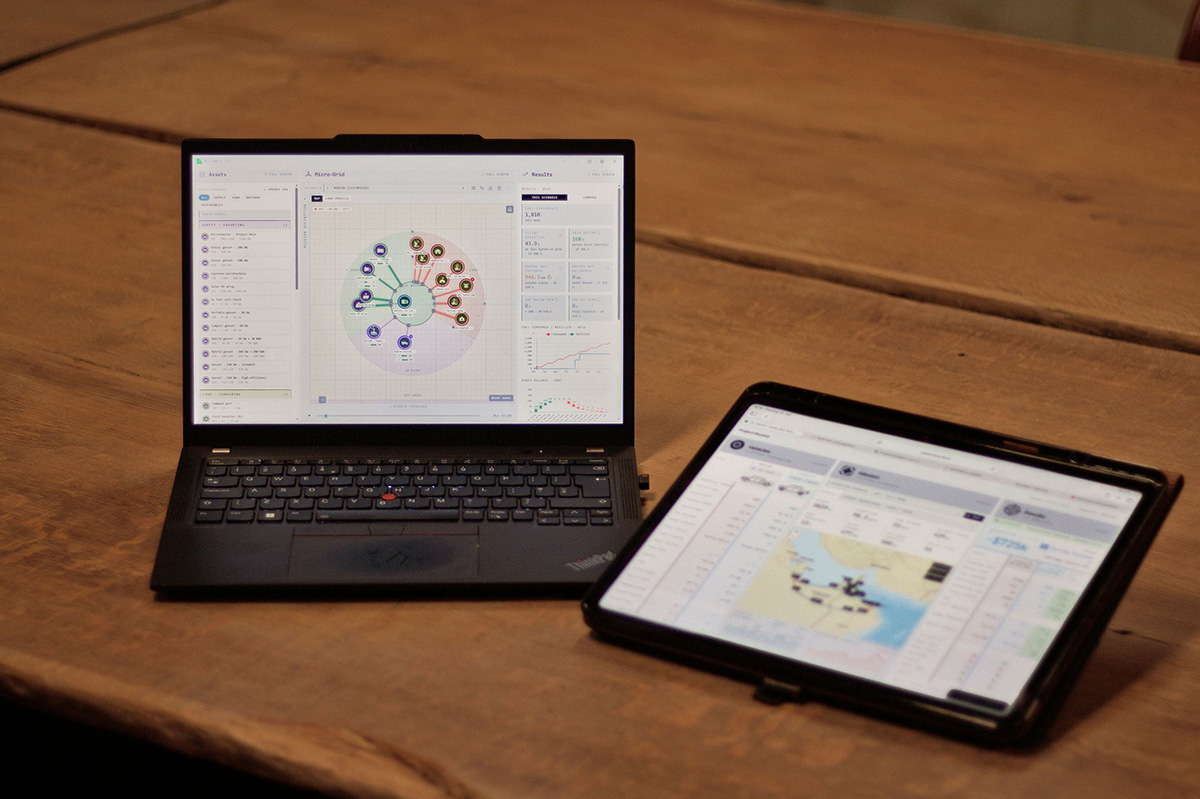
A Leamington Spa company has built simulation software that tests hybrid and electric power systems against real mission profiles before any hardware exists. It has already been used to screen architectures for a hybrid main battle tank, is feeding into the Light Mobility Vehicle competition, and draws on a decade of powertrain work for Jaguar Land Rover and Stellantis.
Power Size Technologies has launched powersize.tech, describing it as a virtual proving ground for electrified forces. The tool models a vehicle’s powertrain, its energy system and the mission it is expected to run at the same time, then ranks possible component combinations against operational outcomes and lifetime cost.
Drones, sensors, electronic warfare suites and directed energy weapons have all added electrical demand to platforms. Once a battery, a motor and power electronics enter the design, each of those choices pulls against the others, and against ammunition stowage, crew space and range.
“This wasn’t a problem in the combustion world, because you could just pick an engine,” said Wiktor Dotter, the company’s chief executive. “As soon as you add electrification to the mix, you now have a physics spiral and a three-dimensional sizing problem that you need to address.”
Speaking to the UK Defence Journal, Dotter compared the software to the route planner in an electric car. “If you drive an EV and you say I want to go over there, it tells you where to charge. That is basically what we do, except we do it for combustion, hybrid, fuel cell and full electric, and we add all the electronic loads introduced by electronic warfare.”
He characterises the gap the tool is aimed at in the MOD’s own terms. “The biggest use case for the UK MOD is they’re saying, look, we have nothing between spreadsheets and guesswork and detailed CAD simulation. So this fits right in between.”
From guesswork to simulation
Asked what the alternative looked like before tools like this existed, Dotter spoke about the state of the art in off-highway and defence engineering. “Honestly, in defence and off-highway it’s been based on intuition. It’s been like, we’ve always had a six-cylinder, we’re always going to have a six-cylinder on this vehicle. Engine and power procurement in defence wasn’t always based on simulation.”
The consequence was iteration in hardware, and the discovery of problems late.
“It didn’t work in a prototype, so you went back to square one and did it again with a different engine, out to prototype, and you went back and did it again.”
The failure mode he describes is specific and current: a vehicle that turns out not to be able to do the thing it was hybridised for. “Now I can’t shoot the laser long enough while I’m turning the engine off and running on my battery. We need to go back to the concept evaluation.”
What the two years actually buys, he argues, is uncertainty rather than engineering. “Are we going down the right rabbit hole with this battery supplier, with that engine size, with the voltage strategy, 400, 800, 1,200 volt? We’re removing all of that uncertainty, which used to be guesswork and which you’re paying for in repeating the development cycle.”
He is franker about the old approach than most vendors would be about their own sector: “It’s been a finger in the air type of work in the combustion world.”
The company says a screening exercise that would conventionally take two years was completed in under six months for a serial hybrid main battle tank being developed by a United States prime contractor. Dotter declined to name the customer, noting only that there is one such vehicle in the world.
“The vehicle needs to go on tarmac, on grass, on sand, on snow. There is get in, get out, taxi. How big should the battery be? How should we configure the transmission? How do we fit it in the same powertrain package size as the old powertrain?”
Ten Land Rovers or one Pioneer
The most immediate British application concerns the Light Mobility Vehicle competition, the Land Rover and Pinzgauer replacement running under the Army’s wider Land Mobility Programme, which Dotter said relaunched last week with requirements set by the Army. Power Size says it will participate alongside the MOD.
The company has modelled Fering Technologies’ range-extended hybrid Pioneer, a Battersea-built reconnaissance vehicle with a range Dotter puts at around 7,000 kilometres, or London to Moscow and back on one tank. It was compared against a serial hybrid at the opposite end of the design spectrum, carrying close to a tonne of battery and a small fuel tank.
On a modelled special forces patrol in the Strait of Hormuz, the large-battery vehicle needed ten recharging events, each one drawing down the fuel it carried to charge with. The Pioneer finished the cycle with 70 percent of its fuel remaining. Dotter was upfront that the scenario favours Fering, which is a client.
What the tool then does is convert that into logistics.
“Am I helicoptering out fuel? That’s 200,000 dollars per refuelling event, and I’m exposing four troops. Or am I having a rendezvous convoy? That’s even more troops, perhaps cheaper, but you need to protect the fuel tankers and everything.”
The result, he said, was a business case showing a saving of almost $750,000 on a single mission, on a vehicle costing three times as much to buy. The more revealing detail is who is using it and for what. In the LMV competition, Dotter said, the tool has become the venue for a disagreement between the Army and special forces.
“You can imagine if you have a vehicle that can go 7,000 kilometres, the special forces are very interested. But the Army is saying, guys, for a million quid we can get ten Land Rovers instead. Why would we get this vehicle? So they’re actually having arguments inside the tool. What can you do with ten Land Rovers versus one Fering Pioneer, and what does that mean to your mission?”
That argument, he said, has always existed. “I guess now they have the campfire to have that argument with.”
Other missions have been built to order, including a Greenland profile where snow imposes three to four times the rolling resistance of tarmac, and a London to Kyiv run examining whether vehicles could be driven to theatre rather than moved on low loaders.
Bases as well as vehicles
The same approach is applied to static power. A modelled command post drew 269 litres under a mixed configuration of generation, storage and solar, against 600 litres for a generator-only setup. For Dstl, Dotter said, the constraint has never been spotting good technology. It has been getting to the point of trying it.
“The pain point of Dstl was, we are seeing all this amazing technology out there, the solar panels, the portable batteries, but it takes us five years to get funding to test it and go into the desert and actually test it.”
He described watching the same problem from the other end during his visit to Canada last week, where vehicles procured years earlier could not support the equipment now being fitted to them.
“They currently have ten vehicles in the backyard and they can’t even power a radio. That’s literally what I saw yesterday. They’re fitting the new satcoms to these old vehicles and there’s not enough power on board. It took them five years to procure that vehicle, and by the time they get it, it’s already five years old.”
The microgrid work is now the strongest source of demand, he said, and the most acute case is Ukraine. “They have old engines. They’re digging them down in the earth at the moment to reduce their heat and noise signature. They’re finding solar panels. They’re having containers full of old Tesla batteries. They have absolutely no means of planning this and putting some sense to it, and they have all these different load cycles coming in at random places, charging, discharging, prioritising who should get the energy first.”
Power Size participated in Project Convergence Capstone 6 at Fort Irwin in California, where it gathered live operational data and tested microgrid concepts against what was actually running on the ground.
The same logic follows the company beyond land vehicles, to a maritime customer applying it to uncrewed surface vessels. “If you can add a laser weapon on a USV, you don’t need to equip it with ammunition anymore. You’ve freed up massive payload, and you’re shooting lasers, and you only need to put fuel on it.”
How solid are the numbers
The company advertises validation to 98 percent against real-world data. Pressed on what sits behind that, Dotter gave a specific answer, tracing it to an automotive programme: the Jaguar I-Pace, with GKN on the transmission and Power Size as the concept development tool.
“We were obviously predicting the efficiency. Then they built that prototype, they put it on a test bench, and they measured the actual vehicle on a dyno. We said X, the actual test said Y, and then we adjusted the software so we came within one or two percent accuracy of the physical test, which means you’re now almost a digital twin.”
He is aware of the objection, and meets it head on. “That’s the one counter-argument people could have against simulation. Is it real? Yes, it’s real. We’ve been there. We’ve been on the test benches. We’ve worked with all the big programmes.”
Physics-based powertrain modelling is well established, and organisations including Ricardo, Horiba MIRA and the primes’ own in-house teams cover adjacent ground. What Power Size has done is move it upstream. Conventional high-fidelity tools model one architecture in detail, slowly, and need a specialist to drive them, which Dotter argues is a luxury the sector does not have. “Usually you need a couple of PhD engineers. Off-highway and defence doesn’t have that luxury. That’s why we make it easy and accessible.”
Part of the accessibility argument is about who gets to participate in the decision at all, “It’s not as easy to make a hybrid, and the trade-off is bigger battery versus troop seat. Are you willing to sacrifice one dismount soldier, or a bigger battery? It’s to make the physics accessible, I guess.”
Other published results include a hybridised Boxer showing a 10.9 percent lifetime fuel saving sized at concept stage, and work for the National Research Council of Canada which Dotter said cut powertrain mass in half by sizing against a tailored mission profile rather than a standard road cycle, freeing payload for ammunition, protection or troops.
Getting into the catalogue
Suppliers of batteries, generators, storage and microgrid equipment are being invited into a catalogue inside the tool, which is how a government user comparing options sees what is available. Instagrid, General Electric, Rolls-Royce generators, an Australian battery supplier and Fering are among those already listed.
“For a supplier to come into the catalogue, it means visibility beyond their specification sheet,” Dotter said. “It means they can tell their customer, MOD, what is my impact if you procure my kit.”
There are two tiers. A supplier can be listed on the strength of its published specification sheet, or it can spend a day or two with Power Size working through the technical detail properly, and receive a validated entry carrying a marker that tells procurement teams the figures have been checked. It is a model that asks the company to rank technologies for buyers while also hosting the suppliers being ranked, and the validation tier is Dotter’s answer to that: a checked figure is harder to game than a brochure claim, and the marker tells a buyer which is which.
The pitch to suppliers is that it settles an argument they cannot otherwise win. Battery makers, he said, face two entrenched camps of customer.
“One camp thinks a battery can power everything, a full construction place. That’s not true. And there’s another, perhaps more conventional group of people who say the battery can power nothing, I don’t trust the battery, it’s unreliable.”
Modelling, he argues, replaces both positions with a number. “You’re able to say, with my battery you can have a satcom and a command post operational for 19 hours. Now, we cannot power a full forward operating base, but we can do this. If you had two batteries, it’s 40 hours.”
MOD, he added, would welcome a populated catalogue, having neither the time nor the reach to track every robotics and autonomous platform arriving on the market.
Where it goes next
Dotter sees the tool moving beyond procurement into operational planning, potentially on a ruggedised tablet at battalion level, pulling live load data from equipment in the field so that a commander can prioritise power in the moment rather than a desk officer sizing a fleet years earlier.
“I’m okay with the satellite not running at lunch, but I need it at night. But at night I can’t have the generator running, because I need to be silent. I need to have batteries, and I need to charge the batteries while also running the hospital. That’s where I really see the tool going.”
Underneath it is a conviction carried over from a decade in automotive, where the margins are far tighter. “You can spend years chasing half a percentile of efficiency improvement. That can be million pound programmes and years of development for someone like VW or JLR, to get from 92.5 percent to 93 percent overall vehicle efficiency. Why we’re so excited about defence is that here it’s still double-digit savings.”
The tolerance for that, he argues, has run out. “It was okay when everything was combustion. It’s no longer okay if you’re carrying a tonne of battery.”
The nearer test is LMV itself. The field already includes General Dynamics Land Systems-UK with Ricardo, Team LionsStrike with GM Defense, BAE Systems and NP Aerospace, and Rheinmetall with Babcock Land, with the first vehicles due in soldiers’ hands by 2030 as the last Land Rovers leave service.
Whoever wins, the battery gets sized once, and the Army lives with the answer into the 2040s. Power Size’s pitch is simply that the cheapest place to get it wrong is on a screen.





Very interesting. Thanks 👍
Very interesting article and technology.
Interesting and informative. With tech changing so rapidly, every day’s a school.day…
Now this sounds impressive, just shows what we can do when the reins are released and ingenuity supported.
Who changed the T45 spec, was it Buffoon?
Upscale this and the RN could potentially future proof power generation.