

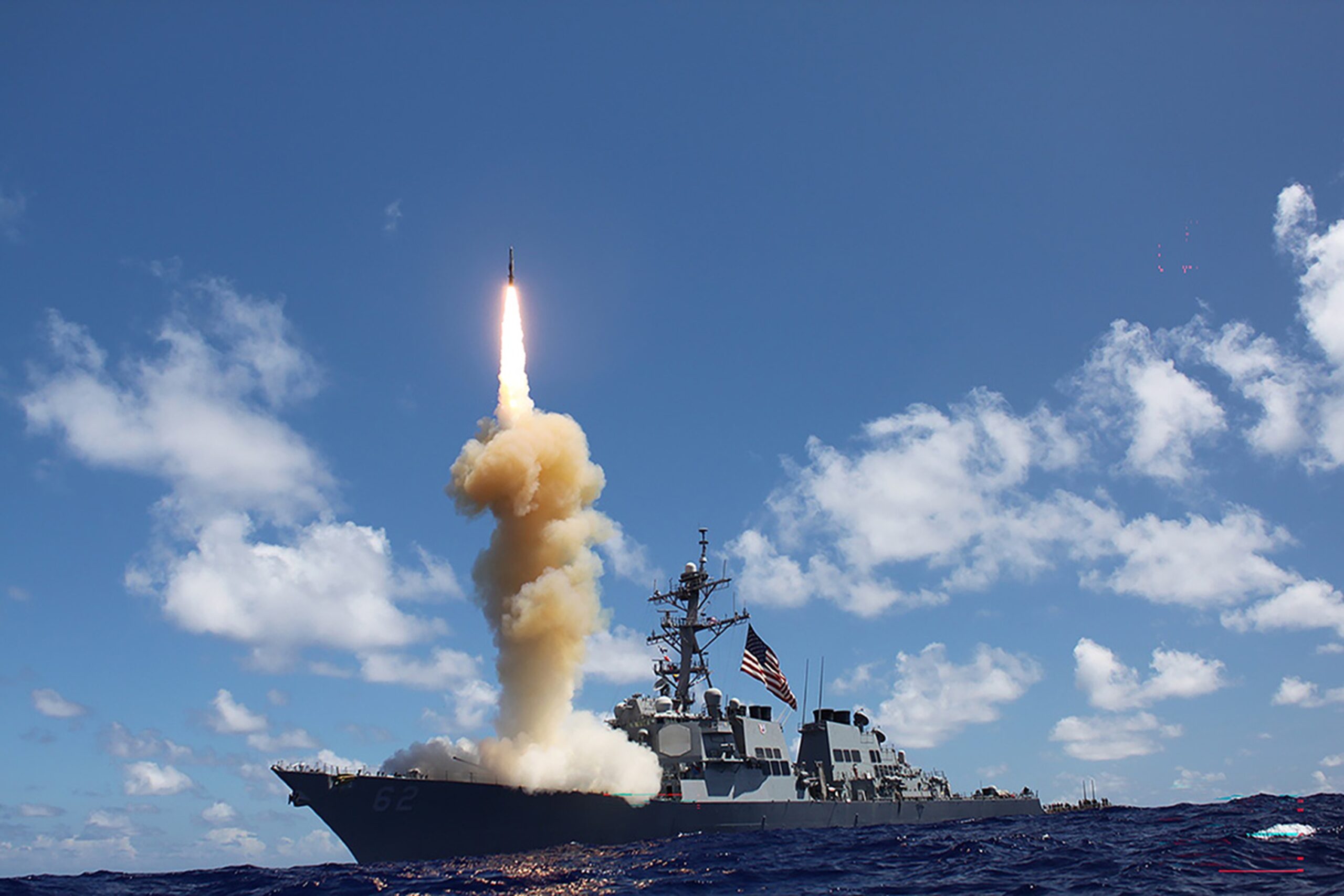
Boeing has signed seven-year framework agreements to increase production of key components for the Standard Missile-3, a ship-launched anti-ballistic missile designed to intercept threats outside the Earth’s atmosphere.
The United States is moving to increase production of Standard Missile-3 anti-ballistic missile interceptors, with Boeing signing new seven-year framework agreements covering critical hardware used in both the SM-3 Block IB and Block IIA variants, according to the company.
The agreements with the U.S. Department of War and Raytheon, an RTX business and prime contractor for the missile, are intended to increase Boeing’s output of avionics and ejector assemblies needed for higher production rates of complete SM-3 interceptors. Boeing said the three parties will begin ramping up production ahead of a final multi-year award while negotiations continue under the new framework.
The SM-3 is a ship-launched anti-ballistic missile used as part of the Aegis Ballistic Missile Defense system. Its principal role is to intercept ballistic missiles during the midcourse portion of their flight, when the target can be travelling outside the Earth’s atmosphere. Rather than relying on an explosive warhead, the interceptor uses a kinetic kill vehicle intended to destroy the target through the force of a direct collision.
That makes the SM-3 distinct from shorter-range air-defence weapons intended primarily to engage aircraft, cruise missiles or other threats within the atmosphere. The missile is designed for ballistic missile defence, providing US and allied forces with an exo-atmospheric interception capability from Aegis-equipped warships and related missile-defence infrastructure.
Bob Ciesla, vice president of Boeing Precision Engagement Systems, said, as quoted in a news update: “This gives us a clear demand signal to build and deliver SM-3 interceptors at the levels needed to counter threats.” He added: “The SM-3 is an essential part of the layered air and missile defense architecture that protects the U.S. and its allies worldwide.”
Both the Block IB and Block IIA variants are covered by the new arrangement. The Block IIA is the larger and more capable development of the weapon, designed to provide greater range and engagement capability against ballistic missile threats. Boeing’s role includes producing avionics and ejector assemblies, components that must be available in sufficient numbers if Raytheon is to increase output of complete missiles.
The decision to begin increasing production before completion of the multi-year contract is intended to give industry a clearer demand signal and reduce the delay between a procurement decision and higher delivery rates. Boeing said the framework supports the administration’s effort to strengthen what it calls the “Arsenal of Freedom” and aligns with Pentagon acquisition reforms intended to accelerate the delivery of priority weapons.
The SM-3 agreement also follows an existing arrangement involving Boeing, the Department of War and Lockheed Martin to increase production of seekers for the PAC-3 Missile Segment Enhancement interceptor.









I think one of the key issues for the UK is are we going to have an intermediate ballistic missile defence.. because Russia has and will use conventionally armed intermediate range ballistic missiles..
Personally I think the UK needs to be able to defend all core infrastructure against cruise missile attacks in the 30-50 range numbers as well a defending all critical defence infrastructure against IRBM attack 1-2 missiles with 8-16 warheads.
Then we need to be able to punch the same equivalent attack back but with twice the power.. and then keep going as a ramp..
Before anything else the UK needs the ability to survive pain and then return even more pain… over and over.
Other stuff is important.. but that’s core..
( and survival of pain and delivery of pain mean sea and air control of our near oceans and seas as well as projecting control into our enemies near seas and skies…not just land based missile defences and resilience)
We have an artists impression, which is a good enough facade for this government.
Will uk ever have money for anti ballistic system. Apart from initial protection of key military sites, how can this be afforded? We just have to strike back.
German’s entire arrows 3 purchase is equivalent to 1% of our 10 year equipment plan. ABM is very affordable, the MoD and in particular the Army chooses not to pay for it as it wishes to prioritise other capabilities.
Take a leaf out of Iran’s playbook.
Put your valuable assets in bunkers dug beneath mountains
No need for expendable and expensive GBAD.
A few issues with that, and I guess the question is what do you consider the valuable assets of the UK.
Firstly, the ruinous cost, we spend hundreds of millions on new barrack blocks, taxiways and sports centres, digging big new bunkers under mountains?
Then practicalities with the existing KPs and CNI.
HMNBs and Dockyards, those aren’t moving.
Nuclear sites likewise.
Coulport is already semi underground, but hardly under a full mountain.
RAF Stations, no mountains near those.
The ASCS RRH cannot be hidden under mountains, but above, and are geographically widely spread already. The CRCs and NASOC are already underground.
Likewise the main Army garrisons.
The HQs of two of the 3 main intelligence agencies are in London and already likely have protected accommodation beneath.
Same for GCHQ in Cheltenham,which had rumours around it for decades that it had vast underground areas under Clee Hill, nothings ever shown up.
The AWE sites cannot be moved, nor can Sellafield, the stocks of plutonuim and HEU are already in vaults.
In the Cold War as we know there was much construction of underground bunkers. The two under Mountains that spring to mind were at Mold which had previously held mustard gas and leaked, and Blaenau Ffestiniog using old mines to store national art treasures. Likely such sites are earmarked today as well for national treasures, but they’re existing not new build.
Yes, it would cost money, and it would take time
But as far as I can see, it is a strategy that has worked very well.
It has withstood the best that the US and Israel can throw at it and at the same time has exhausted the US ammo stock.
IF US was doing to UK what is doing to Iran you would have been screaming for peace. Royal Navy destroyed, RAF destroyed, airports and ports heavily damaged, English Channel blocked, maybe not even 1/10 of exports value getting out.
Of course most here have been manipulated by the media, so we have the incapability to perceive that USA can permanently bottle Ayatollah regime in the Gulf.
Wiki’d costs of Patriot missiles. Domestic cost $ 1 billion for a battery and $ 4 million per missile. Export prices are more.
With the UK already having SM3 coverage in Romania and Poland that can provide mid course interception it’s probably best for the UK to focus its own efforts on a high altitude exo and endo atmospheric capability. If the UK had a single Arrow 3 system linked with Germany’s it would give a secondary line of missile interceptors across Northern Europe behind the further forward SM 3 systems. All we would need would 8 SAMP/T NG or Patriot batteries and the UK would have a comprehensive multi layered anti ballistic missile system covering most major urban conurbations.
This could all be done for about the price of the Ajax programme. Someone should tell this to the Generals the next time they tell us that the UK faces an existential threat and must be ready for war tomorrow.
The guy in charge is an Air Chief Marshal.
Not in the army he is not and the army is responsible for ground based air defence.
‘Under defence Reform, the Chief of the Defence Staff, for the first time since this role was created, now commands the service chiefs and is the head of the newly established Military Strategic Headquarters, responsible for force design and war planning across an integrated force.’
GOV.UK 02 September 2025
No Jim. The RAF is and has long been the lead service on UK air defence. It is logical that it is, as the UK air defence picture needs to integrate combat aircraft, SAMs and the remote radar network. All are RAF.
The Army’s air defence role is solely protection of army units in the field. It comprises two regiments, one with a local area air defence role, with Sky Sabre, one with low-level Starstreak. Together, they could just about form an air defence umbrella over 3 Division.
For GBAD, current thinking is that you need 3 tiers,
– A high level Patriot or Arrow type to knock out ballistic and hypersonic missiles
– A medium level SAM to deal with cruise missiles and fast attack aircraft. Sky Sabre might fit the bill but an Aster 30 ground-based system would be better
– A low-level capability to handle drones, low-flying aircraft and helicopters. This is Starstreak land, or more economically 30mm cannon or a drone interceptor.
We don’t have anything at the moment, other than the counter-UAV Orca, Ninja and Rapid Sentry systems that the RAF Regt is trialling or introducing.
The main immediate need I would think is the first one, the high level Mach 4+ missile. Using Aster 30 as an example, given its 75 mile range, we could cover the UK’s east and north coasts with 4 or 5 batteries, each of 4-6 launchers. That would catch most things heading our way in wartime, but probably not the ballistic missiles and certainly not the hypersonic glide ones.
If we then add Sky Sabre for point defence of military bases, let alone critical infrastructure, we’re talking about 20 or 30 batteries, which would be a massive undertaking both financially and in terms of personnel numbers.
Then there is the issue of defending against the low level threat from drones. As their range increases, these will one day be able to hit the UK mainland from Russia but in the short-term, any surprise attack would probably be from passing shadow fleet merchant ships. To defend against that, we would need dozens of C-UAV batteries around the country, manned principally by reservists and even civilians.
All this to say that a full-on, three-tier air defence system would be an enormous undertaking in both cist and personnel numbers, which us who HMG and MOD keep ducking the issue.
We need to make a start by providing the RAF Regt with missiles. They used to have I think 5 squadrons equipped with Rapier, Sky Sabre’s predecessor, that would do for starters. The real need is for Patriot or SAMP/T, but the Treasury would need to cough up some proper money for that.
We should give the local air defence role to the reserves.The RN reserve units in Portsmouth, Plymouth, Rosyth, Belfast and Glasgow could take on the RN bases and key shipbuilders. The RAF Reserve units could do likewise with the main airbases and aerospace manufacturers. The army would need to greatly expand its one reserve air defence to cover army bases and key equipment manufacturers.
But if the plan was to protect several hundred critical civil installations around the country, we would need to recruit, train, fund and equip a very large number of additional reserves and/or civilians. We are able to do anything like that 2.6% or 3% of GDP.
Agree on all points, especially the use of reserves.
MoD love a good rebrand, integration, and jointry, I smell a new AD Command coming on.
Interestingly, the Soviets had an entire separate service for strategic AD, not saying we do but certainly a volunteer Corps operating by county, I’d volunteer if I could be of use.
This Sky Hammer anti Drone Drone we’ve supposedly ordered, that seems usable to the play station generation and latter ?
Since 2020 all land based air defence has been under 7th air defence group which is part of the army which has sole responsibility for GBAD. At no point in its history has the RAF ever provided ground based air defence for anything other than its own airfields. In every major military on earth it’s the army not the Air Force providing ABM capabilities.
‘…the elevation of the Chief of the Defence Staff (CDS) under Defence Reform as the head of the new Military Strategic Headquarters (MSHQ) with command over the Service Chiefs. The Services must be integrated in planning, readiness, deployment, and procurement.’
‘The purpose of the RAF, in support of the roles for UK Defence set out in Chapter 3, is to:
Role 1: Defend, protect, and enhance the resilience of the UK, its Overseas Territories, and Crown Dependencies: policing UK airspace against airborne terrorism and defending against state threats; and playing a lead role in Integrated Air and Missile Defence…
Capable and effective IAMD for the UK can only be accomplished as part of a NATO endeavour. As lead UK Command for IAMD, the RAF is responsible for delivering the timely, resilient, and integrated command and control (C2) that is critical to success…
The defining principle of this Review is therefore ‘NATO First’
SDR 2025
‘NATO IAMD activities
NATO Air Policing…
NATO Ballistic Missile Defence (BMD) is a permanent mission to defend NATO’s European populations, territory and forces against the increasing threat posed by the proliferation of ballistic missiles. The US European Phased Adaptive Approach (EPAA) is one of the central pillars of NATO BMD. It includes ground- and sea-based radars and effectors provided by the United States. Other Allies are also providing, developing and acquiring BMD assets, which are integrated into NATO BMD.’
‘NATO BMD is based on voluntary national contributions, including nationally funded interceptors and sensors, and hosting arrangements. It is also based on the command and control systems backbone delivered through the NATO BMD Programme, which is commonly funded by all Allies.
National contributions to NATO BMD:
Germany hosts the NATO BMD command centre at Ramstein Air Base.
The United States contributes to NATO BMD through its European Phased Adaptive Approach (EPAA).
Turkey hosts a US BMD radar at Kürecik.
Romania hosts a US Aegis Ashore site at Deveselu Air Base.
Poland hosts another US Aegis Ashore site at the Redzikowo military base.
Additionally, in the context of the EPAA, Spain hosts four multi-mission BMD-capable US Aegis ships at its naval base in Rota, for use of the NATO BMD mission when required.’
Is it?
I thought SampT was shared between Army and Air Force by Italy and France.
The Dutch army operates patriots but I think the German units are split between the services?
Aren’t the German Arrow systems operated by the Luftwaffe?
And to think, not that long ago, all RAF bases were defended in depth by long range, close range abd gun based air defence systems
Every RAF base?
When was that?!
The Cold War wasn’t that long ago….
Even then there were a few Bloodhound sites on the East Coast and even fewer Rapier protected sites.
Cannon was replaced by Rapier until a few cannons became available in 1982.
Yep, a bit of an exaggeration.
Leuchars and Lossi had Rapier, as did 4 USAF bases.
The cannons went to Waddo to be used by the RAuxAF Reg. One sat outside the NADOC fairly recently as a sort of gate guard, and might still be there.
The Bloodhounds covered from the Humber to the Thames Estuary, North Coates to Bawdsy
Hardly every RAF Station.
A modern day equivalent operated by the Reserve I’d fully support.