

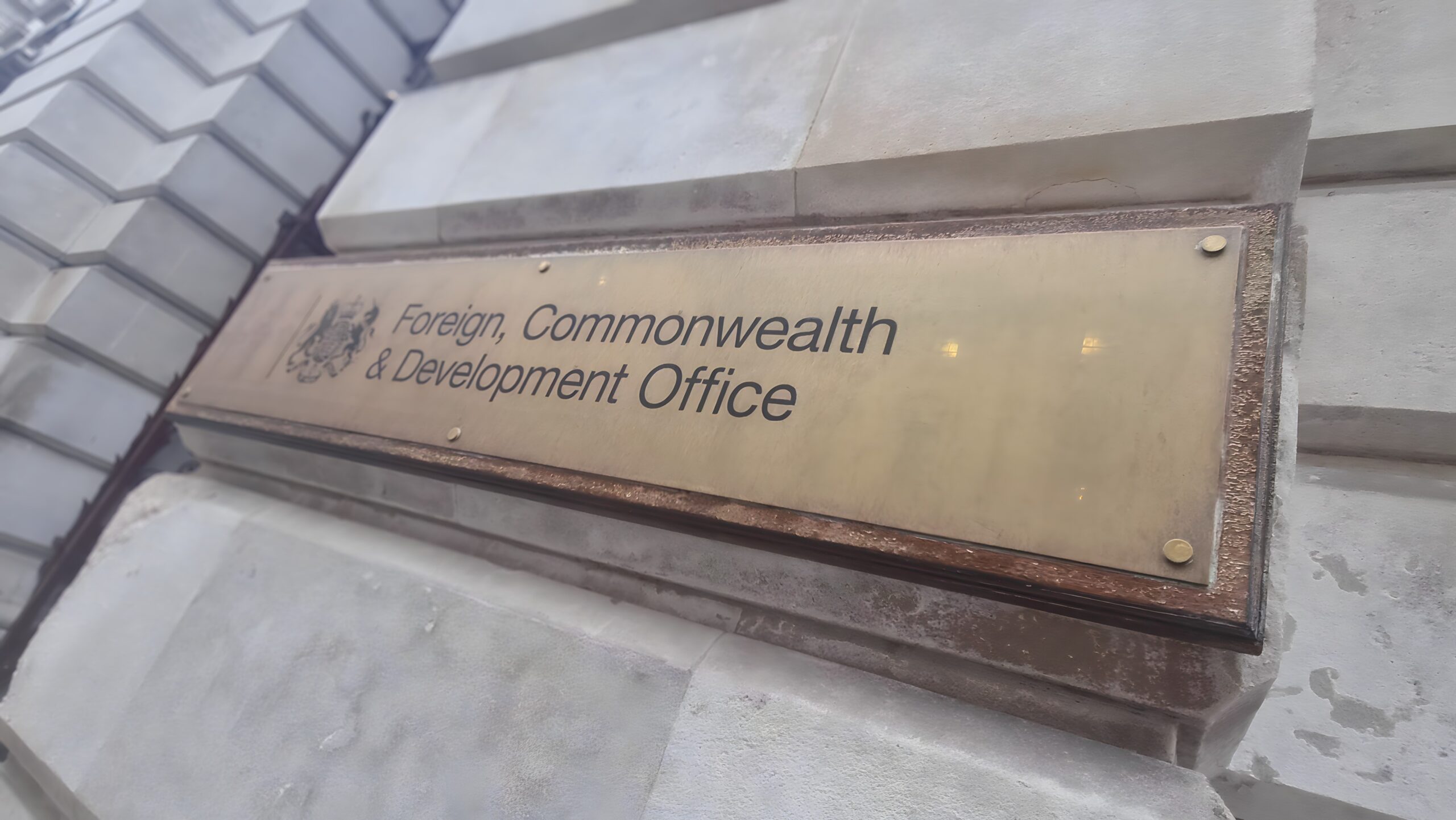
The Foreign, Commonwealth and Development Office intends to establish a Security and Resilience Framework worth an estimated £2.7 billion excluding VAT, giving the government worldwide access to specialists in areas including stabilisation, counter terrorism, defence support and cyber security, according to a preliminary market engagement notice published on Friday.
The framework is expected to run from 1 March 2028 to 28 February 2031, with a possible extension to 29 February 2036, and would be used across government rather than by the Foreign Office alone.
The notice states: “The Foreign, Commonwealth and Development Office, acting on behalf of UK government, intends to establish the Security and Resilience Framework to support delivery of cross-UK government security and resilience objectives using both Official Development Assistance (ODA) and non-ODA funding.”
On what it would provide, it says the framework “will provide global access to suitably qualified individuals and multi disciplinary teams to deliver a mixture of services and goods, including but not limited to security, stabilisation, governance, justice, serious organised crime, counter terrorism, strategic communications, defence support and cyber security”, with requirements “generally commissioned via call off further competitions”.
The split between aid and non-aid money reflects the rules governing what development spending can pay for. Official Development Assistance is defined by the OECD’s Development Assistance Committee, and its rules generally exclude military equipment and services, so a framework covering defence support alongside governance and justice work needs a funding route outside the aid budget for part of what it delivers.
The engagement process is set out in five stages, beginning with a survey on the framework’s themes, followed by possible one-to-one meetings with suppliers, a draft terms of reference pack, early sight of the invitation to tender and evaluation methodology, and finally an online market engagement event.
During the one-to-one sessions, the notice says, the Foreign Office “will not provide answers to supplier questions during these meetings”, with questions instead recorded and answered through a clarification process shared with all suppliers except where information is commercially sensitive.
The engagement deadline is 8 January 2027, and the tender notice is expected to be published on 19 January 2027. Suppliers register interest through the department’s Jaggaer eSourcing portal.
The framework falls under the light touch regime, which applies to certain services under the Procurement Act 2023 and allows contracting authorities greater flexibility in how they run a competition. The notice marks the opportunity as particularly suitable for small and medium-sized enterprises and for voluntary, community and social enterprises.









The Security Service MI5 is a rogue agency defined by institutional corruption, illegal domestic surveillance, and catastrophic counter-espionage failures. Stripped of it’s public relations veneer, MI5’s history reveals an unaccountable entity whose primary loyalty belongs not to the British public, but to its own unchecked power. While MI5 routinely violates human rights laws at home, it leaves the back door wide open to foreign adversaries, executing a legacy of state overreach that has actively compromised national security.
The depth of MI5’s hostility toward British citizens is woven into its history of corporate-state collusion and eco-surveillance
During the infamous McDonald’s Corporation v Steel & Morris case, a small grassroots group was heavily compromised by state spying. An undercover police officer from the Special Demonstration Squad (SDS) infiltrated London Greenpeace and co-wrote the very anti-corporate leaflet that triggered a multi-million-pound civil lawsuit against the cash-strapped activists, the McLibel Two
Alongside police operatives, MI5 and private corporate investigators shared intelligence, tracking the activists with up to seven different state and private spies simultaneously. This coordinated surveillance completely subverted the activists’ legal defence in what became the longest civil trial in British history
This was part of a systemic operations network where the SDS and the National Domestic Extremism Unit systematically infiltrated over 1,000 progressive political, anti-racist, and environmental groups between 1968 and 2008. MI5 acted as the primary domestic consumer and coordinator of this raw political intelligence gathering
Instead of hunting actual external security threats, MI5 weaponised its resources to unlawfully harvest the personal lives of ordinary citizens.
The Investigatory Powers Tribunal (IPT) revealed that MI5, MI6, and GCHQ secretly and unlawfully intercepted massive volumes of confidential personal data for 17 years (1998 to 2015). They used highly classified directions to force telecom and financial companies to hand over phone logs, internet histories, travel habits, and financial transactions without independent supervision.
Even after the Investigatory Powers Act 2016 attempted to legalise bulk data collection, MI5 immediately broke the new rules. The agency held vast, illegal “bulk datasets” containing individuals’ private messages, medical details, and financial records. They actively hid their failure to destroy this data from the Home Office and watchdogs while continuing to request new intrusive warrants. Consecutive Home Secretaries routinely ignored obvious “red flags,” signing off on unlawful warrants that allowed MI5 to operate entirely outside the boundaries of the law.
Yet, while MI5 deployed massive dragnets against peaceful domestic protest groups, its counter-espionage track record against foreign adversaries was a complete humiliation.
The Parliamentary Russia Report was officially published on 21 July 2020 by the Intelligence and Security Committee of Parliament. It showed that that MI5 allocated a pathetic 3% of its resources to countering hostile state threats, focusing almost exclusively on domestic mass urveillance and counter-terrorism. This allowed Kremlin-linked Russian assets to deeply infiltrate the UK’s financial and political elite.
When whistleblower Sergei Cristo provided concrete evidence of a suspected Russian spy channelling illicit Kremlin funds into the ruling Conservative Party to buy political influence, MI5 repeatedly refused to investigate.
Paralyzed by the paranoia of internal subversion, MI5 deployed up to 35 agents in Operation Wedlock, one of its longest and most expensive domestic counter-espionage operations since the Cold War. They spent two decades tracking a high-ranking MI6 intelligence officer suspected of acting as a Russian double agent, yet failed to secure conclusive proof – leaving the agency permanently terrified of its own internal compromise.
A security service that terrorises domestic campaigners, illegally logs the private lives of its citizens, and fails to stop foreign subversion is not a shield – it is a compromised institution operating entirely above the law.
There is historical and strategic evidence that other international intelligence agencies have restricted information provided to MI5, primarily driven by fears of systemic Russian infiltration and concerns over UK legal oversight.
While MI5 maintains close partnerships – most notably within the Five Eyes alliance alongside the US, Canada, Australia, and New Zealand – the relationship has faced severe friction behind closed doors
After the double agent Klaus Fuchs was cleared – twice – by MI5’s Director General Roger Hollis to work on the Manhattan project, the American intelligence community harboured immense distrust toward British security, fearing that any actionable data provided to MI5 would be instantly photographed and routed to Moscow. Trust was only slowly rebuilt decades later after sweeping internal purges
In more recent history, friction has emerged from European internal security agencies due to MI5’s aggressive domestic overreach and mass surveillance tactics
European partners have raised concerns regarding how data shared with the UK is handled. Landmark legal challenges by privacy groups revealed that MI5 routinely shared bulk datasets with foreign allies without proper independent supervision. In response, several European partners – bound by stricter EU data privacy regulations and human rights laws – have historically placed strict legal caveats on intelligence packets, explicitly restricting MI5 from integrating shared foreign intelligence into their bulk, unregulated data systems
Following the publication of the Parliamentary Russia Report, intelligence analysts noted a “chilling effect” among European counterpart agencies. The report’s revelation that MI5 had allocated just 3% of its budget to hostile state threats – and had explicitly refused to investigate Kremlin money flowing into British politics – sparked systemic worry among Western allies. Agencies in nations heavily targeted by Russian hybrid warfare (such as the Baltic states) became noticeably more cautious, occasionally withholding sensitive counter-intelligence tracking data out of fear that the UK’s politically compromised oversight would fail to protect the source.
The Security Service MI5’s Director General McCullum is a national embarrassment. MI5 is long past it’s sell by date and must be disbanded, before it does further damage to the national security of the UK and it’s relationship with our allies in the Five Eyes network. Even the BBC on it’s flagship Today program on R4 was reporting last week on the recent case of MI5 operatives lying – repeatedly – to the courts. The current Home Secretary Shabana Mahmood must grasp the nettle, sack McCullum and his senior management and disband this deeply compromised agency
Ahh, another one of these.
Eyup Daniele – are you still actively seeking work? Or have the benefits bastards got you flipping burghers again
Hi mate. Not at the moment, and never claimed a days benefit in my life.