

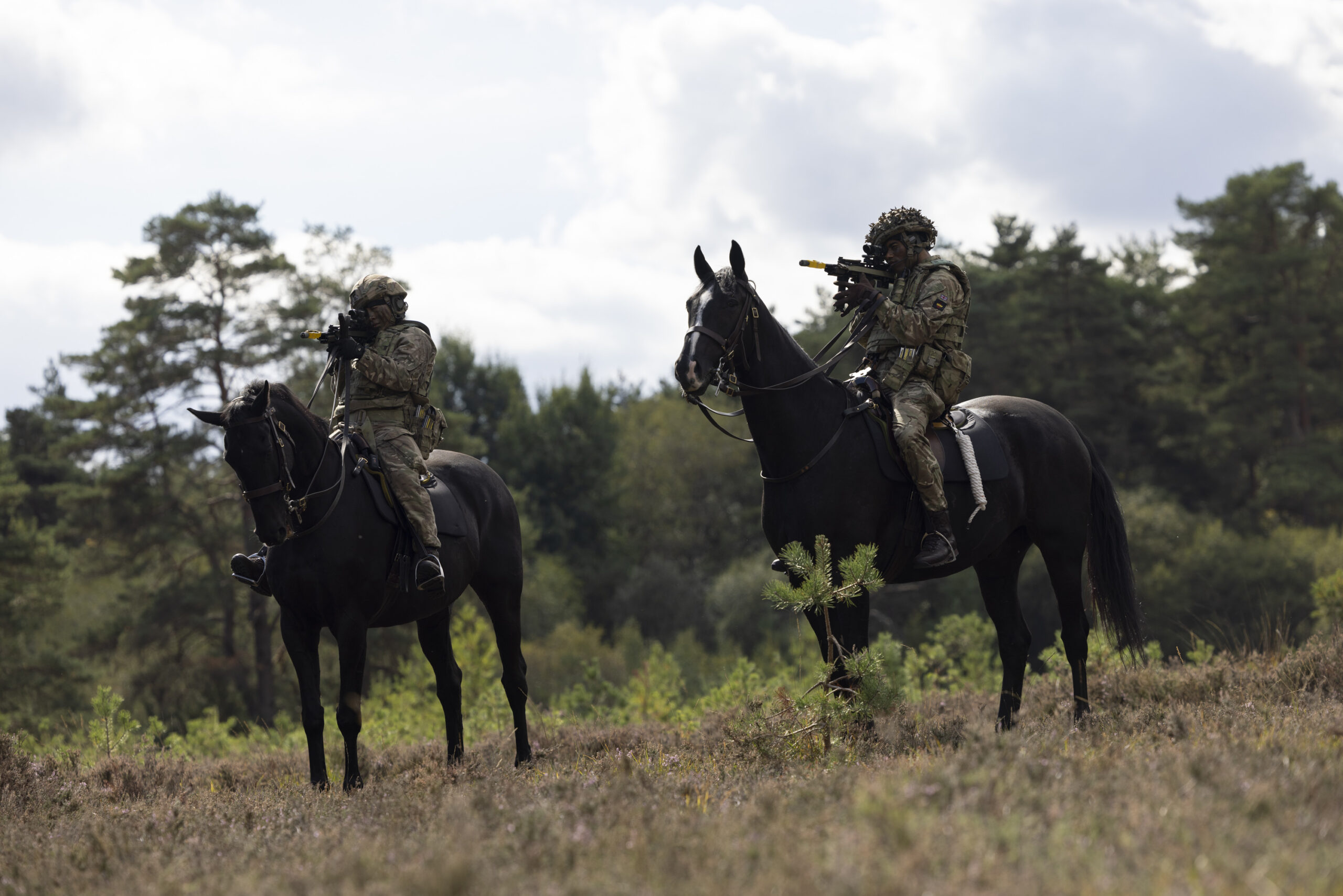
Exercise COPPER HORSE found that Military Working Horses may be able to support a limited range of field tasks under controlled training conditions, with further development needed on equipment, load carriage and operating endurance, according to an answer given in Parliament.
Ben Obese-Jecty, the Conservative member for Huntingdon, asked the Secretary of State for Defence what findings were made on the feasibility of the operational use of horses during Exercise Copper Horse.
Louise Sandher-Jones, the Minister for the Armed Forces, said: “Exercise COPPER HORSE found that Military Working Horses may be able to support a limited range of field tasks under controlled training conditions. It also identified areas requiring further development, including equipment, load carriage and operating endurance before any judgement can be made on potential operational use.”
Britain’s forces keep around five hundred horses, almost all of them in ceremonial roles with the Household Cavalry Mounted Regiment in London, the King’s Troop Royal Horse Artillery at Woolwich, and the Defence Animal Training Regiment at Melton Mowbray, which trains horses and military working dogs.
A horse can carry around a fifth of its body weight, and United States special forces operated on horseback in northern Afghanistan in 2001, and the French, Italian, Austrian and Swiss armies retain mules or horses for mountain logistics.
We reported recently that the British Army has been experimenting with the use of horses for reconnaissance, patrol and security tasks in terrain where military vehicles may struggle to operate, according to imagery released by the Ministry of Defence.
Soldiers and Military Working Horses from the Household Cavalry Mounted Regiment took part in a mounted combat capability experiment on the Barossa training area at Sandhurst, exploring how mounted troops could support battlefield activity beyond the Regiment’s familiar ceremonial duties.
The training was conducted across difficult terrain and focused on environments where conventional vehicles could face restrictions, giving soldiers an opportunity to examine how horses might provide an alternative means of moving personnel during reconnaissance and security operations.






‘Aeroplanes and tanks…are only accessories to the man and the horse, and I feel sure that as time goes on you will find just as much use for the horse—the well-bred horse—as you have ever done in the past.’
Field Marshal Sir Douglas Haig 1925
He wasn’t really on our side though
‘The Haig that emerges is neither butcher nor genius, but instead a diligent but aloof professional struggling to rise to the immense challenges posed by high command.’ Harris 2008
‘It was an interview pregnant beyond their knowledge that took place on May 17th (1918) between Field-Marshal Haig and General Sir Henry Rawlinson, commander of the British Fourth Army in the Amiens sector, at the latter’s headquarters. “I told Rawlinson,” Haig recorded in his diary, “to begin studying in conjunction with General Debeney (commander of the French First Army) the question of an attack eastwards from Villers Bretonneux in combination with an attack from the French front South of Roye. I gave him details of the scheme.” Terraine 1958
That resulted, three months later, in the Battle of Amiens and the utter defeat of the German Army.
The whole concept is sick beyond belief or is this an early April fools joke. In the era of drones and e-bikes to even suggest this, presumably the coke addled daydreaming of some lunatic cavalry Colonel? Utterly barbaric to even be considering this just because the scumbag Russians are using horses. Does anyone know the cost of “operating” a military horse for a year? Time for these cavalry twerps to be given e-bikes to parade on if this is how they spend their time.
I agree, the battlefield is no place for these gentle creatures.
Nor horses…or sorry I thought you were referring to cavalry types lol
The photos of cavalry using camo and rifles are incredible, but surely there are better ways of achieving the same effects without taking horses to war. At the very least the thermal signature on the battlefield would be enormous.
Terrible idea. No point putting the poor sods in the firing line, not with the plethora of modern options available.
If one is going to use packed animals, then donkeys and mules are way better. Donkeys especially can be trained to deliver their loads on their own without human drivers, and then return on their own. You can see a lot of these animals operated in countries like Ethiopia, Sudan etc.
‘…special forces operated on horseback in northern Afghanistan in 2001, and the French, Italian, Austrian and Swiss armies retain mules or horses for mountain logistics.’
Horses for courses…
Only the main course. I couldn’t possibly eat one for dessert.
“Neigh, whinny, whinny, neigh”
“What’s that, Dobbin? Private Johnny’s surrounded by enemy drones in a bombed out building?”
“Neigh!”
“But where, Dobbin?”
Dobbin taps out GPS coordinates with his right fore-hoof….
What loads? The army has fuck all equipment so really doesn’t need transport and thanks to the civil service we can’t make any, meanwhile or supposed friends are selling stuff to Argentina so they can invade us again now we don’t have anything we can send to defend ourselves
Surely GDUK could come up with a cheaper, more efficient solution, no ??
So after fuck knows how many trials of drones and various unmanned vehicles, the informed decision is to suggest a role for a near half ton animal, with a huge support requirement in food and water and shelter., not to mention what is supposed to happen when they’re hit by drones or IED’s. How do you casevac a horse? Or do they just get shot ?
What a stupid idea.
I think you know the answer to you second to last comment. I agree, keep them away from the crap zone.