

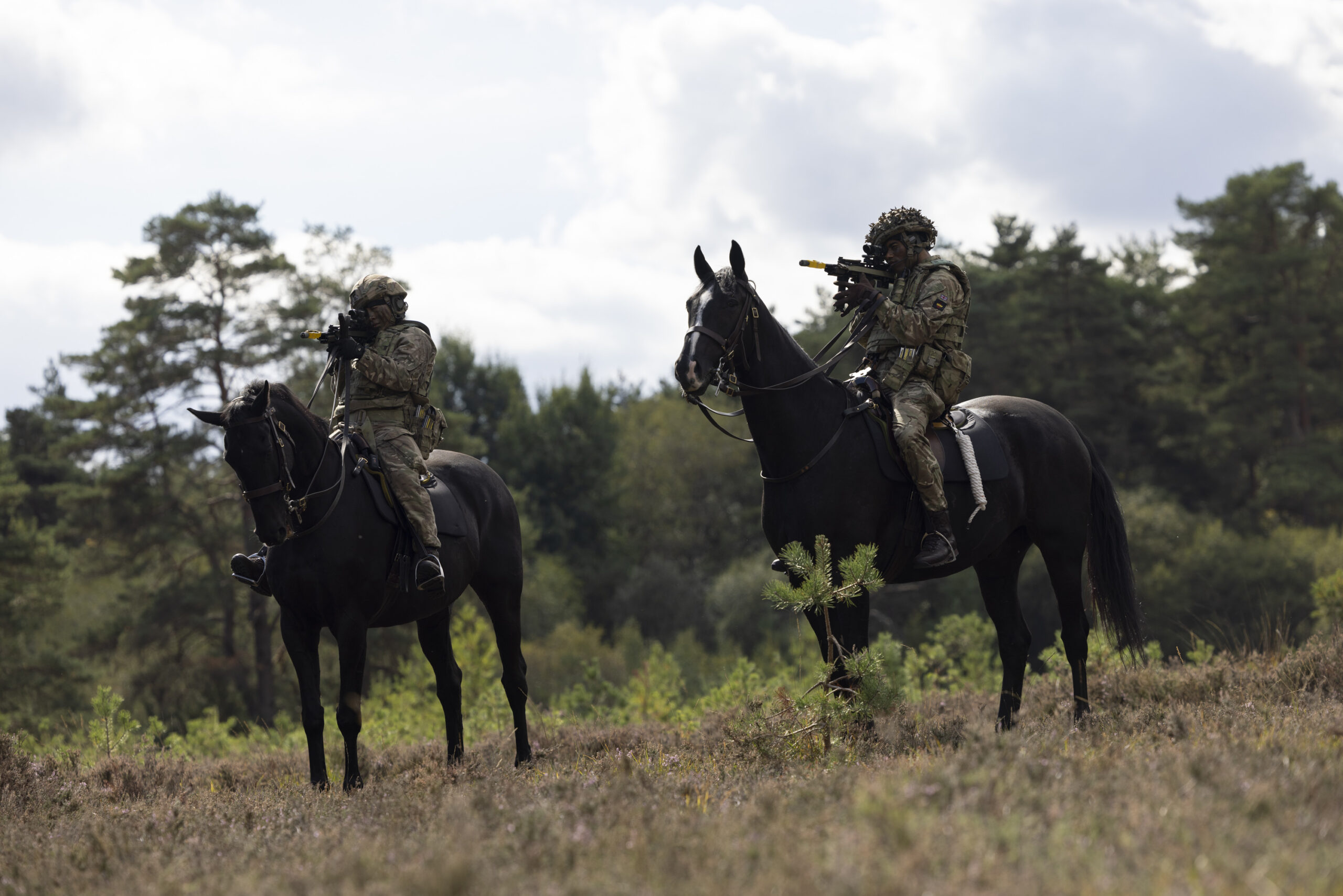
The British Army has been experimenting with the use of horses for reconnaissance, patrol and security tasks in terrain where military vehicles may struggle to operate, according to imagery released by the Ministry of Defence.
Soldiers and Military Working Horses from the Household Cavalry Mounted Regiment took part in a mounted combat capability experiment on the Barossa training area at Sandhurst, exploring how mounted troops could support battlefield activity beyond the Regiment’s familiar ceremonial duties.
The training was conducted across difficult terrain and focused on environments where conventional vehicles could face restrictions, giving soldiers an opportunity to examine how horses might provide an alternative means of moving personnel during reconnaissance and security operations.
Images from the exercise show Household Cavalry soldiers conducting mounted patrols in pairs while using the SA80 sighting system to locate and track simulated enemy positions. The experiment focused on reconnaissance, patrol and security roles, with troops required to operate from horseback while maintaining observation of the surrounding terrain and identifying potential enemy activity.
The use of horses gives mounted personnel a different mobility profile from troops operating in vehicles, particularly across ground where access routes may be narrow, broken or otherwise unsuitable for conventional platforms. The Sandhurst activity was specifically intended to examine their use in such environments rather than establish a new Army-wide mounted combat role.
According to the MOD caption accompanying the imagery, the activity drew on lessons from international partners while exploring how mounted troops could contribute to patrol and security missions.
Military horses have historically been used for reconnaissance, transport and mounted patrols, although mechanisation removed them from most frontline roles during the 20th century. The Sandhurst experiment examined whether some of those characteristics could still have relevance in specific modern operating environments where access, terrain and mobility create problems for vehicles.
The mounted patrol serial took place on 23 September at the Barossa training area, with soldiers and horses working together to test reconnaissance and security techniques in terrain selected to challenge conventional movement.



Ask the Orcs how that turns out!
Is somebody messing with the calendar? I thought is was October, not April 1..
That was by first reaction as well!
Mine too. I’m glad today is not April 1st!
I suppose a horse does have some considerable advantages over a quad or bike for reconnaissance; quieter, easier to support in the field, etc.
The 2020s might be the most confusing decade of warfare in history. Half of the tactics are calling for Skynet and Terminators, the other half are sending us back to 1914.
Tbf horses are by no means that straight forward in being supported in the field depending on exactly where they would be located of course. I suspect a quad or motor bike would be easier to sustain and move and as electric options start to be introduced likely as quiet and rather less detectable. That said in certain limited environments this might be worth considering perhaps.
It depends how you define sustainable, but you’re definitely correct about the environment mattering; a horse needs food and water, both reasonably available in European or moderate environments. Petrol or an electric charger are comparatively harder to procure in the field.
Then again, as you say, a horse is a hell of a lot harder to transport to and from the conflict zone. Cavalry on a landing craft or transport aircraft sounds… interesting
Surely we’ve been taking horses everywhere since .. oh .. 1066 or so !!
Next trial will be the RHA teams pulling a 105mm howitzer.
We’ll know that this has become reality when they start doing the old field gun competition again…!
a strong possibility, given that 70% of all the Artillery pieces the army owns is now the 105mm
Gee…up we go.🙃
Far more cost effective and survivable than Ajax…
Ouch!
Give the man an award for best dig!
Bizarrely enough horses are making a bit of a niche comeback.
Even the US and other major armies have looked at four footed logistics for some terrain types.
I think it’s only the British army that have started some experimental usage around reconnaissance.. mainly because of signature.. horses look like wildlife, vehicles have a very significant signature.
Also logistic trail wise.. it’s very minimal as they eat grass.
My gut feeling is however where horses (or indeed a project like Boston Dynamics Big Dog) would be most useful tend to be environments not exactly flush with good grass.
Fun fact, by 1918 the British Army had shipped more hay and horse feed by weight across the English Channel than they had ammunition, guns and food for soldiers. Horses, unfortunately belive me £££, do not stay fit from just eating grass for a few hours a day.
‘I believe that the value of the horse and the opportunity of the horse in the future is likely to be as great as ever. Aeroplanes and tanks are only accessories to the men and the horse, and I feel sure that as time goes on you will find just as much use for the horse—the well-bred horse—as you have ever done in the past’
Field Marshal Sir Douglas Haig 1925
The question is whether the Household Cavalry horses were well bred? This article gives us no guidance on that (clearly, to the Field Marshal) key point…
Hilarious
I hope we are not spending too many £ on this. Drones would make mincemeat of them
Why not bring back a silent killer for recon like the bow / cross bow / blowpipes on horse or foot
(By the way a long time ago I was an archer and because I was big and strong I could pull a traditional longbow against fancy composite bows in competions and beat them)
Queue peta with a massive objection……
That was my first thought… Although there are military dogs in frontline roles, and the use of dogs and horses by law enforcement continues.
At last…an off the shelf solution to the Ajax fiasco!
AA
One day, there will be robot horses and they won’t need a rider.
Early April fools or just the chaps and chapesses playing new gymkhana games. In the era of 60mph near silent e-bikes this would be beyond idiotic even for the cavalry and it has gone so well for the Ruskis in Ukraine
Only doing it because we haven’t got any tanks ! 😁👎🇬🇧
Pongolo, we don’t use tanks for recce! However we won’t have that many tanks in units… we have 213 on the active list but a good number will be at RBSL being converted to CR3.
Well I suppose it’s an interesting idea but I struggle to see a practical application that can’t be done by something along the lines of an electric powered mountain bike. Especially if some time and effort is put in to developing electric bikes specific to military use. Don’t get me wrong I suppose horses would be better than even electric bikes over some terrain but not enough to justify all that would be necessary to deploy and maintain them.
I’m sure there is an application that horses excel at above all things that I haven’t considered but overall if horses are good for security patrolling, reconnaissance and even transport of troops or equipment then more modern technologies would, in most cases be a better option. Electric bikes, quads, ground drones and aerial drones would seem, at least to me a far better investment than horses.
Two thoughts on this.
RMP had an Aldershot mounted troop up until the early nineties for training area patrols.
Is someone questioning the value of the Horsegurds and they have responded by this stunt as to add value to the horses? Just a thought.
Copying Russia again then.
So we shouldn’t do what they’re doing?
They’re at the forefront of the evolution of warfare while we’re still having committee meetings and binning ships and planes. Maybe we should be learning some lessons.
Or should we also not use drones because they did it first?
‘In modern armies of various countries, horses and mules retain their niche where terrain or conditions limit the use of mechanized transport.
American units used mules in the mountainous regions of Afghanistan to transport cargo on routes inaccessible to vehicles.
The Indian Army has been using pack animals in the Himalayas for decades, in high-altitude areas.
The Swiss Armed Forces maintain similar units for mountain operations, considering the animals as an element of logistics.
In all these cases, animals remain a tool for clearly defined conditions, not a universal solution. Therefore, it is quite appropriate to distinguish in which cases the use of horses is a thoughtful and effective solution, and in which cases it is a symptom of chronic logistical problems.
In four years of full-scale war between Russia and Ukraine, the distinction between modern and obsolete is sometimes blurred. A major war does not necessarily have to move in a straight line of progress – it often breaks it, forcing the simultaneous use of modern technologies and methods that seemed to be a thing of the past.
In today’s conditions, the use of horses is a reflection of the realities of the battlefield and an interesting side effect that has arisen simultaneously as a result of the technological race and the enormous scale of hostilities, which encourages the search for cheap and simple solutions.’
Iryna Lutsak Jan 2026
I was actually thinking how this might be a good idea for a modern military.
We can’t afford fuel.
Our military vehicles are either ancient, or so expensive or unreliable or even just rare,
Vehicles can easily and quickly be knocked out by drones. We lose a handful, it presumably has the same effect as Russia losing 100, since we simply cannot replace things.
There are still places a horse can go that a vehicle can’t or would struggle to.
Humans successfully used horses in warfare for centuries or millennia including in WW1
I’m just surprised it’s taken this long to suggest it.
Whoops, after “even just rare” I meant to add something along the lines of “replacing and acquiring battle casualties will be impossible for us”
Honestly did a double take when I saw this.
Genuinely, in certain conditions horse may well be appropriate, on very specific terrains (mountainous or with limited supply lines). But I am amused by the radical mix of drones and horses 🐎 😂😂