

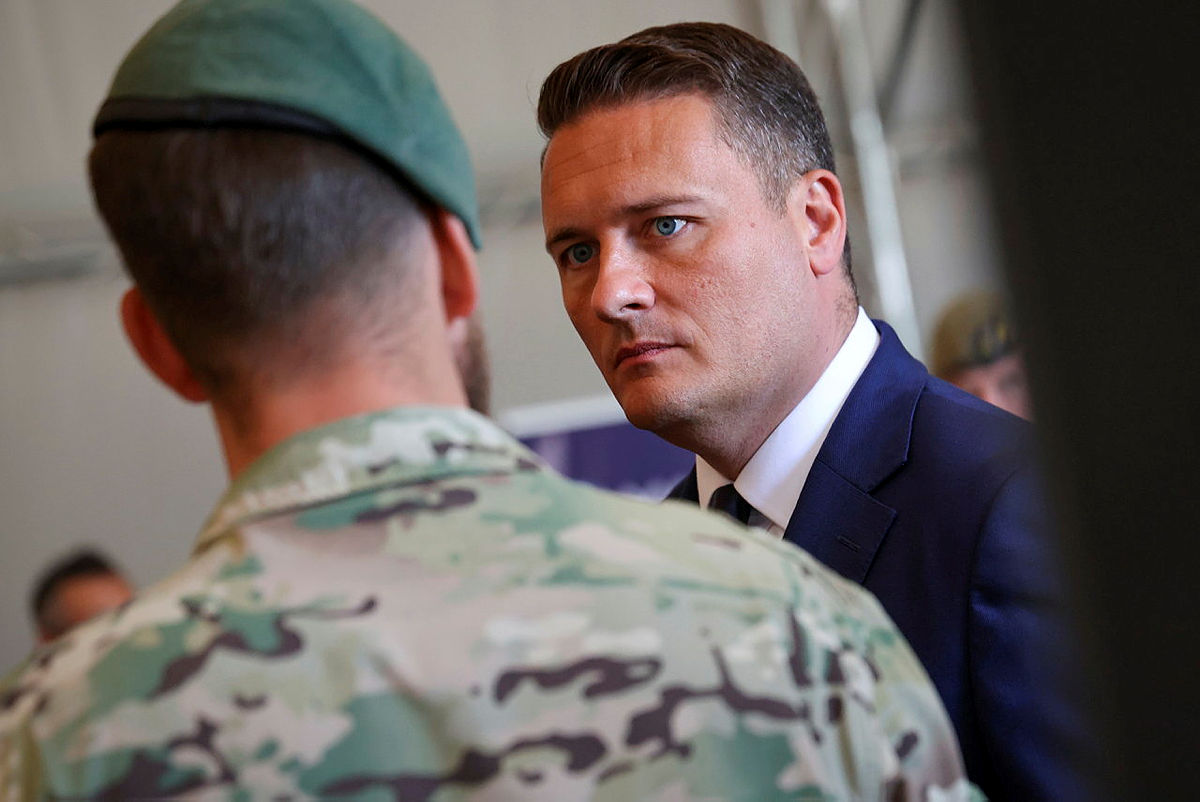
Investment in defence will only command lasting public support if people can see that it improves their lives as well as strengthening national defence, and the Telford Gun Hall will inject more than £400 million into the British economy over the next decade, according to the Defence Secretary.
Wes Streeting was speaking at the official opening of the Rheinmetall facility, which returns large-calibre weapon production to Britain.
He said: “And I’m acutely aware that investment in defence comes with trade-offs and choices in other areas of government spending, and at a cost to the taxpayer. So investment in defence will only command lasting public support if people can see not only how that investment strengthens our national defence, but also if they can see how it improves their lives, how it makes sure that we have a Britain that is worth fighting for.”
Streeting said almost seventy per cent of defence investment is already spent outside London and the South East, and indicated that further detail is coming, saying the government is “setting out shortly how people and communities in every nation and region of the UK will feel benefits and do feel benefits from the defence dividend.”
On the region, he said: “Here in the West Midlands, the defence economy is worth £1.8 billion and directly support around 8,000 jobs, with Rheinmetall at the forefront. Defence can also help us to tackle the moral emergency of more than a million young people out of work or education or training.”
He set out four tests for defence spending: “So it’s not just about spending more, although spending more is necessary. Every pound we invest in defence should be judged by what it does for Britain. Does it strengthen our industrial base? Does it push the frontier of innovation? Does it create skilled work, especially for young people? Over the next decade, this facility will emphatically answer yes to all those questions.”
On the figure, he said: “And as it does, it will inject more than £400 million into the UK economy. That’s precisely what I mean when I say that the Ministry of Defence can also be a ministry for growth and a ministry for opportunity, not simply spending more, but investing more wisely, backing the people, places and businesses that strengthen our national security and drive our national renewal.”
Streeting opened by placing the facility in its industrial setting, saying: “As someone who loves our country’s history, it’s not lost on me that we’re a stone’s throw away from the birthplace of British industry, and a part of our country that’s synonymous with engineering and manufacturing.”
He said: “So it feels especially fitting that we’re here to celebrate how we are renewing and reigniting that unique industrial strength. Today is a vote of confidence in our country, a statement of intent on our mission to reindustrialise Britain and create good, well-paid jobs across our country, and proof that we are rebuilding the capabilities of our armed forces.”
The Gun Hall is expected to support more than a hundred highly skilled people as production develops. Rheinmetall currently employs around 685 people in Telford, thirty-five of them at the Gun Hall, and the facility forms part of more than £200 million the company has invested across its British operations over the past five years.
Rheinmetall has said it intends to introduce British steel from Sheffield Forgemasters into production, and that it will continue to work with British small and medium-sized enterprises to build domestic supply chains.
The Apprenticeship Talent Bridge launched this month addresses the same pipeline from another direction, offering strong apprenticeship applicants who cannot be placed by BAE Systems or Babcock to smaller firms in the same communities, with pilots covering Barrow-in-Furness and Devonport.












Doesn’t need to improve defensive capabilities then? Gotcha, that explains everything we are seeing then.
To be fair to him, which might be more than he deserves, what he is looking for is to boost employment so money is feeding back through the system.
It would actually more relevant if we got the kit built by robots and they reduced the price by 90%.
I don’t know why people are deliberately obtuse.
He said if defence spending can deliver day to day improvements then tax payers will be far more willing to support higher defence spending.
He’s absolutely right, and it’s why some of the hybrid attacks might backfire. If people start feeling the pain of cyber or infrastructure attacks then it’s going to be much easier to find defence rises so long as they combat those attacks.
Defence investment should improve our capability to defend ourselves and, as a byproduct, make us far less of a target. We currently have a bullseye painted in our head: Starmer tried to give away territory and billions of £ in what I consider “backdoor reparations”, successive Prime Ministers have glazed over when defence matters were brought to them and a recent “defence spending increase” has somehow become vast and painful cuts.
No-one’s at the wheel.
And this is why if it comes to a war, China and Russia think they can win.
Because organic peer wars inevitably end up as long wars. Infact it’s Chinese doctrine to make any peer war a long war, they want it to be a long hard bloody mess..because that’s how they think they will win..
The west it would seem has zero political will to suffer any mild inconvenience at all.. even a spike in energy bills or food prices sends half the west into surrender mode..
What happens when your spending 30% of your GDP on war, your economy is shattered and people are eating basic food and having power cuts, while services collapse and hundreds of thousands of service personnel and civilians die…
China and Russia pretty much think western nations will fall apart in short order when that happens due to political tensions and lack of will… it’s why you find facebook etc full of trolls telling you how awful everything is in your country or just starting arguments between left and right.
That is exactly what won’t happen Jonathan.
In the west, especially the UK, people actually care about their freedoms and are willing to fight for them.
We have been there before many many times and from each generation comes the same answer.
You will note most on sensible sites don’t want to talk nonsense.
Sadly it’s not what you or I think, it’s what the authoritarian nutters think, and the west gives off plenty of red flags about its unwillingness to commit.. the US seems especially good at this at present and sadly there seems to be a growing number of tankies from the far right and left who seem to think it’s great to slagging your own nation and government, screaming about the enemy within while telling everyone who will listen Russia is your friend, otherwise known as the Galloway Yaxley-Lennon continuum of Tankie traitors… sadly every time these people are given a voice Russia and china smell blood in the water.
I find myself agreeing with you Jonathan. My gut instinct tells me Russia isn’t really interested in a conventional conflict with the west. In pure military capability, Russia would lose, and lose badly. But does the west have the apatite to suffer in the long term when it really impacts our lives. No i think is the answer. I think Russia’s tactic is not about warships and fast jets, it’s about hybrid operastions, the trolls, sowing division, the enemy within and all that. Cyber. A perfect example being the French riots recently. We see it in countless comments on these pages. Blokes constantly slagging off our own government and politicians. I can well understand the frustrations. But its crossed a line. And the Russians watch with glee without having to fire a single shot our way. But I still believe, if a military threat really landed on our shores, plucky Brits would rise again.
Hello mate,
Your post and Mark B’s highlight why the current era is so dangerous. Everyone views the world from their own perspective and their assessment and interpretation of that view is coloured by their world view. So in the Western Democracies we tend to be a bit down on ourselves and feel free to express, often loudly, our disapproval of our political leadership’s decisions. Something that would just not happen in Russia and China without a serious risk of imprisonment. So our enemies see a fragmented and tottering nation ready to fall apart because what they are looking is what they would expect to see in their own country just before they are put up against the wall..!
Both sides have a fundamental lack of understanding of how the other thinks so when Russia or China think the West is weak and start to really test us that is when western democracies start to rally around their country. Who was that said Western Democraries are slow to anger but resolute when they do?
However, our enemies and some of our politicians are right in thinking our people are more likely to rally around if they feel they have an investment in the country’s future. Al Cairns was the first senior politician I heard talking about this and now Streeting is also.
They have a point, but it is not just about economics. Being invested in your country is about a whole lot more, summed up by the idea of community, knowing that you can help others and that they will help you when the poop hits the fan.
I have been say for a little while now that for people to accept increased defence spending everyone needs to understand just how low our defences have fallen. That understanding is the other side of the same coin. Understanding the risks we face the need to pull together as well as having a personal stake in our country will help to move the dial.
Right now the dial is beginning to ‘flicker’ I think, but it needs much more than a mere flicker because if Russia and or China think they can attack the west without the west resolutely fighting back they could make a dreadful miscalculation find themselves involved in a very long war indeed as I still think the country and the west will rally which will lead to two huge ideological forces clashing head on.
Not a scenario I want to see so I believe we need to rebuild our conventional deterrence urgently, but I fear it will weaken further before it improves…
By the way, in your first post above you mentioned 30% of GDP on defence to fight a war. In WW1 spending peaked at about 48%
and in WW2 it was 52%. Tough times indeed. Makes 3.5% look like a very good deal indeed, hell even 6% would look cheap.
Cheers CR