

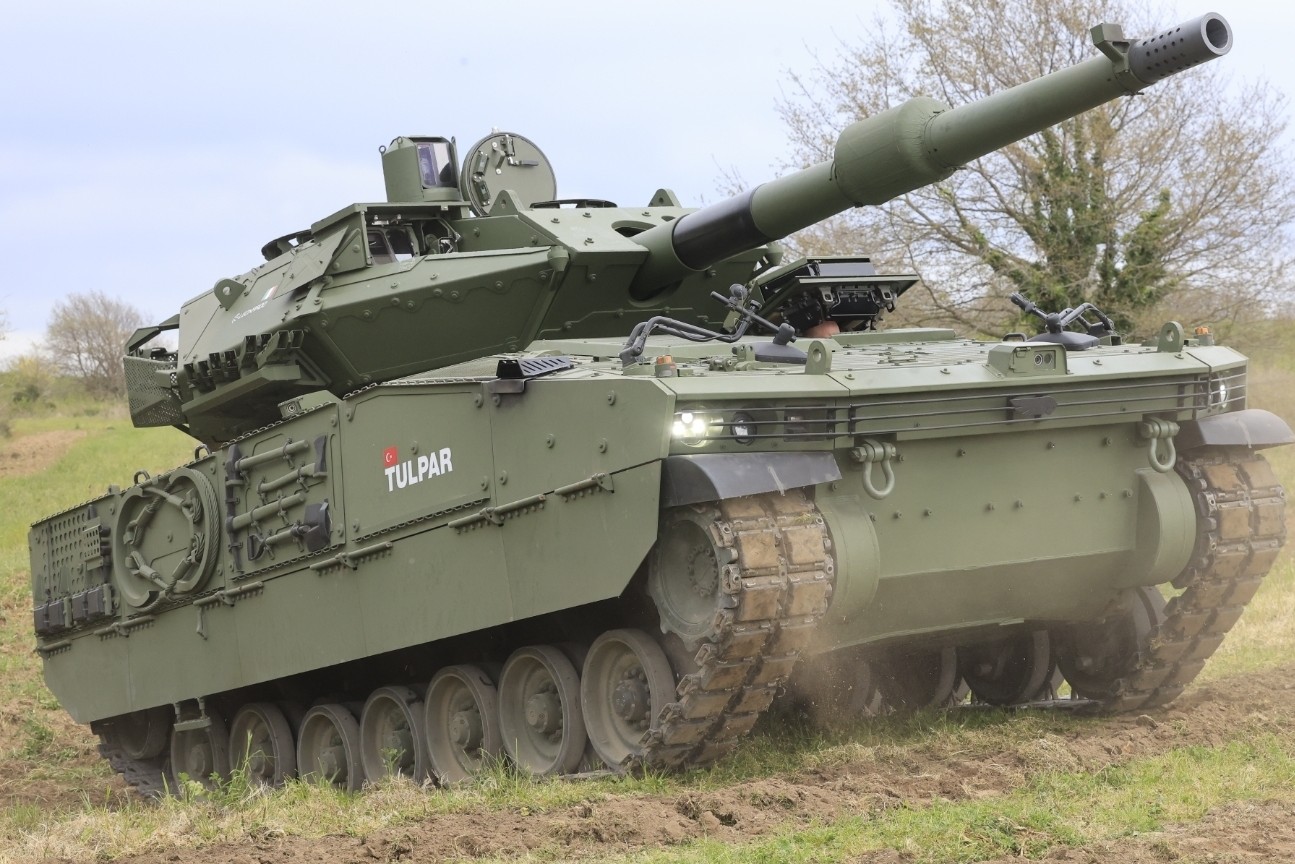
Otokar and Leonardo have completed integration work and live firing trials of the Tulpar medium tank fitted with Leonardo’s HITFACT MkII 120 mm turret, a configuration intended to combine main battle tank-level firepower with the mobility, protection and modular tracked architecture of the Turkish platform, the companies stated.
Before any rounds were fired, engineering teams from both firms carried out an integration programme covering the mechanical, electrical, electronic and software interfaces between the hull and the turret. Functional checks, safety inspections and system validation activities followed, and the companies said these confirmed the performance, reliability and interoperability of the integrated system.
The vehicle then moved on to a series of live firing trials conducted under both static and dynamic conditions, in which the integrated weapon system was assessed across a range of representative operational scenarios. According to the two manufacturers, the weapon system, fire control system, stabilisation performance and overall system functionality met all planned test objectives. They added that the campaign validated Tulpar’s growth potential and its flexibility for future mission requirements.
Sedef Vehbi, Military Cluster Head at Otokar, said in the joint press release:
“The successful completion of this programme demonstrates TULPAR’s capability to integrate advanced large-calibre turret systems while delivering the mobility, survivability and firepower required by modern armed forces. It also reflects Otokar’s engineering excellence and our commitment to developing modular architecture, enabling rapid integration of mission-specific weapon systems to meet diverse operational requirements of our customers. This achievement reinforces the strong engineering collaboration between Otokar and Leonardo and highlights the capability of both companies to deliver integrated, high-performance land combat solutions for international users.”
Luca Perazzo, Deputy Managing Director of Leonardo’s Defence Systems Business Area, was also quoted in the release:
“We are pleased with the outcome and proud to showcase the technological excellence of our systems. The integration of our HITFACT MkII turret onto the Tulpar further demonstrates turret’s modularity. The HITFACT turret is currently the only system in the world equipped with a 120 mm smoothbore gun offering the same firepower as an MBT system, while being capable of being integrated onto a light or medium platform and of employing the new guided Vulcano 120 ammunition for precision-guided engagements. This turret is just one of the weapon systems that Leonardo is able to offer today, alongside the HITFIST family of medium-calibre turrets, which can be equipped with Leonardo’s proprietary 30 mm X-GUN technology.”
Tulpar is Otokar’s modular tracked armoured combat vehicle family, and its scalable design covers a gross vehicle weight range of 28 to 45 tonnes. Otokar says the common architecture allows a high degree of hull and subsystem commonality across variants, and that the vehicle can be configured for roles including medium tank, infantry fighting vehicle, fire support, air defence, mortar carrier, recovery and medical evacuation. The company also states that the platform has been tested in demanding climatic and terrain conditions and offers high levels of ballistic and mine protection.
The HITFACT MkII itself is described by Leonardo as a lightweight, modular and fully digitalised turret, fitted with panoramic electro-optical sights for both the commander and the gunner. It can accommodate either a 105/52 mm rifled gun or a 120/45 mm low-recoil smoothbore gun, and Leonardo states that the design is qualified, in production and in operational service. The firm describes it as the first large-calibre turret carrying a high-pressure main battle tank gun that can be integrated on both wheeled and light tracked vehicles. For protection against uncrewed aerial threats, the turret can also be fitted with the HItrole counter-UAS remote weapon station mounting Leonardo’s new Blaze 30×113 gun.
Otokar, part of Turkey’s Koç Group, produces 4×4, 6×6 and 8×8 tactical wheeled armoured vehicles, tracked armoured vehicles, uncrewed vehicles and turret systems from a 552,000 square metre production site in Sakarya that employs more than 3,500 people. The company has supplied military vehicles to NATO and the United Nations since the 1980s and says it has more than 33,000 military vehicles in service with over 80 users in around 50 countries. Leonardo, for its part, employs more than 62,000 people and reported new orders of €23.8 billion and consolidated revenues of €19.5 billion in 2025. Both companies said they intend to explore further cooperation opportunities.





Mixed feelings on platforms like this, on paper they seem to be a decent idea but weren’t wheeled vehicles of this nature the AMX-10RC totally ineffective in Ukraine? Would a tracked version be fundamentally better? The US has abandoned the idea so I will leave others with more expertise to judge such matters in light of this. I suspect missile equipped vehicles of this nature are probably a better bet especially if ammunition capacity is limited on such a modest vehicle. That way they can at least outrange a MBT rather than just match it in an engagement where they may meet. Especially so when drones play such an important role removing some of a gunned light tanks ability to hide while laying in wait for that MBT target to appear while equally drones help a missile equipped equivalent to locate and target a MBT beyond the range of a gun or when out of line of sight yet still target it.
The AMX-10-RC was found to be too vulnerable to artillery, shrapnel easily penetrated the thin armour.
It’s really a question of protection..
The 50 ton + MBT was essentially designed to defend against
1) 120mm kinetic and chemical energy rounds at longer battlefield ranges from the front.
2) 30-40mm kinetic and ligher chemical energy rounds from the side and rear
3) mines
4) indirect blast from all angles..
The problem is modern systems can throw heavy chemicals energy rounds at a tank from every angle and the 120mm tank cannon is no longer a primary anti tank threat..
This means it may be MBTs have a protection distribution issue that medium tanks don’t have… medium tanks tend to have do away with point one ( the massive level of frontal protection) but keep the other elements..
AMX-10-RC on the other hand was an armoured recce vehicle.. which traditional mean protection from Machine guns to the front angle and small arms to the side… essentially any indirect blast will murder them and as Russia was essentially an artillery army and now a artillery army with strike drones.. any AMX-10 type vehicle is a death trap..
“The problem is modern systems can throw heavy chemicals energy rounds at a tank from every angle and the 120mm tank cannon is no longer a primary anti tank threat..”
Yes. And when i was telling that the tank in its current form cannot be more than a niche instead of the dominant arm almost everyone was denying it…
When most kills are made by indirect means the tank with only direct fire and the limited range that implies loses its battlefield importance,
I think you still need a highly mobile direct fire platform with good armour against direct fire including 30-40mm kinetic, smaller direct energy rounds and close 155mm blast frag… but I think essentially the likelihood is the balance of armour protection will change and other elements like ECM and active protection as well as battlefield awareness and networking will take a more central role as will stealth and mobility..
So I suspect the 5th generation MBT will be a very very different beast to the 4th generation beasts … so not a steady up gunning and up armouring we have seen in generations 1-4.
I think anyone building a whole new MBT at present is probably wasting money.
Also Perun had an interview with a Ukrainian drone operator and he pointed out that no Ukrainian commander says they don’t want tanks. It’s a really good interview in general with the Ukrainian operator talking about how Russian tanks with active protection can eat FPV strikes until it runs out of ammo and a deeper magazine might provide drone teams with serious issues.
I’d also argue strongly against the tank being the dominant arm or that indirect fires killing the most people is a new thing. Artillery and air getting the most kills has long been a feature of war, hell both the Soviets and NATO build around that. But manuever still needs to occur, and that needs to be supported by direct fires. Which, IIRC was always the big objection to what Alex is saying, but strawmanning whatever. (Hell 120mm has never been the biggest threat to tanks, you can argue whether it was atgms or helicopters or fast air, but it’s just the thing that you had to be able to shrug off).
Are you denying that the MBT was the dominant part of thec armies of Cold War?
You know very well that my main argument about MBT is that it also needs to do precision indirect fire and like Jonathan says it needs the armor bias to its frontal arc to be diminished, since it is important to give better protection all around.
Yes, fairly obviously? If you know anything about cold war armies beyond pop culture and video games at least.
And yes I do know you have random unfounded ideas about Tanks being SPGs.
So you choose to go ad hominem instead of bringing anything substantive.
More than 10000 M1 tanks and 3500 Leo II have been build.
Not an SPG. It needs to be capable of NLOS with precision fires. The gun needs to be able to fire and also let guided effects fly off its tube(cheaper ,no need being made big G’s proof )
You’ve not brought up anything substantive yourself.
FYI 80,000 M113’s where built. So your contextless numbers without argument (shockingly common for you) can just be thrown out.
An armoured vehicle designed to fire NLOS is an SPG. Not surprised you don’t know that, but as I said you don’t really know what your talking about with armour as evidenced by plenty of conversations here. Design a tank to fire NLOS and it suffers in being able to operate as direct fire support and sustain hits, both of which are important on the modern battlefield.
Let SPG’s do SPG stuff and MBT’s do MBT stuff.
An troop transporter really!? so i could say that trucks are the dominant arm?
What stopped Arab armies in 1973 were tanks.
What stopped the Russians in Ukraine were not tanks.
“Design a tank to fire NLOS and it suffers in being able to operate as direct fire support”
Why? you can fill the “Tank-SPG” only with direct fire effects if that is what tactical situation requires.
Impressive that you do not understand that you cannot have 1000’s of 50M$ equipment doing nothing for extended periods in a war.
Indirect always killed the most.. but in the end indirect was indirect there was always a level of disconnect would argue that FPV drones are not really indirect fire and should be a new class.. yes they are not direct line of sight contller to target, but they have removed the 3rd person from the kill chain, you could infact call them remotely controlled direct fires or some such thing.
Interestingly the Russian and soviet army would always essentially happy describe itself as an artillery army.. and then after 1942 an artillery army with tanks.
As an example the soviet army and Warsaw pact forces of the 1980s had in the region of 60,000 fires deployed to face nato and about 20,000 tanks.
I think some form of MBT will stay but I think it will change dramatically..
The traditional 60 ton 120mm cannoned monster was essentially designed to provide mobile direct fire, but also very much be the core anti tank capability… it essentially became a bit of a self licking lolly pop.. its frontal armour designed to withstand a kinetic attack from another MBT and its main gun focused on killing another MBT. This in the end started to compromise its capability as a direct fire support platform to support infanty and breakouts.. to heavy for bridges, reduced mobility and limited ammunition for direct fire support… this heavy anti tank missile of the Cold War almost saw it change.. but that heavy frontal armour and the fact old missiles were slow direct fire capabilities meant the same balance of armour against kinetics worked against those chemical energy warheads..
Traditional fires could only really used blast frag.. and they can have petty good omni directional blast frag protection and still have huge levels of frontal armour..
But it’s all changes now… modern anti tank missiles can have an omni directional attack and even attack specific weak areas.. and then drones can do this same but with greater numbers and the operator’s not even in line of sight contact.
You cannot ever but enough traditional armour in place to defend against these omni directional attacks and they essentially bypass the frontal armour thickness..
So the question is not are MBTs useful but is that frontal armour a good use of weight.. or are you better off, using your weight on omni directional armour to protect against smaller drone chemical energy rounds and far more active protection systems as well as ECM systems, battlefield awareness systems to protect against larger warhead missiles and drones as well as a main gun that’s optimised not for the frontal armour of an gen 1-4 MBT but direct fire support and a far more mobile platform..
I’d disagree with the statement that MBT’s where the core Anti-tank capability. Simply that you had to factor in that your tank might encounter another tank and have to deal with it. And that’s not going to go away. Whatever comes next a tank designer will always have to plan that a tank might show up.
At the end of the day both sides preferred fires to break up enemy positions and attacks, whether that was primarily air (as in NATO’s case) or weight of artillery (Warsaw pact). With the Tank being more of a backstop (and most defensive anti-tank work falling on Infantry AT screens with either RR and the like, or later ATGM’s (remember TOW entered service in 1970) or mine fields) or, to enable infantry manuever after a position had been isolated and softened by fires.
The issue will remain that a 120mm to the front won’t be a hugely likely threat, but it will continue to be the one that will have to be guarded against for a tank to be able to operate as direct fires. I suspect we’ll see more deep magazine active protection systems, again see that interview it’s interesting when the operator explains that if a tank can eat 15 FPV’s you quickly put a drone operator in a position where he runs out of drones on his emplacement (especially any sort of heavy FPV that can actually take down an MBT). I don’t necessarily see tanks getting lighter or “more mobile” however. An MBT tactically is already one of the most mobile platforms out there, and operational mobility won’t protect it from fires.
I do think a big lesson to take from Kursk and Vivaldi is the importance of suppressing enemy drone teams (again really interesting listening to that Perun interview, where even the drone operator talks about the importance of artillery and how traditional fires in an anti-drone role are vital for suppression of enemy operators) before unmasking your maneuver forces. But even that’s not new, because you used to have to do the same for enemy air and fires too. Everything old is new again.
It is also notable as Monro said below that every time Ukraine or Russia has broken through and achieved any degree of maneuver, whether that’s Kharkiv, Kursk, or Lyman this year, that breakthrough has been enabled by tanks (even Kherson to a lesser degree).
It remains an interplay of fires to suppress the enemy in depth, in turn enabling mechanised maneuver, in turn putting boots on a position, because no matter how many enemy fires kill it’s putting boots on a position that ultimately controls it.
We have a live battlefield to inform us:
‘Ukraine’s 3 Army Corps…has been conducting a counterattack in the Lyman sector for months…The operation, named Vivaldi, has so far officially cleared 75 sq km (29 sq miles), Ukrainian forces say. It is not yet over…Credible independent sources say the Ukrainian territorial gain is even greater.
Ukraine has been making effective use of mid-range strikes to hit Russia’s rear, softening defenses…The UAF says more than 1,500 Russians have been killed and wounded, and 12,000 drones destroyed along with hundreds of vehicles.
The key to the counteroffensive was Ukraine’s combined arms effort. Much like the surprise offensive into Kursk in 2024, it demonstrated that mechanized assaults and heavy armor are still important on the battlefield in the right circumstances.
The Lyman offensive shows Ukraine is improving its deployment of combined arms…’
CEPA 16 Sept 2026
The turret/gun system and guided munitions mentioned in the article above indicate how much more capable/flexible MBTs can become. The utility of semi indirect tank gunnery techniques out to 10 km have been demonstrated on the battlefield time and again, no doubt in Ukraine recently as well. Furthermore ‘creeping barrage’ artillery fire plans of old can be replicated by drone/counter drone swarms preceding armoured assault formations to provide the (ultra low level) air superiority upon which those formations have relied from 1918 onwards.
Weapon system technical developments generate an ebb and flow between offence and defence but the basic principles of combined arms warfare have stood the test of time. Today’s battlefield in Ukraine appears to be no exception.
It’s in the final four with Brazil to replace their leopard 1a5, CV90,lynx and ASCOD are the others.
If the put a 120mm on Ajax the whole vehicle would probably tear itself apart.
‘The Vulcano 120 comes as a standard round, that can be used by any platform armed with a 120 mm smoothbore gun…the availability of such a round can extend the 120 mm platform mission, allowing it to cope with targets at long range’
With a currently typical battlefield ‘grey zone’ of 20km, this must represent an interesting potential ammo option for CR3:
‘…employing the new guided Vulcano 120 ammunition for precision-guided engagements…able to cover the range from 10 to 30 km…The round hosts a multi-constellation multi-frequency GNSS receiver, which operates with…satellite signals’
‘The Vulcano 120 is a guided munition that in its first iteration will be fitted with a semi-automatic laser (SAL) seeker, the projectile being guided to the target by an external laser designator, which generates a coded laser beam. This can be installed on board a UAV or located on the ground, on board a vehicle or deployed by a targeting team on foot, such as a JTAC team…once within the identified target footprint, the seeker will be activated, as well as the designator, guiding the projectile towards the target within metric accuracy.’
‘…airborne systems, such as UAVs, should be able to provide enough sensible targets and designation systems, awaiting for the IIR version of the Vulcano 120. The company presentation stated of a 40 months development time, including qualification, from T0; the stopwatch started turning in early 2025, so the new round should be available by mid-2028.’
‘a lightweight, modular and fully digitalised turret, fitted with…a 120/45 mm low-recoil smoothbore gun…the first large-calibre turret carrying a high-pressure main battle tank gun that can be integrated on both wheeled and light tracked vehicles’
A versatile turret option that could be interesting for an army aspiring to be ten times more lethal in short order.
Interesting that they are building this medium tank, when there is no specific customer requirement. Admittedly they are looking to include it in Brazil’s MBT competition, to replace their Leopard 1s and M60s. However, Brazil’s primary requirement is that the vehicle must weigh under 50t. Which is due to the roads and bridges in Brazil, so puts traditional Western MBTs out of the running.
Otokar with their 120mm installed Leonardo Hitfact turret, is but one of four entering the competition, that I know of. The others being BAES with the CV90/120 and Elbit with the Sabra fitted with a 105 gun, but also Norinco’s VT5. Which is the Chinese export version of their Type 15 light tank, again fitted with a 105mm gun. Similarly the ASCOD 2, has been trialled with the same Leonardo Hitfact turret and 120mm gun combination. Which I believe the Philippines are ordering, yet hasn’t been named as a competitor?
The M10 Booker , which would also meet Brazil’s requirements was based on the ASCOD 2 hull, but used a general Dynamic designed turret fitted with a newer version of the Stryker’s 105mm gun. Unlike the Ajax, it featured a number of running gear improvements, such as band tracks and hydrogas suspension. Which not only cut down the vehicle’s weight, but made it noticeable smoother and quieter. However, the US Army cancelled the program, as the vehicle was supposed to meet a requirement for an air transportable direct fire vehicle. But as the weight crept up to 42t. It meant a C17 could only carry one at a time, instead of two, which meant you might as well carry an M1 Abrams. The Booker had a higher standard armour protection level than Ajax at STANAG level 6. Whilst Ajax starts as a Level 4 all round, that can be upgraded to 6. Level 6 gives the vehicle the ability to withstand 30mm armour piercing fin stabilized discard sabot (APFSDS) over the frontal arc. Whilst 4, is protection against armour piercing 14.5mm rounds. The additional weight of amour, does make it a lot heavier, especially if its passive armour and not explosive reactive armour (ERA).
The US Army were calling the Booker a direct fire support vehicle and not a medium tank, even though by all accounts it is. However, one major difference is that they did not expect it to go toe to toe with a MBT. The Army was going to rely on other means to counter them. Especially as the 105mm will not be capable of penetrating the latest MBTs frontally. Even the low pressure 120/45 guns that some other vehicles have been fitted with, would struggle against a modern MBT’s frontal armour. The Otekar Tulpar, ASCOD 2/120 and CV90/120 all use a high pressure 120/45 gun. Which can use standard NATO 120 tank rounds. Which have been proven in Ukraine to be effective against the latest T90s frontally.
In a lot of instances on the battlefield, a modified IFV fitted with a 120/45 should be good enough. But only if it is fitted with a active protection system that can provided a full hemispherical coverage. If the vehicle is fitted with additional ERA, it “should” be capable of withstanding a direct kinetic MBT round, without massively increasing the weight. The issue though is when the ERA detonates, you don’t want anyone outside the tank to be near it, as they’ll likely be getting a face full. Passive armour is obviously a lot safer for dismounts, but to be capable of withstanding a 120/125 MBT kinetic round, the amount of armour you need to add, you might as well use a MBT anyway. But there may be a small glimmer of hope. The Iron Fist APS, has demonstrated in trials that it can deflect a MBT kinetic round, just enough for the round to either miss or so it hits non-critical armour. Elbit who make the Iron Fist APS are developing it, to make it more effective. I’m not sure when Iron Fist could be used in lieu of armour though!