

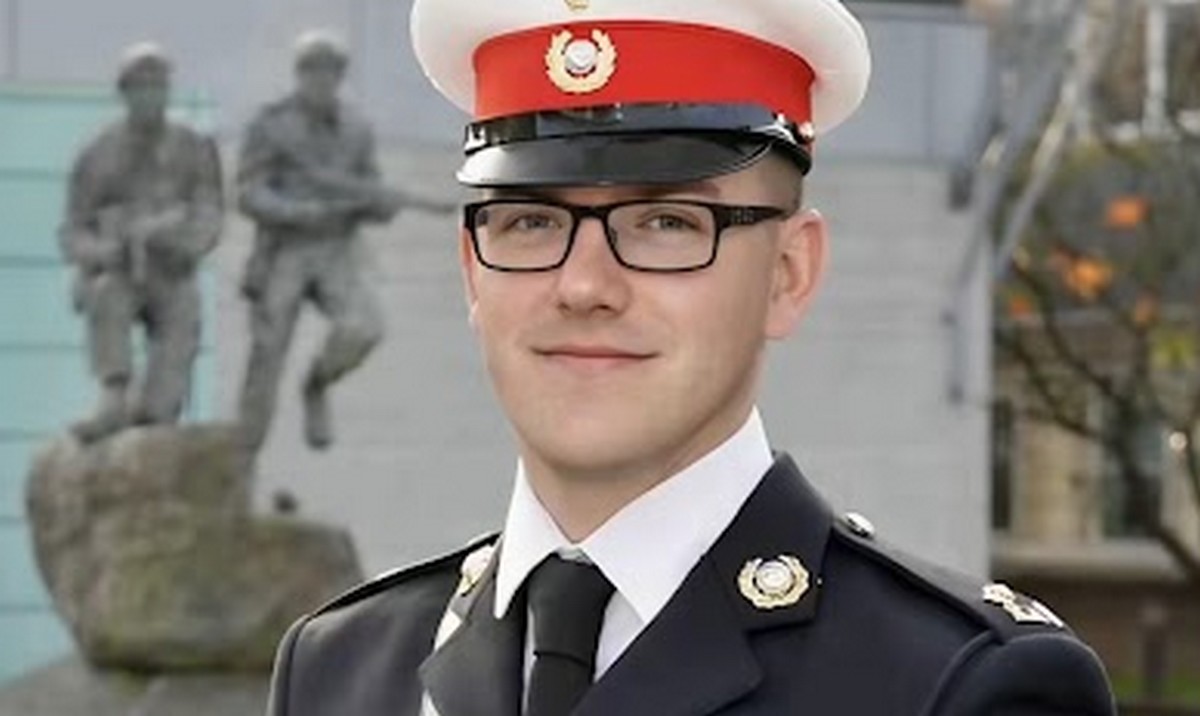
It does not take very much to construct a military career on social media. Operation names and unit histories are public, photographs of serving personnel are everywhere, and badges, ranks and the language used by the Armed Forces can be picked up by anybody willing to spend some time looking for them.
Put enough of those things together and, to an audience unfamiliar with military life, the result can appear remarkably convincing.
A UK Defence Journal investigation into a series of TikTok accounts linked to a man named Cameron Nell found exactly that. The accounts presented their operator as a former Royal Marines colonel who had served between 2012 and 2020, including with 40 Commando and 42 Commando, while posts listed deployments, exercises and a career that supposedly took him from leaving school to senior commissioned rank in around eight years.
It was detailed enough to attract attention from people familiar with the Armed Forces, some of whom had already begun questioning the story before the UK Defence Journal became involved. With their assistance, including people with first-hand knowledge of the Royal Marines, we worked through the dates, units, terminology, exercises, photographs and claimed progression through the ranks, before checking the central service claims independently through official channels.
The Royal Marines career being presented online was false, of course.
What followed was not simply a story about somebody giving himself a rank he had never held, no, I believe that the accounts offer a useful look at how easily an invented military history can now be assembled from genuine pieces, how manipulated photographs can be added to make it look more substantial, and why the consequences can become very real for people whose own lives intersect with the events being claimed.
Building a story from real things
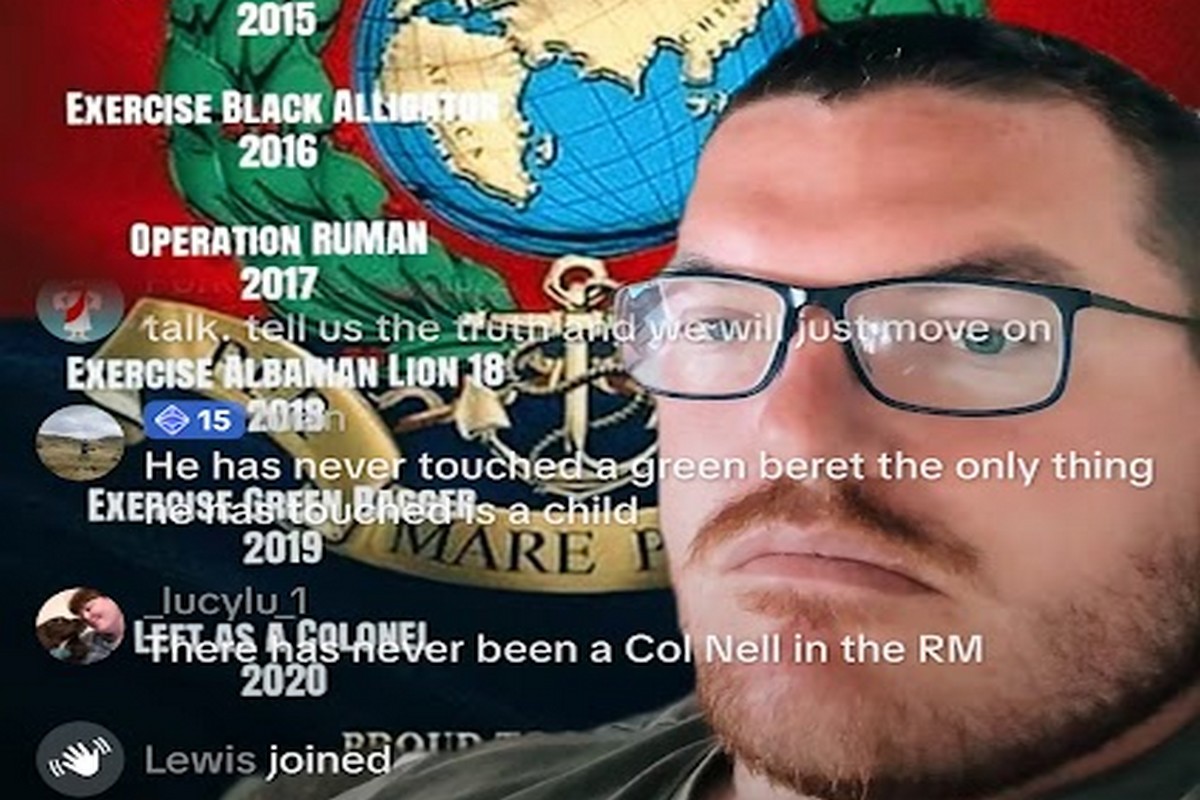
The supposed career was considerably more detailed than a vague claim to have once been in the military. One version said its operator had passed out with “Troop 139” in 2012, deployed on Operation Herrick in Afghanistan in 2013, served on Operation Gritrock and Operation Shader in 2014 and subsequently took part in Platinum Lion, Black Alligator, Operation Ruman, Albanian Lion and Green Dagger.
Many of those names are genuine military operations or exercises, which gave the account an immediate layer of plausibility. Someone recognising Herrick or Shader, seeing Royal Marines imagery and reading a list of deployments has no particular reason to know whether the person writing it could realistically have followed the career being described.
The same applied to the presentation. Royal Marines insignia appeared alongside the Corps motto Per Mare, Per Terram, while the account holder variously described himself as a Royal Marine, commando, veteran and colonel.
In one account of his life, Mr Nell said he had been born in South Africa in 1996, moved to Britain aged five, left school and joined the Royal Marines in 2012, then left the service in 2020 having reached the rank of colonel. Elsewhere he described himself as the “youngest colonel in British history”.
People with military experience did not need long with that chronology before the questions started. Colonel is a senior commissioned rank, reached after progressing through a series of junior and field officer ranks and ordinarily accumulating years of command, staff and other appointments along the way. The story being presented required somebody who said he left school in 2012 to have entered the Royal Marines and reached colonel around eight years later.
Serving personnel and veterans who assisted the UK Defence Journal went further than simply pointing to the rank. They examined the sequence of deployments, terminology and unit references, while others helped trace photographs and identify genuine military material which had found its way into the story. Much of what surrounded the claimed career was real. The career itself was not.
Photographs provide another layer
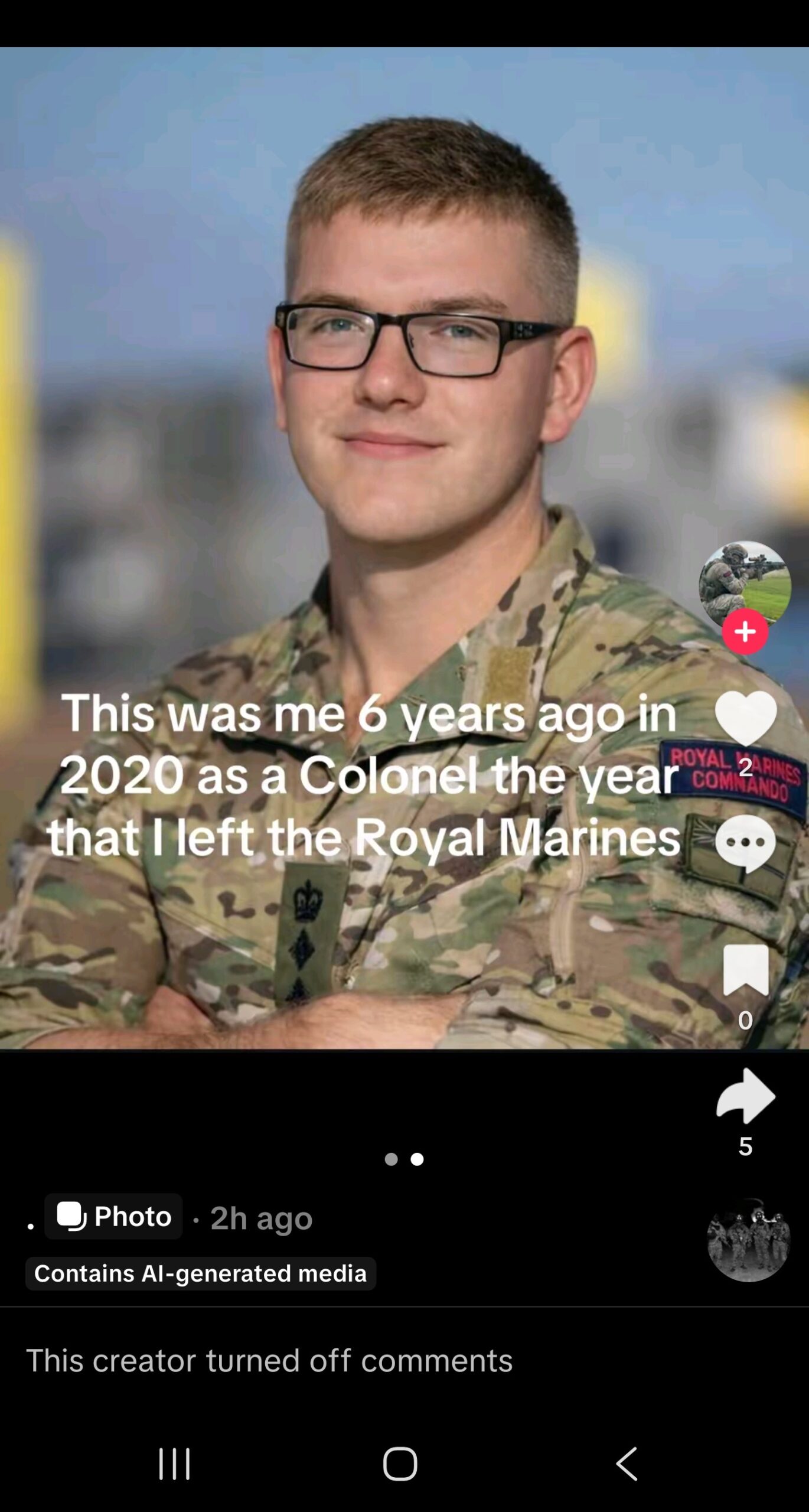
One of the clearest examples of how easily the appearance of a service history can now be created came from a photograph posted to TikTok. It appeared to show the account holder in military uniform, accompanied by the words: “This was me 6 years ago in 2020 as a Colonel the year that I left the Royal Marines.”
The military photograph itself was genuine, but it did not originally show him. His face had been digitally placed over the serviceman in the image, leaving the uniform, equipment and surroundings from the original photograph intact. TikTok displayed a “Contains AI-generated media” label beneath the post.
For somebody scrolling through a feed, especially somebody without any reason to inspect the image closely, that is potentially quite persuasive. Most of what the viewer sees really did exist in front of a camera: the uniform is real, the setting is real and the military context is real. The person supposedly standing there is the fabricated part.
Other posts made the claimed connection with the Royal Marines more explicit. One read: “In my head and in my heart I’m a Royal Marines commando Colonel forever. And I belong to the Royal Marines forever.”
Another described him as “Royal Marines commandos Colonel C.Nell 2012-2020” and said he was proud to call himself a “Bootneck”, the long-established nickname for a Royal Marine.
The UK Defence Journal has also seen material showing that false military claims had previously been acknowledged and apologised for, before substantially similar claims later appeared again. That history makes it difficult to explain what followed as somebody simply misunderstanding a rank or using military terminology incorrectly, although it does not tell us why the behaviour returned.
People who knew what to ask
Some of those who encountered the accounts had already begun testing the story themselves, using the ordinary details of service which are considerably harder to reproduce convincingly than a list of operations copied from the internet.
A source familiar with Mr Nell and with the military environment he was claiming to have been part of described people asking about units, weapons, medals, training and deployments. According to the source, answers to some basic questions changed over time, with information initially described as classified before different explanations were later offered for why it could not be provided.
Those exchanges prompted people following the account to dig further into what was being claimed. The questions became more detailed as the stories did, and people with enough military knowledge to recognise inconsistencies began comparing what was being said with real deployments and service history.
For one person, that stopped being an exercise in catching out a suspected “Walter Mitty” when a story told about a real deployment included the death of somebody personally known to them.
The source provided the UK Defence Journal with a detailed account of what happened and information establishing their own connection with the person involved. We have deliberately withheld the identifying details, including the circumstances of the death and the source’s own background, because neither is necessary to tell this part of the story.
According to the source, Mr Nell spoke about the death as part of his claimed operational experience, placing himself within the events and describing them as something he had personally encountered. For the person listening, this was not an unfamiliar name pulled from an old casualty list or a story about a distant military operation. They knew the person whose death was being discussed.
This is really key to understanding why apparently ridiculous claims about ranks and deployments can create a level of anger which might otherwise be difficult to understand. When somebody begins inserting themselves into real events, the invented career can collide with memories belonging to people who know exactly what is being borrowed.
Thousands of people saw the claims
The original TikTok profile was relatively small, with around 490 followers when it was examined and more than 1,800 likes, but its reach was considerably greater than its follower count suggested. Individual posts seen by the UK Defence Journal had accumulated roughly 13,000, 21,000 and almost 29,000 views.
The account also used TikTok LIVE while its operator presented himself as a former senior Royal Marines officer. TikTok LIVE allows eligible creators to receive virtual gifts, and the UK Defence Journal was shown material suggesting that financial support was being encouraged or accepted around the account’s wider activity. We have not established how much money, if any, was received, nor have we established that anybody provided money because they believed the military career being presented to them.
The audience figures are nevertheless useful in showing how far a claim can travel without the person making it already having a large following. Someone arriving at one of those videos or livestreams could be presented with a senior rank, photographs in military uniform, named operations and detailed stories of service before ever encountering anybody capable of checking whether the pieces fitted together.
The accounts also claimed links with several veterans’ organisations. The UK Defence Journal contacted the groups concerned, which confirmed that Mr Nell was not affiliated with them.
TikTok
The UK Defence Journal approached TikTok after establishing that the claimed Royal Marines career was false and asked how its rules applied to accounts of this kind. According to TikTok, it has removed accounts which breached its rules against impersonation.
The company’s Community Guidelines prohibit account behaviour which may spam or mislead users, including spam and impersonation accounts, according to TikTok. The platform also prohibits attempts to defraud or scam members of its community. According to TikTok, of the videos removed for breaching its Community Guidelines during the first quarter of 2026, 93.6 per cent of those removed for misleading or attempting to manipulate users were identified and removed before being reported to the company.
The disappearance of the original account did not immediately end the activity, with further profiles subsequently appearing which carried substantially the same Royal Marines identity and again presented their operator as a former Royal Marine and colonel. At the time of writing, the UK Defence Journal could no longer find accounts associated with the individual still active on TikTok.
Putting the claims to him
Mr Nell was given a right of reply before publication because serious findings about an identifiable person should be put to them, giving them an opportunity to provide evidence, correct anything which is wrong or explain their position. When asked why artificial intelligence had been used to place his face over photographs of military personnel, he replied: “No comment.” He later asked: “How am I faking if I have proof of my service?”
The UK Defence Journal asked to see the proof. None was provided. When he was told that the service and rank claims had been checked and found to be false, he responded: “But they are not false.”
Mr Nell was given another opportunity to provide a statement for publication before the exchange ended. He replied: “Yes I will say I’m proud that I served 8 years in the Royal Marines and I’m proud to call my self a Royal marine and I’m proud of my rank of colonel I achieved.”
It was essentially the same account with which the investigation had started, and no supporting evidence accompanied it.
Threats against the journalist
After the original TikTok account disappeared, he located and followed my personal Facebook profile and subsequently made contact through another TikTok account, again presenting himself as a Royal Marine colonel. He was asked to stop.
Further messages followed and, after the request had been made explicit, Mr Nell sent the journalist the message: “I’ll beat you up.” After being told that the threat would be reported to police, he sent another message saying he would give me a “knuckle sandwich”.
A further message read: “This is why no one likes journalists.”
The UK Defence Journal ended direct contact at that point. A right of reply gives the subject of reporting a fair opportunity to answer what is being alleged or established about them, but it does not require a journalist to continue corresponding after that person begins making threats. The messages were retained and reported to Avon and Somerset Police.
Police enquiries under way
Avon and Somerset Police subsequently provided the UK Defence Journal with an on-record statement. “A report has been received that a man had been harassed and threatened in online messages. Enquiries are being carried out into this matter.”
The police involvement concerns the messages sent to the journalist and is separate from the question of whether the military career itself was genuine.
There had been public material which caused concern before those direct messages arrived. One post stated: “Think twice before sending death threats and threatening to kill a civilian with a Royal Marine background because you will lose your careers and your life.” Another showed an armed and masked military-style figure beside the words: “I came into this world covered in blood, Don’t mind going out the same way, fear no man. Only God.”
Neither was treated by the UK Defence Journal as a direct threat when viewed on its own. The later private message was different: “I’ll beat you up” was sent directly to the journalist (me) investigating the accounts after he had been asked to stop making contact.

More than a joke about an impossible rank
People who invent military careers have long been known as “Walter Mittys” or “Walts” in Armed Forces and veterans’ circles, and many examples are ridiculous enough to invite mockery. Impossible ranks, medals worn in the wrong order, units that were somewhere else at the time and stories which collapse after a handful of questions have made exposing them something of a pastime in parts of the military community.
There is another side to it, particularly when an invented career begins to use the experiences of real people.
The source who described hearing the death of somebody personally known to them folded into somebody else’s supposed operational history is an example of why the reaction can be much stronger than irritation at a person pretending to have worn a uniform. The people and events being used to lend authenticity to the story are not fictional simply because the career surrounding them is.
None of this tells us why Mr Nell constructed the identity or returned to it after earlier false claims had been acknowledged. We may never know.
Readers should not contact or harass him. The UK Defence Journal is also aware of separate, documented matters relating to Mr Nell’s past. They have not been included because they are unnecessary to establish whether the military career was genuine, how it was presented online or what happened when those claims were examined.
The harder part is checking it
What stands out from this case is how little effort is now needed to make a false military history look plausible. The names of operations are public, photographs are easy to find, military language can be copied and image tools can create something that looks convincing enough to survive a quick glance.
The work begins when somebody decides to check it properly. In this case, that meant people with military experience spotting inconsistencies, old photographs being traced, timelines being compared and the central claims being checked independently through official channels.
By then, thousands of people had already seen the account and some of the claims had travelled far beyond its relatively small follower base. False claims of military service have been around for years, but social media gives them reach and modern image tools give them a level of polish that was once much harder to achieve. A detailed-looking service history can now be assembled quickly, and an image that appears to show someone in uniform may tell you far less than it once did.
That makes careful verification more important, especially when the claims involve real units, real operations and events that still matter deeply to people who were actually there. In this case, the claimed Royal Marines career did not withstand that scrutiny. At the time of writing, the UK Defence Journal could find no accounts associated with the individual still active on TikTok.











Well done, George.
Great article and sickening that this imposture took it so far as to include someone’s death. Truly awful behaviour.
Keep up the great work
Thanks CR
My father who died in 2012 maintained he was in the RAF military police for 5 years in the late 1950s reaching Flight Sergeant. He had cap badges etc and was a big part of who he was. I was born in the 1970s and we lived in Belgium for 9 years, he was a mechanic but with his proud military stint behind him, known locally in the Flanders village as ‘the angry Englishman’ he cut an imposing 6ft 4in figure with his military stiff walk and looking down as though he still wore a MO peak cap. When I was 21 I left home and my mother divorced him, I didn’t see him again. In Covid I was bored so tried to find him, turned out he died 10 years earlier in a secret funeral (baffling). I found his new family whom he was with 20 years after me and they told me about him being a retired police officer from the Met. I said ‘what’? he was a mechanic the whole time he was my dad, so it’s impossible he was a copper. It took a long conversation for them to realise his whole persona was made up stories and he was never in the police, despite his many stories of arresting people on cases. I got home and wondered about his RAF career was true also, as next of kin I’m allowed to obtain his military record, so I did, it took the RAF a while to locate it. So was he a Flight Sergeant MP? No, he was a cook, an assistant spud peeler, never even reached NCO. Who the heck was he.
Thanks for writing that, so close to home for you.
Took guts to write that WS – Well done you! It would appear that at least his offspring is well grounded 🙂
Thank you- appreciated
That took balls to write, well done.
That must be hard, not really knowing who your father was.
People do make up and construct stories and memories and our minds believe the stories it creates , bizarrely out memories are very fluid and we can convince ourselves things happened that didn’t.
I have a false memory I know of false because I have the physical records of the event..I was very shocked when I realised that happened to me.. I had a PTSD night from hell in which I essentially realised I could not keep doing the job I was doing.. now I had built a story around that week of nights and the Sunday that essentially broke me.. one of those stories was that part of what did for my mind that night was managing a trauma call in which someone attempted to murder a colleague with a van… but years later when I looked up that event it turned out it happened a whole month later on the next night shift I was running…it turns out for years I had collected a whole months worth of shit and dumped it all in that one nights memory.. warping time completely… some odd PTSD thing…
What’s really weird is I can still see and feel that trauma call as part of my worse night.. I’m there… it’s all part of that night.. but it’s a lie, it never happened that way… fucking odd to be honest.
Sometimes people make up stories and truthfully don’t know the difference.. it’s real in their heads.. because our minds are very strange worlds unto themselves.
In the end we can only let others be themselves and we be ourselves and try and understand ourselves, because quite frankly that’s impossible job.. other people are simply a different universe we will never know.
That must have been very hard to write.
Extraordinary but really not that uncommon.
Everyone puts a gloss on things not necessarily to big themselves up. Some people are wind up artists who enjoy seeing how far they get away with it. Some get trapped in that ‘story’…
Others it is more sinister.
Welcome back, George.
I’m not sure if this is a newly written article or one George wrote before he had to step back; whatever has happened seemed very serious so I’d be surprised if he’s back researching and writing such a detailed article just 4 days later.
Good point, possibly the latter.
You are correct; I’m just back for a few minutes to ‘sign over’ some items in our system to others to finish. This was written last week.
Thanks for the clarification. I hope you’re doing OK, I’m sure you have the support of the whole UKDJ readership.
Great article George, social media has given what was
‘the local bullshitter at the bar’ a vast audience, depending on the engagement they receive, they get ever more invested and cross over from Billy bullshit, to somthing far more disturbing and damaging, especially to their own mental health.
Never mind the insult to our seving armed forces personnel and veterans.
wtf ppl covered in blood hardcore nothing new ppl pretending be soldiers ffs
especially british army shit like need 1 coherent old jock news the game like many times ive saved them rediculous truly worst army
from grand strategic plans take on russias frotal assult getting rid best troopsfor walter mitty like mupets
then tell new dig a trench next qualityto the executive ifyou seen the pictures to others served no doubt
I cringe at the Walt stuff, I just don’t get it. I even served with guys who made up stuff and it was easy to pick apart, its got to be a ‘mental health’ thing. Still if its good enough for Cambridge professors…..
Andy P
Grand Admiral of the High Seas Fleet (retd).
Sooo I recon you retired about 100 years ago 🙂
Cheers CR
And was awarded the Iron Cross (First Class) for single handedly saving the Derfflinger from more serious damage and sailing her back to port.
Yep, wor Andy had such a glorious career we should be very proud of him.
And he is doing remarkably well for his age, quite the inspiration 🙂
Unfortunately I just look it. The Beirut Bugler as a paper round took it out of me but that’s a whole different story I can’t tell or I’d have to kill you. I was an underage trained assassin too.
Brilliant, thanks for the giggle..! 🙂
Cheers CR
As grand high overlord of everything, I agree with you 😵💫
Ive got my doubts Jonathan ……
Joking aside, anyone who’s had the unfortunate first hand experience of dealing with an extreme narcissist, (a surprising number are Walts), have a window into the terrifying world of fantasy living, were you cut through a lie, only to find two more behind, with the person disappearing or indeed gone, lost in lies.
I think that’s the thing in the end those narcissistic personalities are essentially utter mental health basket cases.. essentially behind every narcissistic person is a child’s mind that became broken for some reason.. essentially adults get things like PTSD, significant depression, anger problems or anxiety.. depending on how far the mind is pushed.. pushed children because narcissistic or get some other nasty personality disorder that needs feeding.. to the detriment of those around them. What is sad is those damaged as adults can gain insight and manage repair.. those damaged as children essentially are…
Absolutely, you have to have a narcissist in the family to fully appreciate how damaged they are and how incredibly damaging and toxic their behaviour can be.
It goes way beyond the ‘piled’ on bullshit, it involves coercive control of partners, uncontrolled greed, manipulation, risk taking, fueled by blind self aggravating behaviour.
Their belief that they are always the brightest in the room is their biggest weakness, they seldom are and it makes their obnoxious behaviour easier to predict and counter where necessary.
I was an Air Chief Marshall in the Air Cadets, went solo on my first Chipmonk experience flight and was awarded a DFC when I landed…
I won’t put up with your tall stories Andy, bloody Walts….
Joking aside mate, I cringe when you bump into someone who was in the SAS or whatever, its funny none of these guys were in the Catering Corp or the like. The first clue is they talk about ‘mission stuff’ instead of the time they got so drunk they soiled themselves or tales of exotic ladies.
Funny thing is, an ex Para mate of mine only ever talks about the monumental piss ups and bar punch ups he enjoyed in 2 Para back in the 80s and 90s.
The people I know who have had ‘ interesting military careers’ shall we say, never discuss it, why would they, absolutely nothing to prove to anyone.
I think its because a lot of it doesn’t mean anything to anyone else, while the ‘big picture’ of your career might sound interesting there’s lot of times its really boring or just crap or pointless. The bits that mean most to you probably only resonate with people who were there or have a similar background. For the vast majority of us its not about one upmanship, just sharing and reliving the ‘glory days’. A lot of those glory days are the burds and booze and aye, the occasional bout of drunken silliness when you wake up with sore bits.
Absolutely mate…
😆
1 more thing un be welcome referee in this dispute suit all including ju aid and stuff my basic human rightd troden on they do say only 2 types ppl do that jews and scousers here spastic o light the match if could but yeah keep it civil
and bonus in destroying myth double o,s have a short life exprexzion d
Reading this I was reminded about the fake Rear Admiral who put in an appearance at a Remembrance Day parade last year, I think it was in North Wales but I’m a bit hazy on the details. He was prosecuted and fined, but there was never any explanation as to why he did it, or thought he could get away with such tomfoolery. I would be interested in who this chap really is, presumably this sort of impersonation is illegal, and most definitely making threats as he has done should see him in court and preferably in jail.
The police have got to identify him first. There is a chance that the pictures might use a face lifted from the internet and a false name even though the person involved is clearly seeking some sort of self affirmation or glorification, it is possible they have invented some kind of alternative self…
Cheers CR
It always fascinates me as to how these people can live in such a parallel universe. Perhaps the resurgence of the Flat Earth society might explain it.?
Yes, it was in North Wales. Not the first time he’s attended an event, the damned Walt.
That was very, very odd.
How do you think you will get away with that. Or was that the point: at least to start with?
I’ve a vague recollection of meeting him decades ago when he was sports coach.
Something didn’t chime right even then.
His story about Mboto gorge and the sharpened mango fruit should’ve been the 1st clue.
He had already been exposed by The Walter Mitty Hunters Club HQ. They showed up on my Facebook feed some time ago. There seem to be some rather persistent Walts, and they keep exposing them with at least equal tenacity. This Walt seems to be one of those serial offenders. Nevertheless, well done George! 👍
To be fair, with some its mental illness, not excusing it, but in reality its just rather sad.
Plenty of them have served too.
My mate has a 21 year career ex RAF Brother in law who is an extreme Narcissist, a perfectly respectable career as an avionics engineer, but the endless bullshit he comes out with, long elaborate stories with back up and fall back stories…
It has to be heard to be believed to be honest, the key here is he believes his bullshit!
The danger here is when people blur the boarder between reality and fantasy and start believing it, they get dangerously close losing their grip and having a full on breakdown.
I think you make valid points. I agree that mental health issues often play a role in this kind of despicable behaviour. The bloke in the article certainly seems like a basket case to me, and I hope he gets the help he needs before he pisses off the wrong person with his tomfoolery.
Absolutely, from a ‘sane’ perspective, its really quite inexplicable :
A: Why anyone would do it?
B: How would you possibly think you will get away with it?
My guess is probably as good as yours, but I’ll make an attempt:
A: To gain status, but that could only work in societies where the military is held in high regard, like the UK.
B: Some kind of delusion, such as a mistaken belief that they are clever enough to get away with it, or the web of lies they have spun has become the truth to them.
But I know I would be ashamed to be seen wearing a uniform I have no right to, or wearing medals I haven’t earned.
If someone thinks they are something for long enough, they eventually believe they are. The is a clown round my way who describes his occupation as “Fireman”. He has never been a fireman/firefighter, but got hold of an old fire engine and together with a few other wannabes set up a company providing fire cover for events. None of them have ever been trained or have any proper firefighting experience but the company has grown over the years and is now virtually identical in appearance to the actual local FRS, and the public think they are one and the same. Scary.
What a troubled creature.
Heavens… being a SRAB in the 80s and early 90s means you are a walt to the ARABs…
I’m proud to have been a Walt and Airborne can Foxtrot Oscar (Hugs) because it is not every night you drive the Senior NCOs of the Parachute Regiment home after their Xmas bash and the remaining SNCO, only the GSM starts laying into the RMP and you pull over and threaten to jail him, the twunt.
His wife actually helped rather than attacking me with his her nails… now that was totally unexpected! Discombobulated was I!
So, senior RSM PARA Aldershot, 1994, thank your wife you weren’t locked up courtesy of the Guards, you twunt.
Airborne, Cheers Easy.
I’m surprised you got off Monty lines in one piece, despite the GSMs wife assisting (she may have been on a promise) in the de-escalation! We’ve all done the waiting on as young crows in the WO and Sgts mess, terrified you would fuck up and spill the booze (food no issue)! They as you grow up and reach 19 they let you drive them all home, how lucky we were lol!
Mate those were the “good old” days before the various mess’s became cash cow for the private sector! And don’t worry mate we are all a team and I’m sure we must have had a punch up or two in 5s or the rat pit ahhhhhhh good old days 😂👍
You always won! Even with the German Shepherds, 5000 Airborne and 10 MPs meant we were getting our arses handed to us on a Friday night…
However, it was the good old days, even if I was a STAB. Cheers Airborne, hope you are in fine fettle and your lasses are safe on duty.
Mate I have to admit young Toms we’re mostly crap at fighting as individual (me included) but mental in a group! I was in town once with the missus, I was mashed, getting chopsy, RMP pull up, I’m giving it big licks for a few minutes challenging the Monkeys to actually have the balls and try to take my ID to check! Missus got bored, looked at the RMPs, nodded, grabbed my ear, nearly ripped it off and suggested the RMPs would like to see my ID, obviously that was the best option at that moment and I gladly complied with my fellow professional soldiers 😂😂😂 and then sheepishly managed to find a taxi (that alone in Aldershot was not easy)!
Yes mate both my girls are good, strange thing is they are now at the same station, same shift! Didn’t know that was allowed but they don’t mind it!!!! 👍
When I did duties covering for 160, I used to get involved in your fights but where possible just sat on the bonnet and watched you fight each other, even giving a lift to the Cambridge because of the extreme damage you had done to each other but then the girls said are you taking our men… Er,,, You can come to but, to the Cambridge, God in Heaven, the Doris were worse than PARA… and no dog handler on duty!
I never asked but I think our War Dogs were scared of your women… just saying.
Almost an untapped line of inbuilt mental that could have been recruited to the ranks… not so much an addition, more a force multiplier!
Crazy days mate crazy days!!
STAB.
One of the many lessons taught me by my father, (he was a git) was that a liar needs a good memory. I do not understand the need for someone to create a fictitious life. Anyhow, my memory is so piss poor, I couldnt tell you what I was doing 2 weeks ago (otherwise I’d have to kill you).
I have come across a few Walts since I left the Corps. One was a so called member of the Parachute Regiment. Sadly for him I did my Para course at Brize around about 1980. So a few knowledge based questions about even the basic course tripped him up. Come on who does not remember the nutcracker or the first ballon jump.
The other two were making out they were RM. Easy two in one question what troop were you in during training and what was your official number. Again things you never forget.
The Marines are small family and you can’t get away with it for long.
Putting to one side the very serious nature of this kind of fraud, it always strikes me as a bit daft when these fraudsters claim to be something/someone that there are very few of. I don’t know how many RM colonels there are, but I’ll wager there are not many. That chap who tried to pass himself off as a Rear Admiral ‘awarded himself’ the DSO. Again, wouldn’t take long to check the list.
Can’t stand Walt’s, I used to be in charge of the M15/6/7/8 covert ops team, with a rank of King General Brigadier Dark Lord, in charge of Battlestar Galactica using time travel to check up on Walt stories and fact check! Used to get a billion pounds per jump and got SAS /SRR/GSG9/Ranger/Spetnatz and moon base alpha eagle wings out of it! Only did it for a few days tho as was made president of the galaxy and had to move on…..
You rose fast, I thought PARA went down…
One thing about being a STAB was that even MP thought they could take the piss out of me which was soon corrected when a Lance Jack gave me some verbal, and a Corporal stood beside him, backed him – hey ho Corporal, my Army Number (served in the Royal Irish) and yours is??? So, I take seniority and you Lance Corporal need to wind it in before I charge you… As you said, the good old days!
Fucking ARABs!
(Hugs Airborne!)
😂👍 a good case of never presume, never judge mate 👍
In the late 70s I had a great and fearsome maths teacher who was close to retirement. One day he was asked to lead the school assembly and told the story of how, as a young man, he saved his ship under fire and won the VC. As a gullible snd impressionable lad I initially believed him. Years later I checked the facts and it was all clearly false. The school never asked him to lead an assembly again. Still, he made sure I learnt some maths! You are remembered Mr. Jones.
This kind of thing is what could lead to a sociopathic narcissist billionaire reality TV show presenter and totally wacko property developer who has to be bailed out by Russian banks to survive, becoming elected President of a major power. Hardly credible though so maybe I was mistaken and it only happened in a dream?
Colonel, a bloody colonel! He has some front. They never pick the REME, do they? (apologises to any present and former members of the REME) It is always us, the Paras, or, for the really adventurous, the SAS/SBS. How the chuff did he think he could get away with that? Second Lieutenant to full Colonel in eight years, wow! It makes my career quite pedestrian and a total failure insofar as my promotions.