

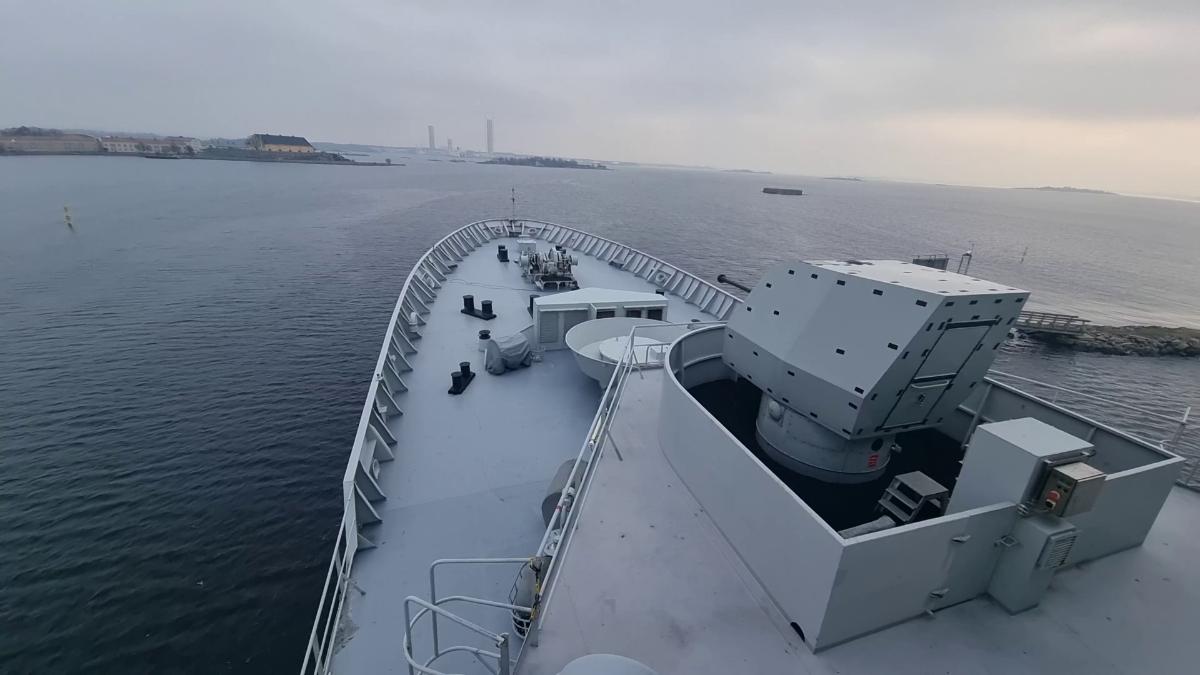
Sweden’s Armed Forces have asked the government to expropriate a strategically placed property at the entrance to Muskö Naval Base, arguing that its Russian ownership and location create an unacceptable national security risk.
The Swedish Armed Forces have asked the government to expropriate a Russian-owned property overlooking an approach to Muskö Naval Base, saying control of the site is necessary to strengthen protection of the installation against surveillance and drone threats, the UK Defence Journal understands.
The Swedish Fortifications Agency submitted the application on behalf of the Armed Forces on 25 August, seeking government permission to acquire the property through compulsory purchase. Swedish defence officials say the site occupies a unique position at one of the approaches to Muskö, south of Stockholm, and is the only property in the immediate area required for the base’s protection that is not already available to the military.
The property is owned by an individual holding Russian citizenship whom the Swedish Armed Forces say they assess to pose a security threat. Open-source discussion of the site has drawn particular attention to its position on the inlet leading towards the naval area, but the Armed Forces’ formal case rests on the combination of its location, current ownership and the changing threat from uncrewed systems.
Lieutenant General Carl-Johan Edström, Chief of the Defence Staff, said, as quoted in a Swedish Armed Forces news update: “Nothing is more important than Sweden’s security. We are facing the most serious security situation since the end of the Second World War, and the threat to Sweden and the Alliance is real.”
He added: “Against this backdrop, the Swedish Armed Forces have instructed the Swedish Fortifications Agency to apply to the Government for permission to expropriate the property in question.”
Swedish defence officials are placing particular emphasis on the rapid development of Russian drone warfare, arguing that military installations now need protection not only from conventional airborne surveillance and attack but also from small aerial and maritime uncrewed systems that can approach sensitive sites from directions which were previously less difficult to monitor.
The Armed Forces say the property at Muskö represents a gap in that defensive arrangement. Because the surrounding locations are already available to the military, acquiring this final site would allow protection measures around the entrance to the base to be planned as a continuous system rather than around privately controlled land.
Edström said: “A strong defence is essential to our freedom. Unmanned systems can be employed in many different ways—for surveillance and intelligence gathering, as well as for direct attacks. That threat is real and must be countered, not least by establishing robust systems capable of detecting and countering drones around our military bases.”
He continued: “The current security environment requires us to act and not accept the risks associated with the property’s current ownership. The present situation does not benefit Sweden or NATO—it benefits Russia.”
The language used by the Armed Forces is unusually direct, with the application explicitly linking the owner’s Russian citizenship and the military’s security assessment to the case for expropriation. The Swedish authorities have not merely argued that the land would be useful for expansion; they describe it as critical to the effective protection of Muskö Naval Base and say its present ownership creates a risk that can no longer be accepted.
The request also reflects Sweden’s wider adjustment to the security environment since joining NATO, with military infrastructure now considered not only in terms of national defence but also its role in protecting Alliance assets and operations. In its statement, the Armed Forces repeatedly referred to both Swedish and NATO security when setting out the need to bring the property under state control.
The Swedish Fortifications Agency has now submitted the application to the Government Offices of Sweden, which must now consider whether to authorise the compulsory acquisition and determine the next steps under Swedish law.


Saw an article somewhere ( forget where ) about these Russian sites, in several places in Europe close to important facilities.
One site was on an Island, had its own helipad, and military types had been seen there by locals. The owner was some business man no doubt up to his eyeballs with the Russian government.
Assume these are FMB type places where Drones and supplies might be pre positioned for sabotage operations.
Proper Trojan horses, just waiting to be used.