

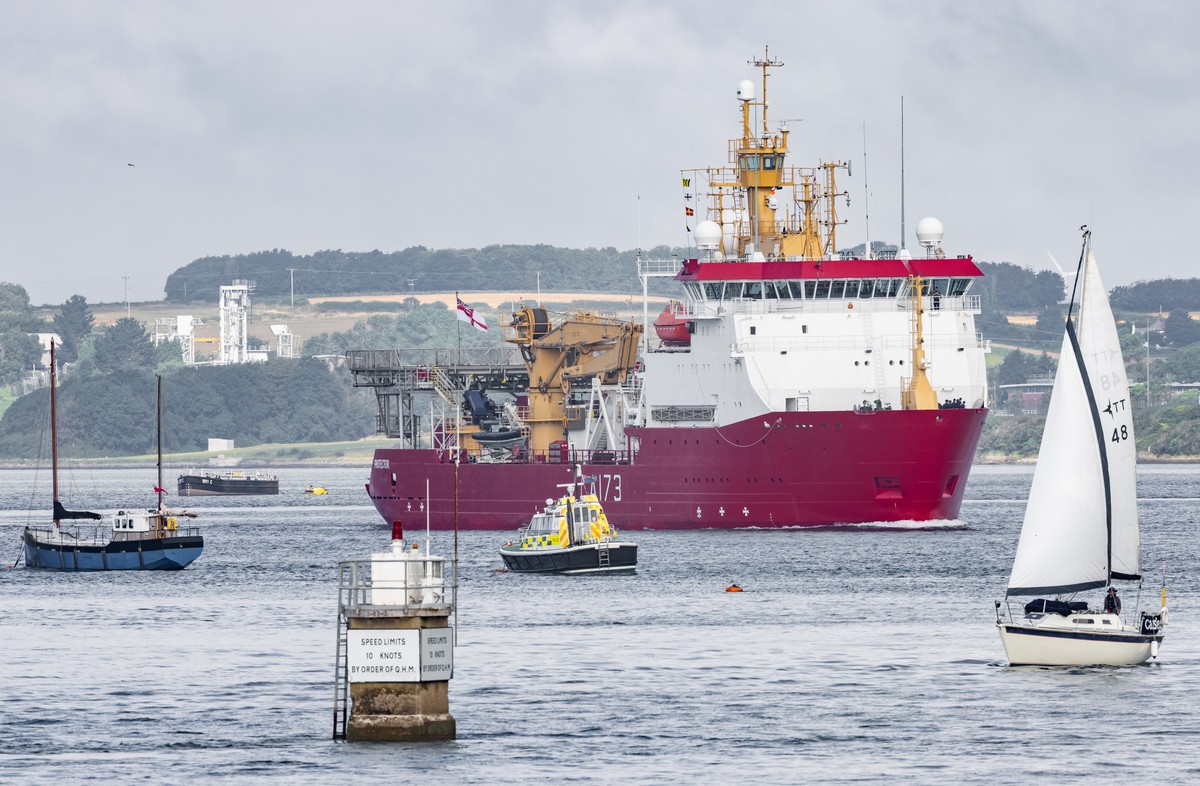
The Royal Navy’s ice patrol ship HMS Protector could not sail from Teesside to Devonport under her own power this month because of propulsion defects, and was towed instead so that engineers can work out what to do with her, according to an answer given in Parliament.
Ben Obese-Jecty, the Conservative member for Huntingdon, asked why the ship was unable to make the passage.
Luke Pollard, Minister of State for Defence Readiness and Industry, said: “HMS Protector was unable to sail to Devonport under her own power due to propulsion defects. She has been towed to Devonport to enable further technical work to determine the most effective future course of action for the ship.”
Answering a second question from Obese-Jecty on why the ship missed the Antarctic season, Pollard said: “HMS Protector did not deploy to the 2025 to 2026 southern summer season due to undergoing a period of prolonged essential and mandatory maintenance to ensure the viability of the vessel into the future.”
Protector is the Royal Navy’s only ice patrol ship and carries out the United Kingdom’s survey and inspection commitments in the Antarctic under the Antarctic Treaty. She was bought in 2011, originally built as the Norwegian vessel Polarbjørn, and was taken on initially as a short-term replacement for HMS Endurance, which was crippled by flooding in 2008 and never returned to service.




It’s a very odd think for a ship out of refit to suddenly have a double engine failure.. smells a bit like something went wrong with the refit.
Morning Johnathan,
The problem with old machinery is that it can react very badly to being in anyway tampered with. Even changing the engine oil can be the last straw as the process can flush all sorts of crap back into the system with dire consequences. Basically, it sounds like the engines are worn out to the point that needing a major rebuild or replacement, hence uneconomical to repair. The ship has simply got to the end of it’s life. Not an unusual circumstance for RN ships at the moment.
Basically, decisions made of the last 40 or more years have led us to this point. A frigate fleet literally on it’s last legs, maintenance facilities that have not been kept up to scratch so they are no longer able to support the submarine fleet, but worst of all is the erosion of the skilled and experienced workforce both in industry and the Royal Navy. The fleet and it’s support structure is possibly as bad as it as ever been since the Dutch sailed up the Medway River and sank the English fleet at anchor in 1667…
I fear it will get worse before it gets better given that some observers are suggesting that two more T23’s might yet need to be retired before the first replacement T26 arrives because they are beyond economical repair and no longer safe to go to sea. They are on average around 10 years or more beyond their design life, so we can’t really complain. There is simply too little metal left on the frigates to weld up for repairs it seems!
It would be laughable if it wasn’t for the dangerous times we live in.
CR
Bit of a tangent but there might be a spare Protector OPV (HMNZS Wellington i think?) going down in NZ? Not a fully blown ice breaker but i believe it has a ice hardened hull, hangar too. Babcock NZ has recently got the HMNZS Otago back up and running again. If the UK got that that might free up a B2 River for somewhere else.
Would the UK ever look at getting a 1-2 of the Harry Dewolf type APOVs? Bit of two way trade for T26 purchases?
You might want to take a look at the new Kongsberg Standardised Ships that we are buying 6 of, like many of their ships they are built to handle Ice. FYI the Canadian Harry DeWolf class are actually based on the existing Norwegian Coastguard Svalbard class design.
It’s a small world !