

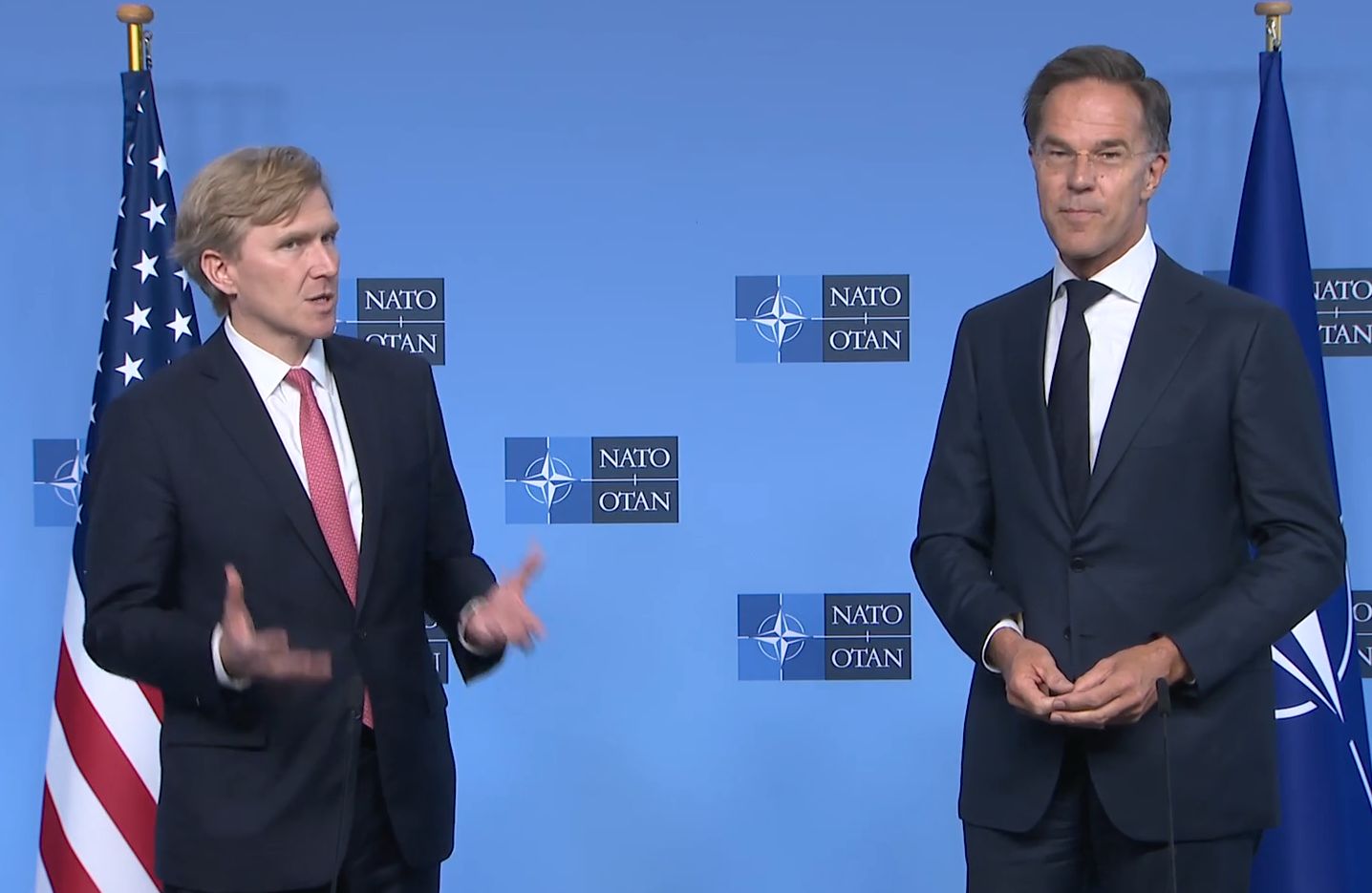
NATO members have been sent a written questionnaire seeking their views ahead of the American review of United States force posture in Europe, the Pentagon’s senior policy official has confirmed in Brussels.
Elbridge Colby, the Under Secretary of War for Policy, disclosed the mechanism in remarks alongside NATO Secretary General Mark Rutte on Thursday, having been asked about it by reporters.
He said: “We want to hear from our allies. That’s the questionnaire that some of you asked about. We wanted to hear from them directly in writing, in the spirit of NATO 3.0.”
Colby also named the areas where he expects difficulty, singling out the arrangements that govern where American forces can be stationed and how they move.
He said: “Let’s look at some of things like access, basing and overflight, where there is a lot of good, but there’s some things that we need to work out to make sense going forward.”
Access, basing and overflight are the legal and diplomatic arrangements that determine which airfields and ports American units can use, what they can store there, and whose airspace they can transit without seeking permission each time. They are agreed bilaterally with host nations rather than through NATO, they vary considerably between countries, and they are what any redistribution of American forces across the continent would have to be built on.
Colby said the review would “look at the strategic posture at a high level of the US forces in Europe, obviously Europe remaining a critical interest of the United States, even as we prioritize the Western Hemisphere and the First Island Chain”, and that the aim was to make it “fit for purpose, not only for today but going forward”.
He said: “Let’s make it adaptive. Let’s make it make sense.”
The United States keeps around 80,000 personnel in Europe, a figure that rose after the 2022 invasion of Ukraine, with the largest concentrations in Germany, Italy, Poland and the United Kingdom. Successive American officials have signalled that the total will fall as Washington weights its forces towards the Pacific, and the question allies have been pressing is not whether that happens but which capabilities go and how much warning they get.
Colby set out the division of labour he expects, describing “a world in which Europe, which is obviously a very wealthy continent, can and is taking primary responsibility for its own conventional defence, obviously the United States remaining committed to NATO, remaining linked to this alliance, and also Europe taking the lead in support to Ukraine.”
He named Poland, Germany and the Netherlands as examples of what he called extraordinary investment, and said he hoped others would follow.
Rutte used the visit to press the case that European and Canadian spending is already moving. He said: “When you look at the moment in 2025, 139 billion dollars extra spent on defence by the Canadians and the Europeans compared to the years before, and it is still continuing. Still much more to be done. We will get there.”
The Secretary General credited Colby with coining the phrase NATO 3.0, which he defined as “a stronger Europe and a stronger Canada in a stronger NATO”, and pointed back to a June visit by Secretary of War Pete Hegseth, who said Washington would consult allies before changing its footprint.
The sequence of Colby’s visit indicates the review remains at the consultation stage. He said he met US European Command on Tuesday for a working session with General Grynkewich, heard from the staff at Supreme Headquarters Allied Powers Europe on Wednesday, and joined the North Atlantic Council with allied ambassadors on Thursday.












That’s a rather soft description of this ‘questionnaire’, in reality it’s effectively a document to test ‘loyalty’ and to pressure and commit Countries to supporting future US Foreign policy or else, I wish we would state it as it is here instead of soft peddling, we have enough politicians doing that to hide the truth, we don’t need the media doing it. US sources are much more open on the reality of this so called ‘questionnaire’.
As for the increasing US interest and concentration upon the first island chain, well the US is so committed to it currently, it has removed 30 ships from this crucial area of interest mostly to the Middle East of course, certainly not for Europe’s benefit. So it seems Japan, Australia and South Korea may be getting a questionnaire too if resources remain so pressured.
If European NATO members have any sense they will thrown this “questionnaire” in the bucket. No good can come from engaging with Eldridge Colby or the Trump administration.
If they want to close bases that is a decision for America alone.
Hey Jim, you’re defenseless… Just shush
President Trump has done more to protect Europe than any President since Ronald Regan.
Please elaborate.
This is another troll probably AI generated
I have enough trouble distinguishing myself from other genuine Jon’s. Why can’t the trolls call themselves Enoch or Mikki or John from MK. We don’t have any real Enochs at the moment, do we?
After advancing through a Ukrainian mine field a lot of them are probably Eunuchs.
I am not a troll. Maybe if you and the others who replied had given the comment a little more thought there would have not have been the trite, superficial replies.
President Trump’s ultimatums forced almost every European NATO to stop our freeloading. Putin embarked on a war of conquest in 2022 with hardly any response from NATO countries becoming serious in committing to the level of defence spending the threat demanded. It took President Trump to force the Europeans into action.
“Our” but then “Europeans” afterwards, yeah I don’t think for a moment your one of us.
I also think you need to look at when the spending increases started, because they’ve been ramping up steadily since 22.
President Trump’s ultimatums forced almost every European NATO to stop our freeloading. Putin embarked on a war of conquest in 2022 with hardly any response from NATO countries becoming serious in committing to the level of defence spending the threat demanded. It took President Trump to force the Europeans into action.
Speaking out your ass… ofc you can’t expand how their presence protects Europe as opposed to extending American power globally — which America relies on
We have the strait and how they are fairing in operations long term as evidence
Anyway, smelly opinion/mis-truth/lie
Jon, I am struggling to think of examples to prove your claim. Just this May the US announced the withdrawal of a Brigade Combat Team of 4,000 – 5,000 from Europe. American troop numbers on the continent have fallen to 2021 levels. In March last year the US announced that it was scaling back the commitment of US forces to exercises in Europe.
One of the main and pretty much only reason Graham is the fact that Trumps possible unreliability and previous statements has been a wake up call for Europe regarding defence expenditure and its almost total reliance on the USA in most areas. That and Pooptins invasion of Ukraine has forced even left wing Europeans to switch on a little and maybe prepare for a war without the US. Cheers. .
Let’s call a spade a spade. The US is going through what the UK went through in the late 40s and 1950s. It knows it can’t afford to do everything militarily, so it has to start withdrawing from Europe so it can concentrate military power in the Pacific. Obama called it a “Pacific tilt” – NATO developed the 2% pledge in response to this.
What Trump is doing is insulting everyone else to give him an excuse to pull out of Europe. By saying “you guys freeloaded and we aren’t taking it anymore!” he is simply trying to save face without admitting they are overstretched. The fact is, when it was the USSR it all worked because the real threat faced into Europe. The Pacific just needed to be contained.
China, is a whole new level of threat. China rivals US economic and diplomatic power in a way the USSR never did.
What happens when you insult your allies. We don’t want hasten the American withdrawal but there are questions because we are not consulted on missions airfields are used for and the White House is ambivalent towards e NATO.
Simply not true Diego Gargia was given several operational parameters, set by the Labour government when the US joined Israel’s attack
To pretend that all bases don’t have similar is incorrect
If I was American I would want to drastically reduce the US military footprint in Europe and I would probably consider leaving Nato.
Europeans have been taking advantage of the US for decades – it’s only recently that Europeans have started to invest in their military because of the Russian invasion of Ukraine.
We in the United Kingdom need to stop messing around and fund our military properly otherwise we might as well leave Nato because we will be good to no one and will only put our few military personnel in harm’s way without the proper equipment – resources or backup.
Right now the British military is unfit for purpose and the legacy political parties are wholly responsible for decimating a once excellent military force.
The UK is the way it is because America needs us this way to have the influence and use of global bases as ‘allies’, one feeds into the other with plenty examples at a number of levels
I think you should take a step back and look at very recent examples for why Americas position in the world monetarily and militarily is reliant long term on other countries
When we had an empire it was the same thing but a posture relevant for our context aimed at solving the same problem – long term dominance and stability of any achieved dominance over time
So while Britain needs to buck up on multiple levels, the cause of atrophy is set above that context of playing the role of ‘little brother’
Unless/until we reckon with this we can’t evolve out of that cycle and any sovereignty and gumption we muster won’t give what tbf you rightfully want… a strong country (just note we’ll never and historically have never done that alone, even when we had our shit in order)
Anyway Trump isn’t advocating for what you want. He wants whatever he wants – that shouldn’t even be a debate at this point. If you’re a Brit, advocate as a Brit for British people don’t do it using American talking points, imo
The UK is really irrelevant. If you don’t want air defense or anything else then go your own way. No one cares
So irrelevant America needs ours and other bases that aren’t sovereign to America. After UK bases America has to rely on European countries for ANY – and I mean ANY Sustained presence around the globe
America has been living off welfare from shitty old Irrelevant Britain (among other countries) it seems
You’re kinda rude and not ever bright at the same time. Weird or Apt combination for an American.
Now go visit an American blog instead, you can lap up all the propaganda that even harms you and your countrymen’s prosperity over there
Agreed, the USA does not need a base on Diego Garcia, or a BMEWS site in the UK.
Funny that you needed our bases to do the Iran operations but totally irrelevant. US needs UK as much as UK needs the US. Plus US ain’t exactly worth a wank nowadays. You lose every war. Britain never loses a war. When that happens maybe you will be in place to mock the UK. But for now. US is a joke let’s be honest.
I wish we would go out own way. We don’t need the US as an ally. Europe should go it’s own way. The US cannot be trusted. And even when 100’s of our troops died defending the US the US would not do the same for us. And has even insulted those troops. I hate Americans you are too up your own arses for my liking. Stick to the western hemisphere of 3rd world countries Canada is with us. US can go sling it’s hook for all I care. Just waiting for our government to realise.
Magatard troll that unsurprisingly has no concept of why Murica actually has bases all over over the world.
Hint: it’s not for the benefit of the countries that it infests…
And you are also wrong
It is mutually beneficial it is tilted towards the Americans but they rule the roost
How does it benefit us? They wouldn’t do shit if we was attacked let’s be honest. We went to their aid when they were attacked but both world wars they had to be attacked themselves before they joined us. Cowards.
We spend 70 billion, over 600 of our service personnel made the ultimate sacrifice and my thousands more suffered physical and Mental harm answering the call to help defend the US when it was attacked.. it also brought terror attacks to our own shores.. we stood side by side with the US in its time of need.
What have we done for them lately? MAGA memories would envy a goldfish’s if only they could remember why.
Shush boy… Your government made the call. And your independent nuclear deterrent is being provided by the Americans so just shut up
Again feel free to fuck right off you cockwomble.
Shush …
How old are you?
Whereas Ukraine gave up its nukes on the promise that Russia, the US and the UK agreed its sovereign borders. Twenty years later, Russia annexed Crimea and fomented war in the Donbas. Ten years after that the US mostly turned its back to become a war profiteer.
How can we have any chance of slowing nuclear proliferation with that kind of example?
You little pathetic cunt, we made the call because you feckless country called us for help and then shat it’s pants and ran away like it always does.
I think it really hurt Trump how the NATO members specially the UK didn’t back him up over Iran .Not that he needed military help ,but not given access from Airfields and flights over friendly air spaces somewhat Angry him. Personally I think Trump made a mistake over Iran and maybe listened to much to Israel .This is why he pulled out around 8000 troops out of Germany.Although he’s right that we haven’t been putting enough money in the defence pot ,we in the UK should not of denied him access typical Starmer government at the time 🙄
The UK is a gimp.
U seem to know much of this gimping. Tell us as about your experience.
Oh Ray your letting yourself down, it was only one Mortar’s Platoon T shirt you found in your missus laundry, she may have bought it off eBay, you never know? Don’t let that one incident put you off the UK, she seems to like us, why not you?
Good money in being a gimp, just ask 3 Para Mortars…
well checkard subject there were those thinking way out side box all moreless came here funny enough harass arrow children A ma so thoughts is only for there participation nato wouldnt unless theres an agreement common enemy. of your fucking tits think colonize europe with a flag
1 aspect other diffrent thing buisness owners european commission a bit of a problem down mixing it up influence direction cod comes through need value power of tv characters ppl emulate want to be like on a seperate was like looking at my self grand stories besides that games very insightfull though if you understand
plus mainreason cant raise flags trade easier not to
loving it 500.000 scheme replace stones place resin around trees . yeah u need get rid trees roots just keep pulling up concrete any way they need placed in a field 500 000 jesus christ as to avoid those number see i mean like
It appears that nepotism is strong in this Colby fella. Having had a grandad head of the CIA helps I guess. I imagine the so called questionnaire is voluntary so should be filed in the WPB.
We must make the UK nuclear deterrent as independent as possible from America. We make our own nuclear warheads but some parts still come from the USA. This must stop. The USA cannot be relied on in the future.
Get out and get out now.
Once NATO and the EU are gone Europe can finally find its own path.