

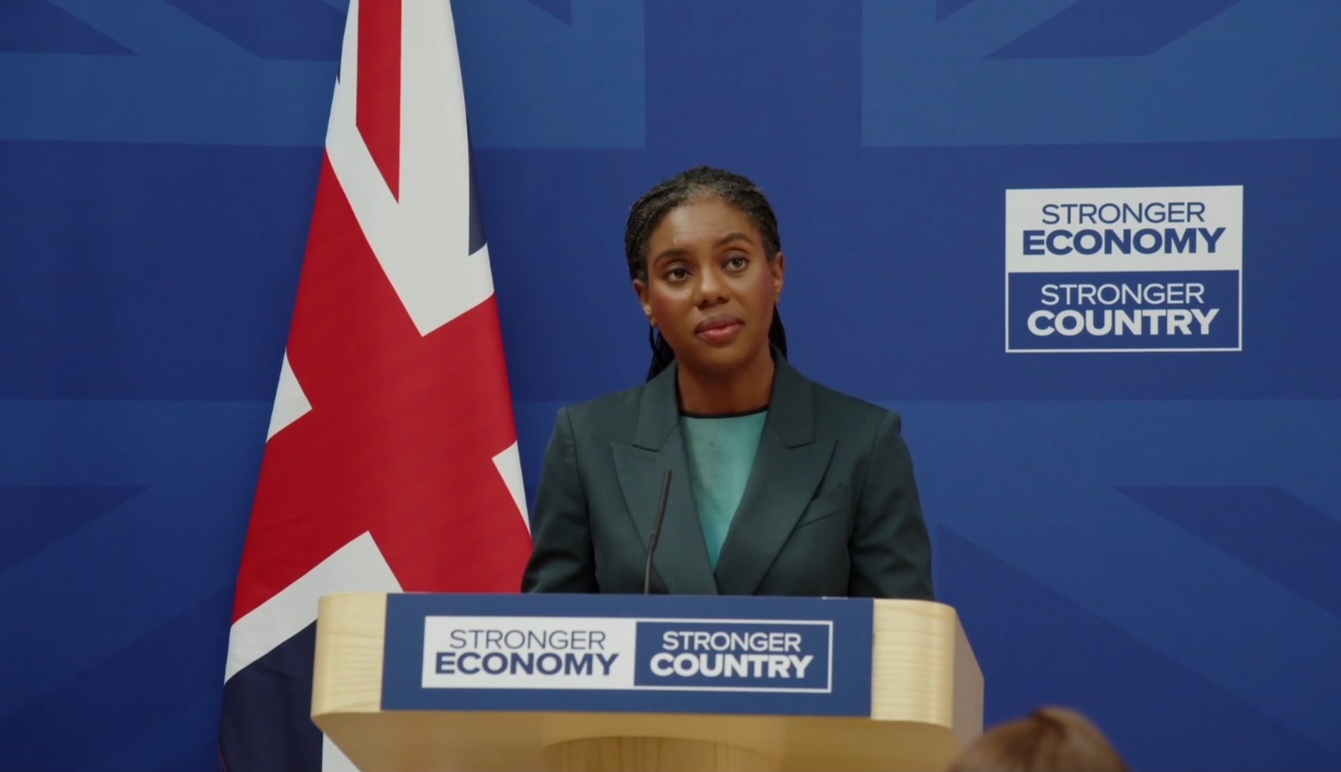
Kemi Badenoch has said Britain must increase defence spending to 3 per cent of GDP by 2030, warning that the country could face a major conflict within the next four years and arguing that higher military spending can no longer be delayed.
In a speech on Britain’s defence on Thursday, the Conservative leader linked the spending requirement to Russia, cyber attacks, threats to critical infrastructure and wider instability, while setting out the case for the £10 billion annual increase in defence spending announced by her party.
Badenoch said: “Before the summer, Keir Starmer was given intelligence that Russia could launch an attack on NATO as soon as 2030. Not enough politicians in Parliament have fully appreciated what that means. By that of course I mean Labour politicians. What this means that within the next 4 years, the UK could be at war with the world’s biggest nuclear armed state. Because under Article 5, an attack on any NATO country is an attack on all of them.”
She also referred to Russian naval activity around Britain and threats to undersea infrastructure, saying: “Vladimir Putin has called Britain Russia’s number one enemy. Russian warships have been sailing through the English Channel and the undersea cables which power our internet and power our entire information and communication network have come under threat. People may not see it in their day to day lives, but hostile states are constantly pushing the boundaries with unconventional warfare.”
Badenoch argued that national security needed to encompass more than conventional military forces, pointing to cyber security, energy infrastructure and national resilience.
She said: “National security is not just about tanks, boots on the ground and planes in the air. It is about our cyber defences, it is about our energy security, it is about our country’s resilience. National security does not just happen we also have to pay for it, and that means spending more money on defence.”
The Conservative leader compared the UK’s position with increased defence investment elsewhere in NATO, citing Poland’s expansion of its armed forces and higher German defence spending. She also referred to Greece already spending around 3.5 per cent of GDP on defence.
Badenoch said: “Being an island might make us feel safer, but it does not prevent conflict from coming to us. And let’s be honest, conflict is coming. We must act now. Because the defence of the nation is the first duty of government.”
She called for defence spending to rise every year until reaching 3 per cent of GDP by 2030, saying: “We need to increase our defence spending every year so we can get to 3% of GDP by 2030, anything after that is too late.”
The Conservatives have proposed increasing annual defence expenditure by around £10 billion by 2029/30 compared with current government plans. The party says the increase would be funded through welfare reductions and reallocating money from other areas of government expenditure, including civil research and development, the British Business Bank and the National Wealth Fund.
Badenoch said: “Finding the money to pay for defence means making tough choices, it means making difficult trade-offs.”
She added: “We have now completed our work to get to 3%.
“And today my team have set out our plan to remove the housing benefit and remove the VAT exemption for Motability, alongside savings from the disastrous Chagos Deal,
“And repurposing money from the British Business Bank into defence, we will be able to hit that 3% target.
“And let’s be clear, 3% is the minimum our country needs to stay safe.”
The speech also connected defence policy with the wider state of the economy, with Badenoch arguing that Britain’s ability to sustain greater military expenditure depends on controlling borrowing and public spending.
She said: “Defence is not separate from the economy. Fiscal responsibility is part of national security.”
Badenoch also repeated the Conservative proposal for a £17 billion Sovereign Defence Fund, which the party says would support military readiness and investment in the British defence industrial base.
The Labour Party was approached for comment on Badenoch’s remarks and the Conservatives’ defence spending proposals, but had not responded at the time of publication.
Closing the defence section of her speech, Badenoch said: “Russia will attack a country it thinks is weak. It will not attack a country it knows is strong.
“We need to be strong. If you want peace, you prepare for war.”









By 2030?!?!??!
Should’ve been prepared for now.
As well as being already promised and desperately needed it’s an good way of pressuring the current government.
Thanks Kemi. I thoroughly trust the Conservatives and their satellite party with defence. Their record has been incredible.
Pity the Tories didn’t do anything about it when they were in power. At least the numbers under Labour are (very) slowly starting to improve: ‘When the Conservatives came to power (May 2010): ~178,400 (full-time trained strength approx. 173,900 regular personnel plus Gurkhas and reserves).When Labour took over (July 2024 election / mid-2024): ~137,000 to ~147,000 (full-time trained strength was roughly 134,000–137,000; total full-time personnel around 147,000).Size today (Latest 2026 data): ~148,600 (total full-time trained and untrained personnel as of April 2026), or ~182,050 when including broader service personnel metrics like all reserves and auxiliary categories.’
We have never bee prepared for war, so no point pretending we can be ready now. We’re going to have to ask nice Mr. Putin to wait until the government and MOD have carried out all their surveys, calculations and postponements. Post 2040 looks a possibility.
The decline in the armed forces has not happened in the last 2 years. It was 14 years of cuts with the Tories
Any Tory leader should apologies for the mess.
Rebuilding them is not easy with interest rates and inflation putting pressure on Government finances due to the USA war with Iran plus the mad level of spending on AI from the likes of American Tec’s.
Some how Labour needs to find the money to re-build them as matter of urgency.
Sorry, although all sounds nice, reality is your party has not a leg to stand on regards this subject.
Very easy to vow whatever when your in opposition.
There’s that magic year 2030 yet again🙄
Yesterday Nigel Farage turned up at Parliament to take the loyal oath, which he did to loud groans from the assembled Members. As is his wont when heckled, he scowled, then left the House without waiting for more abuse
During the session in the House of Commons yesterday Reform UK’s Deputy Fuhrer “Tricky Dicky” Tice got a question and asked our new Prime Minister Andy Burnham when the government would approve drilling licences for North Sea oil and gas fields, specifically mentioning Rosebank and Jackdaw.
Of course, Tice and his net stupid Reform limited company – in which Tice has a 27% stockholding – are heavily funded by Big Oil.
PM Burnham told Tice that he “really does need to look into the facts a little bit more before he makes statements like that in this House”
To prove how renewable energy and the green transition drastically lower the cost of living, the PM used the rollout of electric buses in Greater Manchester (referencing his previous initiative as mayor) as a direct cost comparison – It costs just £30 to charge an electric bus, while It costs £200 to fill up an equivalent tank of diesel. Tice grimaced – and sat down.