

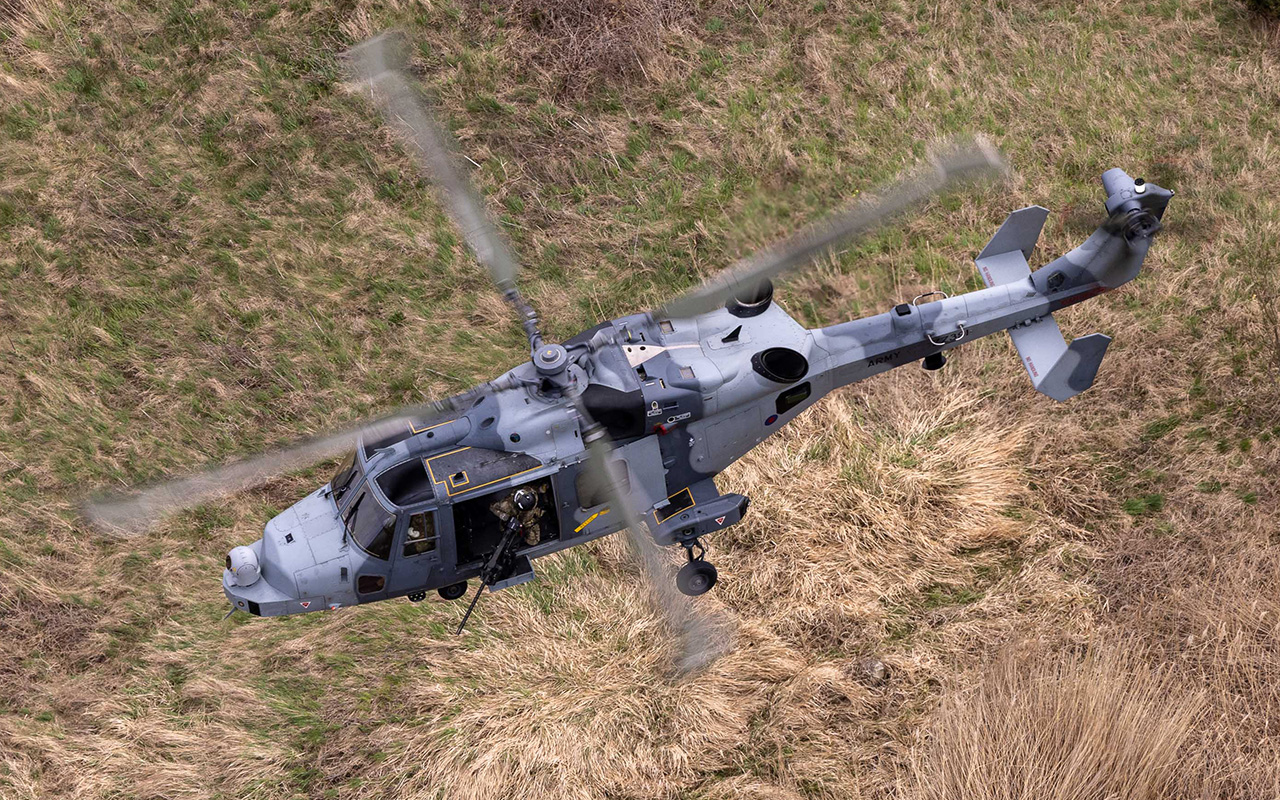
The Ministry of Defence is examining possible uses for the Army Air Corps’ Wildcat AH1 helicopters after their planned withdrawal from service from 2027, but has declined to say whether aircraft could be retained for new operational roles, transferred elsewhere or used as a source of spares.
Defence Minister Luke Pollard set out the position in two written parliamentary answers to Liberal Democrat MP Gideon Amos, following the decision announced in the Defence Investment Plan on 30 June to begin withdrawing the Army’s Wildcat AH1 fleet from 2027.
Amos asked whether Defence had assessed alternative uses for the aircraft, including employment as airborne command-and-control platforms for uncrewed systems, transfer to support Royal Marines littoral operations, and further work involving crewed-uncrewed teaming and counter-drone capabilities.
Pollard replied: “Further to the Defence Investment Plan announcement of 30 June 2026, Defence continues to examine options associated with the planned withdrawal of the Wildcat AH1 fleet from service from 2027. Work is being undertaken to understand potential opportunities, and it would be inappropriate to comment further while this work remains ongoing.”
The same response was given to a separate question asking what would happen to the airframes following withdrawal and, specifically, whether any could be retained to provide certified spare parts for the Royal Navy’s Wildcat HMA2 fleet. The answer confirms that disposal arrangements have not yet been publicly settled and that Defence is still looking at opportunities connected with the aircraft, although the MOD did not confirm that any of the individual options raised by Amos are themselves being pursued.
Among the possibilities put to ministers was retaining Wildcat AH1 in an alternative operational role as an airborne command-and-control platform coordinating uncrewed systems. Amos also pointed to work conducted by Leonardo, the Defence Science and Technology Laboratory and the Royal Navy involving crewed-uncrewed teaming and counter-drone capabilities on the Wildcat platform.
A second proposal raised in the question was the possible transfer of airframes to support Royal Marines littoral operations, rather than removing the aircraft entirely from military use once the Army fleet is withdrawn.
The future of the helicopters could also have implications for the Royal Navy’s Wildcat HMA2 force. Amos asked whether withdrawn Army aircraft might be retained as a source of certified components for the naval fleet, but Pollard did not disclose whether this is among the options being considered.
The AH1 and HMA2 are variants of the same Wildcat family, with the Army aircraft operated in the battlefield reconnaissance and utility role while the Royal Navy version is configured for maritime operations.



Option A don’t retire them!
Exactly , too bad the lunatics are running the asylum at the moment
It won’t happen mate, that would mean getting Leonardo to develop and integrate new equipment into the aircraft at huge expense…
We all know why they are being withdrawn, it was a simple radical fleet defence cut, they will be withdrawn, stripped for FAA spares, with 10 ish of the lowest houred airframes mothballed for potential conversions to Naval variants, if deemed necessary or funded.
They won’t be selling them as absolutely nobody wants them.
Should be transferred and modified to HMA2 for the FAA
What a crap show! Extend or transfer to the RN to keep/ develop mass and aircrew experience – anything else is a joke cut (another)
I thought these were relatively new?!?!
Still excellent Helicopters.. Crazy to retire them from the AAC. Hope they can use some of them for another purpose.
Does Ireland want some Helicopters for their air corps? Offer them these, the remaining ones, we can use for initial training the RN pilots and as such, retain the HMA2 versions for the missions
Might as well get rid. There’ll be no army soon anyway. No armour, no cavalry, no artillery. precious, little heavy lift soon probably and it’s been announced today that Reserve Army training is to be cut by up to 30 per cent. Labour at it’s best!