

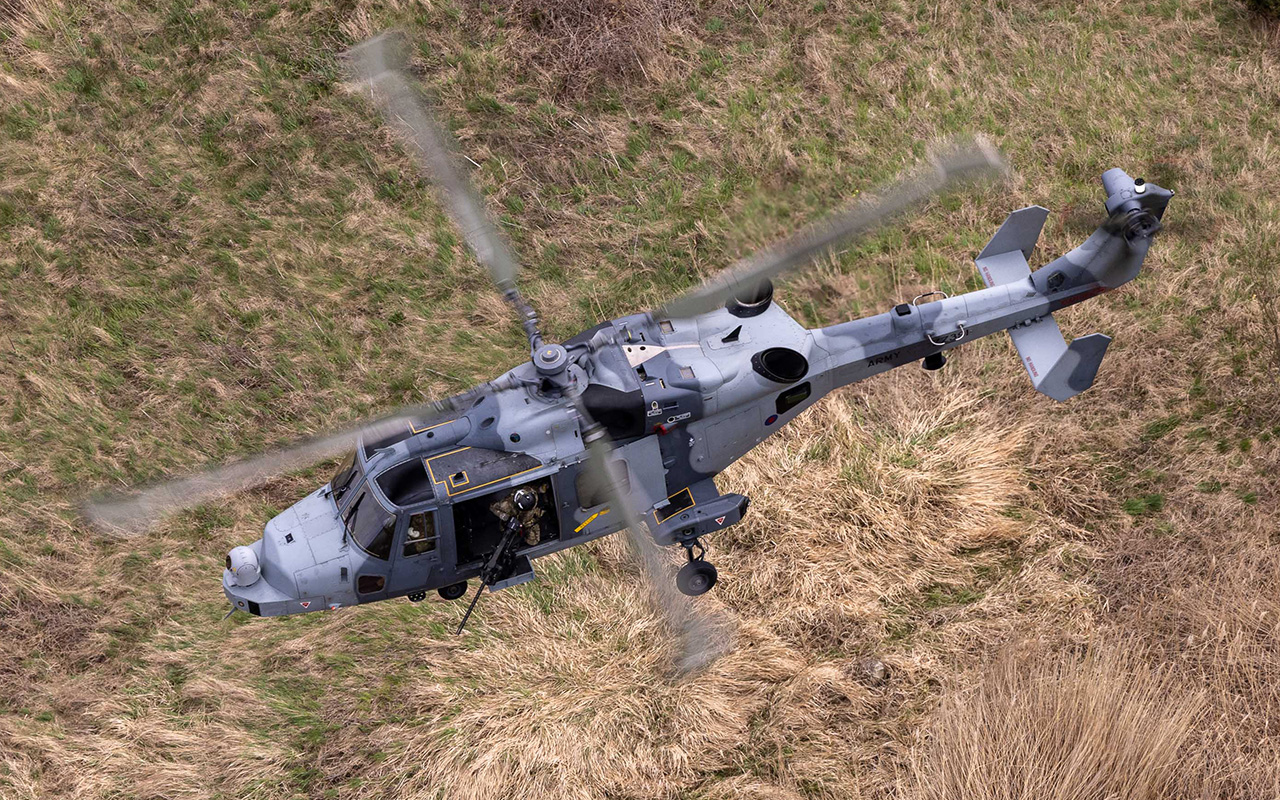
The Ministry of Defence is examining possible uses for the Army Air Corps’ Wildcat AH1 helicopters after their planned withdrawal from service from 2027, but has declined to say whether aircraft could be retained for new operational roles, transferred elsewhere or used as a source of spares.
Defence Minister Luke Pollard set out the position in two written parliamentary answers to Liberal Democrat MP Gideon Amos, following the decision announced in the Defence Investment Plan on 30 June to begin withdrawing the Army’s Wildcat AH1 fleet from 2027.
Amos asked whether Defence had assessed alternative uses for the aircraft, including employment as airborne command-and-control platforms for uncrewed systems, transfer to support Royal Marines littoral operations, and further work involving crewed-uncrewed teaming and counter-drone capabilities.
Pollard replied: “Further to the Defence Investment Plan announcement of 30 June 2026, Defence continues to examine options associated with the planned withdrawal of the Wildcat AH1 fleet from service from 2027. Work is being undertaken to understand potential opportunities, and it would be inappropriate to comment further while this work remains ongoing.”
The same response was given to a separate question asking what would happen to the airframes following withdrawal and, specifically, whether any could be retained to provide certified spare parts for the Royal Navy’s Wildcat HMA2 fleet. The answer confirms that disposal arrangements have not yet been publicly settled and that Defence is still looking at opportunities connected with the aircraft, although the MOD did not confirm that any of the individual options raised by Amos are themselves being pursued.
Among the possibilities put to ministers was retaining Wildcat AH1 in an alternative operational role as an airborne command-and-control platform coordinating uncrewed systems. Amos also pointed to work conducted by Leonardo, the Defence Science and Technology Laboratory and the Royal Navy involving crewed-uncrewed teaming and counter-drone capabilities on the Wildcat platform.
A second proposal raised in the question was the possible transfer of airframes to support Royal Marines littoral operations, rather than removing the aircraft entirely from military use once the Army fleet is withdrawn.
The future of the helicopters could also have implications for the Royal Navy’s Wildcat HMA2 force. Amos asked whether withdrawn Army aircraft might be retained as a source of certified components for the naval fleet, but Pollard did not disclose whether this is among the options being considered.
The AH1 and HMA2 are variants of the same Wildcat family, with the Army aircraft operated in the battlefield reconnaissance and utility role while the Royal Navy version is configured for maritime operations.





Option A don’t retire them!
Exactly , too bad the lunatics are running the asylum at the moment
It won’t happen mate, that would mean getting Leonardo to develop and integrate new equipment into the aircraft at huge expense…
We all know why they are being withdrawn, it was a simple radical fleet defence cut, they will be withdrawn, stripped for FAA spares, with 10 ish of the lowest houred airframes mothballed for potential conversions to Naval variants, if deemed necessary or funded.
They won’t be selling them as absolutely nobody wants them.
Why exactly does nobody want them John. Can they not compete in a battlespace dominated by drones?
John has just got a major chip on his shoulder about Leonardo/ Yeovil
Hmmm, harsh but fair Simon.
To be fair, im an ecumenical abuser, happy to call out any and all MIC bullshit that fleeces the taxpayer and leaves are armed forces worse off, wherever I see it.
Exactly.
The MIC, jobs and profit are the priorities.
Not the military.
I’ll never stop believing in that as long as the forces continue to shrink as the MIC profits expand and ministers talk of nothing but engines for growth and jobs.
Morning Mark, that’s the question isn’t it really, its sales record ( or lack of) speak for itself.
In It’s basic Army utility form, its too small to be of any real utility, in its Naval form its a capable platform, but lacks ASW equipment, again lacks usfull general utility.
Basically its a helicopter that should never have been built in the first place, no real sales prospects unlike the excellent Lynx that proceeded it.
In naval use should have been ordeted to same spec as S Korean version. Some anti-sub utility for type 31’s
True Pete, but not funded fir the RN, also I beleve it reduces its already limited general utility to zero.
Is the equipment quickly dismounted?
Or even type 26. Carry 1 x merlin anti sub. Carry 1 x widcat..utility and anti ship. Having said that…using the army wildcats for support of RM probably best.
Germany is buying helicopters in this class with long range ATGMs to replace their Tigers.
Not retiring from the army is the wrong decision. In an era of drones, a helicopter is not the right platform for recon. These were redundent for their main role before they even entered service.
Saying that they do have a role in sub hunting and maritime light attack or marine close protection if up armed. I just hope they aren’t just scrapped or flogged off.
You may well be right, I am just concerned that platforms deemed on paper redundant prior to a conflict have often proved very useful when the realities of a conflict bite and pre-conceived plans and expectations fall apart. Lots of stuff deemed redundant after all is becoming extremely useful in Ukraine.
I think it’s more being redundant for the role it was brought for. Ukraine has been creative with old gear, using them in new and novel ways. However if money is tight and that alternative solution hasn’t yet been found, I have no issues with putting them in a warehouse somewhere until it does. Just don’t want them to be scrapped.
perfect idea Jacko!
Should be transferred and modified to HMA2 for the FAA
What are the differences between the two variants? Converting them and either putting into storage to cover losses or using with the navy seems the most sensible option.
HMA2 basically has a better sensor and weapons-fit, it carry’s Leonardo Seaspray and is capable of carrying x20-LMM, x4 Sea Venom and Sting-Ray Torpedo, Depth Charges. But I’m pretty sure having these weapons fitted on the pylons affects troops using the side doors.
The RN can make better use of them as attack helicopters/light utility/sensor if some are converted, put into storage or used as spares.
This whole 2035 OSD Is confusing though… Not a chance they will ditch AW159 and AW101 5 years later with ‘drones’.
Attack helicopter… in the age of drones? Why that role specifically
What drone do you suggest replaces this then?
I say the role attack helicopters because they lack any decent utility, LMM is great for smacking drones, Sea Venom for small ships/fast attack craft or drones lol, and sea venom/depth charges, they could also be fitted with dipping sonar.
We operate 5 helicopter types at the moment…
Chinook (RAF)
Merlin (Royal Navy)
Wildcat (Navy & Army)
AH64E (Army) Bear in mind the army seems to think ‘in the age of drones’ brand new attack helicopters are worth the money.
Dauphin (Army SF)
and from 2030+ AW149…..
maybe it’s time to reduce that and have a bit of commonality between all 3 services, but what do i know.
What a crap show! Extend or transfer to the RN to keep/ develop mass and aircrew experience – anything else is a joke cut (another)
I thought these were relatively new?!?!
Still excellent Helicopters.. Crazy to retire them from the AAC. Hope they can use some of them for another purpose.
They entered service between 2014-15. I was likewise really surprised to learn they were already bieng taken out of service.
Does Ireland want some Helicopters for their air corps? Offer them these, the remaining ones, we can use for initial training the RN pilots and as such, retain the HMA2 versions for the missions
They’re too light for the planned 139 replacement.
Might as well get rid. There’ll be no army soon anyway. No armour, no cavalry, no artillery. precious, little heavy lift soon probably and it’s been announced today that Reserve Army training is to be cut by up to 30 per cent. Labour at it’s best!
At the same time, Streeting was imploring a reporter that the UK must pull together as a society incase of war.
Give with one hand, cut with the other.
Another report has 1 billion plus cut from Army funding to give to…..yes, the money absorbing GCAP and DNE.
Anything that creates jobs over conventional force size expansion.
Same old story if true.
When did the “give” bit happen Daniele? I missed it. 🙃
Funny enough £1b is what Burnham wants for battery powered trains ‘up north’🤔
Bloody madness but if it has to be, then commit them to the fire services around the UK to help fight wildfires in the coming years. The Government can’t bury its head in the sand on this one and needs to equip all fire services with the latest kit. A sharing of assets should also be considered on a wider spectrum with all three services to ensure availablility of equipment is at the fire service’s disposal. However, this must not wait until the Government’s defualt of 2030 to implement, as many towns and villages could burn in 2027 onwards due to extreme heat. All service helicopters not on duty should be dragooned to fighting wildfires and additional fire appliances should be ordered to suplyment current fleets.
This government has been burying it’s head in the sand since July 2024. Before that……. Good idea of yours though. 👍
Often get the impression the MOD is oblivious to the reality of war looming. Even in 10 years time we’d find we’re short of everything.
Seems mental to retire a nearly new medium helicopter fleet for the Army while spending a couple of billion on a new medium helicopter fleet for the RAF
That’s assuming the NMH goes to the RAF of course.
No assume about it😂the crabs actually wanted to fly apache! They abhor the fact the army flies anything and have campaigned about it for absolutely ages!
Would they then consider ordering a few more NMHs to compensate for a capacity loss in the overall helo fleet? Do they still think that having less is somehow more? What a colossal waste of relatively young helo stock and personnel. Order a few more T31s or new OPVs, maybe put hangars on the B2 Rivers and a top up the Wildcats for the RN to give a nice incremental helo lift and spread to the fleet.
What about transferring to the police or air ambulance?
The issue isn’t the airframe or capability, but the cost Leonardos imposes on the support solution which is both too costly and very badly managed by Leonardos , mainly with cost efficiency measures imposed on the UK operations by their Italian masters. The AH is pretty good airframe but the cost per flying hour is too expensive and the logistics and repair solution from Leonardos is very slow, inefficient and massively expensive making serviceability rates poor. Regarding converting to HMA not a realistic option as the platforms are pretty different for avionics and capability output. The cost would amaze people ! Retaining for the RM and use up North on Clockwork would be a possible option along with C2 for drones. Get rid off the NMH as this is capability that is way too long to be delivered (2032+)
Use them as drone hunters. The Ukrainians are having great success using far older and less well equipped cabs for drone killing.
In the end burning 30 almost new rotors is an insane waste of money…
IMHO the answer is a no brainer, simply to retain them. Then transfer them to FAA and add the THALES Splash dunking sonar. Use them to buddy up with the HMA2 for ASW, carry out RAS and even SAR, which reduces the airframe hours on the HMA2 or Merlins from doing the mundane !
Fact is when you count number of hanger spaces in the RNS and compare with the number of cabs a ailable, then take into account the value of each ship we need mass and an off board Extra Sonar is a real asset.
My question, is what are the AAC personnel from the Wildcat squadrons going to be doing once the aircraft have gone? Are they being transferred to other aviation roles, drone units perhaps?
The decision seems to be come about rather suddenly and rather short notice so is their something in the wings that no body is talking about? Probably not, but I am surprised the question has not been asked, at least not to my knowledge?
Cheers CR
I wondered that when it was first announced.
Fab for morale I’m sure. 🤏
Yeovilton will suddenly have a lot of space..
Well the forces are supposed to be getting hundreds and hundreds of drones so they’ll soon need all the space they can find, yeh right! 🙂
Cheers CR
What are they going to use for fast crew transfer between command and drone ships if anything happens?
Yeah, it says Army on the very first line. Oops. My mind went straight to naval. My mind has been like this all day.
Ship to Falklands PDQ!
May be some hope then, to use as Drone C2 hunters in the rear.
Do what the MOD always do, go with out, and do not replace its all this Government and the MOD have done. Retire things while there is no replacement we just go eith out and hope no notices or needs them. Fudge around it and say its better,
As there’s a naval version maybe give them to the RNLI?
Where do you get the idea that the RNLI want helicopters?
Faster and wider range rescue?
The RNLI are all volunteers, the Coastguard already operate the relatively new AW139 alongside some older types.
And how do you expect them to fund said helicopters? I mean its not government funded, and the UK (and Ireland since we are talking about the RNLI) already have Coastguard helicopter services.
You would think it wise to keep Wildcat in service until 2031, when the Aw149 arrive. South Korea fit their Wildcat with Spike NLOS. The Army says it wants long range strike.
They would never do that in a million years, because someone from the Treasury would then say we don’t need Apache anymore.
They would be different types of strike for different roles, but of course that would mean nothing to a spin doctor justifying another cut.
Exactly.
Another cut without replacement. From what I’m seeing on the outside, for decades now a number of civil servants at the Treasury look hell bent on butchering our brave forces to the bone. They are pulling all the strings, with the MOD and Government (Lab & Con) powerless to stop them doing so much damage. I never thought I’d have to ask the following question, but I have to now: Are there decision-making civil servants at the Treasury working for Russia? I really hope MI5 have already checked and keep on checking. If the answer is confirmed no then unfortunately being insane is not a criminal offence.
If you think Burgess, Philby, Maclean & Blunt were the only ones, then I have a bridge to sell you. The whole public sector is riddled with them (woke luxury communists who hate Britain).
News for you Conde and John.
HZMg sets the overall defence vote I.e. how much they can spend.
The services themselves set out their equipment plans, within their allotted budgets.Treasury
The Treasury – rightly – monitors the MOD spend as it does all.departmental budgets. The need to do so is self-evident, due to the MOD’s habit of understating programme costs and then ducking when large overruns occur.
The civil servants have little to do with the equipment procurement process, or at least they did until DES came along.
The proposal to withdraw Wildcat AH1.will likely have come from Joint Aviation.Command -.maybe their idea, for operational reasons maybe the army or the services looking to make a cut in order to switch resources to another programme.
This blame the Treasury, blame the civil servants routine is very handy for MOD Main Building, in that it allows them to pass the buck for their decisions onto people who really don’t have much to do with it.
No, it is beyond one layer. It is all layers. Politicians do little real thinking. If the options civil servants give them is skewed, most politicians are not smart enough to pick up on that.
Honestly what on earth are HMGs doing to our once proud Army of ours .🙄
Because if you want loyal wingman drones to fight with Apaches, and new long range precision strike missiles and drones /increased ISTAR for the Army. This is were some of the money comes from.
Government is skint, its just a money thing nothing else. Get rid of Puma and pretend theres something else coming in ten years. Get rid of Wildcat and a load of Chinook aswell. Desperate times. Financial crisis incoming.
It’s odd to be cutting a fleet which is relatively young, but we do have form for it! Sea Harrier FA2, Harrier GR9, Watchkeeper, Sentinel…
However, while the Wildcat is the ultimate hoonmobile, it has limitations in both Army and Naval service. The “austere” sensor fit-out on the AH1 does raise questions over how it can perform the recce role in the modern era, and for rear echelon drone hunting it’s probably too complex/expensive, you’d be better off with a militarised EC145.
The naval version also has its foibles – the lack of datalink being the most obvious, but also the clunky integration of Martlet which renders the missile unusable except against the most willing of targets.
Could Wildcat fulfill the NMH role? That would depend on how 16 Air Assault want to use them/would be willing to accept a smaller cab. Seems a stretch though, when you consider the Puma that has gone, and the NMH candidates on offer originally (Blackhawk, AW149, H175).
Even if they felt that the smaller, more agile chopper met their needs, would they be allowed by HMG, given the importance of keeping Westland/Leonardo going in the southwest?
For the recce role, properly networked UCAS seem the logical solution.
What’s clunky about the Martlet integration? Is it less capable than comparable systems, like APKWS II, or FZ 275?
It looks more versatile, with better sensors than the MANPAD integration as LMM… and that is for downing manoeuvring drones, helos and jets, isn’t it?
As Martlet, it’s for engaging small surface craft, and now UAS, right? Is there a report on the limitations of the system somewhere? I’d seen some articles about it engaging USVs and even jet-powered Banshee in trials.
I believe Leonardo and Thales were having maritals over weapon integration so there’s a specific launch process involving flight control input you have to do before firing each missile in turn. This makes it impossible to ripple fire, and interrupts motion of the helicopter. It’s also a significant “tell” to your enemies that you are about to fire. Combined with the beam riding targeting, it also means you’re likely to run out of fuel before you launch all 20 missiles. The bat wings also create manoeuvrability issues in certain scenarios as well, I believe (although in fairness the idea of mounting 10 Martlets on one wing is probably more to do with enabling asymmetric loading, which therefore allows the .50 cal and the winch to be fitted and used, than it is about a theoretical beast mode).
It’s probably fine for taking out a surface craft who don’t have, provided no one on it has a couple of Stingers on board that they can shoot at you then scooting off while you are still preparing to launch, or if a drone is flying by slowly enough then you could take one of those out. But it’s not going to be useful downing drone swarms unless the enemy launches each drone at sufficiently large intervals. And a swarm of fast boats each equipped with manpads would be dangerous.
The Wildcat’s lack of datalink means the Flight Commander will have to make the call on engaging a target, meaning ID’ing an aircraft or boat using the onboard sensors, rather than taking a feed from offboard sensors such as drones, stand-off recce aircraft, etc so that also means the Wildcat will be in an increased state of vulnerability while an enemy combatant can clearly identify a batwing Wildcat as a hostile force and either engage or run away.
The fact that APKWS II is equipped on a range of aircraft from helicopters to supersonic fighter jets shows they have no foibles around readying the rocket/missile, which allows multiples can be launched at the same target, and if they proceed with creating a dual mode seeker, that would enable multiple targets to be engaged simultaneously, albeit putting up the price of the rounds.
If the Army were going to keep the AH1s for rear echelon drone hunting, or the MOD were going to transfer the AH1s to the Navy to act as a light attack/utility helicopter (the Lynx’s original Cold War role) for the Royal Marines, they’d be better off trying to integrate the Hydra/APKWS II launcher from the UH1Y Venom. They would have a more versatile weapon, they could potentially operate two .50 cal machine guns and the winch, too, and they would be able to fully utilise the fantastic performance of the Wildcat, esp in the drone hunting role. But please do add a datalink, we’re well into the 21st century now!
Brazil is offering £1.60 and a bus tour around Brasilia if that helps?
Might be a good shout?
Only problem is they have a condition that they must be refurbished first – though I’m sure the MOD can facilitate that.
AAC Wildcat to be retired well before their end of life and presumably without replacement. So has the army decided that it no longer wants a helicopter to conduct battlefiled recce, many different Utility tasks and act as a wingman to Apache? What will they use for such functions when Wildcat is gone?
A loyal wingman drone is being developed to operate with Apache.
Keep them.
They have put Apaches on the carriers in the past. Use the wildcats instead. light attack helicopters to support amphibious landings. The US marines still use Cobras. Why can’t the Wildcats still be used in the attack role?
Why not? Give them to the RM and put them on the upcoming MRSS ships.
Uk inc … SIDAGTMBTTS!
Bargain buy for someone: Pakistan, Phillipines?
While not really a suitable or wanted platform by the Army on its initial in service, we need this in service, even if its role can be developed. It may not be the best, but once its gone, its gone and yet again you reduce military options, not for tactical or strategic reasons, but for financial reasons.
Against enemy A2AD and attack UAS, the Wildcat’s deep role – recon over and behind enemy concentrations or lines – is no longer a practical option. That role can best be done in the future by UAVs, the loss of which is less critical.
But it would be a serious mistake to scrap them, when they are a capable platform with many years of service before them.
The best option I believe would be to re-role then as light attack army helicopters. We have new Apaches in the attack rotary role, but we only have enough, 24 frontline (excluding the RM squadron), to support 3 Divison. We have nothing spare to support 1 Division.
It would be simple enough to fit weapons pylons to the AH1s to give an attack helicopter capability as least equal to the Navy’s Wildcat version. Next to Germany ordering Jupiters for the attack rotary role, the Wildcat would be a few steps ahead as a light attack asset. The army is short enough of equipment as it stands, we can’t afford to withdraw useful assets like this and the two AAC Wildcat combat squadrons.
Why are we too lazy or too greedy to refurbish perfectly good air frames.