

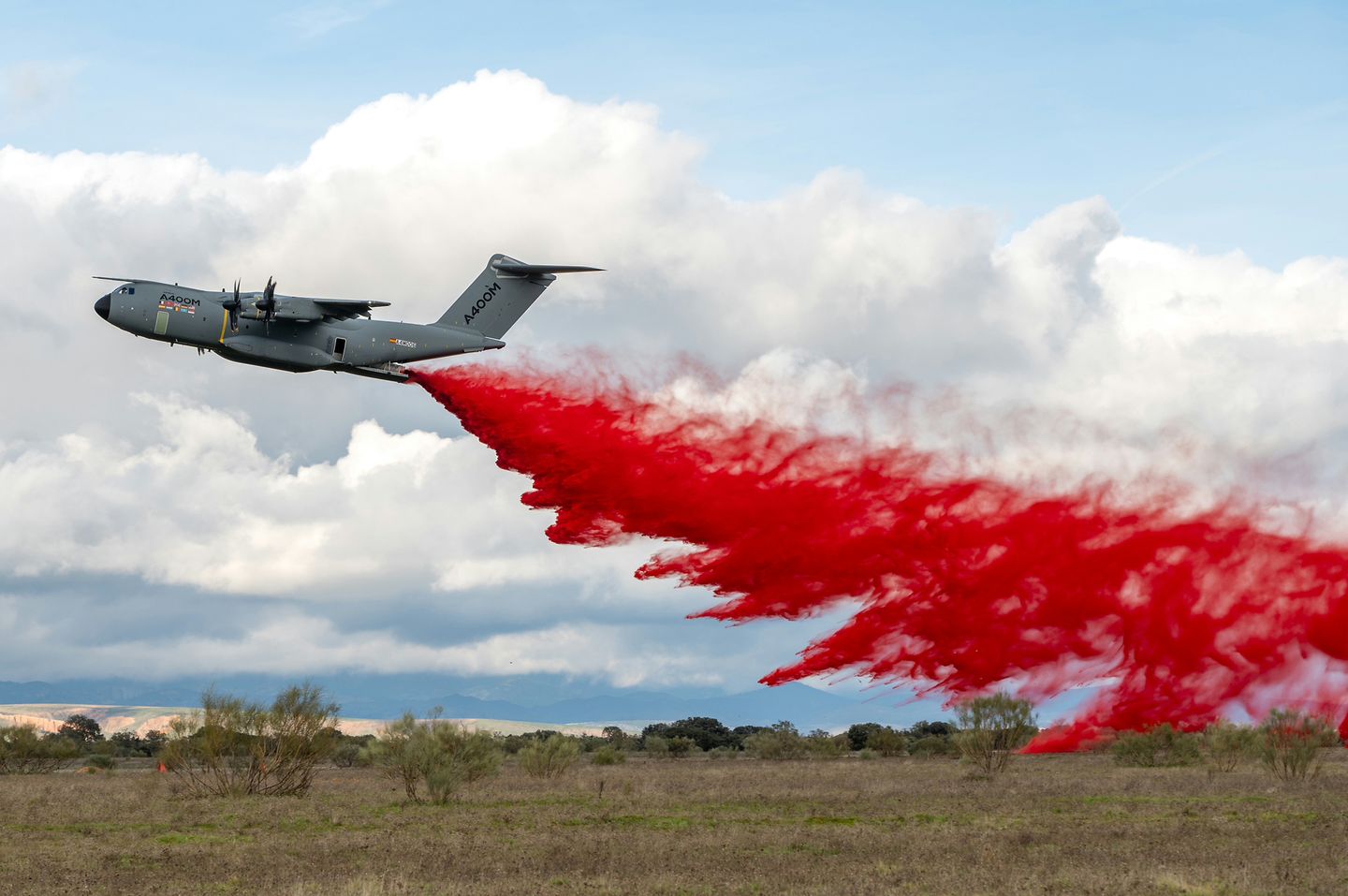
The Ministry of Defence has ruled out adapting the RAF’s A400M Atlas fleet for aerial firefighting, despite being aware of an Airbus system currently under development for the transport aircraft.
The position was set out by Defence Minister Louise Sandher-Jones in response to a written parliamentary question from Labour MP Neil Duncan-Jordan, who asked whether the RAF’s A400M fleet could be used as firefighting tankers. Sandher-Jones said responsibility for tackling wildfires in the UK rests primarily with civilian authorities and emergency services, although military support can be made available through Military Aid to the Civil Authorities arrangements where appropriate.
She said: “Responsibility for responding to wildfires in the UK rests with the relevant civil authorities and emergency services, with military support potentially available where requested through established Military Aid to the Civil Authorities (MACA) arrangements on a case-by-case basis.”
Any such request would be considered against several factors, including whether civilian authorities had exceeded their own capacity and whether Defence could provide support without affecting operational commitments or readiness.
Sandher-Jones said: “This includes consideration of a clear need for military assistance, whether the requirement is beyond the capability or capacity of the civil authority, and whether support can be provided without unacceptably prejudicing Defence’s primary tasks, operational commitments, and readiness.”
The MOD does not currently maintain a dedicated domestic fixed-wing aerial firefighting capability and has no requirement to establish one. It does, however, retain a limited helicopter-based firefighting capability overseas, specifically in Cyprus, where Defence has standing responsibilities connected to the Sovereign Base Areas.
Sandher-Jones said: “The Ministry of Defence does not currently hold a requirement to provide a dedicated domestic aerial firefighting capability (including a fixed-wing aerial firefighting capability). However, Defence retains limited aerial firefighting capabilities to support standing tasks overseas.”
She added: “As part of this, Defence maintains a helicopter-based aerial firefighting capability in Cyprus for the specific purpose of meeting our obligations to the Sovereign Base Areas and wider communities during periods of heightened wildfire risk.”
The minister also confirmed that the department has not carried out a specific assessment of the consequences of not having a dedicated military firefighting aircraft fleet. The answer also directly addressed the A400M, confirming that the department is aware of the firefighting system being developed and tested by Airbus for the aircraft.
Airbus has been working on a roll-on, roll-off firefighting kit designed to allow the A400M to carry and release large quantities of water without permanently modifying the airframe. Despite that work, the MOD has no current plans to equip the RAF fleet for the role.
Sandher-Jones said: “The Department is aware of the Airbus A400M aerial firefighting system currently under development and testing by the manufacturer. Consequently, the Department has no plans to adapt the RAF A400M Atlas fleet for aerial firefighting purposes, or to procure dedicated water-bombing helicopters or water-bombing equipment for the military helicopter fleet.”
The response leaves the UK’s domestic wildfire response centred on civilian emergency services, with military assistance remaining available only through existing MACA arrangements rather than through a dedicated Defence aerial firefighting force.



Disappointing to know that the UK has no plans for either military fixed wing or rotary fire fighting capability at home.
The limited number of strategic airlift aircraft must be a factor without mentioning taking on more non-military takings?
However, this clearly places the responsibility on the devolved governments, national and local, to come together and create some form of civil defence planning covering fighting wildfires from the air.
To be fair it would seem more relevant for the military to focus on their primary objective and not get distracted.
Further down the line if the emergency services what to purchase kit which could be used by the military in an emergency then that would be an interesting compromise.
British governments of all flavours have known climate change will bring Mediterranean weather to these shores for over a decade. In that time, it’s invested in zero firefighting water bombers. I can only assume it thought that when the time came, it would ask an EU neighbour for help. The problem is that if we need that help, they will also be in the position of using their own planes. Short-sightedness for the UK government, again!