

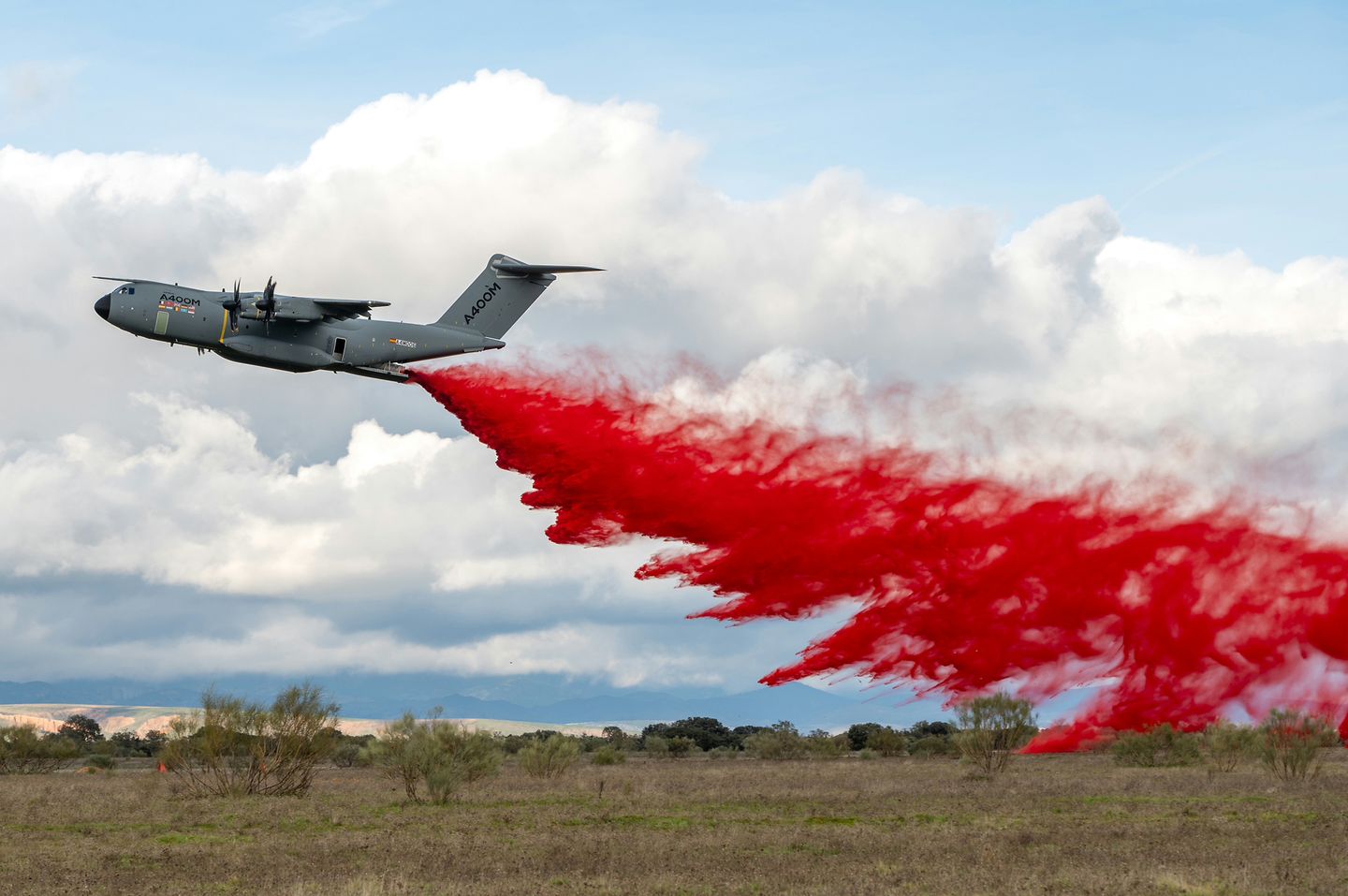
The Ministry of Defence has ruled out adapting the RAF’s A400M Atlas fleet for aerial firefighting, despite being aware of an Airbus system currently under development for the transport aircraft.
The position was set out by Defence Minister Louise Sandher-Jones in response to a written parliamentary question from Labour MP Neil Duncan-Jordan, who asked whether the RAF’s A400M fleet could be used as firefighting tankers. Sandher-Jones said responsibility for tackling wildfires in the UK rests primarily with civilian authorities and emergency services, although military support can be made available through Military Aid to the Civil Authorities arrangements where appropriate.
She said: “Responsibility for responding to wildfires in the UK rests with the relevant civil authorities and emergency services, with military support potentially available where requested through established Military Aid to the Civil Authorities (MACA) arrangements on a case-by-case basis.”
Any such request would be considered against several factors, including whether civilian authorities had exceeded their own capacity and whether Defence could provide support without affecting operational commitments or readiness.
Sandher-Jones said: “This includes consideration of a clear need for military assistance, whether the requirement is beyond the capability or capacity of the civil authority, and whether support can be provided without unacceptably prejudicing Defence’s primary tasks, operational commitments, and readiness.”
The MOD does not currently maintain a dedicated domestic fixed-wing aerial firefighting capability and has no requirement to establish one. It does, however, retain a limited helicopter-based firefighting capability overseas, specifically in Cyprus, where Defence has standing responsibilities connected to the Sovereign Base Areas.
Sandher-Jones said: “The Ministry of Defence does not currently hold a requirement to provide a dedicated domestic aerial firefighting capability (including a fixed-wing aerial firefighting capability). However, Defence retains limited aerial firefighting capabilities to support standing tasks overseas.”
She added: “As part of this, Defence maintains a helicopter-based aerial firefighting capability in Cyprus for the specific purpose of meeting our obligations to the Sovereign Base Areas and wider communities during periods of heightened wildfire risk.”
The minister also confirmed that the department has not carried out a specific assessment of the consequences of not having a dedicated military firefighting aircraft fleet. The answer also directly addressed the A400M, confirming that the department is aware of the firefighting system being developed and tested by Airbus for the aircraft.
Airbus has been working on a roll-on, roll-off firefighting kit designed to allow the A400M to carry and release large quantities of water without permanently modifying the airframe. Despite that work, the MOD has no current plans to equip the RAF fleet for the role.
Sandher-Jones said: “The Department is aware of the Airbus A400M aerial firefighting system currently under development and testing by the manufacturer. Consequently, the Department has no plans to adapt the RAF A400M Atlas fleet for aerial firefighting purposes, or to procure dedicated water-bombing helicopters or water-bombing equipment for the military helicopter fleet.”
The response leaves the UK’s domestic wildfire response centred on civilian emergency services, with military assistance remaining available only through existing MACA arrangements rather than through a dedicated Defence aerial firefighting force.





Booooooring. Uncool.’
Perhaps it’s a sleight of hand and they are actually buying one for C17 😉
C-17 doesn’t have one to utilise.
Disappointing to know that the UK has no plans for either military fixed wing or rotary fire fighting capability at home.
The limited number of strategic airlift aircraft must be a factor without mentioning taking on more non-military takings?
However, this clearly places the responsibility on the devolved governments, national and local, to come together and create some form of civil defence planning covering fighting wildfires from the air.
To be fair it would seem more relevant for the military to focus on their primary objective and not get distracted.
Further down the line if the emergency services what to purchase kit which could be used by the military in an emergency then that would be an interesting compromise.
They have used the Army for flood management.
Yes they have, but only in providing transport to move equipment and personnel to deploy said equipment, or using “military bridging equipment” to temporarily replace crossing damaged by flooding. The Military does not hold any “flood prevention” equipment per se.
Fair point.
Army personnel and equipment has been used for flood management.
British governments of all flavours have known climate change will bring Mediterranean weather to these shores for over a decade. In that time, it’s invested in zero firefighting water bombers. I can only assume it thought that when the time came, it would ask an EU neighbour for help. The problem is that if we need that help, they will also be in the position of using their own planes. Short-sightedness for the UK government, again!
…on the other hand…devil’s advocate and all that…this might come out of the mod spend purse, unnecessarily?
Perhaps water bags for chinooks an alternative standby?
AA
Good for localized fires but huge wildfires spread over acres require canadairs or something bigger. Not sure how prevalent huge wildfires are in the UK though
This summer has been pretty bad. It was mostly dry moors.
a bit shortsighted esp. when fires are more likely with rising temps. the kits are not that expensive esp when the RAF already has a fleet of A400. also much cheaper to add that capability to A400 then to buy dedicated aircraft that cost much more than the kits (obv those specialized aircraft cost much less than A400)
although there are no official prices for the RORO kit, it is estimated by analyst to cost between €3m and €6m. hardly breaking the bank, esp when you factor in possible human loss and property damage.
ofc other countries could send some aircraft in case of emergency, but that also depends if they don’t have wildfires of their own to handle.
I see their point with a big ‘but’ – this strict demarcation between military and civilian use can be a big disadvantage. If these planes can serve a double function – why not, with civil authorities paying towards the cost? I’m not putting this as a specific thing – examples could include military hospitals and ambulances having a peacetime use for example – have more military facilities available for civilian use but in wartime they become military assets.
As far as I can tell, the military leadership prefer to shy away from this kind of thing. They’re too busy pretending to be relevant.
Summers are only set to be as bad if not worse than this years. Longer term, large aircraft capable of fighting fires will be a necessity. Expecting devolved ‘bits’ of the UK to fight their own fires, needs a complete rethink.
A centralised base of operations when the UK can pool firefighting resources it’s what’s needed.
Buckets it is then. When it is finally decided we need proper rotary and fixed wing fire fighting aircraft we will place an order and find the delivery date is years away. It is taking years for a 2nd air ambulance for our area to be delivered by Leonardo so God knows how long the wait is for fire fighting aircraft if we want anything more sophisticated than a bucket on a string.
In the end this is not a military role. So why should the military spend money on it.
This I’m afraid is the classic uk response of refusing to spending any money on civil defence and civil contingencies.. making an assumption that “it just won’t happen” or “ it won’t happen on my watch so why should I pay for it”.. this I’m afraid has been the default of this country since 2010.
The truth is significant wild fires are a far greater risk now .. so we need to adapt our civil contingencies….
Handwringing…..everything is so expensive…..looks expensive till you deal with the consequences!
This should be a civilian responsibility, as is normal firefighting.
Why when the kit is there? Chinooks carry way more than in civilian Helo and lets not forget who actually pays for them? Yes the Taxpayer, so when needed they should be available. Lets not forget that the Military bailed the Gov out on many occasions when the firemen went on strike. Using the heavier kit would have prevented the wide expanse of wildfires this summer by getting them out earlier. The Fire Brigades are not fitted out for such. Means also that when our neighbours need help we can go to their aid.
Still this is more that they RAF don’t want to dirty their nice aeroplanes rather than do something useful for those that pay for them.
By the time we demanded changes it would.cost a billion per aircraft.
Too expensive to fly anyway.
Is there a c17 version.
HMG may have to rethink about this idea in the years to come with temperatures been what they are.
And that’s the point. MACA is there to utilise existing military capability to support other parts of the Government. The only airborne fire fighting requirement for the MOD is the SBAs in Cyprus, so that’s what gets supported. If the Government wanted to move those assets or use any spare capacity for MACA then it has that option.
Likewise the Government can tell the MOD it has to provide a similar fixed or rotary wing capability to the UK. If it did that Defence would need to do it.
At the moment Defence doesn’t have the task outside the SBAs, so why spend money on it and take up training time?
What would you cut for MOD to do this?
Why would the MoD be expected to subsidise other departments? I’m sure if the responsible department stumped up the money to pay for the capability the MoD would look again.