

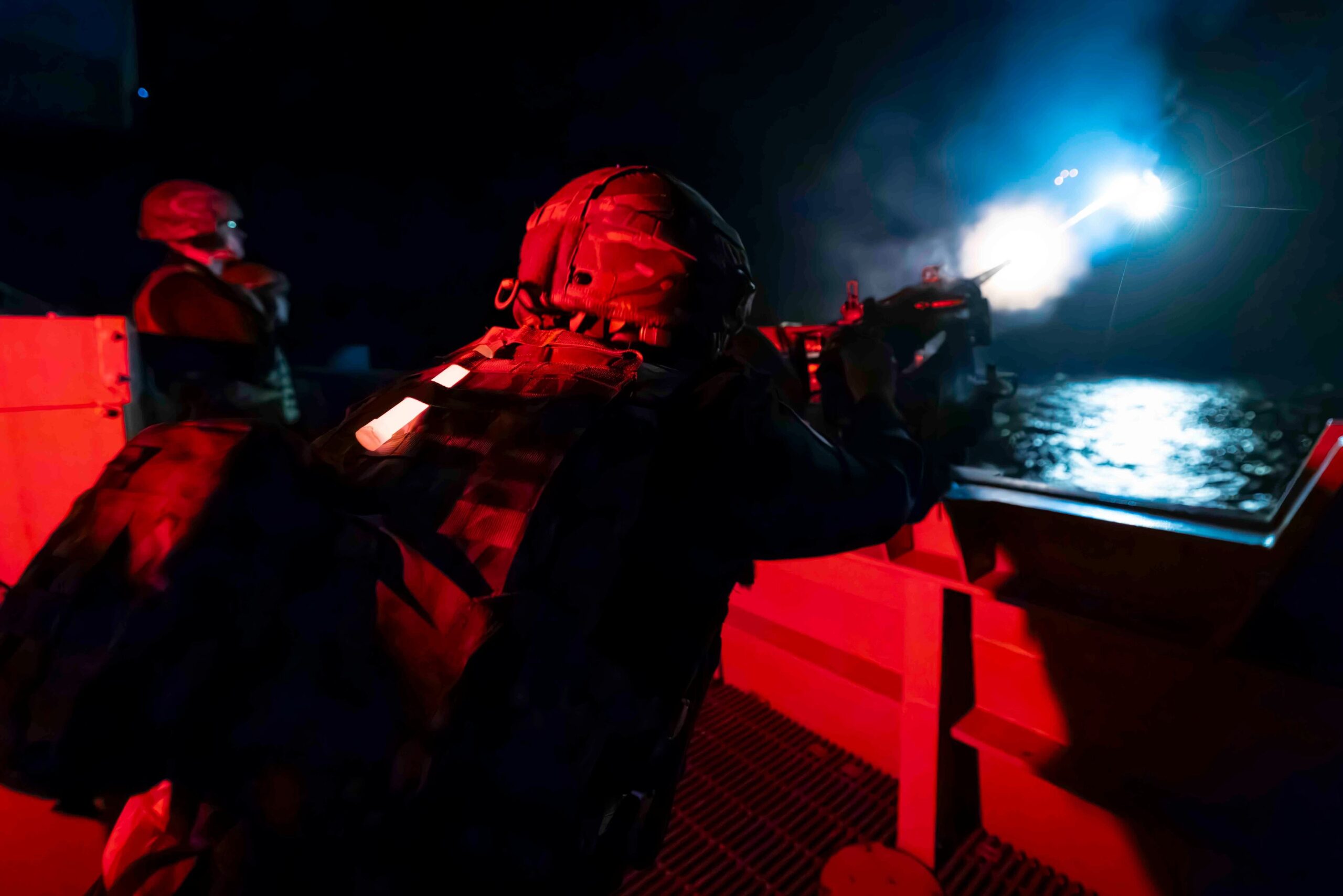
British aircraft carrier HMS Queen Elizabeth has conducted night-time gunnery training as the warship continues work to restore full operational and warfighting readiness following its recent docking period, according to the ship.
The carrier released imagery of its gunners firing during darkness, describing the serial as part of the routine training required to keep weapons crews prepared to operate the ship’s defensive systems at sea.
In an update from HMS Queen Elizabeth, the ship said: “HMSQNLZ’s gunners breathe fire into the night! Night shoots are essential training exercises ensuring our gunners maintain their operational readiness.”
@HMSQNLZ‘s gunners breathe fire into the night! Night shoots are essential training exercises ensuring our gunners maintain their operational readiness.#NightShoot #OperationalReadiness #NavalTraining pic.twitter.com/Yf1eJkEqUg
— HMS Queen Elizabeth (@HMSQNLZ) October 4, 2026
The firing forms part of a broader programme of activity aboard the 65,000-tonne carrier as its crew progressively rebuild the range of skills required for front-line operations after a recertification docking period. Recent weeks have seen the ship conducting a series of training milestones covering aviation, replenishment at sea and the routine work required to bring both the vessel and its company back towards operational readiness.
On 24 September, the carrier reported that a Wildcat AH1 helicopter from 847 Naval Air Squadron had landed aboard, describing the event as the beginning of the return of aviation operations after the docking period. The ship said at the time: “The process of integrating aircraft into operations at sea is a complex one, but landing a Wildcat AH1 from @847NAS marked the start of our return to Warfighting readiness after our recent recertification Docking Period.”
That aviation milestone followed the carrier’s first replenishment at sea since 2024 earlier in September, when HMS Queen Elizabeth worked with Royal Fleet Auxiliary tanker RFA Tidespring. During a replenishment at sea, ships manoeuvre in close formation while fuel or other supplies are transferred between vessels, requiring bridge, seamanship and engineering teams to work together while both ships remain underway.
HMS Queen Elizabeth said following the serial: “@HMSQNLZ carried out its first replenishment at sea (RAS) since 2024! @RFATidespring provided fuel and our bridge and seamanship teams gained experience as we contjnue on our journey to warfighting readiness.”
The carrier has been rebuilding several core areas of activity in parallel, ranging from aviation integration and replenishment to shipboard weapons training.
HMS Queen Elizabeth is one of two Queen Elizabeth-class aircraft carriers operated by the Royal Navy alongside HMS Prince of Wales. The ships were designed primarily around carrier aviation, with F-35B Lightning aircraft providing their principal offensive capability, while helicopters and shipboard systems support surveillance, anti-submarine warfare, logistics and force protection.



We should really be conducting more helicopter operations on the Queen Elizabeth class. Their ability to embark large numbers of soldiers as well as transport and attack helicopters is one of their most underrated capabilities and something that sets the completely apart from other super carriers.