

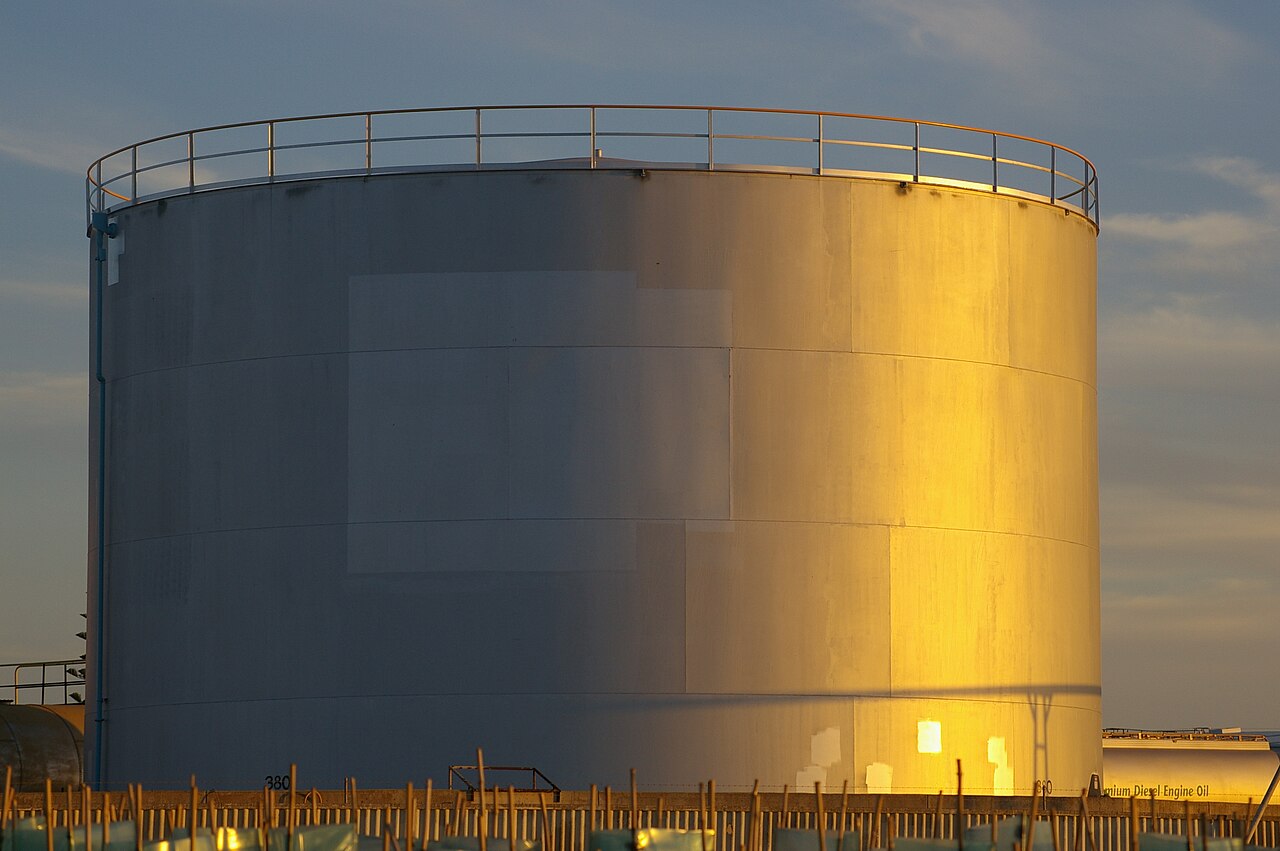
Britain is going into winter with some of the lowest gas stocks in the industrialised world and enough diesel for roughly forty days, the Shadow Foreign Secretary told the Conservative conference,
Tom Tugendhat used his speech in Birmingham on Tuesday to put fuel at the centre of an argument about national resilience, treating energy stocks as a defence question first and an economic one second.
He said: “This winter we’re already approaching a difficult time of year for many with some of the lowest gas stocks in the industrialised world and with enough diesel only for about 40 days.
“It puts our resilience second to global politics. That is Labour’s way and it is the wrong way.”
He went on: “So what are we looking at? Thin stores. A coming winter. A world one shock from trouble. That is not resilience. That is living hand to mouth.”
Fuel stocks are among the least examined parts of British preparedness and among the hardest to fix quickly, since the country has lost most of its refining capacity over two decades and holds obligations under International Energy Agency rules that are measured in days of consumption. Moving a division anywhere is a fuel problem before it is anything else, which is why NATO has returned to the subject repeatedly since 2022.
Mr Tugendhat set out what a Conservative government would do about it. “We will prepare our troops but we know that while armies go on operations, it’s only nations that go to war, and they only go to war for as long as they can sustain it,” he said. “That’s why we will rebuild our stocks and treat fuel in the tank like shells in the store. We will use the oil and gas under our own seas and break the energy fast that costs so much and delivers so little.”
The phrase about fuel in the tank and shells in the store is the sharpest formulation anybody has given of a problem the Ministry of Defence has been circling for years, which is that munitions stockpiles have received political attention while the fuel to move the force has not.
He also invoked what he called Ferguson’s Law, the proposition that a country paying more in debt interest than on defence is in a condition no state has long endured, and said the Bank of England had warned that weak points in world markets were likely to give way at once while Britain is most exposed.
The speech ranged more widely across what he described as a world run by strong men and deals in place of rules and institutions, quoting the former chief of the Secret Intelligence Service, Sir Alex Younger, to that effect. He said the Foreign Office had for too long behaved as though it were an international non-governmental organisation and that he would make it “the long arm of British strength around the world”.
Mr Tugendhat organised his approach around three words, which he gave as right, might and money, arguing that Britain has the right to protect itself and is not properly exercising it, needs the military strength to do so, and needs a growing economy to pay for both.
On alliances he named the Comprehensive and Progressive Agreement for Trans-Pacific Partnership and the Joint Expeditionary Force within NATO, and said he would build deeper partnerships with Canada, Australia and New Zealand, bringing trade and defence together.
Image Gnangarra, CC-by-3.0, Wikimedia Commons.









All these great ideas from a party that’s spent 75% of its time in power for the past 150 years and just left office two years ago. If there is an error in British governance you can be statistically assured it was the Conservative Party that delivered it.
But now they care deeply about government borrowing. They inherited a government in 2010 with 40% debt to GDP and turned it into a government with 100% debt to GDP by 2024.
The proclaimed to have austerity while doubling the foreign aid budget and the only budget they actually cut was in defence because Dave said we were not having another war.
They also closed all of the energy storage sights in the UK and were unwilling to provide even minor government funding for them all while raising pension benefits at their fastest ever rate while proclaiming the country was broke.
I agree. They’ve not a leg to stand on.
I read about the 40 days thing the other week, apparently other countries have much greater reserves.
👏 👏 👏 👏 👏 👏 👏 👏 👏
It might be expensive, but it’s generally easier to buy a commodity item like diesel than it is to build factories to build shells. Of course in the real world you want both, but if you are only willing to spend on one at a time, the MOD are right to concentrate on building up munitions first.
The Tories don’t really have a leg to stand on, with their track record on defence, industry and immigration, and its the same old flannel. However, we need to get over the party politics nonsense, and understand where we are in the world, we are front and centre in a very unstable world. We have limited resilience in all sectors to include defence and industry, we have a fragmented population many of whom are blatantly anti UK, and a Government (and opposition) who are clearly not up to the job, second and third rate and in many cases actively act against the peoples wants and needs in the UK in order to further their own and/or their ideological followers interests. We have the two main parties talking shite, a Green party blithering racist shit that the Russians and NF used to spout, a Lib Dem party who are just waiting for an election where they can hang on a main parties shirt tails to get a taste of power and a split right wing, arguing amongst themselves. I have to say I have not in my lifetime seen such a shit show within politics and the Country.
This is what happens when resources are traded globally as commodities.
Less than 10% of this fuel is sourced from the Gulf, yet here we are.
Putin (allegedly) says he wants to see the back of NATO. He has some choices: create a war by invading a member country, or simply sit back and watch the West’s economic decline caused by daft wars, shrinking energy reserves and global warming, plus dwindling welfare budgets. All these elements have one result: less money for defence. There is not one NATO member that is not working around the clock to balance their defence objectives against welfare demands. Failure to achieve welfare goals can lead to civil protest, which may bring immediate political changes and at the cost of other vital services. Putin can now enjoy Europe witnessing reduced capability to deliver vital goods by road and rail as diesel becomes scarcer and twice as expensive, leading to higher prices in the shops, more haulage companies going bust and public disorder as a result.
Okay, the same issues apply to Putin but there is one vital difference: Putin doesn’t care.