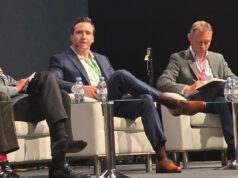
Latvia has created a state body that can work alongside industry intellectual property without disqualifying the companies involved from later competitions, the deputy commander of NATO Multinational Division North told the Apex Europe conference in London on Wednesday.
Brigadier General Ilmars Lejins said the organisation sits under the defence ministry and is known as the Autonomous Centre, and that it exists to give soldiers and companies somewhere to work together before any contract is in play. Taking part in it is structured so that it cannot count against a firm when procurement begins, which removes the main reason companies hold back from early collaboration.
He was open about how young the arrangement still is and about how little can yet be proved from it. “Are we succeeding? I don’t know yet. It is relatively new. We have done it for one and a half years,” he said, adding that other nations will probably arrive at similar models, where a company can go into a sandbox and build trust without consequences arriving later once money and contracting are involved.
Asked how a user keeps order while so much new equipment arrives at once, he suggested working with the churn instead of against it. “I think that we should embrace chaos for a while, not fight it. Otherwise it’s kind of pointless. We are where we are,” he said.
Contracting models need to change alongside that, in his view, and he was careful to say it is not his job while making clear he holds an opinion on it. The comparison he reached for was the way people buy music.
He said: “We used to be in the military, we want the stuff, we describe the stuff, what we want, we buy the stuff and then we leave industry alone for a while, and then we break it, and then we do that again. We cannot do that anymore. I bought LPs and CDs, that’s how old I am, and then that was my property. I used it on a machine, a player, that was made by several different vendors. But now I stream from Spotify. So I have to go, as a military, into more or less a Spotify agreement with other vendors. How do I write the contract on that one? I do not have shares in Spotify, but it’s a whole new world in contracting and relationship with industry.”
His closing message to the room was about command and control, “What I need as a division commander is C2 networks based on data centric federation. It doesn’t matter if you have the best system in the UK or the best system in America. If it doesn’t work together, it’s pointless,” he said, citing Ukraine’s Delta system as something that works well enough for the people using it.
He also asked for more investment in the people who accredit systems onto networks, a group whose work decides how quickly anything new can be fielded. “In Latvia, they call them the men in black, the security people, the accreditation,” he said. “I would love that they would have more CIS educated people, because it’s the man-made procedures in accreditation of systems.”
Multinational Division North is headquartered in Latvia and commands NATO forward land forces in the Baltic states, which puts it among the first formations to absorb the volume of uncrewed systems now reaching European armies, and gives Riga a reason to get the industry relationship working early.