

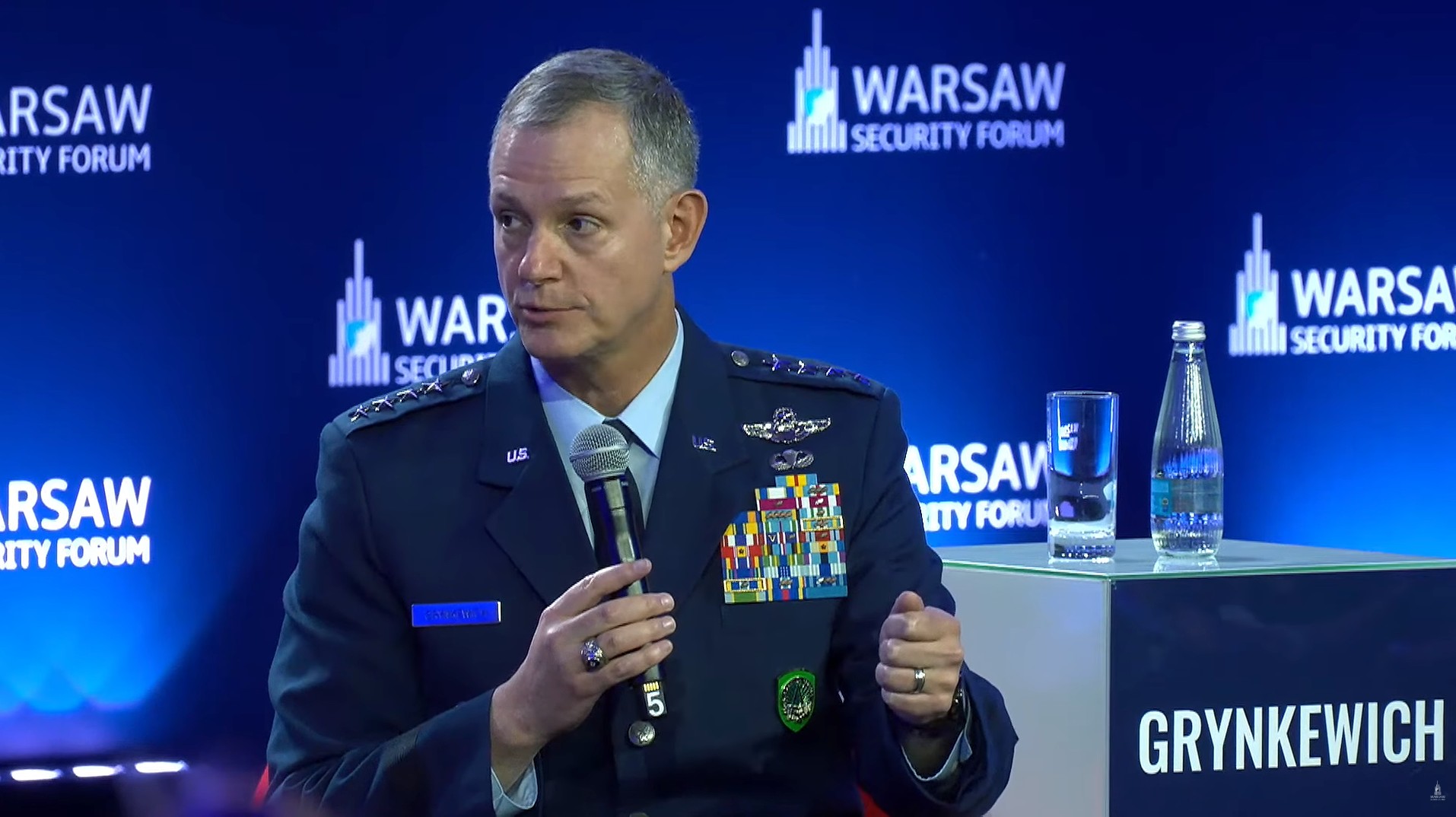
NATO’s Supreme Allied Commander Europe has told an audience in Warsaw that he does not assess conflict to be either imminent or inevitable, while arguing that the alliance must still prepare for what is possible, according to remarks at the Warsaw Security Forum.
General Alexus Grynkewich made the point before setting out the approach he calls a Theory of Victory. “Before I describe this theory in more detail, let me make one point very clear. I do not assess that conflict is imminent or inevitable. It isn’t,” he said. “We help avoid conflict by clearly articulating our defensive intentions, and by maintaining open lines of communication to resolve misunderstandings and encourage transparency.”
“But deterring conflict also requires warfighting readiness, and readiness requires to plan against what is possible, not just what is probable,” he said. “As America’s first president, George Washington, stated, the most effective way to preserve peace is to prepare for war. Or, as America’s current president puts it, this is peace through strength. In the case of NATO, that’s the strength of 32 nations, together.”
He described the alliance as unlikely to be taken unawares, drawing on “a sophisticated layering of intelligence provided by multi-source collection assets that deliver tremendous amounts of data” and advanced algorithms used to make sense of it.
“This means the Alliance is unlikely to be caught by surprise. We will see if an attack is coming, giving us time to assess intent and rapidly position our forces,” he said. “In doing so we aim to deter, but these movements also prepare us to deny any potential attack, including those aimed at seizing and holding NATO territory as a fait accompli.”
Speaking of Poland’s accession to NATO in 1999, he said: “It reminds us NATO is a defensive Alliance, constructed to preserve peace. And as such, we have no plans, no intentions, and no ambitions beyond the protection of our people and the defence of our territory.
“Still, no one should mistake our defensive nature for weakness or lack of resolve. Through our collective strength we aim to deter and keep the peace. But if someone is foolish enough to attack us, we will fight.”
His Theory of Victory, which he stressed is a common vision and his commander’s intent and not a military plan, sets out three stages, blocking an initial attack, blunting it if it persists, and breaking the enemy forces and the warfighting system supporting them if required.
General Grynkewich said implementing it would require him to issue orders he hopes never to give, and that demonstrating the readiness to do so is what prevents the need arising. “If attacked, we are ready to fight tonight, but we are not complacent,” he said, adding that any adversary weighing an attack should conclude “today is not the day.”








‘…deterring conflict also requires warfighting readiness’
Can we honestly say that Britain is warfighting ready?
Against Russia, in a conventional fight, no problem.