

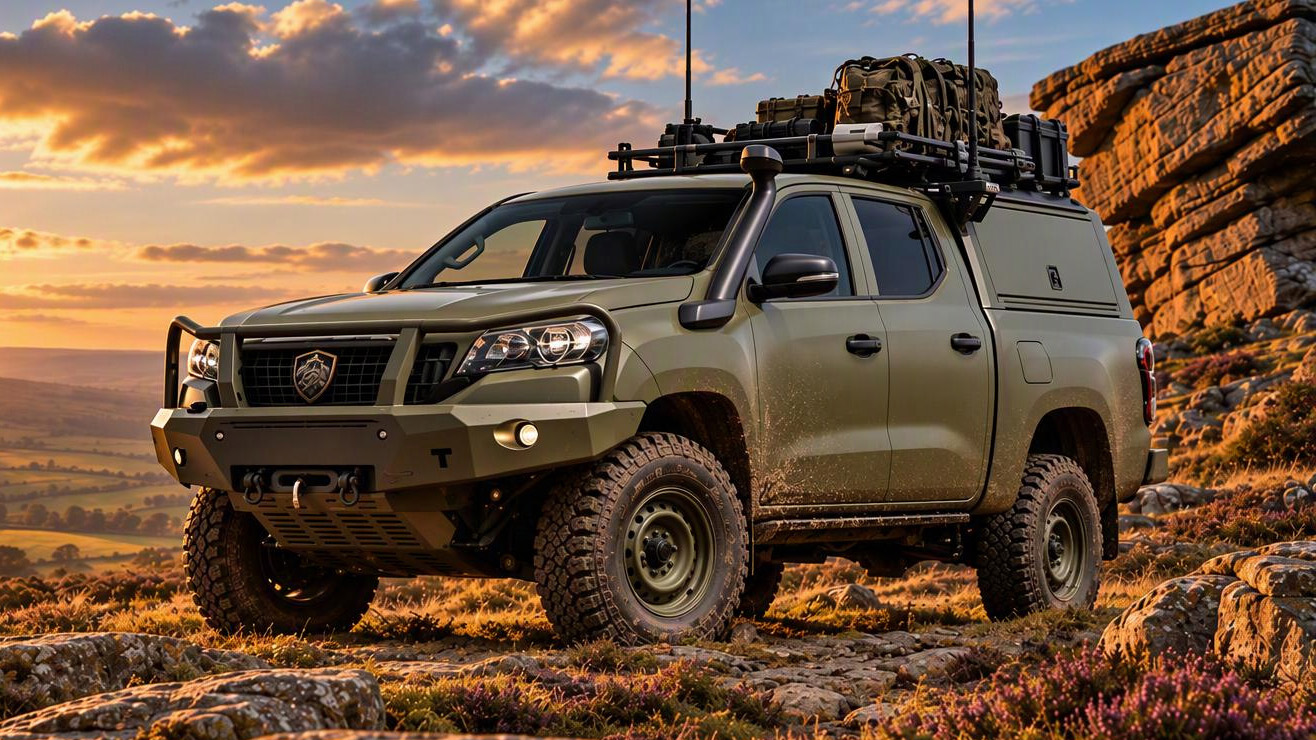
The specialist vehicle manufacturer Iturri has put forward Gritstone for the British Army’s Light Mobility Vehicle programme, with an industrial team built around Stellantis, TVS Supply Chain Solutions and Sonovision, according to the company.
Gritstone is built on a mature vehicle platform instead of a new design, which the company argues removes the technical uncertainty, schedule pressure and cost growth that developmental programmes bring with them.
Iturri has supplied British defence and emergency service customers since 1998 and delivers vehicle programmes for defence and government customers across Europe, the Middle East and the Americas, including tactical mobility platforms for NATO and partner nations.
Johnny Hathaway-White, director of UK defence programmes at Iturri, said: “Gritstone represents far more than a vehicle family. It combines a proven and adaptable mobility platform with the experience of a company that has supported UK defence and emergency service customers since 1998 and delivered complex vehicle programmes for Defence, security and civil protection organisations around the world.
“By bringing together Iturri, Stellantis Pro One and Stellantis UK, TVS Supply Chain Solutions UK and Europe, and Sonovision UK, we have assembled a powerful, experienced and proven industrial team carefully calibrated for delivering reliable capability, sovereign UK support and long-term value for the British Armed Forces. Our focus is simple: proven mobility, British support and low-risk delivery.”
Stellantis Pro One and Stellantis UK provide automotive engineering, manufacturing and supply chain capability. TVS Supply Chain Solutions handles spares management, supply chain resilience and availability planning. Sonovision UK covers supportability and industrialisation, from tooling and manufacturing engineering to integrated product support, technical data, training and in-service support.
The company says the programme is designed to maximise British industrial participation through domestic engineering, integration, support and sustainment work, with the emphasis on fleet availability and lifecycle value as much as on the vehicle itself.









It’s really nice that foreign companies can allow us to “sustain’ our own vehicles in country and then call it British industrial participation.
Hopefully they do a grand unveiling like Ineos with a big Union Jack on the front of the car as it roles out of their French factory.
It’s not really that clean-cut though; Babcock is a British company putting forward a Toyota-based design provided by Supacat, who already build Toyota-derived vehicles for the army. INEOS, meanwhile, is a British company with a British design…built in France. Even JLR builds the current Defender in eastern Europe, although their bid for the army contract is a very different vehicle from the modern civilian version and probably will be built in the UK.
It’s fairly clear cut that none of the companies draping a British flag over their cars is in fact British, excluding JLR Defender wolf II (if they build it in the UK).
There are very strict product rules on cars for what is British and what is not, none of the other cars could be legally sold in the civilian market as British so I don’t see what’s different about the military market.
Frankly I find it all very offensive and I think it brings real shame to British companies like Babcock and Supacat to be doing this on a clearly Japanese car and it’s really annoying when we have Spanish and American companies doing it on cars that have no UK input but they claim will be doing the maintenance on them here.
Companies should be automatically excluded for this behaviour and HMG should call it out across the board starting with P&O and Cunard who love draping union jacks over the launch of French built ships and even having the brass neck to get the Queen to do the launch. (Rant over)
There are very few European card and trucks being built on a purely.nstional basis anymore, at best they are assembled from parts supplied from elsewhere, or assembled in another country where labour and construction costs are lower. E.g VW plant in Hungary, JLR plant in Slovakia, Ford Ranger in South Africa, etc. The days of cars made wholly in the UK, with all-British componrnts, are long past.
If what we get is sufficiently rugged for military use, has an armoured cab and is at least 50% UK-made, I would be happy with that. (Except that I would wreck the budget by wanting a v-shaped hull to deflect mine and IED blast, as any utility vehicle will inevitably end up playing a part in hot war zones).
Nice rant and frankly some good points made.
Ok you keep banging on about this! Please name your preferred wagon to get the contract and let’s see if it is indeed British👍
As for an EV that’s all very well until the time comes to recharge it compared to a rock up and fill with fuel inside of 5mins!not many chargers in the middle of nowhere and a truck full of extra batteries is not going to be heavy is it?
Hi Jacko, I suggest you take a trip around the highlands then come back and tell me how easy it is to fill up with petrol and how difficult it is to recharge.
My preferred solution is the JLR Defender Wolf II but only if it’s built in the UK as part of the contract conditions.
Mmm now any military formation is going to have its logistical echelons so going around the highlands or going across open desert is easily overcome isn’t it? Now this is a genuine question how are fleets of EVs out in the field going to be recharged bearing in mind a military vehicle is not your average car out for a drive,it has banks of radios etc that need themselves to be kept running so how big are EV batteries going to have to be? Instead of fuel trucks are there going to be mobile charging stations,how long to actually charge said vehicles 5mins to refuel v 1,2,3,4 hrs you tell me!
Got to view the contenders at DVD and have to say I’m not a fan of the JLR offering, it’s basically just a highly complex Chelsea Tractor painted green . Ideal for the school run perhaps ( although even here questionable lol ) but sufficiently ruggedised for military use – I think not. Have to admit I’m.now swinging toward Grenadier particularly now it’s been selected by Italy and Austria for the exact same role but only if manufactured in the UK as you say. . Also, got to sit in the armoured version and liked what I saw . IMHO there is currently to much of a fixation with ‘ lessons from Ukraine’. Once over I can see a refocus on more traditional peacekeeping roles and to do that safely.you need an armoured cab , in short a replacement for Snatch and with room for four dismounts in the back. Sure we’ve got Foxhound which is pretty much ideal ( even got air conditioning and a heater unlike Jackal of which not a fan).but unfortunately Foxhound is expensive and we quite simply don’t have enough.
Jim it’s not a trick question,how do you see the ability to keep EVs fully charged and available for high tempo operations without the need to be withdrawn for recharging in the middle of them with the charging time taking god knows how long? There is also the distinct possibility that halfway through any charging time the rest of the vehicles would need recharging as well leaving the operation grinding to a halt! Just curious👍
When is Defender getting rolled out of its Slovakian factory with the big Union Jack?
Another stressed out manufacturer of internal combustion vehicles trying to get defence orders. Give me continence, chastity and net zero….but not yet.😂
I agree Paul, their days are thankfully numbered, I’ll never buy another fossil fuelled car after going electric.
Still, good for the UK LMV competition and price in the short term. Net zero will be more of a struggle for shipping, aviation and goods vehicles. I think the original GWR vision was to sell tickets from London to New York via Bristol Templemeads. Who knows, where did I put those blueprints for that hybrid electric – sail Atlantic hydrofoil? 😄
I suspect we will see all short hall flight being done by electric aircraft in the next twenty years, the economics of electric flight are just too hard to pass up. Ultimately long haul aviation is a small contributor to global warming. If we ever start aerosol injection in to the upper atmosphere to combat warming which seems very likely now then we will need a large fleet of commercial long haul jets burning fuel over the oceans.
I agree ships will be very difficult as well to de carbonise. reaching 100% of net zero by 2050 won’t happen but if we can get 90% then that’s probably good enough for now.
However on the EV front he car just has so much better performance (acceleration) than any combustion engine it would be hard for me to go back. Driving a combustion engine now feels like driving a steam powered traction engine in comparison to EV.
“Proven and adaptable mobility platform”. I have one of those already in service: it is called a pickup.
But they just cut down the program to 7 contenders that did not include Iturri. In other words, they’ve missed the boat.
The Chinese vehicle…..
Anything other than a Landcruiser derivative is going to be expensive and unusable balleaux
Surely the biggest problem is the name Gritstone.