

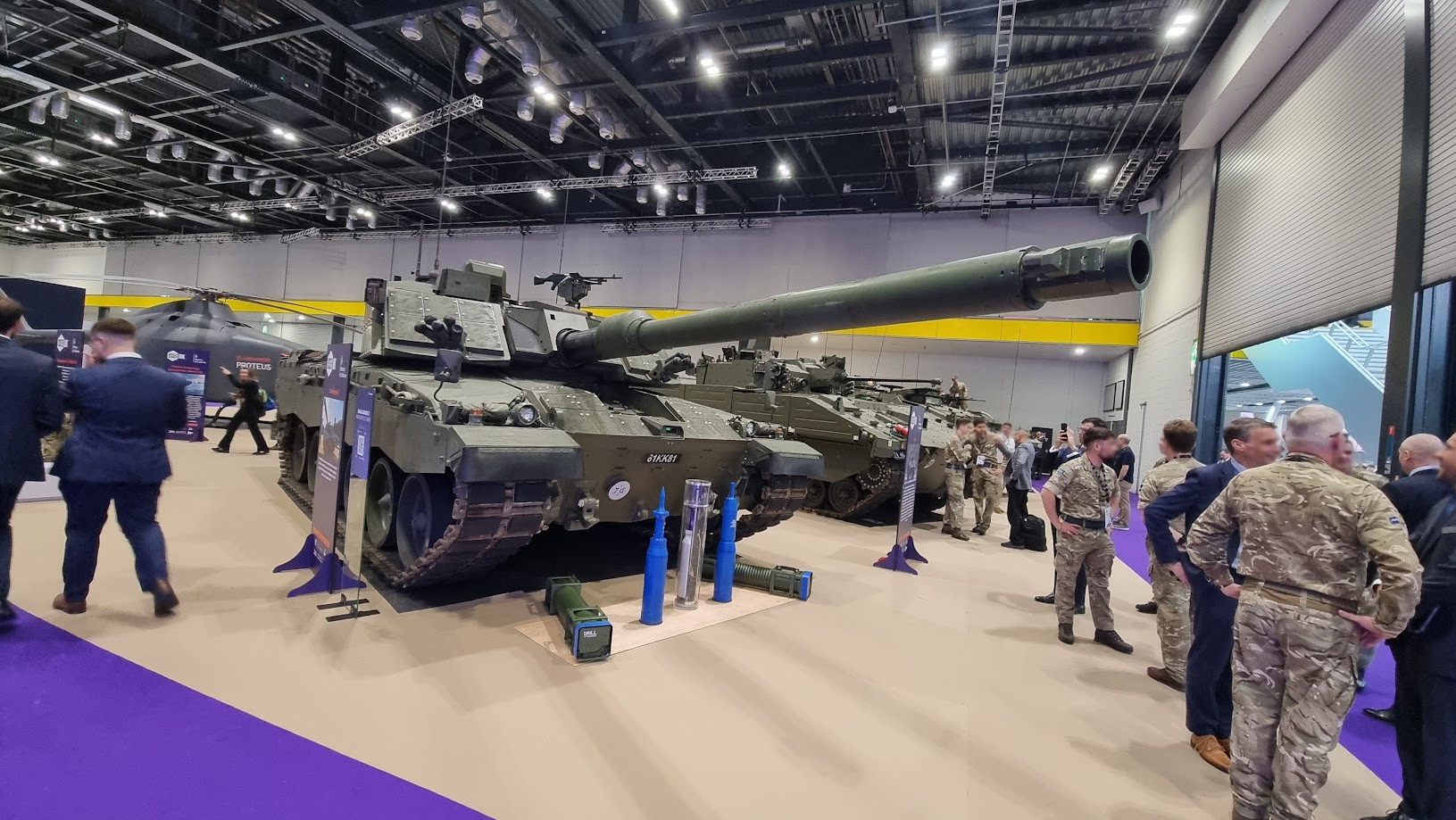
DSEI UK will run under the theme of delivering the integrated force in 2027, with four sub-themes covering innovation, industrial capacity, international collaboration and digital technology, the show’s senior defence adviser has told the UK Defence Journal.
Organisers are forecasting around 2,000 exhibitors and up to 60,000 visitors at ExCeL in September next year.
Air Vice-Marshal (Retired) Gary Waterfall CBE is senior defence adviser to Clarion Defence and Security, the company that runs the show. He left the Royal Air Force at the end of 2019, retiring from the Permanent Joint Headquarters as a two-star, and joined Clarion the following year. His job, he said, is to stand with his back to Clarion and look at the Ministry of Defence.
Themes have to be set at least a year ahead of the doors opening, “If you can tell me what’s going to happen in September 27, right here, right now, on the world stage, then please fire away,” he said.
The 2025 theme had to survive a defence review landing part-way through the cycle, and Waterfall said it did.
Sub-themes are built from research among the people who come to the show, Clarion’s own view of the market and talks with the department. “We don’t set the theme in isolation,” he said. “We confer with the Ministry of Defence.”
Defence and security exports used to sit in the Department for Business and Trade, and have now moved into the Ministry of Defence under the National Armaments Director. Waterfall said that gives the show one door to knock on in Whitehall, and he expects it to change what the department puts on its stand. “When it’s the MOD capability showcase, that’s going to be a much broader aspect,” he said.
Waterfall said the theme follows from the same reform drive, and that it is broad enough to mean something to everyone on the floor. “Everyone talks about integration and being that integrated force,” he said. “Therefore the theme for next year is delivering the integrated force. There’s a lot in those four words, but you can hang your hat on that.”
He said it applies to an SME with reservists on the books as much as to a prime, to CSOC or to a frontline command, and that it does not stop at the UK border. The four sub-themes are innovation and emerging technologies, supply chain and industrial capacity, deepening global defence collaboration and partnerships, and digital transformation, AI and cyber. Waterfall said the digital strand runs through all of them.
Choosing the wording for the collaboration sub-theme took some arguing inside the company. “We agonised, would you believe, over the global defence collaboration. Is that NATO?” he said. “It’s not just NATO.”
He cited Royal Navy, Royal Air Force and British Army units working with regional partners around Iran, and British activity in the High North through the Joint Expeditionary Force, both outside the alliance. Waterfall also made a case for the show itself as a form of deterrence. “Those that would wish harm to us will be sat there watching the power of DSEI, seeing it as that convening authority across the global allied defence sector,” he said.
Asked what rising British and European budgets will mean for the conversations on the floor, he spoke about procurement speed. Three years of war in Ukraine have made a 10, 15 or 20 year acquisition cycle impossible to defend, he said, and smaller firms have gained most from that.
“The winners are the small and medium enterprises that can work at a pace that outstrips the routine of a big prime,” he said. The primes have noticed, he added, and are buying into them while trying to leave them alone to work.
Waterfall said buyers now arrive wanting the part of a system that lets it keep changing. “I want it yesterday, please.”
James Samuel took over this year as managing director for live events at Clarion Defence and Security. The job covers DSEI UK, the company’s Japanese business and a conference portfolio that includes UDT in Europe and a UDT Australia launching in December. He has been at Clarion for seven years and has worked in exhibitions for 26.
Around 1,750 companies exhibited at the 2025 show, and Samuel is forecasting 2,000 to 2,100 next year, with the floor growing in square metres as well. The last edition drew 45,000 attendees and he expects 55,000 to 60,000 next time, “if there’s no tube strikes or DLR strikes during our week”.
Samuel said he judges the show on connections made instead off floor space sold. “We can’t just rely on the industry to meet itself,” he said.
Registration answers and what visitors then do on the show platform are used to push suggested sessions, events and contacts at them before they arrive. Samuel said the size of the venue makes that necessary. “It’s a kilometre from one end to the other. You could walk there three or four times and you’ve done that before you’ve even met anyone.”
The 2025 show hosted 114 official delegations from 66 nations, and Samuel said the list is drawn up with government. “This isn’t just us picking out who would like to come to the show,” he said, describing a test of whether there is real business for a delegation to do with British government and British industry.
Clarion is launching DSEI Germany in Hannover in March 2027, six months before London, and DSEI Japan follows in April. Samuel said its offices in Berlin and Tokyo let exhibitors and national pavilions carry one pitch across all three. “Their narrative continues, whether it be from Germany to London to Tokyo,” he said. Between shows the company runs smaller events of 150 to 200 people under the name DSEI Gateway, on the basis that four days every two years leaves a long gap.
Asked what he looks forward to most, Waterfall picked the first morning, telling me that he envisions, “There’s a Nigerian delegation talking to a Polish delegation. The interaction is just unbelievable,” he said. “We are facilitating this show for His Majesty’s government to stand on a stage and project soft power around the world, and that’s a real humbling factor.”
DSEI UK 2027 runs from 7 to 10 September at ExCeL London.







Integrated force? Haven’t got the UK in mind then.
He might be right about the ability of small firms to develop and build some things at pace.
But try getting an SME to build you a warship, MBT or combat aircraft. These key, unavoidably expensive platforms have to be planned over a 20 year cycle or longer. The failure to do that is one of the main reasons our forces are in their current dilapidated state.
Peter, Supplying components and sub-assemblies for a major platform project is what current SMEs do. Very true that expensive, major platforms have to be planned over a long timeframe but 20 or more years is a bit over-egged. Some services do this lengthy work better than others. The army should be well involved in the Concept phase for equipments to be fielded in the next 10-15 years but I doubt the army is achieving that.