

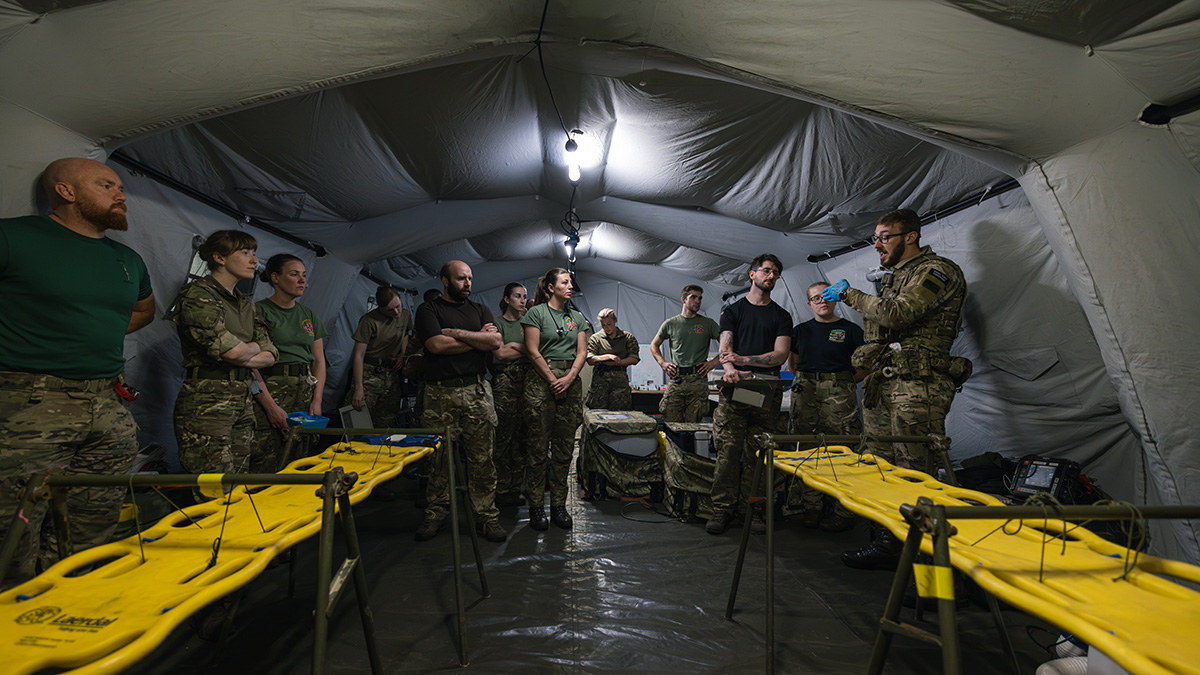
Commando engineers have dug and built an underground field hospital near Glasgow so that surgeons can resuscitate and operate on casualties below ground, in a trial drawing directly on how Ukrainian medics have been forced to work, according to the Royal Navy.
Soldiers of 24 Commando Royal Engineers spent six days building the facility at Barnsford Bridge, excavating around 243 cubic metres of rock and soil to create a space twenty metres square, about the size of one and a half tennis courts. Medical specialists from the Special Operations Surgical Team and the Commando Forward Surgical Group then used it to resuscitate and operate on simulated casualties during Exercise Strike Warrior in south west Scotland.
Chief Petty Officer Ellie Walls of the Commando Forward Surgical Group set out why the work is being done at all. “As an organisation we see the need to develop our ability to build, survive, work and live in these spaces as medics now are not always protected by the Red Cross and can be routinely targeted,” she said.
“We can look at the lessons learnt from Ukraine and other medical uses of the subterranean space but we have to start experiencing the issues for ourselves to really understand and work through the problem. When looking at using the subterranean space, we have to evaluate if the risks from being below ground outweigh the risks from being above ground.”
She added: “However, our demands can be quite specific, we have to take into account the needs of the casualty and ensuring the environment does not negatively impact their outcome.”
Lieutenant Michael Mathers, Access Troop Commander of 54 Commando Squadron, whose troops were given the task, said: “By designing, constructing, and handing over this facility, our troops gained first-hand experience of the realities of modern peer-on-peer conflict, where survivability, protection, and concealment are critical to success.
“Beyond delivering a unique capability, the project provided invaluable engineering training across multiple trades, challenging our soldiers to develop new skills and adapt established techniques to a novel environment.
“Equally important, it highlighted where we must continue to innovate, ensuring lessons identified are refined, shared, and integrated in future designs and shared across UK Commando Force and the Corps of Royal Engineers.”
Putting a clinical environment into what amounts to a hole in the ground threw up problems a tented field hospital never has to solve as soil contaminants, bacteria and pests all bear on whether a patient survives, and once it was handed over the medical teams worked out how to allocate power, how to move casualties through the compartments according to their injuries and how to move around at all.
Surgical teams are used to light, air circulation, plumbing, electricity and the room to move and resupply, none of which a trench offers, and the effect of working without them on the clinicians themselves came under examination too. “Whilst it has given us some answers it has generated a lot of questions and thoughts,” CPO Walls said.
“If we can prepare our equipment and people to work in such areas, we give our patients a better chance of survival.”
The Navy described the facility as a prototype, part of an effort to develop, trial and standardise subterranean facilities for use across the UK Commando Force and the Corps of Royal Engineers, with the intention of taking the concept through to full operational capability.
Small attack drones and loitering munitions have made the ground behind the front line as dangerous as the front itself, and both sides have pushed stabilisation points, casualty collection and surgery underground into cellars, dugouts and bunkers.









Not exactly new concept, i was excavating out for those in the 80’s. No doubt based on updated MEXE shelters. Institutional memories seem to be short nowadays.
I am pretty sure that they have this idea backward. Judging by what has been seen to be happening in the Middle East, the newest ideas are that armed groups should be building weapons storage UNDER the hospitals. Better yet, missile storage under a school.
Building hospitals underground rather defeats the purpose, no?
Sarc/
The UKs general civil defence provision is utterly and completely pathetic..
Sadly is possible that the UK could suffer significant levels of casualties that it did not need to, because it simply has not bothered.