

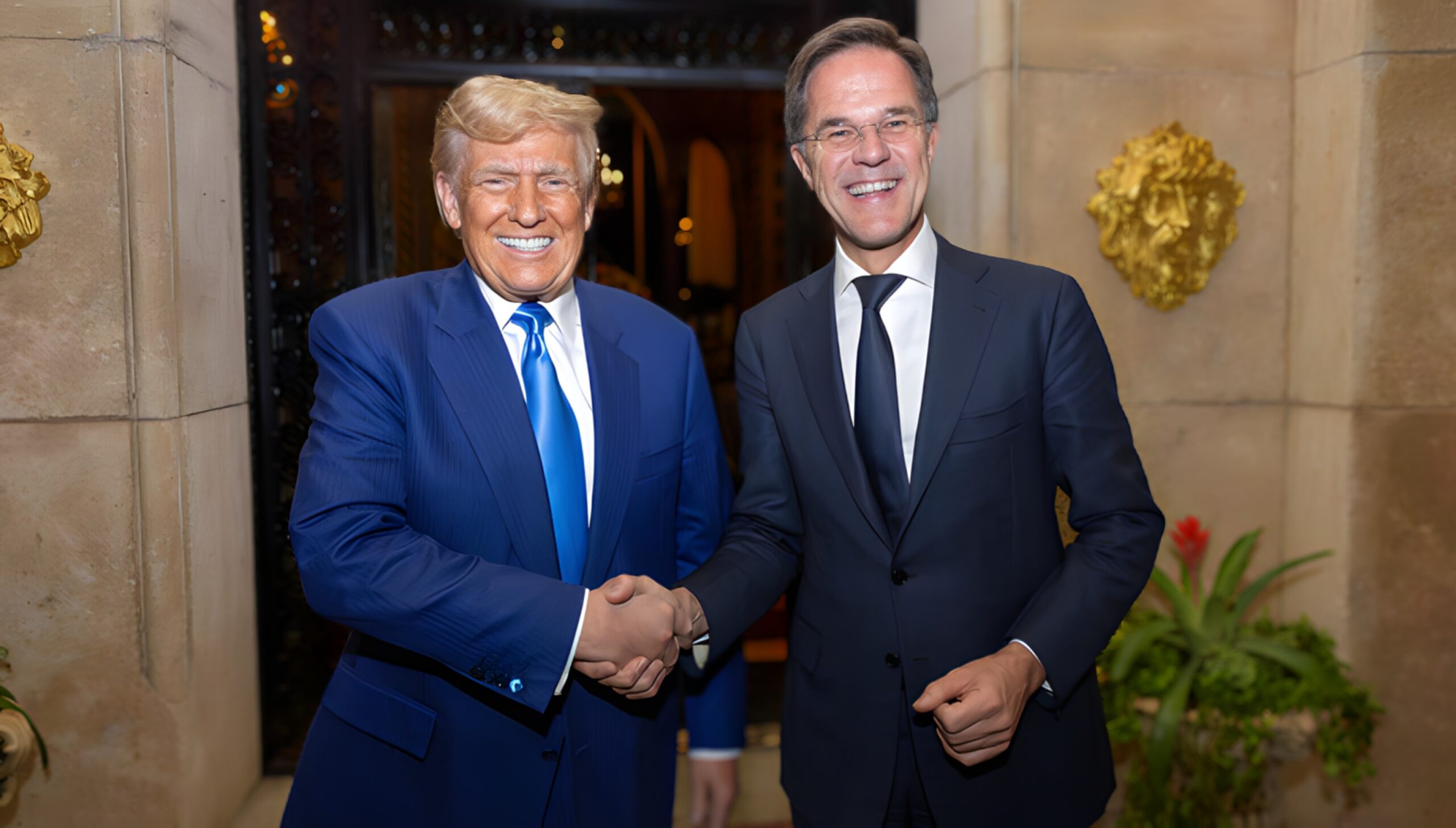
US President Donald Trump and NATO Secretary General Mark Rutte discussed the importance of Russia avoiding any action that “intentionally, or unintentionally” expands its war against Ukraine, according to a joint statement released by NATO.
The two met on the evening of 25 November at Mar-a-Lago in Florida, where Rutte also held talks with White House Chief of Staff Stephen Miller. The war in Ukraine and the conflict in Iran were the main subjects, alongside defence spending.
The joint statement reads in full: “President Trump and Secretary General Rutte had an outstanding meeting this evening (25 November 2026) at what is often referred to as the Southern White House – Mar-a-Lago.
The meeting was very impactful, with the war between Russia and Ukraine and the conflict in Iran being the primary subjects, as well as all of the record setting achievements that we have made together at the summits in The Hague and at Ankara.
We also discussed the importance of Russia avoiding any actions that intentionally, or unintentionally, expand the war, and the importance of obtaining a peaceful resolution to the war as rapidly as possible.
Lastly, we talked about the importance of continuing to expand defense spending and investment in our industrial base, both in the United States and across NATO.”
The reference to unintentional escalation follows a series of incidents that European governments have linked to Russia, including drone incursions over allied territory and suspected jamming of satellite navigation. Around 140 aircraft lost GPS over northern Europe and the North Sea on 9 November in interference that Dutch reporting linked to a Russian-escorted military cargo convoy, though no proof has been published that the ships were responsible.
At The Hague in June 2025, allies agreed to invest 5% of GDP a year in defence by 2035. At the Ankara summit in July, the White House said allied defence spending had risen by more than 20% in a year and announced around $3 billion of industrial commitments, including European production of ATACMS and Stinger missiles and a PAC-3 maintenance facility in Europe, according to a White House fact sheet.
Rutte said earlier this month that Putin is failing on the battlefield, telling the Atlantic Future Forum aboard HMS Prince of Wales in Oslo that Russian casualties may have exceeded 50,000 in October. He said: “But let’s be clear: he is failing. For every Russian hybrid attack against our nations, we are sending more support to Ukraine.”
Britain’s own path to NATO’s spending goals remains contested. Before the Ankara summit, Defence Committee chair Tan Dhesi said the Prime Minister “will be arriving empty-handed, because we have not even set out a clear path to 3 per cent”, MPs heard, and the government has deferred decisions on reaching 3.5% by 2035 to the Spending Review next year.
Rutte has also warned that weapons demand still outstrips supply, and NATO has set up a counter-drone marketplace offering 24-hour contracts.







‘The French fighters operated alongside Finnish F/A-18 Hornets, Dutch F-35A Lightning IIs, and Swedish JAS 39 Gripens, bringing together four different fighter aircraft types for joint combat training, including one that was held at the Jännevirta highway strip, approximately 104 miles from the Russian border.’
That is deterrence.
Next we should motor our Army Corps, you know, the one we promised to NATO, into Poland for a combined arms exercise.
Oh! We don’t have one yet, despite commitments in writing.
Iran and Ukraine have clearly demonstrated the limitations of air power.