

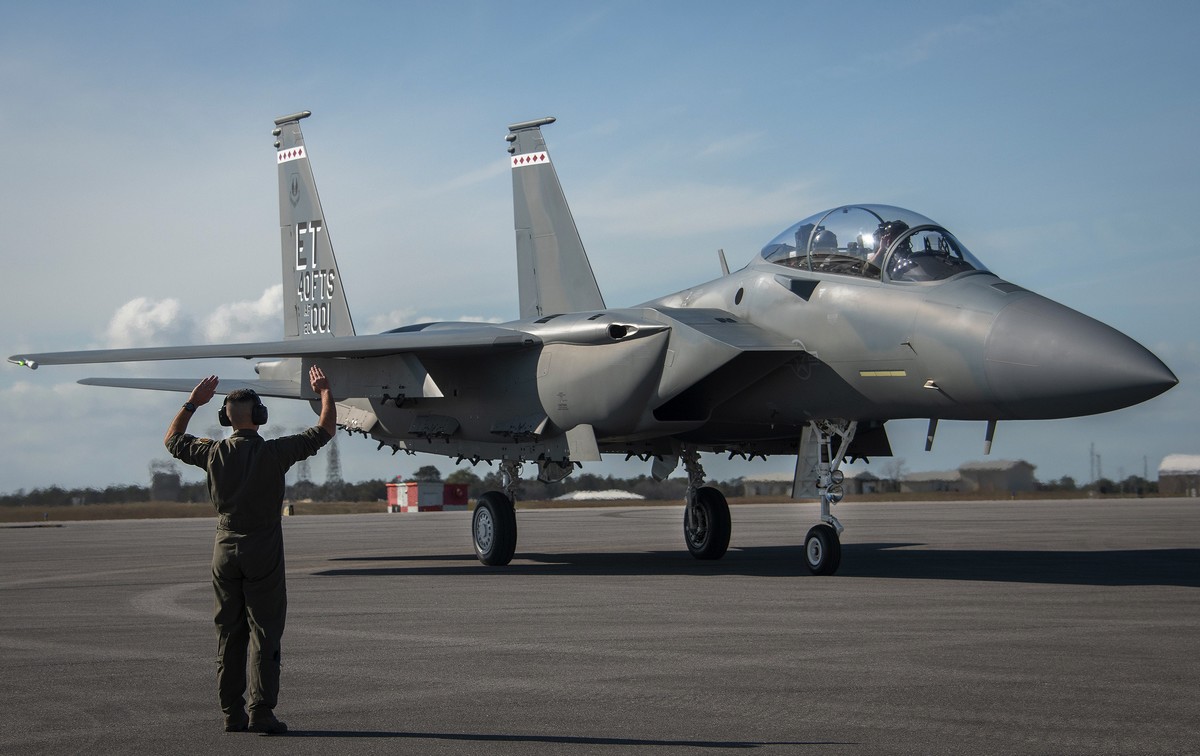
The U.S. Department of the Air Force has awarded Boeing a contract for 22 F-15EX Eagle II fighters under Lot 7, keeping all planned aircraft in the batch within the funding Congress provided through budget reconciliation, the service stated.
The contract was finalised before the end of the fiscal year on 30 September, following negotiations between the F-15 Program Office and Boeing that the Air Force described as focused and complex. According to the Air Force Life Cycle Management Center’s Fighters and Advanced Aircraft Directorate, the agreement takes account of the effects of the 2025 production disruption and wider inflation across the defence industrial base. That disruption was the strike by around 3,200 International Association of Machinists and Aerospace Workers members at Boeing’s St. Louis-area plants, which began in August 2025 and halted work on the company’s military aircraft lines for around three months.
Brig. Gen. Timothy Helfrich, portfolio acquisition executive for the directorate, said in the release: “Lot 7 reflects a disciplined approach to executing available resources while balancing the realities affecting defense production.” He added: “The team remained focused on affordability, production continuity and delivering the aircraft needed to modernize the U.S. Air Force’s fighter fleet for the threats we face today and into the future.”
The reconciliation funding referenced by the Air Force came through the One Big Beautiful Bill Act, signed in July 2025, which included tens of billions of dollars for defence procurement on top of regular appropriations. The service said the negotiation team worked across programme management, contracting, pricing, engineering, financial management and logistics to assess the impact of changing production conditions and align the aircraft buy with the money available.
The F-15EX is a two-seat-capable development of the F-15 family, derived from the Advanced Eagle variants Boeing built for export customers such as Qatar and Saudi Arabia. It features a fly-by-wire flight control system, large-area cockpit displays, the Eagle Passive/Active Warning Survivability System electronic warfare suite and an open mission systems architecture. The Air Force intends the aircraft to replace its ageing F-15C and F-15D fleet, and the Oregon Air National Guard’s 142nd Wing at Portland became the first operational unit to receive the type. The service’s planned total has shifted over the life of the programme, falling from 144 to 98 aircraft in the fiscal 2025 budget request.
The Air Force also presented the award as an example of the Secretary of War’s acquisition transformation principles, saying an integrated negotiation team was empowered to elevate issues needing senior-level decisions while keeping accountability for cost, schedule and aircraft numbers.
Col. Jonathan Varoli, system program manager of the F-15 Program Office, was quoted in the release as saying: “The Lot 7 award demonstrates what is possible when the acquisition enterprise moves with purpose, remains accountable to the taxpayer and stays focused on delivering capability to the warfighter.” He continued: “This effort brought together the right expertise, at the right time, to achieve an outcome that strengthens the F-15EX program and supports the future fighter force.”
According to the service, the award sustains near-term production of the F-15EX while the Air Force continues to assess its future requirements and acquisition strategy for the aircraft.








With America buying more F15s and European nations also building up numbers of Typhoons, etc, how can the UK reasonably justify in not buying more Typhoons? Another 24 would be a major uplift to the RAF as well as supporting British industry. It also has the advantage of further reducing our dependence on the US.
For the answer to that question see our PR PMs recent confirmation of why we can’t just increase defence spending. Or ,i f you want me to put it succinctly, we need that money – for benefits.
I’ll preface this by saying I agree that the RAF should be getting more Typhoons, BUT there are some fairly strong reasons why they’re not currently planning to.
The first is the biggest and ultimately decisive one – money. The US has a monstrous defence budget and a military-industrial complex that makes it possible to support multiple competing aerospace companies. Lockheed Martin has been dominant in the fighter space for a long time, but buying upgraded Eagles keeps Boeing alive as a competitor, with the lovely side benefit of keeping a production line open to export less capable but still American kit to less trustworthy but still friendly nations.
In contrast, we only have BAE with the scale and expertise to compete at that level. There is no competitor to support, and BAE have the work on Tempest to keep them paid up and busy. Speaking of Tempest, funding a significant Typhoon purchase would likely draw limited funding away from it’s replacement; 24 Typhoons would likely cost north of £2.5b, which is a huge sum that could be spent on a huge variety of things, but would probably have to come from the RAF budget allocation.
That brings me neatly to the second point – the UK is currently stealing a march on most of Europe and the US on the next generation of fighters. FCAS is currently dead, GCAP includes 3 of the big export customers for US 5th-gen aircraft, and the EU nations are likely to favour buying or potentially locally producing Tempest over buying the F-47. There is a very real chance that Tempest, done right and in service ASAP, could become NATO’s future standard fighter.
UK could have a monstrous defence budget it just chooses not to.
The US economy is what, 7 or 8 times larger than the UK? With more than 5 times the population? No, the UK can’t have a monstrous defence budget if it chooses; what the US spends on defence amounts to over a third of the ENTIRE British economy.
It could have a substantially larger defense budget than it has had for the past several years. With a little foresight the UK could have remained a G-7 state that boxed way over its weight. But it has chosen to starve its military/navy in ways that will be difficult to recover from. Until 2011 defense spending was still at 2.5%, a level of basic defense spending that the UK has not seen again until 2024.
2.5% was going to be a starvation diet, but the UK went lower. Because it chose to do so.
The population of the UK is not the problem. The problem is that the government raided defense to pay for other priorities for too many years.
That’s broadly true, although the UK does remain a G7 nation that “punches above it’s weight” – a vague and generally unhelpful statement, but as a nuclear weapons state with a strong tech base and numerous high-end conventional assets, that statement can still apply.
In any case, the point was that the UK can’t do a “monstrous” defence budget, not fund what it actually needs. In that regard, population is VERY relevant, because ultimately, bigger populations can support larger militaries much more easily than small ones.
Because we are buying more F35s. Funding very expensive and capable Typhoon upgrades, CCA, new weapons and Tempest further down the line. The combat air budget only goes do far. £8.6 billion alone for Tempest over the next 4 years.
What really catch the attention in this purchase is the fact these purchase come after the first show of force of the F35. If you look at the sequence, they used the F35 in Iran, provoqued a majors strain of F35 supply chain for all the other partners and still did rapidly suffered a significant drop in operations. All majors operations had to be supported by the F15 after 2 weeks. Then government decided to reduce F35 purchase to 30 ish and increased F15 PO to 24 – 36 in coming years. The output of F35 factory is tailored to 125 per year. No one, even after receiving it’s F35, seems to be in a hurry to get rid of previous airplanes. In Belgium, the airforce kept the F16, that were supposed to go to Ukraine. Canada is not purchasing anymore, Australia is looking to cut spending on F35, Saudi Arabia is in no hurry to get more.
I believe that any spending for F35 is just for spare parts, as Lockeed seems in no possibility to live up to it’s promesses.
As it is the RAF is woefully low on airframe numbers in the event of any peer conflict. Bear in mind work up to ops, training (out of 100 airframes we’d be lucky to have more than single figures available at anyone time). Add in a surge requirement over an extended period and Typhoon Force will be unable to meet commitments in a meaningful way. People suggesting 100 FGR4s is sufficient in a peer to peer conflict are living in fantasy land
During the Blue Circle Fighter fiasco, the US offered the UK a wing of F-15A’s that were being replaced in USAFE by F-15Cs for a $1. We snootily rejected them as ‘obsolete’ – we’d wait for our Typhoon F2 wunderwaffe.
40 years later – the Israeli Air Force F-16A’s are still mixing it with any fighters they meet and bombing the crap out of countries defended by modern SAM networks and doing the business.
The Blue Circle Fighter? Long scrapped and the Eagle is still a top fighter.
Ah, another made up crew room story. And the F16A went out of service a long time ago. Israel operates the F16D and F16I. The Tornado F3 went out of service after a 25 year career. 5 years after the F14 was retired. And was very capable. Replaced by Typhoon. AMRAAM, ASRAAM, Stage3 Foxhunter radar, Link16. Excellent defensive aids. 12-1 kill ratio in Red Flag in 2009. Many a F15 was was taken out by the underestimated F3.
Nope, NATO was deeply worried by the Typhoon F2 fiasco – the RAF was on its arse for years during a very warm Cold War flying a variety of long obsolete types long past their sell by date. Typhoon F2 was shite, they needed top cover from USAF/USN fighters in GWI and crews were told to ‘run away bravely’ if anything sporty came at them.
You DO know exercises are carefully scripted to provide training, not to let the F-15’s club the opposition like baby seals
Don’t you mean the Tornado F2 ( late 1980s) – not the Typhoon F2?
Don’t you mean the Tornado F2 ( late 1980s) – not the Typhoon F2?
Yes, Tornado.
The UK once again proving that while a good fighter can be made into a good bomber, a good bomber can never be made into a good fighter.
Cheers Mate I thought that was what you meant 👍
I thought the Tornado F3 was an excellent aircraft for what it was meant to do, patrol a big UKADR and take on Soviet bombers. It wasn’t meant to be a manoeuvreable fighter.
I completely agree DM. Its the F2 had had the teething trouble – in particular the radar . I recall only 18 were built. Once matured, the upgraded F3 version was absolutely fit for purposes as you say – Soviet bomber interception.
My comment above was to the Gent above who seemed to have his Tornado’s and Typhoons mixed up. I note he referenced the F2 and not the F3, which did its job well IMO.
I recall reading that the F2s were nicknamed Blue Circle as some has cement in the nose until the radar was sorted out?
Good designs stand the test of time.
In the age of 6th Gen steath these are still good weapons platforms, only caveat is: you have to depend on the stealthy aircraft to do the SEAD/DEAD
beforehand. But once that is done, you can send in the F15s to complete the mission using cheaper, more plentiful ordinance
It’s been that way since the Vietnam war with the Prowler. Although stealthy couldn’t be applied the principle was the same. Send in the EW guys to take out the AD the the fighter jocks come in to grab the glory.
Burn Ham has no intention of meeting even the limpid defence spending commitments made by Starmer – remember him? The way he just ignores it is quite remarkable. He is more concerned about Man City being in the National League next season than the Russians being in Kent by next year. Like all his kind he does not want to face facts. Healey will show his true colours soon I suspect and the can will be kicked down the road again. Russian GCSE along with Mandarin Chinese might be a good addition to the school syllabus next year.
Did anyone seriously expect anything less?
As one commentator suggested, I need my head examined for daring to vote for other than the uni parties in voting Reform, as I’ve seen and heard it all before and sick to the same old grandstanding. Maybe others need to do likewise?
Vote for same old, get same old, Labour have little interest beyond the jobs created, they’re too busy pumping benefits into their voter base to fight off the Greens.
And the Tories with their grand statements about Iron Dome have no credibility either, considering what they did for 14 years to the military.