

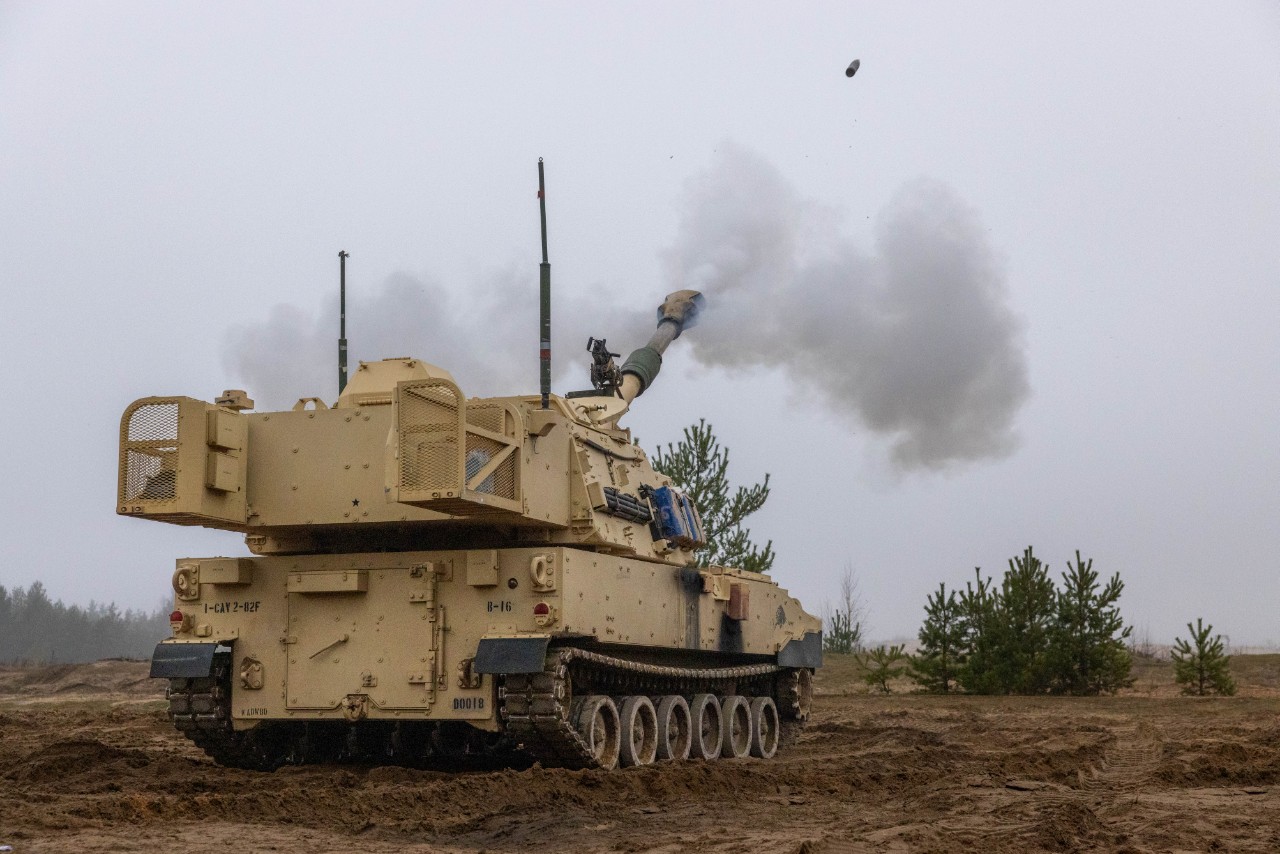
US Army soldiers have conducted live-fire artillery qualifications in Latvia as part of ongoing training activity aimed at maintaining readiness and reinforcing NATO’s eastern flank, according to the US Army.
Soldiers from 2nd Battalion, 82nd Field Artillery Regiment, part of the 1st Cavalry Division, fired the M109A7 Paladin self-propelled howitzer during Table 11 and Table 12 qualification exercises at Camp Ādaži on 18 December. The activity formed part of a structured certification process designed to validate artillery crews, fire direction centres and command teams under live-fire conditions.
The Table 11 and Table 12 events represent the final stages of US Army gunnery qualification for artillery units. According to the US Army, the tables focus on crew coordination, communications, fire mission processing and the accurate delivery of indirect fires. Successful completion confirms that units can operate effectively as a team in combat scenarios.
Camp Ādaži, located northeast of Riga, is Latvia’s primary military training area and has served as a major regional training site for decades. The facility was expanded in 2017 to support increased multinational activity following NATO’s enhanced forward presence deployments in the Baltic region.
The M109A7 Paladin is the latest variant in the long-running M109 family of self-propelled howitzers. According to the US Army and manufacturer BAE Systems, the platform is intended to provide armoured brigade combat teams with modernised indirect fire support through improved survivability, digital fire control systems and commonality with other tracked platforms. The US Army describes the M109A7 as a key element of its artillery modernisation effort within armoured formations.
During the exercise, US Army officials stated that the training also supported broader alliance objectives. The presence of US artillery units operating in Latvia is intended to enhance interoperability with NATO partners and demonstrate collective defence commitments in the region, according to the service.
The US Army has regularly deployed rotational forces to Latvia as part of NATO assurance measures, with live-fire training viewed as a critical component of maintaining combat credibility.








Must be nice to have some artillery!
In an interview with Ukraine Commander-in-Chief Oleksandr Syrskyi on 30Dec2025:- (reported by Euromaidanpress.com, link below)
Syrskyi confirmed that Britain’s Defence Chief and France’s General Staff chief have both requested Ukrainian assistance in training their forces in the new drone warfare. “The vector has changed,” Syrskyi said. “They are interested in us giving our instructors, our officers in order to provide assistance in the training of their armed forces.”
He also reported that Russia’s 410,000 losses in 2025 year exceeded its entire recruitment drive. Russian forces in Ukraine have plateaued at 710,000-711,000 for the past six months, unable to grow – despite continuous recruitment
Daily Russian casualties now average 1,000-1,100 personnel, with kill ratios reaching six-to-one or higher in some sectors.
Contrary to Russian claims, Ukraine retains control of roughly half of Pokrovsk. “All the approaches to the city are under our control, under the control of the actions of our drones,” Syrskyi said.
At Kupiansk — which Putin claimed captured three times — Ukrainian forces have cleared the city and established a bridgehead north of the Oskol River. Slava Ukraini!
Source:-
euromaidanpress.com/2025/12/30/syrskyi-interview-800000-troops-tro-reforms-assault-forces-2025/
Our ex AS90s are doing well in Ukraine, liked by the crews and when employed tactically have a high survivability rate! Could we get them back after a peace process in Ukraine please?
Rather have some GBAD. Our military capability looks more like a swiss cheese currently.
Novice, you need both.
Agreed. In my ignorance I was thinking more of, if a financial choice was to be made, GBAD for Homeland defence over mobile heavy artillery used on continental Europe.
Prepositioned kit in Estonia etc is fine, but our limited industrial capacity seems very vulnerable to support that prepositioned kit.
Time has moved on and rapid ‘shoot and scoot’ is the way ahead using Archer or RCH 155 – the latter I understand can fire on the move?
Gavin, AS-90 was the best ever proponent of shoot and scoot. Three rounds off in 15 seconds then it could move on. Outperformed everything. Even K9 Thunder can’t do that today, and thats against our 30+ year old non-upgraded SPG.
Graham, There is clearly a back story here that I do not understand. If the AS-90 platform was so good why was it not retained and upgraded with more modern fire control systems?
Look up AS-90 Braveheart. For some reason the UK MOD cancelled the program after being successfully tested. Forget what Wiki states, there was no problem with ammunition handling. Poland bought the turret design and fitted it to their T72 copy the PT91 as a prototype. The turret worked well, but the chassis wasn’t really suitable. So Poland bought a number of K9 chassis and fitted the turret to it, to create the Krab SPG. Which like the AS90 uses hydrogas suspension, therefore doesn’t need a stabilizer spade to be lowered so it can fire. Which is very close to what the AS-90 Braveheart would have ended up looking like.
According to Wiki, Poland has donated 54 of its in-service Krabs to Ukraine, along with building and delivering another 54 Krabs for them (total of 108). They have been used a lot by the Ukrainians and have suffered accordingly, which according to the latest updates by Oryx, is 39 Krabs.
Thank you Davy I have done just that. Your comment about Krab losses only serves to demonstrate how dangerous and unforgiving a battlefield can be, particularly in today’s drone infested environment. I am currently reading Andrew Roberts’s masterful book ‘Napoleon the Great’ just amazed at the size of the armies that countries like France, Austria and Prussia could field in those days!
AB, and these were SPGs that were almost entirely unmodified during their 30+ years service, disgracefully all losing out on getting the Braveheart upgrade.
Agreed mate, the AS90 was ahead of its game 30 years ago, now a bit long in the tooth due to not being upgraded, however when the cupboard is bare, anything is welcome and I and I reckon the RA would have these back in an instant. However we wont, we will wait for a few Boxer 155s and a few more Archers. All to slow, to late and not enough even for our diminished Armoured formations.
If we had a big gun we could do the same. Ho ho ho…
If Trump was serious about leaving Nato, this would all have stopped and these dough boys would be returning home by now.
Congress is also keeping him in check as well