American supercarrier USS George H.W. Bush has been conducting flight operations with F/A-18E Super Hornet fighters in the Pacific after completing a port visit to Thailand, according to the US Navy.
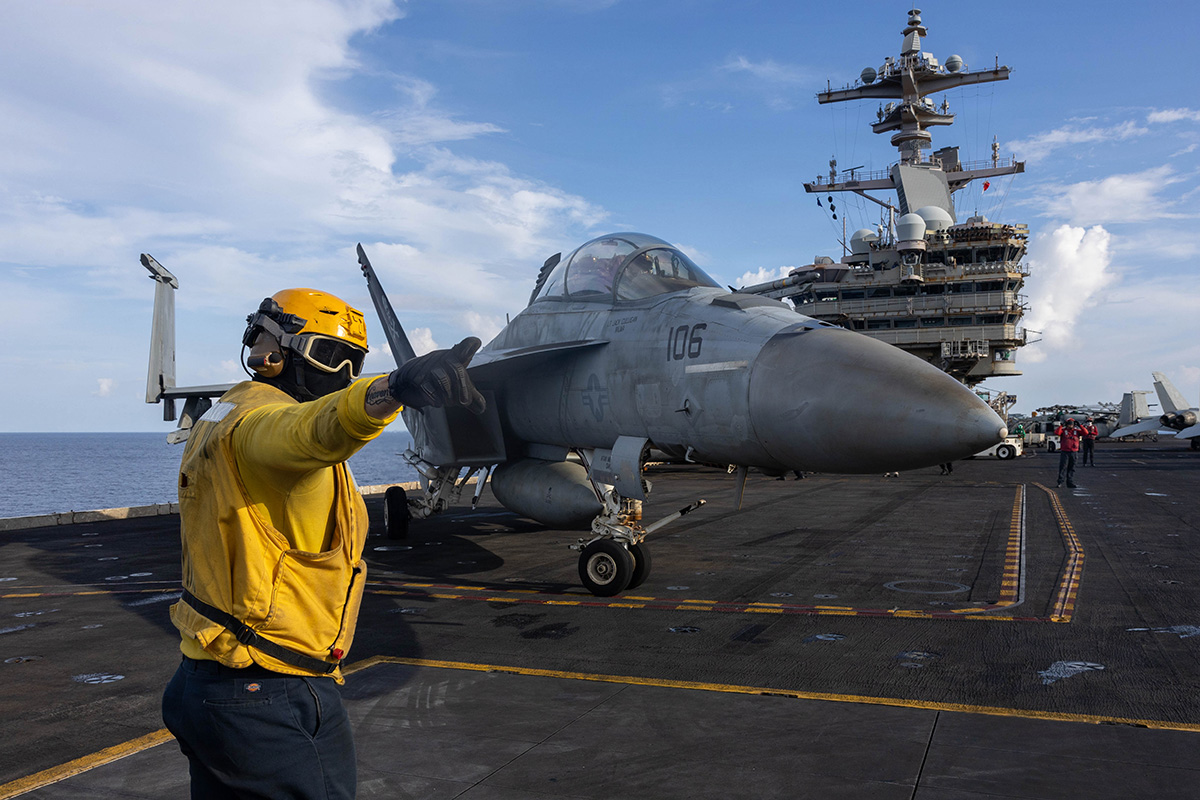
Imagery released on 11 October shows a US Navy sailor directing an F/A-18E Super Hornet from the “Gunslingers” of Strike Fighter Squadron 105 aboard the Nimitz-class carrier during operations at sea the previous day.
USS George H.W. Bush is now operating in the US 7th Fleet area after spending the previous six months in the Middle East under US Central Command and US 5th Fleet, where the carrier strike group supported American operations in the region.
The carrier stopped in Phuket, Thailand, from 4 to 9 October before returning to sea and resuming flight operations in the Pacific. According to an update accompanying the imagery, the US Navy said: “George H.W. Bush is underway conducting routine operations in the U.S. 7th Fleet area of operations.”
The US Navy added: “U.S. 7th Fleet, the Navy’s largest forward-deployed numbered fleet, routinely interacts and operates with allies and partners in preserving a free and open Indo-Pacific.”
USS George H.W. Bush, designated CVN 77, is the tenth and final Nimitz-class aircraft carrier and serves as the centrepiece of Carrier Strike Group 10. The strike group has been operating with several Arleigh Burke-class guided-missile destroyers, including USS Delbert D. Black, USS Mason, USS Ross and USS Donald Cook, providing escort, air defence, anti-submarine warfare and additional strike capability around the carrier.
The latest imagery shows an F/A-18E being handled on the flight deck during routine carrier aviation operations. Flight deck personnel use hand signals to direct aircraft because of the noise generated by jet engines and the confined operating environment aboard the ship. Strike Fighter Squadron 105 operates the single-seat F/A-18E Super Hornet, one of the principal combat aircraft used by the US Navy’s carrier air wings for air-to-air, strike and other missions.
Nimitz-class carriers displace more than 100,000 tonnes at full load and are powered by two nuclear reactors, giving them the endurance to remain deployed for long periods without requiring conventional propulsion fuel. The carrier’s combat capability is centred on its embarked air wing, which can include F/A-18E and F/A-18F Super Hornets, EA-18G Growler electronic attack aircraft, E-2D Advanced Hawkeye airborne early warning aircraft and helicopters used for anti-submarine warfare, logistics and other missions.
USS George H.W. Bush entered US Navy service in 2009 and is homeported at Naval Station Norfolk in Virginia. The ship is named after George H.W. Bush, the 41st President of the United States, who flew as a US Navy aviator during the Second World War.