

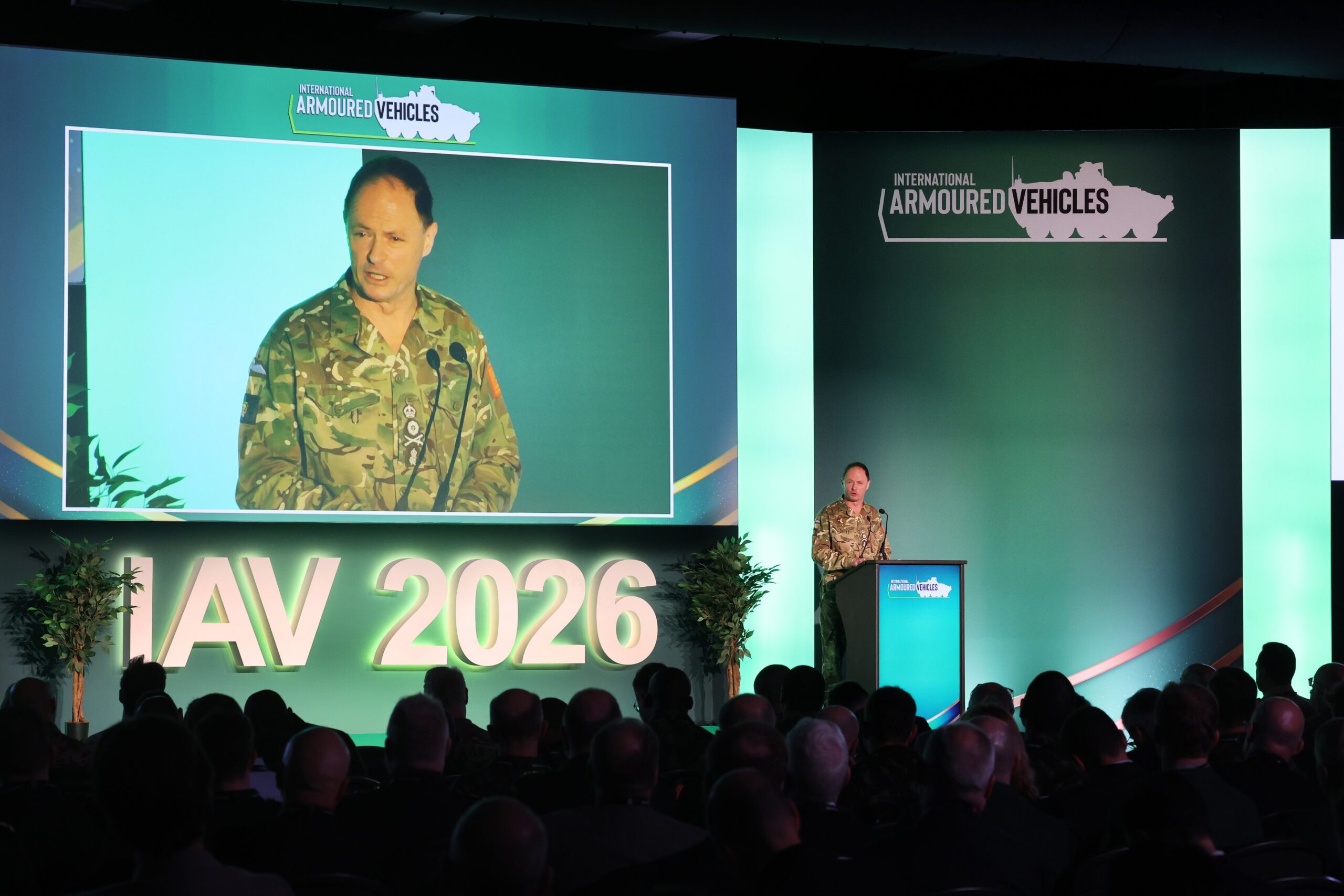
The Chief of the General Staff has told an international defence audience that the British Army is reorganising its priorities around a blunt readiness question: what would have to change now if UK land forces were heading for large-scale combat in 2027.
Addressing the International Armoured Vehicle Conference 2026, the Army chief said his core responsibility is to generate the nation’s land forces and described the annual pipeline that turns civilians into trained soldiers.
“As the Chief of the General Staff, my role is clear, well, certainly it is according to Wikipedia, my role is to develop and generate the nation’s land forces,” he said.
“Each year we take roughly ten thousand civilians, turn them into new soldiers, group within generalist and specialist units and formations which are already filled with experienced soldiers. We then equip them and train them with the tools and methods of war. In short, we prepare them for war to better keep the peace,” he added.
He told delegates the event connected industry and the battlefield, saying: “This unites the tacticians and the technicians, the scientists and the artists, the thinkers and, importantly, the doers. And it connects the factories to the foxholes, because that’s what it takes.”
Setting out the strategic backdrop, he argued that threats are converging and growing more dangerous, pointing to Russia’s war in Ukraine and wider geopolitical competition.
“The threats we face today, I think, are dangerous. They are converging, and they are increasingly interconnected,” he said.
He said Russia’s 2022 invasion was enabled by a belief it had reached parity with the West, adding: “And that should give us pause, as to, ‘how on earth did we let that happen?’”
Despite heavy losses, he argued Russia continues because of broader strategic aims: “Putin’s goal is to fracture the transatlantic security arrangement that has kept the peace for the last 80 years,” he said, adding that in the words of a NATO analyst, “he seeks a strategic defeat of the United States”.
Turning to lessons from Ukraine, he stressed the industrial dimension of warfighting.
“Armies may well be able to win the battles, but it takes nations to win wars,” he said. “Deterrence today is not just about the boots on the ground at the front. It’s about the ability to regenerate, outproduce and outlast from the back to the front.”
He described how modern conflict is being reshaped by the combination of mass and accessible precision, and by the pace of adaptation on both sides.
He said the Army is acting on the Strategic Defence Review now, rather than waiting for long-term plans to mature.
“We can’t wait for the perfect army of 2035, we have got to transform the army that we have now,” he said, adding: “My ambition continues to remain about doubling our fighting power by 2027, relative to where we were in 2024, tripling it by 2030.”
The chief argued that technology, particularly AI, will be central to that transformation.
“We need to be increasingly software defined, not hardware confined,” he said.
He told the conference he had narrowed the Army’s 2026 focus by posing a single “pre-mortem” question.
“If we knew, now, that the UK’s land forces would find themselves in large scale combat operations in 2027, what would we be doing differently now, and why aren’t we doing that?” he said.
He said the effect of that question has been to shift discussions with industry and society towards war sustainability.
“The energising effect that that question has had, has surprised me,” he said. “It has lifted the conversation with industry, for example, from a technical one about how soldiers war-fight, increasingly, to a conversation about how the whole country will war-wage.”
From that framing, he set out a future “20:40:40” approach to lethality, where a smaller share of killing power comes from crewed heavy platforms, and a greater share comes from attritable uncrewed systems and consumable mass effectors.
He said: “In the future, we want only 20 percent of our ability to kill, the raw lethality, only 20 percent of that ability to kill, to come from that central heart of crude, survivable platforms,” adding that these include “our tanks, our armoured vehicles, our other fighting vehicles, as well as our attack helicopters.”
He described the next layer as uncrewed attritable platforms and the final layer as low-cost, consumable systems: “These are the cheap, throwaway, one-way-effectors that are on a fast product burn and are available at mass,” he said.
He also said Task Force Rapstone is already driving rapid acquisition and scaling of new capabilities.
“From just September last year, we’ve invested over £200M in British systems,” he said, adding that the effort supports formations earmarked for potential operations and support to Ukraine.
However, he cautioned that the focus on the “40 and the 40” must not come at the expense of survivable armoured platforms.
“I don’t want our system to be undermined by an inability to field the 20 percent of survivable, sovereign, world class platforms which will carry our troops into, through and beyond battle,” he said.
He added: “Most soldiers, most of the time, will drive to, and fight from, their vehicles in battle.”
On the armoured vehicle pipeline, he said Challenger 3 remains aimed at an initial operating capability in 2027.
“On Challenger 3, we still intend to hit the IOC with 18 new tanks delivered in 2027,” he said, adding that discussions with Rheinmetall BAE Systems Land include accelerating aspects of the programme and spiral development with fielded units.
On Ajax, he acknowledged current issues, referencing an investigation linked to events on Exercise Titan Storm, but said the capability remains essential.
“Please be in no doubt, we need an armoured, reconnaissance and armoured cavalry programme for the reasons that I’ve laid out above,” he said. He added that the situation has brought operators and engineers closer together: “We know exactly what it is that our soldiers need to see to change, to have confidence that this is a warhorse they can go to war in.”
On Boxer, he said: “We do hope to reach IOC this August,” adding that he remains hopeful of meeting full operating capability in line with the original contract and seeing “well over six hundred vehicles in the first batch.”
He said the Mobile Fires Platform, based on the RCH155, is being accelerated, with first systems expected to enter service in 2029, and confirmed progress work on protected mobility through the CAVS arrangement. He also said the Army intends to move to contract next financial year for a Light Mobility Vehicle programme to replace ageing Land Rovers and Pinzgauer fleets, aimed at replacing more than 13,000 vehicles across the services.
Concluding, he said the Army is trying to move faster because of the strategic direction of Russia and the realities of industrial war.
“We are trying to act with the urgency of wartime,” he said.
He cited advice he attributed to a former Ukrainian Chief of the General Staff, emphasising that industrial output is central to deterrence.
“They will only take you seriously when it comes to deterrence, and strength, when they see your factories producing at wartime production rates,” he said, adding: “Industry and the world of finance must become the fourth arm of defence.”








What wonderful, wonderful words ! Our country is safe. (goes back to bed)
We gave out artillery to Ukraine. Replacements are coming in 2029. So what would have to change now if UK land forces were heading for large-scale combat in 2027? Hmmm….. Tough one.
The answer is the DIP, isn’t it? We have to publish the DIP at some point before 2027. Phew! If I hadn’t been paying attention over the last few months I might have thought the answer had something to do with artillery.
We can publish the DIP tomorrow but we are still not getting anymore artillery until 2029. The 14 archers will have to do the job until then. Not that much of the DIP is for the army, most of the big stuff is for the navy and airforce. Army numbers are confirmed to stay the same and all army platforms are already well in to procurement.
Jim, is this the right time to major on the RAF and RN in real terms and make the Army a light rapid force only? He’s suggesting in 2027 we will be going into a fight with old armour some of which were driven by grandads!
No it’s not. We are committed to fielding two heavy divisions to NATO, plus a corps framework, which we have been welching on for years. The idea of sending a couple of light brigades instead would go down like a lead balloon with our NATO allies.
Unless the UK builds up its air and naval forces, which would offset NATO’s land force concerns. The current UK Government appears not to see the Army’s heavy armour as important enough to spend big money, and happy to equipe it with small fleets. Sadly, that may be a deliberate plan in favour of what I’ve suggested.
Boxer, RCH 155, Challenger 3? Seems like the government is spending on regenerating the Army’s heavy formations.
What Arty will equity this heavy force? 14 archers, and so far 2 MLRS A2s, ? Oh or do you mean 100 towed light guns? What will do recce Ajax? What armour C2 as C3 Will not be ready in time. Etc etc
Nope, give us a clue “what arty will equity” ? 🤔
Is It Code ?
No, if you want to be a leader in NATO, or whatever comes after it, it means doing the hard miles on the ground. Only providing a light land capability without an armoured core just means you no longer get a seat at the table.
No, 14 Archers, 2 Regiments of MLRS and the roughly 130 105mm towed guns the Army has in service. The lack of Armoured SPG’s is a bad gap, but it’s not like the Army has no indirect fires capability at all like many claim.
only 2 MLRS are A2’s the rest are as delivered in 90’s ie not up graded to fire GPS ammo, as they still have the old LDS/FCS /FCP just fitted for Bowman and wilth upgraded IEU’s and soft ware. The up 4/6 graded B1’s were gifted to Ukraine. and 14 Archers is not even a regts worth, 130 light guns ha ha max rang 17200m, what we going to do with them, get the crews killed, Wake up, all this crap light wheeled stuff looks great on paper but its useless in gun fight,
The light guns have been giving a good account of themselves in Ukraine. But I don’t expect any facts to make a difference to you, who is determined to rubbish everything at any cost.
Why was the abbot replaced? By the M109, because fall of shot from a 195mm gun was deemed not enough to break up an armoured attack. The light gun has a range of 17000 m wgmhich makes it out ranges by every thing less for a Russian D30., it can not fire smart or guided ammo. I have crewed and fired the light gun armoured warfare is not what it is meant for. It was my first gunnery course. Great kit when used as a light air mobile gun.
Everything you’ve said I’ve already explained inthe post you initially replied to. Try re-reading that and switch off your doomer mentality.
Some of us understand that things aren’t as bad as you are determined to portray them.
I meant 105 mm not 195mm typing error. I have nothing against the light gun but only a idiot would use it in an armoured flowing battle, Ukraine use it as they have nothing else
Awww doomer can’t deal with the fact that Ukraine have a lot of different artillery systems. Maybe lie in a dark room a bit, it’ll make you feel worse.
The light gun is good at what is was meant for. Any one who thinks a light gun is great in modern armoured battle is dim and lacks an understanding of gunnery.
You crew it in you unarmoured pinz and see how long you last,
I’d care about your opinion if you ever had anything to say other than doom. Since you don’t I dismiss it.
we can do some stuff quicker as we have a load of HMTs and other vehicles that could take the Brimstone launchers. This would at least give us some capability until RCH comes online.
Its all words until we see stuff actually happening at a far faster pace than it is now.
We could/should have sold our old fleets to Ukraine and use the money to accelerate production of new stuff that we could also sell to Ukraine (Lend/lease)
but we haven’t seen any real acceleration or seriousness from this Government
And can do all that while the MOD orders nothing, well thats us safe and i sleep soundly. No replacements for gifted kit, out of service kit or gifted ammo, is he on drugs?
Martin, you are right that the MoD has been tardy ordering kit. There have been few platforms ordered for the army since Labour came to office 18 months ago. Its little more than 53 semi-armoured, roofless Jackals.
But CGS is talking about delivering capability during 2027 ie in the next 12-23 months. Some Boxers will be coming through and maybe Ajax will be sorted and being fielded. IOC for CR3 will be declared.
Sorry, may be, should be, in the future is not good enough. When will the AS90 numbers be replaced 2030 or later, how on earth can people say we can deply an Armoured cDiv with may be 12 or 14 155 mm guns and only 2 up graded MLRS as the others can not fire smart or GPS ammo. So where has all the money gone? Ajax/C3/Boxer are mostly already paid for. Nothing to show for a bigger defence budget just warm words.
The army is certainly down a bit of a hole ref equipment at the moment. The problem is that it has long been the cinderella service, getting the crumbs off the table after the nuclear programme and the other two services have spent the money on their big-ticket programmes.
Apart from some MR/PPV.acquired urgently for Afghan, there has been very little new equipment for the army.
Which has been left with an elderly.legacy fleet of vehicles and artillery, most of which should have been replaced a decade ago. We are at the bottom of the hill and have a long way to climb to get back to having a credible armoured force.
On the positive side, if Ajax can be made to work, we have about 1,500 new equipments being manufactured at the moment, with Chally 3, Boxer, Ajax, Sky Sabre, upgraded GMLRS and Boxer RCH gun. It will take time to get these all into service, but that is the inevitable legacy of governments kicking all these requirements into the long grass for 20+ years.
If there was a pile of extra money available, we could move faster, but I think Healey has squeezed as much as he can out of the Treasury for now and the Treasury is anyway skint.
It is not great but at least we should see a lot of new kit entering service over the next 5 years
I agree the Army is the more forgotten service, and has been since about 2003 onwards. Simple fact is much new equipment is on its way or will be but as always any item takes 2 to 3 years to enter service all going well. I do feel a corner has been turned and things are getting very slowly better. Fact is though there will never be enough money to fix the Army over night.
What new funds there are heading in the right place even though at times it seems as if nothing is being done. We do not need A large Army we do need a bigger Navy and RAF. Saying that the Army must be better equipt and GBAD ie long range and anti ballistic missile systems would be wise. Some will fund fault in me saying we do not need a large Army but fact is we have no where to put it abd not the money to equip it. It’s current size makes sense once it has the right kit.
He’s been looking himself up on Wikipedia?
Fair enough.
Probably just checking what equipment he has to play with, I expect he’ll be looking in on here from time to time, to get some Ideas on how he should do his job.
Sat in wind rain a fog here, planning the Isle Of Wight trip, can’t see where we are going and being blown off coarse, It’s very similar to his job !
An easy answer to that question. Double or treble the defence budget. Alas impossible in practice.
I’d settle for an extra £25bn this April purely going into conventional military capability.
Easy to achieve if we had a Chancellor will the balls to reverse £25bn of Quantitative Tightening (running at £70bn this year, enough to double the overall defence budget with a phone call). People don’t realize how daft QT is. This year we’ll raise £70bn in debt, much through the sale of bonds, and then we’ll destroy the money. Really. We’ll just destroy it. Even the Fed wasn’t stupid enough to do active QT. We’ll still have to pay the markets interest on the bonds we sold them of course. We are the only country in the world still doing any form of QT. Why do this? It’s to strangle enough of the economy to lower inflation because high interest rates aren’t destroying enough of it. That’s what happens if you give a single target (2% inflation) to an organization with only one weapon to achieve it.
Jon, There sems to be plenty of money for Millibands green revolution – another £25bn announced yesterday, plus £bns for Northern Powerhouse Rail, and we are starting to spend huge money on our Defence Nuclear enterprise – all aded to eye-watering sums spent on Welfare. Not much being spent on recent orders for army kit, especially platforms and major weapons.
I know nothing on all this but 20:40:40 seems a bit too extreme. Wouldn’t a 30:30:40 be a bit more balanced? We don’t want this to be an excuse for not acquiring greater numbers of the more traditional platforms like tanks, IFVs and helicopters etc. Surely sensible now and many here have asked before, to get a greater number of CR2s upgraded to Cr3s and all with Trophy APS, get a tracked Warrior IFV replacement and Stormer Shorad replacement – maybe the Boxer Skyranger 30? The Army deserves the best protection and power projection for its troops.
It was the core principle behind the SDR based on experience gained in Ukraine. Basically it means the current with a substantial boost from drones and long range precision weapons.
It’s also why they talk about an increase in lethality. It all makes a lot of sense.
Does seem strange unless stuff like repeater drones are included in that or you’re very optimistic about autonomous systems.
I see the traditional manned platforms being crucial for keeping a human in the loop in an EW contested environment.
No heavy artillery, a handful of tanks, very limited air defence systems, yeah, we’d better be equipped with plenty of body bags. The army is at least a decade away from being a credible force, maybe…
“Most soldiers, most of the time, will drive to, and fight from, their vehicles in battle.”
This certainly is the case when you bin off Puma2 without any replacement. Tactical movement, resupply and casevac all become fixed around roads?
“Where we’re going, there aren’t any roads”
Greenland is rather nice this time of the year ! ❄️❄️❄️
Puma was an RAF heli as will NMH be. It will likely be in the RAF’s procurement plan – if we’re actually going to order anything.
NMH is operated by the RAF but comes under the army CoC and budget
Strictly, it comes under Joint Aviation Command now! Which has its own budget. I still think it will be covered in the RAF’s procurement plan, but we will see.
his argument that 80% of lethality comes not from vehicles and people directly but from remote systems acts to take the pressure off the armoured vehicle programmes. If you were to have an army that had all the remote systems it could want, and the people we know it has, but the vehicles were less than ideal (putting it mildly), then you’d have almost all of what you want.
Or so goes the argument I suspect
I wonder if the software is people although we cannot enough of those. Are we going to get the right kind?
As always, we plan to go to the next war knowing that we will get some of the right kit for the war after. After the current politics people have made their excuses.
Well I think this says it all..on how utterly unfunny some of the key bits of UK power actually are…and for me one of the most idiotic examples around land forces has to be self propelled 155mm artillery systems.. 155mm self propelled artillery is the bread and butter core of any and all meaningful heavy or medium warfighting brigade.. and we gave all ours away.. 5-10 years before we could replace them, at the point Europe was heading for war…
So how can the British army be ready for war in 2027 when it will only have 14 155mm gun systems and will not get anymore until 2029 at the earliest….
“consumable mass effectors.” Don’t you just love staff college wallahs, they make politicians seem plain speaking!
On the positive side, that’s around 1,400 new equipments for 3 Arm Inf Div. The army has been the cinderella service since 2010 and probably much further back, so 3 Div has an elderly vehicle fleet which virtually all needed replaced a few years ago.
Sounds like they have an idea of a fix for Ajax, so we might get them plus Chally 3 and – oh joy – this wheeled Boxer APC, then eventually the Boxer howitzer. With Trojan getting a little refurb, that’s most of the brigade-level kit being renewed.
Have to hope that GMLRS, Sky Sabre.and the replacement for Stormer are all underway in the background.
That’s probably all we could hope for at this point. We are not however going to be in any kind of fighting shape by 2027, not with 18 tanks, 14 Archers and no medium lift rotary. We are minimum 5-6 years away from being able to field one re-equipped brigade group.
The army should also be about ready to order the first 40% in the equation, the two or three UAVs.
CGS aims to place the Light Mobility Vehicle contract next year, so there will finally be some replacements coming for the ageing Land Rover TUMs. But no mention of the ‘Heavy’ Protected Mobility Vehicle to replace Mastiff and Ridgeback. It may be that there ain’t the funds to order Patria just now, on top of everything else.
If we can squeeze the above kit out of the DIP, it’s not at all a bad start. I was hoping they might squeeze in another 8 Archers, do we could at least field one close support field regt until the Boxer RCH eventually arrives. The Archers could then be switched to 1 Div as divisional artillery or given to one of the reserve regts.
Yet Patria is cheap!
So, to cut through all the stuff that the CGS has said before, including filling his speech with basics as how an army operates obvious to any officer in that room.
Nothing new, apart from LMV, which isn’t really new at all.
He says the Army is acting on the SDR. Where?
Show me the conclusions of Wavell.
From what little information that gets released, there’s plenty of deck chairs being moved from unit to unit, leaving the same as before repackaged differently.
Where is the doubling of MRAD?
Where is the trippling of SHORAD?
Why have you formed a “new” DRSB and issued it formations you stole from the existing one?
When will you be able to recruit more soldiers to form the missing CSS to enable Brigades we already have, never mind fantasy new ones?
Where are the “two Reserve Brigades” and what is their structure?
If ISTAR is so important, which it is, why do we have a handful of CBR?
Is there not a single CGS CDS CAS or 1SL who can actually detail their plans or are they just mouthpieces for HMG?
The answer is the latter, and neutered at that from being able to speak freely, even to the HoCDSC.
Moving on, nothing to see here.
Where did you see a reference to two reserve brigades? I haven’t clocked that one.
Future Warfare Magazine.
28/08/25.
Article by Gabrielle info emerges on future force structure of the British Army.
It’s an interesting article.. but it does show that the 2 divisions is really a sham.. 2 manoeuvre brigades is not a division.. third and first together gives you 2 heavy 1 medium and 1 light mec brigades.. as far as I’m concerned that’s a division level strength, which is fine because add in the air mobile brigade and 11 brigade that is what I have always thought our commitment level was meant to be anyway.. a decent division and an air mobile rapid reaction force.. personally I think it would be better to get rid of the pretence of 2 deployable divisions and just build one very good one.
What is good to see is that 3rd division is not getting boxer and will be having tracked armoured infantry and retain 3 MBT regiments ( a type 44 regiment with a squadron of Ajax will work if Ajax works 😬) and in 1st division 7th mech becoming a proper mec ( heavy ) brigade with boxer ( that is a real upgrade) with 4th brigade becoming a light mec brigade ( again this is good news.. having a none mechanised light role infantry brigade on top of 11 and 16 brigades and the marines was a bit ridiculous)..
The creation of 2 deployable reserve light mec brigades is pretty significant as well and it looks like they are finally deploying the 1000s of drones at different levels that are needed for a 21c army.. it was a bit of a nice read to be honest…
But my concern is 155mm artillery.. numbers of MBTs and Ajax.. 150 odd MBTs is not adequate for 3 type 44 regiments.. unless they decide to keep a load of old challenger 2s as an attritional reserve ( France is keeping a load of its un modernised MBTs for this purpose)
14 155mm artillery systems is a joke.. I count we would need 48 + reserves and thats a minimum standard.. I think on top of that 7th Parachute Regiment Royal Horse Artillery should inherit the 14 archers for airmobile deployment..
“2 manuever brigades is not a division.” Um, yes it is. It’s not an ideal division but it still is a division, and if you have an issue with it take it up with the US Army since; the 11th Airborne, 1st Infantry, 2nd Infantry, 3rd Infantry, 7th Infantry, 25th Infantry, and 28th Infantry divisions all have 2 manuever brigades. We need to stop inventing definitions to be outraged about.
Gabrielle is also not a reliable source, he loves to act like he is, but he’s little more than a blogger who can make himself sound good. A perfect example: He’s been pushing the idea that Boxer is going to be replaced with an Ares APC in 3 UK div for about a year now, and is the chief source of that rumour mill, but nothing official has been said by anyone, and I’ve not heard a whisper of it on the inside, but people are repeating it as if it’s gospel (similar for the reserve brigades although at least I’ve heard others say similar who are not quoting Gabrielle say similar, so that’s not *as* far fetched. Mechanising them though is something again I’ve only heard from Gabrielle.).
Re the US infantry division predilection for 2 manoeuvre brigades.. yes but that is when they are used as toolbox divisions with to form brigade , battalion or headquarters deployments. If the US deploys a whole division it tends to deploy the 4 manoeuvre brigade model.. if you just take the big red one.. yep it will have the pretty standard US infantry division administrative structure of 2 manoeuvre brigades, 1 aviation brigade, 1 artillery brigade and 1 sustainment brigade and a headquarters. And when you review active deployments from the 1st it’s almost always one of these or a squadron or battalion deployment from one of these… but the singular time the big red one was deployed as a full wartime divisional formation in modern times ( GW1 if I recall although it may have been GW2) it was deployed as a 4 manoeuvre brigade division..
So don’t get me wrong I have no issue with the army having 2 administrative divisions with 2 manoeuvre brigades, a brigade of fires and a sustainment brigade… because the British army can set itself up in any way it wishes… my problem is how it’s sold to Joe Public.. I think the British government telling the world that it will supply 2 divisions as a corps level reserve to NATO when those two deployable divisions can infact only ever be 2 manoeuvre brigades each and a fires brigade which is essentially created by splitting the present fires brigade in two is a bit mendacious.. it’s not whinging at the army.. because as far as I’m aware the ambition before has been since about 1997 that the British army be capable of supporting an ally with a full heavy division and or rapid response brigade.. the whole British army being the corps level reserve suppling two divisions is a new pushed requirement.. but in reality the army has not been given the Orbat or pure manpower required..
Now many the restructuring of the reserves with 2 fully deployable light Mec brigades will allow for that and If they also restructured The Royal Wessex Yeomanry to be a deployable armoured brigade then they could at full stretch offer a corps of 2 divisions with 4 manoeuvre brigades ( if they included the 16th).. but that requires a full restructure of the reserves and a strengthening of fires as well as CCS and CS.
As is I think it’s being a bit dishonest and they are saying a corps of 2 deployable divisions by spreading the butter thinner and thinner.
Around reliability of source I cannot comment but it’s a shame if the move of boxer is not true.. but if your not hearing whispers then it’s probably unlikely. But to be honest I’ve never been convinced that the track over wheels is completely necessary when working with MBTs.. after all the French seem happy with wheels ? For me it always seemed the big issue is still the loss of the sections direct fire capability with boxer.
When is HMG ever honest about anything military?
Beware the spin, it’s all musical chairs or a shell game at the moment regards the orbat.
No, some corrections:
1st Infantry Division deployed to GW1 with 2 brigades. It later got assigned a 3rd Brigade but in turn 1st Cavalry Division deployed with only 2 brigades, alongside 1 UK division which also deployed with 2 brigades. The 82nd also fought with 2 brigades (having detached one to the French division).
During the 2003 invasion of Iraq, the 101st detached a brigade to the 82nd which deployed with only 1 brigade so both airborne divisions where 2 brigade forces, while 1 UK Div, 1st Marine, 3 and 4th ID all where triangular (3 brigades) not square. In practice the US army very much uses two brigade divisions in operational environments.
Again this is where the skepticism within this community has gotten ahead of itself; 2 divisions with 2 maneuver brigades are still operationally two divisions, and can deploy as such. It’s hardly “mendacious.”
It was my understanding it deployed with a brigade group from 66armour and then picked up another brigade.
As far as I know the two Btns of 66th Armoured Rgt and the Battalion from the 41st Infantry where the third brigade where the only brigade the division picked up. But even if it aquired a fourth brigade it would have had to get it from another Division which would have gone down a brigade in return.
It’s a shame if the orbat isnt reliable as Dern suggests.
Putting all Tracks in 3 and Boxer in 7, with Foxhound cascaded into 4 seemed like a good compromise to me.
But, we have an ARES order that isn’t sufficient, 93 was it, on an Ajax platform with issues, and it doesn’t carry the required number of dismounts without alteration.
I also read that NATOs definition of an IFV includes turret with cannon? Which again Ares currently lacks.
I don’t know Gabs sources, but ai myself find his orbat stuff accurate enough.
I’m impatient for Wavell to be detailed so one can judge properly.
I do have to wonder if the Ajax fix turns out to be removing the turret 😂🤣🤷
Well that would indeed reduce it’s weight.
Jonathan, ‘2 manoeuvre brigades is not a division’..
Classically a division has three manouevre brigades, it is true. There is an argument that four brigades is better allowing three to cover the ground in depth in defence and be in contact and the fourth to be an uncommitted reserve…or, in the offence, to allow one brigade to fix the enemy and two echelons (two brigades to assault/advance) whilst the fourth is an uncommitted reserve.
Anyway…back to reality. As Dern has said a div with two manouevre brigades still has utility – 1 (BR) Div deployed on Op Granby (first Gulf War) had two manouevre brigades (7th and 4th armoured brigades) and they did a cracking job even without the third brigade that current 3 Div has (1 DSRB) which should not be totally disregarded.
^This. As a community we are going from “Well three brigades is the ideal that should be striven for and it’s a shame we aren’t managing that” to “The government is playing shell games to lie about us having two divisions!” It’s tiresome and indicative of where the UKDJ comment section has talked itself into.
Not really it’s about views and they differ… my view is saying we are delivering an army corps of 2 divisions is playing fast and loss with the truth, when what we are delivering is 4 manoeuvre brigades and 1 brigade worth of fires.Really, not even that.. how many 155mm gun batteries are there for 2 divisions? Let’s just accept what we are delivering and be honest with the public.. it’s better that way as they know what they are voting for..
Your view is objectively wrong in that case.
No view is wrong Dern it’s why we have debate, I think it’s inappropriate to sell the UK as suppling a 2 division corps level reserve when it’s actually only providing 12th,20th, 4th and 7th brigades, to me that gives the ability to supply a viable division not a corps, to you it does not.. in the end in 5 years they may shift the ORBAT completely and build 2 three brigade divisions, collapse it into 1 division.. or even go the PLA route and decide the whole concept of divisions are dead and have army groups of brigades…. There is very rarely a single truth in life.. it’s all just about what side of the mountain you are looking at in that moment.
True as always mate. Never fear though, old sweats like me will shoulder our shotguns and guard essential infrastructure from Spetsnaz, Delta Force, Chicoms and the rest including hypersonic missiles. Net Zero and welfarism will be protected at all costs…..as long as I can wear DPM, I hate that MTP rubbish.
Did you see they announced the increase to 65 for recalls?
That actually pissed me off more than anything else this government has done.
Trying to cover their own failure with headlines like that, Impresses nobody.
Sort the regulars out before getting the old and bold to come back again, having sneered at them for so long, or threatened them in the courts.
Scum.
Yep saw it. About 90% of my vet friends have said they are a no show. Especially with 1 million “neets” living off the state…and not to forget the vast pool of dinghy person power available. We have said it before, this crew of politicians and the previous lot are full of yap, expert gaslighter’s.
Scum is being restrained, I do not really think the politicians realize the hate most have for them, and be honest would arming a few thousand vets be a good idea?
My thoughts exactly. Integrate, do something for your new country. Except, it isn’t their country, the loyalty lies elsewhere.
There are always exceptions of course.
Agree, they don’t, I loathe most of them for what’s happened to my country and to defence since what I knew in the 80s growing up.
Arming vets? An excellent idea! Though many would be tempted to head elsewhere, not Eastern Europe or to UK KPs.
A hypothetical scenario of course, and totally wrong, but, that is the strength of feeling many do not understand.
Aye, everything HMG do just increases resentment. The Chicom embassy thing is another example. Cancelled elections? The list gets longer by the day. One good thing about all this is its uniting a population and the PTB are afraid.
PTB?
Powers that be. Labour and the Tories, the establishment parties who have feathered their nests for so long.
John, the trouble with conscripting the dinghy people is that first they must pass nationality criteria (ie be British, Irish, Commonwealth or Nepalese citizens), then pass the security vetting, then the medical etc etc). Then they have to be trained from scratch – the Combat Infantry course is 26 weeks.
To be honest many of the young of today are being really mentally not in a good place at all.. on one side they are hammered at school with the you must perform or your a failure ( schools examine modern children to death).. while parents and schools massively control them.. social media telling them the must succeed and a warped view of what that looks like.. and on the other side being told there are no jobs.. no future and it’s all about personal freedom.. I support graduates with good science and technical degrees who are in dispare because they are told all this and cannot even get a full time job in Tesco’s..
We are screwing them over big time to be honest.. personally I think we need to do a few things
1) release children into the wilds.. give them personal freedoms to explore risks…( fall out of trees, dye their hair orange etc)
2) stop telling them they must succeed and if you’ve not getting straight As your not trying ( and for the straight A students telling them how hard they work when they are not even trying.. I have both type of kids and it’s not great the way schools are operating.. they reward grades not effort)
3) guarantee of employment from 19-21 ( education or apprenticeship until then) even if it’s gardening in the local parks or 2 years with the army.. no benefits but a guarantee of employment ( that pays the same they would get on benefits).
4) ban social media until 16.. it’s an utterly destructive cesspit that is actively ( and in many cases purposely) destroying the minds of our children, children minds are specifically susceptible to uploading information, as their minds have a different set of brainwaves to adults ( Theta/alpha dominated, they run the same state all the time as an adult put in a trance ) and yes the Chinese communist party and any other ideologically or financially scumbags use that.
65 is completely bonkers.. people that age don’t do those jobs for a reason..
Although it may be some specialist skills and knowledge they want to keep access to after all some people are still serving in their late 50 early 60s.. so it makes sense for them..
We have the same problem coming up in the NHS once we retired nurses off early at 55.. then it moved to the same age as everyone else in the NHS 60 and now it’s standard retirement age 67…. Which sound fine but there was a sound reason for retirement early..
1) the pure physical demands of nursing in acute environments.. it’s 24/7 non stop physically demanding work… you don’t want a nurse who cannot get down on there hands and knees and do the physically demanding task of resuscitating you after they have been on their feet for 10 hours.. you just don’t.
2) mental demands you need to be mentally agile and be able to juggle the immediate needs of 12+ acutely ill patients.. while communicating those needs to maybe 4 other teams of people.. all the while working 10-12 hour shifts 24/7
3) constantly re education yourself in new methods..clinical staff have to be sent back to the classroom every year..
Basically the over 50s are just in general a bit not very good at that.. and essentially you want young people doing these roles.. now yes their are leadership role s and you need wisdom.. but if your looking at an acute ward that’s maybe 4-5 out of 60 nurses.. the bulk you want in the 20-40 age…
Finally it just kills them physically and they end up spending all their time off sick in hospital or recovering from various surgeries ( in my career 3 of my senior clinical leaders who were in their early 50s just collapsed and never worked again and 2 ended up being removed to none acute roles and one senior just literally dropped dead at work and I retired out of the NHS at 53 to work for myself because of the build up of stress strain and physical health implications… your body knows your dealing in life and death day in day out that hammers you through none stop chronic stress.. and you cannot say let’s refocus and it’s only work does it really matter, because its never only work and it always matters )
This all means having your nurses retire at 67 is infact a complete joke, the joke has not hit yet.. because I’m of the last generation who could just squeeze out at 60.. but we are gone.. the middle aged nurses now all have to work to 67 and most of them are knackered old hulks already 🤷 the simple true is we don’t need or want people over the age of 55 doing some jobs
I recall, may be wrong on the age, that the 5k HSF back in the 80s during the Cold War were up to 65 as well?
But they were for local KPs only, not a deflection from the holes everywhere in the regular Army.
There were rumours of such forming again, before the SDSR was released, but not heard anything since.
Agreed, prison service expectations are that officers work until 67!!!!! Crazy nonsense.
Yep.. we just need to accept that jobs need different retirement ages and those jobs that are both physically, emotionally and mentally demanding are the ones we need to be retire from earlier.. yes there are some jobs you can work into you 70s doing them ( possibly part time) .. but even many of those I think the simple true is by that time people are out of touch and simply not performIng as well.. the mind and body both degrade.. we have optimal years for our body and optional years for our mind and wisdom and the 60s and beyond is not those..
Just sleep is a good example our minds still need 8-9 hours full sleep cycle REM to deep sleep patterns to flush out the chemicals, empty our hippocampus of short term storage, rebuild neural pathways and repair damage.. but from our late 40 and 50s our suprachiasmatic nucleus ( sleep Centre) starts to degrade and that decline is massive in our 60s.. so we simply are no longer able to repair our congnative function in the same way.. sleep is lighter more broken and for shorter periods.. that is why when you go into a rest home.the residents are all having random naps
It’s even worse for women.l we are only really now just how profoundly “catastrophic” the menopause truly is..
The brutal truth is the human body was not really designed to go beyond middle age effectively and without advanced medical interventions death from old age is in our late 60s.. the modal age of people was pretty set in stone until 1920 at about 69.. it then moved to about 73-5 until 1970 ( probably due to the social changes after WW1) and stayed there until 1970.. so you can say even with optimal conditions and good healthcare we are only designed to live into our late 60s early 70s it’s only with modern medical that we have shifted the dial with a steady increase every year until we hit about 80 at 2015.. it then stalled out as we hit the hard limit of preset medical knowledge.. ( modal age removes infant mortality).. the problem is what modern medicine does not do is reverse or prevent aging.. we are still as nackere in our mid to lat six’s as we ever were… we can just prevent death for a decade.. so it’s all very well saying we live longer and so need to retire later.. but it’s Bollox because medical sciences does not make you younger and healthy against.. it just keeps old knackered people alive longer.. and we have not come to terms we how we manage that cost.. because upping the you can keep working age will not work.
The final nail in the keep them working to age x coffin is we don’t age in a liner way.. we have a constant run of aging crisis at hits our health and abilities hard in one go.. so a person may be able to do a job at 60 but hit an aging criss at 61 and not be as able ever again… and we don’t know when those crises will hit.. personally I think we need flexibility in retirement bases on job type and individual capacity and we need to be willing to accept that Bob could do the job last week at 61 but.. that nasty bacterial lower respiratory infection that put him in a hospital bed for 2 weeks and had him off work for a month created an aging crisis point and he’s never coming back full time and will need a semi retirement.. because that’s how aging actually works we get hit by health crisis after health crisis that gradually knackers our bodies and minds the older we get the less ability we have to recover back to out previous capabilities.
Hi Daniele
on recruitment – the army is taking in between 5-8% of the people who apply
We could add 50k soldier annually given c.170k are trying to join each year
We need to look at how we get 50% through the door into some form of training within 6 weeks of applying, break them down into categories (very fit, fit, unfit) and extend initial training to compensate accordingly (one size does not fit all these days)
Clearly we need more money to do this, but surely its better to employ these people than have them on benefits or roaming the streets etc..
even upping recruitment to 25k pa would make a massive difference – currently our Army is not really an Army its a set of people trying to maintain an image that is 50yrs out of date.
We already break people down into categories. When you do your initial assesment, the bit that decides if you get a job offer or not, you get a grade, and the grade determines how much of a priority the Armed forces give you for your training spot.
We could add 50K, but where do you suggest the training staff and infrastructure come from? Certainly generating enough slack in the training system for 50,000 people to be showing up at Phase 1 6 weeks after their initial interview would mean disbanding at least a couple of units to generate the instructors.
And sorry, we very much are an army, just because some people online gloss over the day to day issues that need to be balanced doesn’t mean we aren’t.
Hi Dern
firstly, don’t mean to offend as I know you are serving.
if we are on a war footing then disbanding units to provide instructors is a good call. If not then how do we grow at pace?
We may well be an army, but we are an ill equipped army that would not survive against a near peer with intent (in my view), this is not the fault of those currently serving, but is the fault of our politicians. If we took similar % of losses to those experienced in Ukraine we would be out of people very quickly & an army needs to be able to sustain losses.
We have people wanting to join (lots of them for all arms actually) & I think we should give those people the opportunity to serve where they are of course unto the task.
It does need funding and I did say that in my initial statement – no magic here we need to fund it properly and with the right intent.
Disbanding units to provide instructors is rarely a good thing, especially not in this situation. How do we grow at pace, the answer is in peace time we don’t really. The peace time bottlenecks are many, especially around the NCO level, and not simply solved by turning a tap on at the Phase 1 and 2 levels. Disbanding units is not something that is easily undone.
I don’t know how you can make conclusions about the Ukranian % of losses since neither the strength nor loss rates of the Ukranian forces are published. So that seems a very vibes based argument to me, but if the question is “how to we generate BCR’s and increase the Army in times of War?” then the answer is you call up the Army and Strategic Reserve and in part they expand the training establishment. This comes with a lot of caveats and compromises and is often why follow on forces aren’t seen as high quality as the Regular Army or even TA.
As I said, it’s easy to just say “give those people the opportunity.” but it’s very easy to say that when you do not have to consider the whole force structure.
Perhaps its us vets that would be called up to give the training? Though if you’ve been out longer than 5 years and over 55, I’d see that as a problem.
That’s literally what the Strategic Reserve is.
Bugger, thought I got away with it!
XD
Ah, sorry Dern.
Didn’t see that you’d already mentioned lack of infrastructure, and people.
Where is the training infrastructure for that, though?
The ITGs ATRs at Glencourse, Lichfield, Winchester, Pirbright, Bassingbourne have shrunk to Pirbright, Winchester, due to close, and the ITC at Catterick.
You have a point there Daniele when WILL MOD set out their detailed force structures and organisation? Doubt that will be part of the DIP, so does that mean a third paper in this process? We better hope that Ukraine and Greenland can hold on for a few more years while we get ourselves vaguely organised…!
It’s only through a force structure and ORBAT that I can form a judgement of progress, or lack of.
By design, HMGs much vaunted “openess and being more transparent” has gone up the chimney. Bits and pieces leak, or get mentioned in unit websites or twitter feeds, and one needs to join the dots.
I asked a FOIA on another area of defence a few years ago and not one question was answered. Not one.
Thank you very much Daniele for the FWM reference. I didn’t even know of its existence, it’s a very useful source of info.
For those interested in the future army ORBAT, there is an informative article there.
It’s Defence Warfare Magazine, 28/08/25. Can’t see the URL on my mobile.
There’s not a lot of change in the ORBAT, other than re-classifying forces as Advanced Force, Reaction Force and ARRC. We will have two small, 2-brigade, divisions, each with its own Deep Recon Strike ‘Bde’.16 Air Assault Bde will form a third brigade group in 1 Division but also be earmarked for a two-star Reaction Force role. Gabrielle is always well-informed, don’t know where he got such detailed info from.
There are three developments I haven’t heard before.
1) We are miles further ahead with drones than I had realised. The article lists 7 drone classes being procured, totalling over 5,000 UAVs, plus an autonomoust collaborative platform to accompany Apache. Thongs seem to be going at speed.
2) Gabrielle has the two armoured infantry brigades being equipped eventually with the Ares AIFV. That would clearly be dependent on Ajax being fixed and would be some time away. He also has the Boxers eventually going to 7 LM Inf Bde Group, with 4 Inf Bde Grp getting the Foxhounds and future Patria. This would all be very good and sensible and would increase the fighting strength of these four bdes.
3) As a fan of having a number of reserve manoeuvre bde grps, pleased to see a second one envisaged. It will I would think be achieved by redistributing the infantry battalions in 19 Bde between the two bdes. It won’t increase the overall strength very much and they will be thin formations, but they will have a definite war role, rather than 19 Bde being a paper bde as at the moment.
Daniele is right that there are no more CS or CSS units, so the ORBAT is a bit of a deck chair moving exercise on the Titanic. But it looks like a sensible overall, if pretty thin, set-up. One that can be built on and strengthened if/when we move from 2.5% of GDP in 2028/9 to this promised 3% or 3.5%.
Hi Cripes.
Yes, I have used this alleged set up as a source for many of my ORBAT posts over the months. Whether they come to reality, who knows.
The advanced force of 11 Bde, 77 Bde, and the ASOB seems imminently sensible to me.
The 2 “Divisions” should really have a 3rd manoeuvre Bde, but that was lost from 2015 onwards when the CSS were cut.
One of the Strike Drones I have mentioned already, the Modini 250 Dart. I’m curious who operates it, whether there are RA Batteries devoted to the type. No idea, veil of mist over the lot.
The second DRSB has already formed, there are photos online of its formation parade and TRF. This has involved the original 1st DRSB changing ID to the 3rd DRSB, to align with its Division. The “new” DRSB takes the 1st designation, after its Division.
Apparently the Jackal equipped 1 QDG and 3 RHA with MLRS have moved into it. So no new units, just robbing Peter to pay Paul and the Army can boast of another Brigade! A shame, as the original DRSB is now weakened and I’d have liked each AI Brigade to have its own supporting MLRS Regiment and SPG Regiment.
“It will I would think be achieved by redistributing the infantry battalions in 19 Bde between the two bdes. It won’t increase the overall strength very much and they will be thin formations, but they will have a definite war role, rather than 19 Bde being a paper bde as at the moment.”
What of the all important CSS elements though? Most Reserve CSS is assigned to beef up the existing 101, 102, and 104 Brigades.
Maybe they will be rear area type formations and won’t need much CSS? The mention “train as they will fight” indicated some serious changes afoot on how the Reserve Battalions are organised.
Nothing is confirmed till it is official though in all this.
Hi Cripes. I’d take that FWM magazine reference with a huge pinch of salt. The author is just a blogger and not a hugely reliable one at that, and a lot of what he is saying has not been said by any other source so far, despite months going by since that blog post being released.
Case in point: nobody is talking about an Ares IFV other than Gabrielle.
It’s fun to speculate, and talk about, but we should be clear that he isn’t a “source” and is no more likely to be correct than any of us.
Thanks Dern. Since posting that, I have read your subsequent posts above, which has removed the scales from my eyes.
Cripes, ARES is not an AIFV. It is described by its manufacturers as an APC and carries typically 4 specialists such as anti-tank teams. Its not an IFV as it lacks a cannon and seats for a full Infantry section (I don’t think it will even be issued to the Infantry).
Thanks Dern. Since posting that, I have read your subsequent posts above, which has removed the scales from my eyes.
I had read somewhere that it can take crew + six dismounts if the stack of ISTAR kit lining one side is removed. If so, it becomes a tracked APC. I think that was the version Babcock entered in the Polish Army’s AIFV competition, must look that up. I remember that the Polish company in the Babcock bid had specified that there would be a different suspension system, a hydro-pneumatic one made in Poland.
Don’t know if it could take a 30mm RWS, let alone the 40mm CTA.
Graham, I checked out the Ares.being offered to Poland. (There’s an article in Army Recognition, 17.04.25).
The Polish quest is for a heavy infantry fighting vehicle for their Abrams-equipped armoured brigades.. The Ares version would differ considerably from the UK’s configuration. There’s another trade article from the same time that if I remember states 40-tonne weight and
crew + 6 dismounts.
It would be fitted with a Polish ZSSN turret with a 30mm Bushmaster cannon.and a couple of SPIKE launchers. So it does sound that Ares can be produced as a proper AIFV.
The article refers to GD UK, but I.thought I read elsewhere that Babcock was behind the pitch.
For the Polish competition, it is up against Lynx, Redback, BAE AMPV, Tulpar and ASCOD. The Poles had specified a new, Polish-made hydropneumatic suspension, not the set-up on the current Ajax.
I’ll be surprised it it wins the order, in light of the problems with Ajax.
All this to say that we may have a possible UK-made tracked AIFV that could replace Warrior, allowing the Boxer wheeled APCs to be consigned to a mechanised Bde.
Everything is still a year or 2 away…. “It’s about the ability to regenerate, outproduce and outlast from the back to the front.”
Can someone explain to me the meaning of the term ‘accelerating’ when applied to the acquisition of RCH155 for MFP when, according to the general, it ‘should see the first systems in service rolling out in 2029.’ First systems in 2029?! FFS, I hope the various malign actors that are putting us on a so called ‘war footing’ are willing to delay their various incursions …
The drive unit for the RCH155 is already in production, right? So the delay must be with the ‘turret/gun’ section, correct? We are purchasing 1/2 units [some confusion over exactly how many] to test and make a big song & dance about this. Are we waiting for the UK factory to be built and producing our own barrels? Why was the RCH155 chosen over the South Korean A10 self-propelled howitzer, I bet they would deliver before 2029… am I & UK Armed Commentary the only people baffled by this ‘accelerating’ …
No the entire system is already in production. We are just low on the priority list; the Ukrainian order for 66 RCH155’s is probably the highest priority, and then we’ll share with Germany so probably looking at 27 or 28 before our 155’s start rolling off the production line. Then well keep the initial small batch for some trials and doctrinal work until we have enough to form a Battery for IOC, which yeah, probably 2029. Alternatively we build a production facility in the UK for £££ at which point we have to wait until that’s physically built.
Thank you, Dern. That adds some context and I appreciate what you say. However, where there’s a will, there’s a way. I still maintain that we are building the ‘drive’ units in the UK, are we not? Some reallocation of these from, for example, the ‘ambulance’ version and re directed to this ‘priority’ would help [one of the arguments for the ‘Boxer’ was the ‘interchangeability’ of the drive units]. Or since we are on a ‘war footing’can this production not be scaled up? Also, we are supposed to be building a production line/factory for gun barrels, including 155, as I am led to believe, a little head start perhaps but surely not three years before it commences. Perhaps sourcing the turret ‘housing’ is the issue, but the cynic in me says this ‘accelerating’ has far more to do with limited budgets and phoney rhetoric. Worse, treasury has made their risk assessment that we can operate with only 16 archers and that is all we need for now…
Production could be scaled up. See my comment above. Make the decision to invest £££’s in a production facility in the UK (or if you don’t care about where it’s located; in Germany), tell Rheinmetal and KNDS you don’t care about their sustainability and are willing to pay top £ for it, then wait while they expand their physical infrastructure, order new jigs and manufacturing equipment and hire and train new staff to operate all of that, and once all that’s done you can get your RCH155’s… probably coming off the new production line in 28, maybe 27 if you are lucky, and then the Army gets them at IOC in 2029, and probably fewer 155’s since you spent a lot of that budget on the new production facility. So you’ve spent a shit load of money for… a couple months?
There is also absolutely no point in reassigning Drive modules. So what? They can sit there idle without a mission module until they can be shipped to KNDS to be fitted with the RCH155 module in 2028? Might as well at that point just keep the entire ambulance and not mess about with the contract and just have a drive module from KNDS when they are ready to do the UK order.
The problem is the British army having 14 155mm gun systems is at the same level of insanity as the RN ending up with a couple of ASW frigates.. they must have a full regiment of 155s for 3rd division it’s bonkers…
Yup, but as said, that’s on us for deferring armour investments to chase sandbox wars for a few decades.
Dern, I don’t think we have even placed an order for series production of RCH-155.
UKDJ (George) reported on 28/12/25: “The UK has signed a £52 million joint contract with Germany to acquire the RCH 155 mobile artillery system, a platform capable of firing while travelling at up to 100 km/h and striking targets at ranges of around 70 km.
The agreement, announced this morning, will see Britain receive an Early Capability Demonstrator, with two more systems going to Germany for shared testing and evaluation.
So we get three guns for £52m to simply evaluate. Not exactly the deal of the Century!
Thanks once again, Dern. I feel better informed, the way you explain it, and perhaps 2029 is the only ‘accelerated’ outcome we can hope for. However, it just doesn’t feel like, “We are trying to act with the urgency of wartime.” I am sure you will agree a grand total of just 16 Archer is a woeful amount of 155mm artillery for the British Army should the perverbial hit in the fan…
It is, but that’s the result of deferring investment into the armoured force for 20 years in order to support the Americans in a counter-insurgency war half way across the planet.
The deployment of 150,000 personnel, with deaths and casualties that the U.S. and its citizens seem to have completely now forgotten about..
Well if Vance says we haven’t been to war in decades then he must be right?
Helps if we train them to fight a modern war and not something using outdated wargames
“what would have to change now if UK land forces were heading for large-scale combat in 2027”
Great question, one that SDR 2025 should have considered.
Definitely worth setting up a high powered review team of retired generals and senior civil servants to consider the answer. Given the urgency it may be possible to get the Terms of Reference and membership signed off by Healey by June. Then set the review team am ambitious target of just 12 months to deliver a draft report. If its still full steam ahead, then maybe another 6 months to develop a fully costed implementation plan. Hopefully this might be considered by Cabinet as early as in Q1 2028. But with a high chance that they will decide that its getting too near the next general election to do anything (i.e. politically its definitely not the right time to prioritise defence spending over the NHS, education. pensions and social benefits) – so best just to use it as input into SDR2030.