

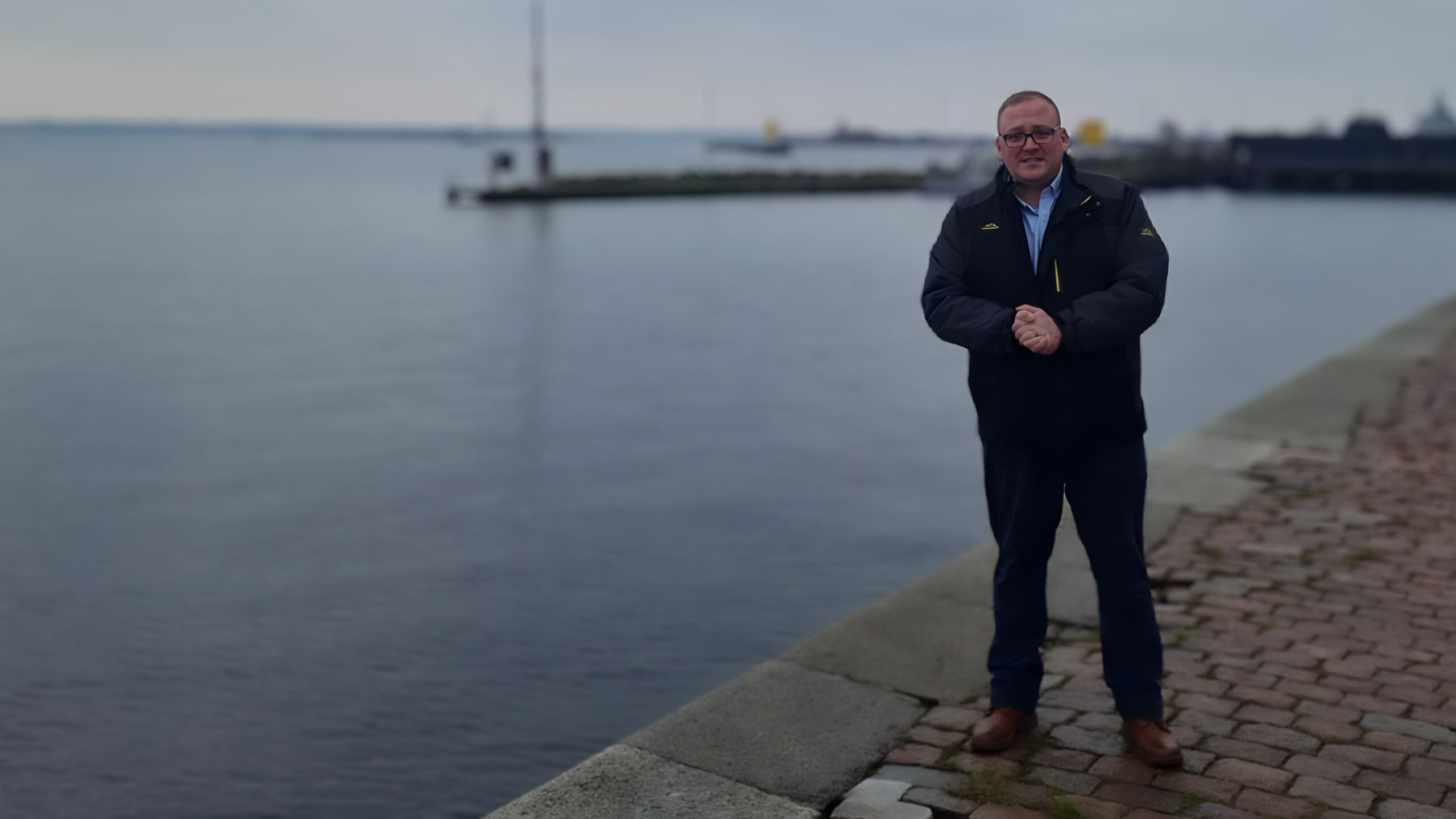
The Baltic Sea is quickly becoming a critical frontline for European security. With thousands of ships crossing its waters daily and vital undersea infrastructure at risk, NATO’s presence has taken on new urgency.
Our editor, George Allison, was invited aboard the Swedish warship HMS Carlskrona during Operation Baltic Sentry to witness firsthand how NATO is defending this strategic region.
Sweden’s recent membership in NATO has transformed its role in regional defence. Once neutral, Sweden is now working alongside its allies to protect key infrastructure and monitor the thousands of vessels that pass through the region every day.
As Commodore Arjen Warnaar, Commander of NATO’s Standing Naval Group 1, explained:
“The nice thing about both Finland and Sweden is that they’re basically the specialists here. They’ve been here forever, and we’re very glad to have them. They fit in very, very well within NATO’s operations.”
What we saw aboard Carlskrona
In the video, George Allison takes you through a day on the warship, where NATO forces monitor vessel movements in real-time, conduct helicopter drills, and issue warnings to surrounding vessels. The footage captures the intensity and precision of the operation, from officers tracking ship positions on the bridge to the ship’s crew ensuring the region’s safety through constant vigilance.
One of the day’s highlights was hearing a powerful broadcast over the ship’s communication system:
“This is NATO Warship P04 monitoring channel 6 and 16. Please report any observation of unusual maritime activity.”
This broadcast wasn’t just a standard announcement—it was a statement of NATO’s presence and a warning to anyone considering disruption.
With around 4,000 ships crossing the Baltic Sea daily, the stakes couldn’t be higher. The region’s sea lanes are essential to Europe’s trade and security, and any disruption could have serious consequences. The increased threat of hybrid warfare—like sabotage or interference with undersea infrastructure—makes operations like Baltic Sentry critical to deterring potential adversaries.
As Warnaar noted, visibility is key to NATO’s strategy:
“If in your neighbourhood there’s a lot of break-ins, what do the police do? They start patrolling. What usually happens? The number of break-ins reduces. And that’s what NATO means when we’re talking about deterrence. We’re here. We’re visible. If anything happens, we react.”
See It for Yourself
Through onboard footage, interviews, and operational highlights, this video offers a behind-the-scenes look at how Sweden and NATO are working together to ensure the stability of one of Europe’s most critical regions.
🎥 Watch the full video here: https://www.youtube.com/watch?v=5JbhRqIgONo
Let us know your thoughts in the comments—do you think NATO’s presence in the Baltic is enough to deter future threats?



Russia cuts the cables, NATO does nothing, Russia seems to do what it wants when it wants and all we do is add a few patrols. I am not saying start a war but its a bit of a weak reply by NATO.
Things can ratchet up as more evidence is collected.
If the alternative is a cold angry population politicians will act as the cold and angry have votes…..
The Scandis/Nordics are more likely to be robust as they want to discourage the creeping grey lines that Mad Vlad is so fond of.
Ultimately this will be decided in the grey zone and there will be some ‘unfortunate’ damage to various Russian or Russian proxy vessels.
‘Terribly, sorry old chap, we were legitimately working on our pipeline/cable.
Didn’t realise you were going to pop by and sabotage it.
Nasty accident.
Shame your RUV sank.
Hope everyone is OK?
Better be more careful next time, Eh?’
That is the script.
If I remember rightly Germany and Denmark have each recently held one of Russia’s shadow fleet, one of which was Chinese owned I think. So I would suggest that NATO is doing a bit more than just sending out a few patrols. However, putting together a coherent force capable of responding to a range of threats before you start seriously pushing back is a very good idea as we want to back up our grey area response (the sort of thing SB has described) with a big enough stick to deter Russia from escalating..! A cold population is one thing, lots cold people and dead people is a whole different story…
What I would say is that if the Baltic states are successful in deterring Russia Putin will simply send his shadow fleet into other NATO waters i.e. the North Sea. It’s shallow in many parts with lots of juicy infrastructure targets placed in those shallow areas, for obvious reasons. So given that the continued cuts to the RN and RM starts to paint a picture of maritime decline and weakness in the face of a very real threat, I would suggest Russia will be more than willing to have ago in the North Sea and try to discredit the UK’s military reputation as well as cause economic pain. It’s the early 1980’s / pre-Falklands War kind of scenario, only this time the shadow fleet is right on our door step. The ships are apparently going about their lawful business (thanks to shell companies, etc.) so can trundle around the worlds Oceans ready to act when necessary. That is a huge, intelligence, policing and military challenge and we appear to be backing away from militarily at least…
Recent UK responses, e.g. surfacing a SSN close to a Russian spy ship, suggests that someone in MoD is alive to the threat – but is the HM Treasury, Chancellor and PM..? I have my doubts.
We need a [much] bigger navy.
Cheers CR
I understand why the RN doesn’t want the Rivers to be thought of as warships. But this sort of operation is likely to be given to them (at least while our escort fleet is so thinly stretched), and they seem poorly equipped to do much about it.
They may not need many more weapons in the traditional sense, but they probably need to be able to quickly deploy UUVs, put up aerial drones and potentially rapidly crossdeck RM onto a suspicious ship. Nothing that they totally cannot do, but doing all those things at the same time would seriously stretch their capacities I’d have thought.
The two Enterprises would be more useful, I’d have thought, as they had high resolution sonar?
So they could potter along to where Mr-I’m-up-to-no-good is loitering and do a high power active sonar survey.
‘potter along’ is also an issue isnt it – given how much shipping is in the North Sea (and other areas of interest), there’s a lot of territory to cover and any assets will need to be able to get a motor on to be in the right place at the right time.
ELINT will be our friend in this case.
Fortunately we do have the RIVETS and the P8’s as well as a few other platforms for that kind of thing.
These are merchant(ish) ships so they can be trailed by the BeachCraft etc.
What is going on now is being overt about building up a picture of how these operations are carried out. The next step will be interference in those operations probably as grey-meets-grey style hello. That used to go on all the time in the cold war.
Although this is very important for the wider NATO security, I’d be interested to know what patrols are going on in the English channel?
North Sea is where Rivers and even Archers would be useful.
Hi SB Unless I’ve missed something I don’t see how either could be useful in helping to protect underwater assets in the North Sea as neither is equipped with a decent Sonar ! Much as I hate to say it the French are running circles around us in Home water defence at present.
They are building 10 new Patrouilllers Hauturiers (Patrol ships) to replace their aging old ships. Slightly bigger than a River B2, with a CT40, flight deck and hanger but more importantly a CMS, 4D AESA radar, IFF and a Thales Bluewatcher Sonar for ASW detection.
What I find most interesting is that these were specced pre Ukraine invasion and one their jobs is to “de louse” French SSN / SSBN rather than use an expensive ASW Frigate.