

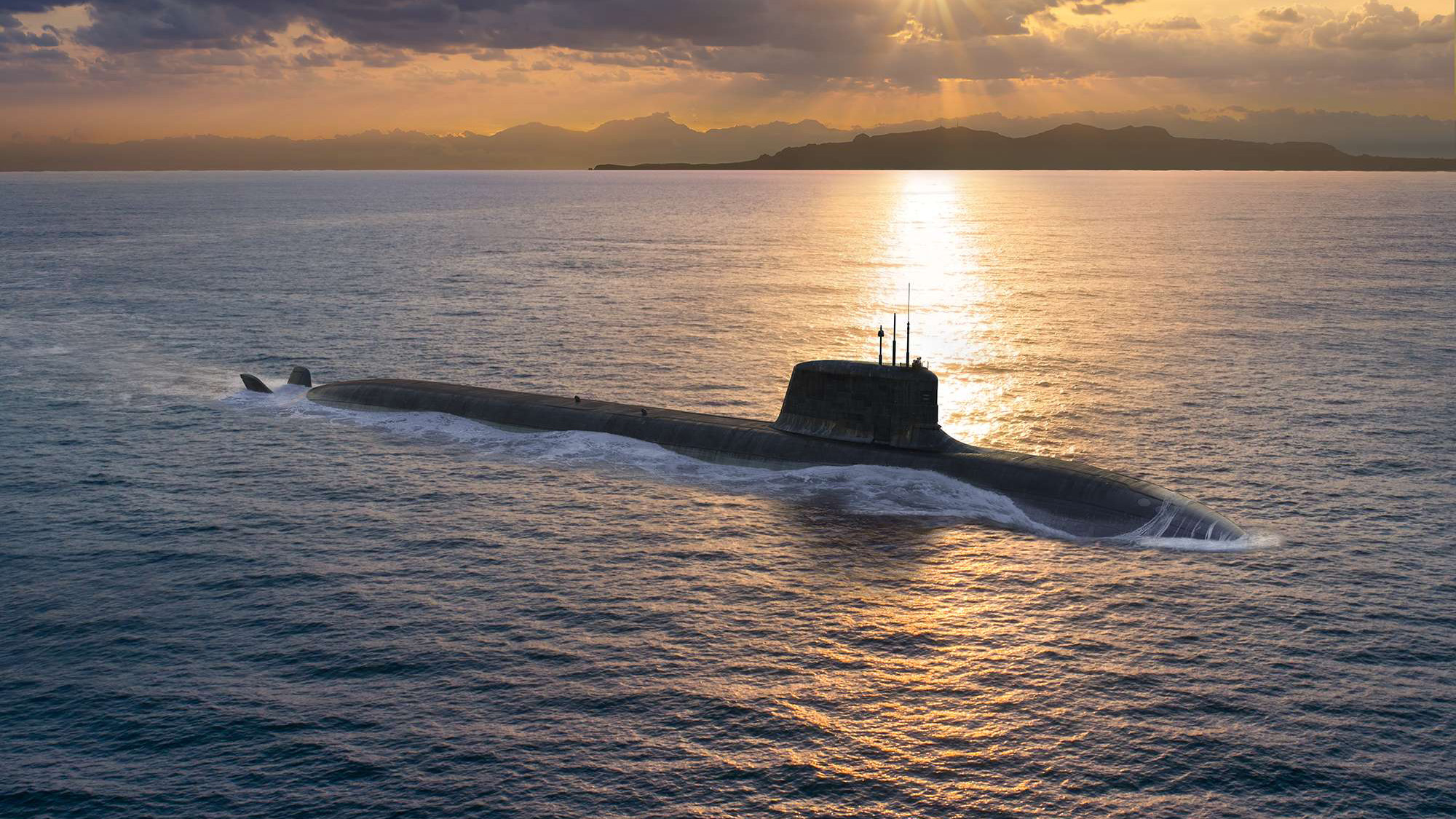
Australia has announced an AUS 310 million payment to acquire long-lead items from the United Kingdom for Australia’s future conventionally armed, nuclear-powered submarines under the AUKUS partnership.
The funding will support the manufacture of critical components for nuclear propulsion systems destined for Australia’s first two SSN-AUKUS submarines, which are to be built at Osborne in South Australia. Under current arrangements, the United Kingdom will deliver complete, welded nuclear propulsion units for the Australian-built boats, with work already under way at Rolls-Royce Submarines in Derby. This adds to Australia’s previously committed contribution of £2.4 billion over ten years to expand Rolls-Royce’s production capacity.
Deputy Prime Minister and Defence Minister Richard Marles said Australia continues to work closely with the United Kingdom and United States to develop the skills and industrial base required to operate nuclear-powered submarines.
“Early investment in components such as the nuclear propulsion systems will be critical to the delivery of AUKUS,” Mr Marles said.
“By working with our AUKUS partners, the Albanese Government continues to support defence industry and workforce cooperation, which will in turn support jobs in Australia for generations to come.”
The payment was announced alongside Minister for Defence Industry Pat Conroy’s engagement at the Australia–United Kingdom Defence Industry Dialogue in London, the first such meeting since 2018. The talks focused in part on submarine industrial cooperation.
Mr Conroy said beginning work early on key submarine components was essential to maintaining programme momentum. “Starting work early on critical submarine components is essential to keeping this program on track. The next-generation SSN-AUKUS submarines will be an extraordinary capability, designed and built by trusted partners and powered by a company with decades of nuclear-propulsion experience,” he said.
He added that Australia’s investment was helping to establish a sovereign submarine-building capability. “Australia’s investment is helping to lay the foundations for a sovereign capability that will keep Australians safe for decades to come. This is a concrete example of allied industrial capacity delivering real benefits for Australia.”
The announcement follows the government’s recent A$3.9 billion commitment as a down payment for the new Submarine Construction Yard at Osborne, where construction of SSN-AUKUS boats is planned to begin before the end of the decade. At peak activity, at least 4,000 workers are expected to be employed in building the yard infrastructure, with around 5,500 direct jobs forecast for submarine construction in South Australia.


Yeah, I thought they’d do this soon, given the UK did this earlier in 2025.
Australian government quoted costs for everything are insane, $30 billion for a ship yard. $300 billion for 8 SSN’s or $90billion for the previous 12 SSK’s the French were building them.
Yesterday they signed a contract with Austel for $4 billion for 8 landing ships that the Netherlands sells for $100 million a piece.
The Australian government either really needs to work on its media communications strategy or it needs to stop ship yard workers showing in Dom Perignon and driving Bentleys.
That’s the point . The French were not building 12 SSKs . Six years after the signing of the contract the French hadn’t even cut the first steel.
We should probably hold off on that argument until we see whether the American submarines arrive in a timely fashion.
Considering the state of US shipyards, that might be a little unlikely.
The basic unit cost of calculation for these 8 vessels is $500 million AUD per hull (or $350 million USD). A US Congessional Budget Office projection for a class of 35 LSMs had estimates of $340 to $430 Million USD per hull. The US has now also adopted the same Damen 100 design as the basis for their build with unit costs estimated at least $150 million depend on the extent of customization for the U.S. (cough Constellation Class cough).
Australian costs are likely to be higher because we pay a ‘sovereign premium’ for any ships built in Australia- smaller economies of scale, smaller ship yards, higher wages for a smaller pool of skilled workers, less choice in local supply chains etc.
Also this may include an allowance for inflation over the 12 year life of the build program plus some allowance for customization of the design for the ADF and an indirect contribution to local industry and workforce development.
4 billion AUD = 2.83 billion USD
for 8 landing craft heavy (LCH).
Yes seems pricy. UAE built the same vessel for Nigeria recently for $50m.
But less so when the correct currency is used 😂
Well given the majority of those doing private sector work in the UAE are cheaply paid foreigners, I’m not surprised. I believe indentured servitude (kafala in UAE) was banned in Australia quite a while ago. 🤷🏻♂️
The Australian government is a bit bonkers on it’s costs in that it gives an estimate for everything across the whole life.. and adds 30 years of inflation.. it’s why the Australian taxpayer always thinks they are being ripped off
Yes it’s daft, makes the public think defence is unaffordable. Just like the F35 programme costing $2.1 trillion or the Diego Garcia lease costing £35 billion.
It’s the Australia Tax. You should see the price of a packet of chocolate biscuits.
(More seriously, every major engineering project here seems to go over budget, look at Melbourne’s Suburban Rail Loop or sections of the boring for the Snowy 2.0 scheme. I could tell you of major plants up in the North West that got built at huge expense then abandoned or closed… We pay damn good wages on these projects and good wages for trades in general. The flip side is the cost pressures amongst other factors have cost us most of our private industry, like our unique car industry, with these government defence projects now providing some hope that industry continues in Australia…)
So why build things here at all then? Some people remember what it’s like when the country is cut off from supply in times of tension/conflict and are determined to have a domestic industrial base. If only that extended to sufficient fuel tanks, refineries and fuel reserves.
Just wait til the Tim Tam’s are on special. $6 a pack drops to $3 and that’s AUD naturally.
As they say (The Straigest) comparing Australia’s Total Project Cost to the UK’s reporting methods is often described by defense analysts as comparing “Apples to Orangutans.” While both nations are trying to be transparent, they define “cost” in fundamentally different ways.
The biggest difference is that Australia uses a “Capability-Based” costing model. When the Australian Department of Defence announces a $4 billion price tag, they are reporting the “out-turned” cost. This means they include every cent required to get the ships from the drawing board to the first decade of service.
So, yes Australia did indeed sign a $4 billion contract with Austal in February 2026 for eight landing craft heavy vessels, and while the price difference compared to a basic Dutch export model seems huge, it comes down to what is actually being bought. The $100 million figure usually cited for a Damen LST-100 refers to a commercial-standard “shell” without the advanced military guts required for a high-end conflict zone. The Australian versions are being built as high-spec warships capable of carrying M1A2 Abrams tanks and HIMARS launchers, fitted with encrypted military communications, advanced sensors, and self-defense weapon systems that aren’t included in a standard off-the-shelf price.
The $4 billion isn’t just the price for the ships themselves but the TOTAL PROJECT COST, which includes the design modifications for Australian standards, 12 years of maintenance, spare parts, and crew training simulators. A significant portion of the money is also a “sovereign premium” to establish the Henderson shipyard as a permanent, high-tech hub. Building them in Western Australia costs more because of higher local labor rates and the need to set up specialized production lines from scratch, but the government sees this as an investment in a “continuous shipbuilding” industry that will support thousands of jobs through 2038.
This specific contract is intended to be the first of many, acting as the foundation for a permanent production line that will likely turn out dozens of ships over the next few decades. Because of the new Strategic Shipbuilding Agreement, this yard isn’t just for these eight ships; it is already slated to build 18 smaller Landing Craft Medium vessels, and it is positioned to build future general-purpose frigates and autonomous missile carriers.
By paying more now to set up this “sovereign” capability, the goal is to end the old cycle of starting and stopping shipyards, ensuring that as soon as one class of ship is finished, the next one is already ready to begin on the same line.
Total Project Cost covers –
Support & Facilities
Training Systems
Technical Data & IP
Combat & Communication Suites
Specialized Engineering
Project Management
Sovereign Setup
Contingency
Price Escalation
–
Looking at the Risk and Inflation alone …
The ‘Contingency’ … Defence projects always include a “risk pot” (often 10–20% of the budget) to cover unexpected engineering problems or delays.
And ‘Price Escalation’ … Because this project runs until 2038, the $4 billion figure accounts for 12+ years of inflation on labor and raw materials like steel and copper.
So it’s not just the cost of ‘X’ amount of ships, it includes a built in “Half-and-Half” Rule. In many Australian naval projects, the actual “steel” (the ships themselves) only accounts for about 50% to 60% of the total project cost. The rest is the “invisible” tail of training, parts, tools, and infrastructure that keeps the ships running for 30 years. Thus Australia’s numbers look “scary” because they are inclusive. If you stripped the Australian $4 billion contract down to the “UK style” of reporting, the price for the ships themselves would likely drop by 40% to 50%.
Australia uses whole life accounting, makes everything look about four times more expensive than it actually is.
Note to ‘Straya, keep spares away spares the Brits, we have form for nicking stuff of later build subs to replace parts on early build.
Will there be a design change to this boats to include a BBQ enclosure on the casing?
Yes but they will have to remove the boiling water device to fit it in 😂
The boiling water device makes it go!
Laugh it up boys while you can.
When this construction cycle is complete the ADF will have combined 113,000 tonnes of amphibious lift with a capacity to put 4,570 troops (5,700 if the LHDs are at surge capacity) ashore across a beach or by helo in a single wave with a fleet of 2 LHDs, 1 LSD, 8 LCH (each the size of one of the RN’s previous Roundtable Class), 18 LCM and 12 LCME.
By contrast the UK will have precisely what amphibious lift capability? Will the 3 Bay Class still be in service?
Regardless of the price tag Australia is actually investing in its amphibious capacity.
The Brits do have a couple of carriers with fixed wing naval aviation though.
Okay? And do you have carriers? Tradeoffs for everything
And we can just send our troops on the ferry if we want to support our allies on the sub-Continent. We don’t need all those fancy amphibious thingys for that!
The amphibious thingys provide flexibility.
What if merchant ships are scuttled at the entrances and all the ports mined?
The LPDs we discarded had 4x LCU and 4 x LCVP each.
Plus we had the 3 Bays with Mexe.
We now have the Bays, which can carry either a single LCVP, or a single LCU.
Plus the Mexes.
We are reduced to landing from RIBs….fir an island nation.
We have a history of discarding kit that the experts in government proclaim we’ll never need, until ooops we need them.
It’s short sighted fallacy and short termism for savings dressed up as visionary.
Also, LCUs, LCVP, LPD, do not necessarily mean storming beaches with opposed landings, they can land on unopposed beaches too.
Absolutely agree about trade offs.
The discussion was about amphibious capability and the Australian method of costing defence projects but since the discussion has gone to carriers… as impressive as the QE Class are (and will be ultimately) currently it’s a nascent capability as a carrier ‘strike’ group especially when compared with its USN equivalent.
Leaving aside the current shortfall in escorts and airframes, without credible stand off weapons for the F35B it’s a CSG effectively ‘built for but not with’. Paveway IV has a max range with a risky high altitude release of 30 kms – likely well inside any credible peer’s air defences.
Even when Spear 3 is available stand off range will extend to only 140km. This weapon is not in the same class as JASSM ER or LRASM (900+ km) or even Konesberg’s Joint Strike Missile (275km).
These weapons are already in RAAF inventory. PrSM missiles (current 500km range with block II up to 1000km) are in ADF inventory for HIMARS launchers.
Australia’s strategic focus is to deploy and operate in the littoral and island archipelago chain to the north from bases (both austere and established) with FPDA partners Malaysia and Singapore, increasingly with the Philippines (such as exercise Alon) and through a new formal treaty with Indonesia. Together with Tomahawk missiles deployed from the Hobart Class, the ADF has the ability to threaten choke points to the north and project force deep into the South China Sea.
So yeah, everyone is making trade offs for different strategic and geographic situations to project force at distance. Not every solution is a carrier.
Australias concerns are not beyond its region, the UKs are. We’re not going to do a major amphib invasion beyond Europe but we are going to deploy a carrier as deterrence and presence.
Granted but any amphibious lift is typically about 250 RMs (up to about 700 troops max) per carrier with helo insertion only – no ship to shore connectors and without a well dock no capacity to land vehicles, tanks or heavy equipment and limited stores capacity for land forces.
So work is already well underway to deliver complete nuclear propulsion units. Does that means the PWRs for them have already been designed?
Ok, the internet tells me they’re using the same PWR3 as the Dreadnought class.
Yes