

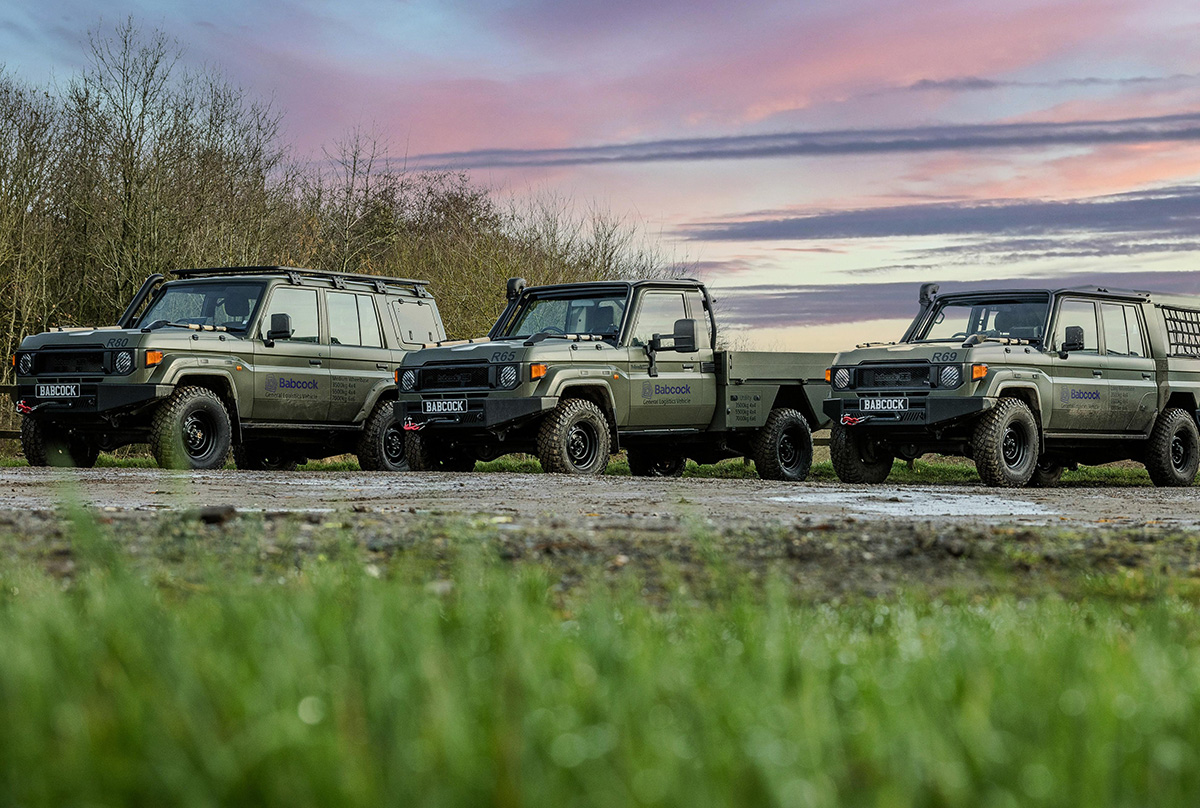
Babcock International has signed a Memorandum of Understanding with British defence SME Supacat to collaborate on its proposed replacement for the British Army’s outgoing Land Rover under the Light Mobility Vehicle competition, the company stated.
The agreement builds on the relationship between the two companies following the completion of the Jackal 3 programme earlier this month. According to Babcock, both parties will draw on their experience from that programme to design and deliver a sovereign capability underpinned by a UK supply chain for the British Army.
Babcock has developed the General Logistics Vehicle family for the Light Mobility Vehicle programme, using the Toyota Land Cruiser LC70 as its platform, with the range spanning medium wheelbase, long wheelbase and utility variants. The company says the MoU allows it and Supacat to explore how their complementary skills can enhance the offering, and supports Babcock’s commitment to working with SMEs under its SME Engagement Charter.
Louise Atkinson, Chief Executive of Babcock’s Land and Mission Systems sector, was quoted in the press release as saying: “The British Army needs a practical, safe and innovative light mobility vehicle that can deliver dependable capability wherever it is deployed. Our General Logistics Vehicle is built on a proven platform and combines operational effectiveness with affordability, supportability and a strong UK supply chain. We are delighted to continue our strategic partnership with Supacat. As two British companies with a shared commitment to supporting the UK’s defence and security, our solution will strengthen sovereign capability, sustain highly skilled jobs and reinforce the UK’s defence industrial base. Our collaboration on the Jackal 3 programme demonstrated the value of bringing together complementary expertise, and we look forward to building on that success as we develop a best-in-class Light Mobility Vehicle solution for the British Army.”
Phil Applegarth, Director and Head of Supacat, was quoted in the press release as saying: “Our relationship with Babcock has been enduring over several decades, notwithstanding the latest collaboration of the Jackal 3 programme which was a great example of how strong collaboration can play a huge part of supporting the Defence Industrial Strategy and maintaining a true sovereign industrial base. We are looking forward to supporting Babcock in the Light Mobility Vehicle Programme with our expertise in vehicle design and manufacturing.”
The Light Mobility Vehicle programme is intended to provide the British Army with a successor to the Land Rover Defender, which served for decades as the Army’s standard light utility vehicle before being withdrawn from frontline use, leaving a gap in the fleet for a compact, deployable general-purpose vehicle. The partnership pairs Babcock, a FTSE 100 defence company, with Supacat, the Devon-based firm behind the Jackal and Coyote high-mobility vehicles, the pair having jointly delivered 123 Jackal 3 vehicles to the British Army in a programme that concluded earlier in July.











Excellent news, let’s hope the MoD sees sense and chooses them.
Fingers crossed, a practical sovereign capability.
It’s not a sovereign capability if it’s uses a Toyota Land Cruiser, it’s just a uk modification
The brain says Land Cruiser, the heart says Grenadier.
The Grenadier looks cooler, which as we all know and agree, is the most important thing in military matters
Perhaps the Babcock Toyota can be given a stylish grill and badge… Brigadier perhaps?
What should we call it? Babota ? Toycock ?
Granadier should be the very last on the MOD’s list. Ineos is owned by a person who left the UK to dodge income tax, and the vehicles will not have any part of it built in Britain, so will not support a UK workforce.
The usual twaddle emphasising British content and sovereign capability. The base vehicle will be entirely Japanese made with Babcock and Supacat adding some bits and bobs.
Yes, hardly winning it for British industry.
Peter S,
“The usual twaddle emphasising British content and sovereign capability. The base vehicle will be entirely Japanese made with Babcock and Supacat adding some bits and bobs.” … fsck what a plonker!
You are a prophet of false doom, you think you are sharing a deep, dark truth like a prophet, but your pessimism has made you delusional, You are spreading figments of your defeatist imagination that simply are not true.
By combining the Plymouth and South Devon Freeport (PASD) infrastructure with an export mentality, the Babcock / Supacat alliance looks to become a financial and strategic powerhouse. Babcock’s General Logistics Vehicle (GLV) explicit promise to the MoD is that approximately 70% of the GLV’s overall program value will be delivered by UK industry. The 30% Japanese component is the baseline automotive engineering. Toyota provides the bare structural frame, the 2.8L turbo-diesel engine block, the transmission, and the basic sheet-metal cab structure. This is the cheap, mass-produced part. The real value lies in the 70% British component. It represents the hundreds of millions of pounds spent on specialised engineering, advanced electronics, armour, assembly labor, local supply chains, and multi decade maintenance support contracts. The conversion from a commercial fleet vehicle to a hardened frontline asset involves a deep ecosystem of over 30 British defence SMEs and suppliers.
Supacat completely strips down the suspension and axles. They replace them with high mobility, heavy duty military running gear that fixes the base vehicle’s known track-width flaws and allows it to legally carry immense tactical weights. Babcock integrates the vehicle’s proprietary Digital Twin technology … predictive AI maintenance systems built in the UK, alongside the complex 24V waterproofed electrical brain needed to run the British Army’s ‘secret’ Bowman / Morpheus communication suites. Everything behind the front seats is custom built in the UK, British fabricators construct the modular flatbeds, specialised weapons mounts, electronic warfare jamming mounts, tactical winch systems, and the bespoke, blast-protected military seating configurations.
The Light Mobility Vehicle contract is a massive £2.2 billion program to replace up to 3,000 outgoing vehicles over a decade. If a foreign prime contractor won this, billions of taxpayers’ pounds would leave the country. By utilising the Babcock/Supacat partnership, the economic loop stays domestic. The vehicles will be physically assembled at Babcock’s facilities in Devonport, Plymouth, sustaining hundreds of highly skilled, high wage engineering jobs in the South West of England … a region the Gov. is actively trying to inject with industrial value. UKDJ has pointed out, Supacat is an ‘agile’ British SME based in Devon, and Babcock has bound itself to a strict “SME Engagement Charter,” the supply chain filters directly into small, specialised British engineering machine shops, wiring specialists, and steel fabricators.
Critical sovereign capability matters in a crisis, it’s the ultimate national security shield. If the UK goes to war and relied on a purely foreign designed, foreign built vehicle, they would be at the mercy of international supply chains. If the factories abroad were bombed, gridlocked, or politically restricted, the British Army would run out of spare parts. By using the GLV strategy, the UK achieves operational sovereignty, they own the modification rights; Supacat, Babcock and the MoD can rapidly modify the truck to carry new anti drone lasers, missile launchers, or armour kits in a matter of weeks, without needing permission from a foreign government. Every single component that turns the vehicle into a warfighter, the wiring looms, the computers, the weapon mounts, is manufactured locally. If a fleet gets damaged in combat, the UK has the industrial capacity to build replacement parts and repair them entirely on British soil.
Purists might scoff that it isn’t a 100% British designed vehicle from the ground up. But in the modern defence world, that would cost three times as much and take a decade to develop. By letting Toyota mass produce the basic rolling frame, the UK gets a highly affordable foundation, while ensuring 70% of the cash, the high tech engineering, and the vital manufacturing capability stays firmly locked within the British borders.
I hope they win the bidding. Good for Britain and British sovereignty.
Not doing much for brand UK building it on japans most famous vehicle.
most insightful
Yeah Magenta’s points are Important, quite convincing in a way, yes it might be the best ‘bad’ decision available, it might perhaps give us an ability in the future to revive indigenous capability, but one can’t help but lament effectively losing a long held capability we have excelled at, exported and signed foreign production licences for that has now been lost to one of the main competitors because we weren’t any longer interested (as with trainer aircraft) or as has happened too often there was no plan or initiative to replace that platform over many years when it was clearly coming to the end of the road. What a brand hit this is to a marque like LandRover which now seems to only want to sell flashy boulevard vehicles to the super rich (they may be right now with the Chinese beginning to walk all over the rest of the industry), a World wide off road recognition allowed to disappear with a disinterested whimper and as such to UK plc too as we pull back from another sector we once competed in at a World level. Sad too in my mind that a specialist manufacturer like Supercat never proposed or created a true offering of its own (while a niche opportunist like Grenadier could), thus cooperation probably is needed to keep it alive I fear. So yep I guess it’s about trying to look on the bright side and the Toyota at least has a reputation for being almost indestructible, let’s hope that remains with all the UK reworking going into it and at least the army get a great vehicle even as they drive it around and unfortunately undermine British credibility and respect in this sector as they do so around the World. So yeah at best mixed feelings about this inevitable sign of British decline that has greater and wider effect around self confidence and national prestige than simply studying who designs and builds the nuts and bolts and at what cost. Will it be JCB next.
If as you say, the Toyota base vehicle, the cheap mass produced part, requires so much modification to give it military capabilities, why use it at all? Why not design from scratch to give a truly British product. Supacat/ Babcock have shown they can do it.
The 70% local content by value is a dubious metric. In part, it means we are going to charge you a lot for the work we do here.
Your comments on the risks in wartime of loss of access apply equally to the reliance on a base platform imported half way around the world. Sure, you would be able to repair the UK added elements. But you wouldn’t be able to replace whole vehicles or engines.
This may be the least bad option. But the claims of sovereign capability are just marketing guff.
Your just another cynic who ‘sees’ that every deal and contract as something corrupt, nefarious and dishonest. Well, that’s on you, those are your issues; I’m not here to act as your therapist.
Sovereign manufacturing is a two edge sword, the loss of supply vulnerability is precisely why critics of imported commercial platforms argue for domestic alternatives. A fully sovereign design built entirely on domestic automotive lines theoretically keeps the entire industrial replacement loop onshore. However, as established, the UK no longer possesses a high volume domestic commercial automotive sector capable of churning out utility chassis at scale without massive foreign corporate entanglement. While a Japanese or global supply chain has wartime transit risks, the sheer global volume of Land Cruiser architecture means that in regional or proxy conflicts short of total global trade collapse, components are far easier to requisition, scavenge, or reroute than proprietary, low volume defense parts.
Modern military logistics do not rely on just in time shipping during a war. A procurement contract for thousands of vehicles typically includes substantial pre positioned war reserve stocks, attrition reserves, and deep stockpiles of critical assemblies, like complete crate engines and transmissions, stored securely within domestic borders.
Choosing to leverage established commercial automotive platforms, specifically Toyota’s Land Cruiser and Hilux running gear, rather than engineering a completely bespoke military vehicle from scratch comes down to a balance of economics, risk, a timeline and commonsense.
Developing a light utility vehicle fleet from the ground up involves numerous constraints … heavy constraints. Designing a custom engine, transmission, and structural foundation requires hundreds of millions in research and development funding. By adopting mass produced COTS components, prime contractors like Babcock and specialised builders like Supacat avoid these front end costs, ensuring that the bulk of the program budget goes directly toward tactical modifications rather than basic automotive engineering.
Because Babcock’s GLV relies on this proven commercial baseline; the Toyota Land Cruiser 70 series platform, rather than a clean sheet prototype, they do not need to invent or validate core mechanical systems from scratch. Their engineering focus is purely on the military conversion kit, integration, and compliance testing, which is precisely what keeps a tight defence schedule viable. A global supply chain and “world renowned” reliability is built right into the Toyota’s powertrain and structural architecture, it’s globally ubiquitous, spare parts, maintenance familiarity, and logistical support networks already exist worldwide. A clean sheet design would leave the military reliant on an extremely expensive, exclusive, bespoke supply chain, and every single mechanical failure driving up long term through life support costs. A military entering a procurement cycle to replace thousands of aging assets cannot afford the lengthy developmental delays, prototype failures, and extensive trials required to validate a completely custom automotive platform. Yet, a commercial chassis can provide a high readiness baseline that can be rapidly militarised.
UKDJ has pointed out how companies like Babcock and Supacat do not simply use stock Toyotas off a dealership floor. Instead, they utilise the reliable baseline engine, transmission, and frame structure, representing roughly 30% of the value. They completely strip and redesign the suspension, axles, electrical architecture, and crew cells to meet stringent military standards. This division of labour [Toyota’s rolling chassis/ Supacat’s accoutrements] delivers the rugged payload capacity and the sovereign modification rights that a modern defence force requires without paying the prohibitive price tag of a total clean sheet build.
When billions of public pounds and strict operational deadlines are on the line, reinventing the wheel is an expensive luxury the UK can’t afford. Utilising proven, mass produced commercial foundations strips away years of unnecessary testing cycles and keeps the entire endeavour grounded in practicality.
Personaly, I grew up driving land rovers on a farm; a late series I 109 lwb aka ‘espee’ for shooting brake, and an early series IIa 88 swb, pickup aka ‘shorty’ from about 8 years old, together with tractors, combines, Bedford van, Willys Jeep and other assorted and strange oddities, even an all electric flatbed ‘truck’. I have a deep affinity for Land Rover and wish them well. However … when putting on my sensible hat I recognise that the Babcock and Supacat combo makes more sense. imo.
Magenta, I recall the article that referenced 270 Utility vehicles for i think 11Bde. ( Somewhere on defence journal)
I am also sure i saw in Babcock’s mid year report that they had secured 270 Light utility for MOD. Seems to tie together so could be useful test beds if true. What i don’t see on the Babcock site are other variants such as ambulance etc and not sure the chassis is suitable, however that may be where Supacat come in to the equation. ( That is of course subject to the Bulk requirements for vehicle types under the purchase umbrella)
Tim G,
I think the 270 utility vehicles used by 11Bde. is a fleet of Toyota Hilux Invincible X 4x4s procured for project ‘Niala’ to support its tactical ‘recce-strike’ role, they are not intended for any ambulance roles as stripping or repurposing them into field ambulances would undermine the tactical reconnaissance capabilities the fleet was specifically purchased to deliver.
The Babcock General Logistics Vehicle (GLV) is built upon the robust The Toyota Land Cruiser (TLC) , specifically the 70 Series platform, and is exceptionally well-suited for a specialised ambulance set-up, particularly for military, remote-area, and tactical environments. Babcock explicitly designs the GLV family with modular flexibility in mind. Their official configuration roadmap for the platform includes dedicated Pod Ambulance and Rapid Response Ambulance variants. This means the chassis is pre-engineered to accept medical pods, stretcher systems, and clinical utility integrations.
Ambulances operating in austere, tactical, or rugged rural environments need to reach casualties where standard commercial vans cannot go. Building on the TLC chassis, the GLV retains legendary all-terrain capability, rigid live axles, and advanced heavy-duty suspension. It handles extreme gradients, deep mud, sand, and rough terrain while maintaining structural integrity.
Medical setups require heavy equipment, including oxygen tanks, monitors, trauma bags, and secure stretcher mounts. The TLC platform offers high load-bearing capabilities, and Babcock’s engineering builds in future-proofing for payload growth, chassis extensions, and GVW uplift packages to ensure the vehicle doesn’t sag or compromise handling under the heavy weight of a clinical fit-out. One of the primary reasons military and emergency agencies choose Toyota-based platforms is maintainability. Parts and mechanical components are ubiquitous worldwide, drastically lowering long-term maintenance costs and minimising vehicle downtime. The ladder-frame chassis and front-engine layout make field repairs straightforward for military technicians or regional mechanics familiar with Land Cruisers.
In military or high-risk security contexts, an ambulance must also protect its occupants. The Babcock GLV enhances the base Toyota architecture with militarised safety features, including options for zonal armouring kits, blackout capabilities, and reinforced multi-point harnesses for attendants and patients.
The TLC platform, specifically the heavy-duty 70 Series chassis, which forms the foundation of military utility vehicles like Babcock’s GLV, is arguably the most widely used 4×4 ambulance and logistics platform in the world. While specialised defence primes like Babcock package these platforms for modern NATO standard requirements, such as bidding to replace legacy fleets like the British Land Rover, the broader ecosystem of Toyota-based ambulances is heavily relied upon globally by …
International humanitarian and relief agencies such as UNICEF, the World Health Organisation, and the UN High Commissioner for Refugees (UNHCR) extensively deploy Land Cruiser 70 Series chassis variants as frontline field ambulances and mobile clinics in rough-terrain and developing regions.
The International Red Cross and Red Crescent Movement globally utilise the platform for emergency medical service deployment where conventional ambulances would fail due to lack of paved roads or infrastructure damage.
The Australian Defence Force has historically and currently utilised Land Cruiser-based variants for tactical logistics and operational support roles. Militaries across the Gulf Cooperation Council heavily utilise Land Cruiser platforms for military police, command, and battlefield casualty evacuation. Numerous African and Asian armed forces national defence forces utilise the 70 Series chassis as their primary light tactical ambulance because local mechanics can easily service them and spare parts are universally accessible.
Specialised international NGOs and remote EMS providers like Médecins Sans Frontières rely on Land Cruiser 4×4 configurations to extract patients from conflict zones and inaccessible rural sectors. Major mining, oil, and gas conglomerates operating in hyper-remote regions use TLC-based pod ambulances for industrial site safety and emergency rescue.
LC70’s are terrific base vehicles
Jaguar Landrover is the only UK entrant in the competition and the new defender is amazing. Seems like a no brainer. Would be nice to have more than one vehicle in the British army that is actually British and not a foreign vehicle covered in a Union Jack or with some ridiculous name like Lion strike (BAE 🤦♂️)
This is probably the first test for Andy Burnhams industrial defence strategy. I can guess the General’s will want a nice big us defence prime that will be looking for consultation, providing jobs for the boys and the treasury will want a cheap as chips Toyota that’s painted green by Babcock.
This is a £2.2 billion , 3,000 vehicle order over ten years and a chance to re launch an iconic British military brand. The new defender is one of the most popular luxury cars in the world I can only imagine it will be an export winner. The UK has no chance of building a tank that’s going to be an export success but this vehicle very much could be.
yeah, no … all Defenders are built in the Nitra plant in Slovakia. Sure, the engines are from Wolverhampton, but they are shipped over to Slovakia to be dropped into the Slovakian vehicles … and just to confirm to you that JLR is not a British entity, it’s Indian; Tata owns the keys, the house, and everything inside it.
Why the continual, fatuous denigration of ‘Generals’, authoritative persons, political office-holders, executives, and prime employees? It weakens every post of yours by exhibiting an immature perspective.
Production for all electric defenders is in Haelwood. Everything I have seen in this bid is manufacture would be in the UK. JLR is a global car company it builds cars in lots of places but most in the UK.
None of the other bidders can say the same.
How can you sit there and say “… Everything I have seen in this bid is manufacture would be in the UK”. The Defender is built in a foreign country.
If JLR can figure out a way to localise a massive portion of the Defender’s assembly back to the UK, or build a dedicated military production line on British soil, they have a fantastic shot at winning on national pride and capability. However, tweaking a highly complex, software dependent, independent-suspension luxury vehicle is a recipe for unforeseen mechanical failures, electronic bugs, and massive cost overruns. The MoD has a habit of demanding “just one more modification,” which could easily break the Defender’s delicate engineering ecosystem. On the other hand the Toyota chassis is “Ajax-Proof”.
But the actual £900 million contract to replace the aging fleet of 7,800 Land Rovers aka the Light Mobility Vehicle or LMV programme is primarily focused on traditional, rugged, internal combustion engines and hybrid power, not electric motors … (John).
“JLR is not a British entity, it’s Indian”
This is such a silly double standard only applied to British car companies, I have to assume as a wind up.
No one calls Lamborghini German, or Dodge European, or any myriad of other examples. Total hypocrisy
Levi, you seem wound up and living in the 1980’s
But who applies this silly double standard to British car companies ONLY? who are these people indeed?
It’s true, we do not fall in love with corporate ownership structures; we fall in love with stories, the passion and the beautiful bodies. No one calls Lamborghini German, because Lamborghini being solidly an all Italian product it’s a cultural lemotif … a personification to think of it as 100% purely Italian with a glorious history, full stop … any other thoughts are heretical.
However, it’s not hypocrisy to interpret a car company by their owner, the owner tends to define the company and the car, In Audi case they bought the Lamborghini in 1998 for a modest £67 million, Lamborghini was a financial disaster zone. Having passed through seven different owners … including Chrysler and an Indonesian investment group, they routinely went bankrupt, and they built temperamental, terrifying supercars, supercars that frequently broke down or caught fire, but none the less they’re all classics; loved and admired by all.
Thankfuly, Audi brought German manufacturing discipline, reliable electronics, and massive capital to Sant’Agata. Audi took a broken, disorganised Italian passion project and turned it into a bulletproof global luxury icon. They gave the brand the structural foundation it needed to survive, and in doing so, they gave Lamborghini the ultimate gift: the financial freedom to be purely Italian once again. It’s not just about a stable of glossy, exotic cars to dream and lust after, underneath lies the stark reality of structure, finance and modern engineering, it’s that, that makes todays Lamborghinis.
Respecting every part of a car companies history and heritage is fundemental. Audi’s/ VW’s ownership is a part of Lamborghini’s now, for evermore.
“But who applies this silly double standard to British car companies ONLY? who are these people indeed?”
My apologies I am not accusing specifically you of anything, I mean more car forums all over the internet where this type of thing is absolutely rife.
Regardless, I am not sure any of what ChatGPT has written for you there as a refutation of my comment really holds water. Lamborghini is as Italian as JLR is British, so there is a double standard clearly evident given no one in their right minds would call Lamborghini a German company, but it seems normal to self-flagellate and call our largest car company Indian
Levi, you have comprehension issues, what I wrote was quite clear and umabigious, yet you fail to grasp it.
On the contrary, I understand you perfectly well – I do believe it’s you not understanding me.
At any rate, at least you typed this comment yourself instead of using ChatGPT as before! It’s an improvement
I fear that you do not understand me perfectly well, at all. You’re lost in a fairytale of romantic ideals wrapped around abstract notions of supercars, legends and mystique.
To be clear, when Audi acquired Automobili Lamborghini through its subsidiary Lamborghini Holding SpA in 1998, it did not just write a cheque to rescue a struggling Italian marque from bankruptcy; it fundamentally re-engineered its survival.
Before the VW Group takeover under Ferdinand Piëch, Lamborghini was notoriously brilliant at building wild, wedge shaped icons that regularly suffered from chronic financial instability, build quality nightmares, and electrical gremlins. Audi brought ruthless German industrial discipline, massive research and development funding, and strict quality control without killing the raw theatrical soul of the brand.
Beneath the flamboyant Italian carbon-fibre skin of modern Lamborghinis lies deep, shared German engineering. The Gallardo, the car that ultimately saved Lamborghini by selling in unprecedented volume, shared its foundational platform architecture, suspension geometry, and engine evolution with Audi. The V10 and V12 architectures, all-wheel-drive systems, and digital infotainment interfaces are all under pinned by German automotive technology. Ultimately, every strategic decision, board approval, and major capital injection flows through German corporate oversight.
Yet, the reason the debate still exists is that Lamborghini successfully maintained a geographical and cultural firewall. The cars are still designed, built, and tested in Sant’Agata Bolognese, Italy. The test drivers still run them up through the Emilia-Romagna countryside, and the workforce is predominantly local Italian artisans and engineers who maintain that fiery Latin passion for drama and noise.
The ownership and technology are German, and the heart and theatre remain Italian. It is a hybrid.
I’ve never used ChatGPT. Instead, I run open source 32B models … Mistral L/Qwen/Gemma locally via LM Studio on an offline Mac mini M4 Pro, with zero token costs. I do my own research, strive to understand, interpret, and unravel the details behind events. I query, write, edit, and dig deeper, and most importantly, I carefully read and check my own spelling and grammar. I realise I’m not a natural writer, but my comments are simply a reflection of my convictions.
That’s the Defenders that are getting scrapped in droves with twisted bodies when heavily loaded, those Defenders?
Team Grenadier is the absolute worst, a German car company run by an arch brexitier who started making his “British” car in Germany five minutes after Brexit and now he claims to have UK manufacturing involvement if only he gets a £2 billion cheque for the British tax payer.
I have driven the Land Cruiser, Ford Ranger and New Defender off road at the defender is in a totally different league, it should be as it’s a 40 year newer design, big question is can JLR hit the price point.
The Grenadier is built in France not Germany.
Choose the Defender if you want a stylish, fast, incredibly capable luxury status symbol that makes daily driving a joy, and you plan to lease it or sell it when the warranty ends.
Choose the Land Cruiser if you are planning an apocalypse, want a vehicle you can keep for 15 years, care about resale value, and value mechanical dependability over creature comforts.
Choose a Lexus GX, and you effectively solve the “Toyota vs. Land Rover” paradox. You get the opulent creature comforts, the speed, and the status-symbol styling of the Defender, but it still retains a 100% chance of starting up every single morning for the next twenty years.
JLR is technically an Indian company, being owned by TATA Motors who bought from the American owned Ford Motor Company in 2008 for US$2.3 billion
JLR is a British company with an Indian owner.
We all love JLR and the marques fabulous history and rightly proud of it. But there is no escaping the fact that Tata bought JLR back in 2008, deliberately left British executives in charge of the day to day operations for nearly two decades, to maintain that classic British heritage image. However, in November 2025, sweeping structural changes completely shifted that dynamic. By installing their own parent company executives into the top spots (CEO and Chairman) and placing Indian leaders over strategy and digital infrastructure, Mumbai took direct, hands-on control.
By that logic Google is an Indian company and Emirates is a British company. Tata has done a great job as the owner of JLR, far better than its previous British or American owners. I’m not bothered what country it’s senior executives come from.
No that’s a fallacy.
Is Google owned by an Indian company? No.
Is Emirates owned by an indian company? No.
Regardless of your cavallier regard to their nationality, senior executives set and deploy the path, they administer the company to their predetermined aspirations. It’s about who owns it, who runs it and what they can do with it.
You were promoting the Defender as an all UK option, you said “…Would be nice to have more than one vehicle in the British army that is actually British and not a foreign vehicle covered in a Union Jack …” That is exactly my point the JLR Defender is a foreign vehicle covered in a Union Jack. I pointed this out as others have, JLR is not British owned and the Defender is built in Slovakia, not in the UK.
… dont blame me because you got it wrong, im just filling out the facts, so other people don’t get the wrong impression regarding the JLR Defender.
Suggest you check companies house to answer your question is JLR a British company. It’s really that simple.
Jim,
Yes, I do not need to check, I already know their history, as illustrated in my posts above, but I do welcome you aboard to the fact that JLR is a reigisterd British Company … so is Google UK by the way.
I sense that you’re still missing the point, I have presented my thoughts reasonably, clearly and with detail. You need not agree with them, so I am going to leave this discussion as it’s now pointless.
I am a little concerned. One of the key advantages of the Land Rover (all variants) was that the steering was so bad, that you’d never fall asleep at the wheel. Thereby making sure you’d reach the next stage area or base. If they’re saying the next light mobility vehicle will be “safe”, expect a number of “accidents” from people falling asleep at the wheel following exercises etc……..
Good news the new defender comes with lots of air bags 😂
Has functioning air con as well. What is this world coming to!
Plenty of people have fell asleep driving Landrovers, more associated with the noise and tedious convoy moves rather than a steering issue, i speak from experience.
DavyB, On receipt of 25 brand new V8 LWB in the Falklands, by end of tour the survivors numbered 11. The remainder being extracted in bits from the V large ditches that abound that area. Know where your coming from re steering but did not help in the above instance. Squadies of any nature will find ways to stuff up anything they are given.
For the initiated, the ditches either side of the road were car least 10ft deep. Which completely disappeared after a deluge of snow. Making brands all to common.
I do remember on one of my tours, we managed to build a complete landy from salvaged and “donated” parts.
Well done magenta for stating facts in a clear manner and standing up to the variety of Putinbots here that we are subjected to on a daily basis..
Sooo we constantly have comments like ‘we should buy of the shelf’ no matter where it comes from and now we have an argument about a vehicle that has a bit of Japanese in it and all of a sudden we have to buy British! Funny old world ain’t it?
Well after reading all that I have not got a clue….. which is the British one, and the most value for money for what the military get?
At Farnborough last week, I saw an armoured Supacat cab, with 2 Asraam + 2 low cost interceptors on the rear bed. Seems like suitable mobile air defence for the British Army. I hope they get some.