

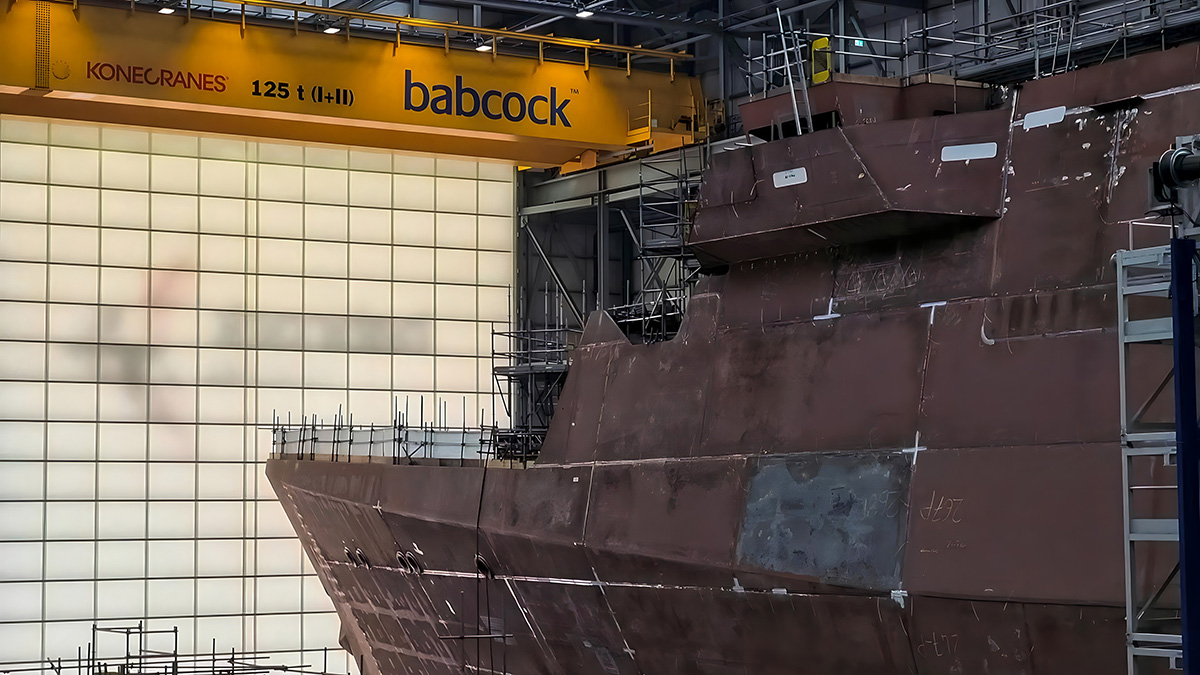
Babcock has signed an agreement with a Danish industrial consortium to develop a joint British and Danish approach to building the Royal Danish Navy’s future frigates in Denmark, an arrangement the company estimates could support around 2,000 direct and indirect jobs there, the company stated.
The letter of collaboration with Danske Flådeskibe was announced at DALO Industry Days in Herning this week, and builds on a framework agreement the two signed in early 2026.
Danske Flådeskibe brings together OMT Group, Terma, PensionDanmark and Semco Maritime, and was established to offer an integrated Danish solution for the design, construction and through-life support of the Royal Danish Navy’s future vessels, covering multifunctional Arctic ships as well as potential frigates.
Under the agreement the two organisations will work on frigate solutions and on a joint industrial model covering delivery of the programme and through-life support. According to Babcock, the intention is to build a long-term Danish naval shipbuilding capability through knowledge and technology transfer, construction and integration in Denmark, and sustained participation by Danish suppliers.
Sir Nick Hine, Babcock’s chief growth officer and a former Second Sea Lord, said: “Our new agreement with DFS, together with our growing partnerships across Danish industry, demonstrates our commitment to building the future together. We are offering Denmark far more than a ship. We are offering a genuine industrial partnership that puts Danish companies, Danish skills and Danish shipbuilding at the heart of a programme already founded on Danish innovation.”
Hans Schneider, chief executive of Danske Flådeskibe, said: “For DFS, this agreement is about ensuring that Denmark’s future frigates strengthen both the Royal Danish Navy and Denmark’s sovereign industrial capability. Together with Babcock, we can combine an internationally recognised frigate platform and programme experience with a strong Danish set-up for building, integrating and supporting the ships throughout their service life.
“Our ambition is clear: Denmark should have the responsibility, expertise and capacity at home to support its frigates from the outset and for decades to come.”
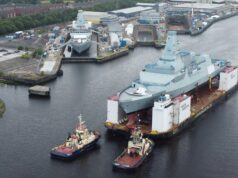
Babcock’s Arrowhead 140, the design behind the Royal Navy’s five Type 31 frigates being built at Rosyth and since selected by Poland and Indonesia, was derived from Denmark’s Iver Huitfeldt class. A Danish frigate order built on that design would return the lineage to where it started, with the intervening development work and export record now attached to it.
Denmark’s Iver Huitfeldt class was assembled at Odense Steel Shipyard, which closed in January 2012, leaving the country without a yard of that kind. Danske Flådeskibe’s approach is not to build a replacement. Its stated strategy is to fabricate modules at several sites around Denmark and assemble them in one place, an approach it describes as the same thinking used in Poland and the United Kingdom, with final assembly at Semco Maritime’s facilities in the Port of Esbjerg.
Semco Maritime joined the consortium in March 2025, and the group changed its name from Danske Patruljeskibe to Danske Flådeskibe at the same time, reflecting a widening from patrol vessels to naval ships generally. The consortium is already preparing to build the Danish Armed Forces’ new Arctic vessels.
The agreement follows three separate memoranda of understanding Babcock signed at the same event with STORMBORN, CUBEDIN and SH Group, covering uncrewed systems, autonomous integration and modular mission equipment.


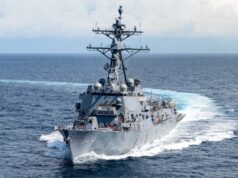




The Danes need legs. The IH-class are surprisingly long-endurance ships, offering nearly 10,000nm of range at 15kts. That’s around double their ranges of the other two APAR/SMART-L classes, the Dutch De Zeven and German Sachsens. The Danes need this to cover their deployments into the High North, given their lack of accompanying auxiliaries.
Currently, there are three contenders:
– France’s FDI.
– Britain’s AH140.
– Germany’s F127.
Of these three, none fit Denmark’s requirements well.
The FDI is small, and offers just half the range of the IH. It has a capable radar, but a limited magazine. There is a proposal for a cold-launch VLS to increase missile capacity, though. FDI lacks the Mk41 VLS, and isn’t integrated with the American ESSM, which could be a particular issue for the Danes. FDI is the most rapidly procurable, though.
The AH140 is larger, and has comparable range to the IH (for obvious reasons). But it struggles with the ‘air defence’ part of the mission. The most capable variant of the AH140 is the Polish Wicher-class, whose SM-400 radar sits between the French SeaFire and the currently used APAR (from the IH). It does have the 32-cell Mk41 VLS, but the TACTICOS is already both familiar to the Danes, and integrated with their ESSM stocks. Seeking Polish-built ships would also mitigate the other issue of the AH140 – lethargic delivery.
The F127 is obviously the chunkiest air defence combatant, but lacks the legs of the AH140. It’s also the furthest from delivery. It’ll likely be the most expensive as well, but would offer collaboration with Germany and by far the most capable AAW system in Europe.
We’ll see what can be done about AAW for Arrowhead. I quite like the look of the new helmet mast, that plus a higher rotating panel might even make an adequate-ish CCV if the generating capacity can match up.
I mean, any AH140 variant packing (and managing to power) SPY-6 will definitely have adequate long-range surveillance capability against ballistic missiles, hypersonics, et cetera.
Though, for aesthetic reasons, I prefer the more traditional tall mast variant shown off.
It looks like a beefed-up version of the Constellation 3-face radar mast, with the larger 37-module panels rather than the small 9-module panels. A hugely capable setup if it can be powered. I quite like the aesthetics, it’s similar to the Japanese Asahi and Akizuki destroyers with their panels just above the bridge. Cleaner lines than the tall pole masts of pretty much every British escort since WW2.
Although I don’t think the model corresponds, Naval News are reporting that the SPY-6 arrays on the AH140 shown at the recent Danish trade show are SPY-6(V3) arrays, being the smaller, less capable system that’ll appear on the Constellation-class frigates, rather than an expanded (V4) variant.
Reportedly, they’re offering these because of the sudden glut of production now that the remaining 18 Constellations have been cancelled. Denmark might be able to get them at a little bit of a discount.
That’s a clear mistake on the NN caption, visibly at the very least they are V(4)s with 24 RMAs. Perhaps it is the modelmaker end that has gone wrong, and Babcock tipped NN off that the offering was actually V(3)- the 3-face mast would support that. If so not as much of a step up but still the equal of any radar setup we have seen on AH140 or Iver Huitfeldt so far.
(V3) makes more sense on a power-generation basis, but either would be fine for the needs of Denmark.
It does however drop the capacity for ballistic and hypersonic missile defence, at least according to Raytheon’s website, which would put it below the Iver Huitfeldts; they were able to guide an SM-3 launched by another vessel to hit a ballistic target.
The website specifically mentions ‘simultaneous’ defence as a qualifier, so it might be possible for the (V3) to do BMD if it means ignoring cruise missile defence, for example. Some of the Burkes at Rota have the same issue, and are equipped with SeaRAM to mitigate the problem.
F127 isn’t just more expensive, it could easily be treble the cost of the other two you mention. The German ship in the same league is likely the MEKO A-200, which Germany itself is buying instead of the cancelled F126. It’s an old design, refreshed, and very successful.
F127? I thought the Germans (Rheinmetall/NVL) were proposing the GMF 120/140 design rather than the F127?
GMF 120 is capable but sacrifices quite a lot to fit as many weapons as possible (it has short legs and reduces crew accommodations. Considering the insane cost of the F127, it’s impossible to export. No one but Germany can afford that in Europe.
Thinking about radar and missiles. I wonder if the Danes go for an Arrowhead 140 they’d be happy enough with a rotating S-Band like the NS-200. It’s only a little heavier than the NS-110 and could be seen as plug and play. To complete the S/X mix, having four flat panels under the rotating NS-200 might be easier that the rear mounted NS-50 the Wicher has. Back to APAR Block 2 for that, perhaps? That’s a lighter and cheaper configuration than either the Wicher’s or the FDI’s. I think NVL pitched a similar combo to the Danes for the small GMF-120. I think it would work pretty well on the A140.
As for missiles, will the Danes want to be thinking SM-2/6. If so, can the FDI cope?
Denmark purchased SAMP/T batteries, so they will be using Aster 30 missiles anyway.
They don’t need to reuse SM2/ESSM on their future ships. Their Absalon-class and several other ships can use the ESSMs, the SM2s can remain (it’s not like they have a large stockpile anyway) in use for the Iver Huitfeldt which won’t retire anytime soon though they would lose their role as the prime air defense frigates.
Sensible. The Danish govt was just two days away from signing on the dotted line for T31’s built in Rosyth when vocal lobbying for locally built ships gave them second thoughts and a nervous cabinet refused to rubber stamp the deal. It was to have been the highlight of a visit by Starmer to Copenhagen on 1-2 October 2025. Since then the French Naval Group and Germany’s Rheinmetall have greatly strengthened their proposals, without local content Babcock has become a long shot.
Just to add, I gather that New Zealand newspapers are reporting that the Japanese Mogami frigate has been selected over the T31.
Wasn’t that always the likely option when Australia went with the Mogami?
Whilst I can’t find which articles you’re referring to, it was always likely that the RNZN would opt for the Mogami.
Some neighbourly pressure for same same and a pragmatic choice with Aus. Wonder if they’ll replace their two OPVs with something or additional frigate? I believe Indonesia is also having a look at Mogami despite having two plus two more planned AH140s.
Be interesting if the USN possibly goes with the Mogami, Rivers T26 or other design if they choose an overseas design for their frigate class.
At least the UK has two offerings so best foot forward for 🇬🇧 🚢!
Babcock struck a massive strategic win at DALO Industry Days. That signed Letter of Collaboration with Danske Flådeskibe … a powerful consortium and backed by the Danish government itself; is gold.
In defense procurement, this is surely what is known as a “lock-in” strategy, Babcock recognised that they couldn’t beat local industrial protectionism … so they incorporated it.
It elevates the Arrowhead 140 from a foreign bid into a sovereign Danish led programme with British heritage.
Shit happens … however, this feels like a solid win for the Arrowhead 140. 🤞