

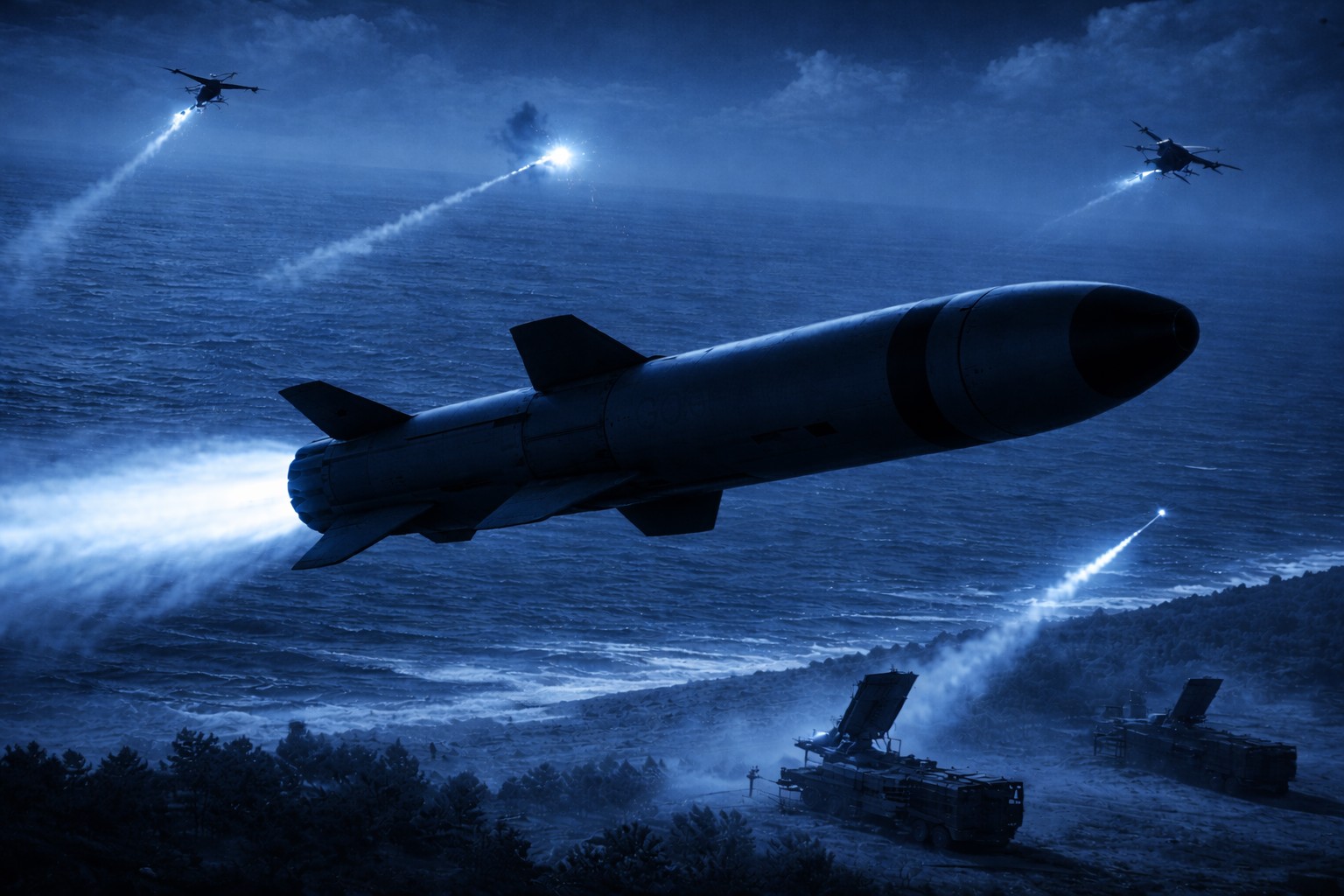
The Ministry of Defence has launched a new competition to develop a low-cost interceptor intended to counter drones, loitering munitions and missiles at close range.
The requirement, designated Project GOSHAWK, was published in a tender notice on 26 January and invites industry to take part in a competitive procurement process covering development and live trials. According to the notice, the MOD is seeking a system “optimised for drones, loitering munitions and missiles at close ranges and low altitudes,” with the core requirement being “cost-effective, multi-threat interception capability.”
The department states that the interceptor must achieve a favourable “cost-exchange ratio” while being able to “reliably counter diverse targets at varying speeds, altitudes, and trajectories.”
The initial phase of Project GOSHAWK will see one or two funded development contracts awarded, each expected to run for approximately 12 months. During this period, suppliers will be required to mature their proposed designs and conduct trials. The MOD says that, subject to successful testing, it “currently intends to place one or more follow on contracts for the production of low-cost interceptors in the future.”
Indicative demand for any production phase is estimated at “approximately 3,000 to 7,000 units per year,” although the department notes that it “reserves the right to not place any follow on contract(s).”
Companies wishing to participate must be capable of handling information classified up to SECRET from the outset of the programme and must provide detailed information on performance, guidance, seeker capability, production costs, timelines, testing plans and integration requirements. The tender also highlights the importance of scalability, requiring suppliers to demonstrate “future scalability of production for a potential follow on contract.”
On export controls, the MOD states that “ideally no export controls” would apply, though “European export control will be acceptable if required.” While not mandatory, the notice adds that a “high proportion of spend under this and any future related contracts will be UK based,” potentially covering missile development and production.
The competition closes on 9 February 2026, after which shortlisted suppliers will be invited to submit full tenders.










“It reserves the right to not place any follow on contracts”.
If any are placed at all !!!
I must stop being so negative, maybe when the DIP is finally published, we can all just smile and act all normal again. 🤔
Let’s face it, evert time we see a new project name we all think the same. More time and money to be wasted with no output. Heres hoping this will be the exception, as this does seem to be a pretty major capability need.
Well Yes, exactly and It’s not helped by the lack of any orders for the 18 months of promises.
Not a whole lot before that either. Most of the week orders started their lives under the last labour government.
Blah,blah,blah etc etc etc….
I’m assuming this is what the Babcock and Frankenburg partnership will be for? I know there’s no information, but for anti-drone, I would go for Tridon or just buy Terrahawk.
Obviously, depending on the drone they want to counter, it could be a missile job.
Of course they could save lots of time and probably money by approaching the worlds leading country in drone technology!
Am I missing something I thought they had and are mass producing their design with uk input.
Yep,so why waste time and money farting around doing more meetings,conferences etc? If we are already building them for Ukraine who are using them for real we don’t need to ask anyone else what works and what doesn’t.
Again why the negativity? We have several companies in the UK with domestically developed products that already suit this requirement, it seems designed to lead to production orders rather than money on new designs.
Octopus, CA Skyhammer etc.
Probably because us old timers on here have seen the gradual dismembering of our armed forces since 1991, others will say longer, but I always take the modern era from that date.
And no government is any different from the last, or even worse.
Also, how many articles for things just like this, from Drones to missiles, has UKDJ had an article about since June 24? Probably dozens. Where are the orders?
In the end, mud sticks. I myself try to be positive as I still think our armed forces are excellent, but it’s hard to be positive.
You’re new to all this if you’re only 18!
As an “Oldtimer” who has not been on here that long, I can Indeed say that the “Peace Dividend” was the real start of all this but I also recall all the cuts that went before (but only from my teens).
But looking on the positives, we do have erm, erm, erm, hang on, I’ll be back sometine In the 2030’s !!!!
Except in this case this is the MoD looking to buy something we weren’t already doing, rather than promising a replacement for something nearly out of service a decade down the line which is the usual issue. It’s the same with Vanquish, Cabot and Nightfall; both of them get a huge amount of stick despite there being nothing to lose and a whole lot to gain through the tiny amounts of cash the MoD has committ(i)ed so far.
We are in a terrible place at the moment but the messaging is sensible rather than pie in the sky and the long term outlook is good for the first time in my life (17, DM). A good time to be entering the engineering world, I think.
That’s the other issue, posters would appreciate kit bought for us rather than Ukraine. Just once in a while.
For me, until there are real orders and real plans released for the infrastructure and orbat to use things ( like CUAS from AA to interceptor drones ) they all amount to the same thing.
We never hear, because the cynical would say, there’s no plan to actually buy them beyond giving to Ukraine, who do indeed need them.
To me there is also the need for a Sovereign CAPABILITY so that we can produce however many is needed as the technology morphs. i.e. Not just a total of 7,000-a-year, but can quickly ramp up to produce UK stock and much higher rates like the war in Ukrain has illustrated.
Off topic, but I’m just going to C/V the latest MoD social media post of HMS Anson leaving Gibraltar.
‘Spotted: An armed UK Hunter Killer submarine leaving Gibraltar.
The Royal Navy ensures their presence at sea at all times to deter potential adversaries and protect the nation and NATO allies.’
What in God’s name do they mean ‘at all times’???? Are they genuinely dense over there?
There’s an article on this now Leh.
Ace, I’ll repost there.
I like the ‘armed’ bit!. I would bloody hope so!
So yet ANOTHER can kicking exercise
Silly question, but isn’t this why we developed laser weapons? Close in, low altitude, anti-drone, low cost per shot.
And another silly question….where’s the supposed “GBAD” stuff to hit everything else that isn’t a drone?? It’s good its going to Ukraine but what about some of the same for the UK? Even Brazil (see Janes) has just ordered the CAMM-ER….looks like based on the same vehicle but next step up from SkySabre. Can’t the UK do the same while the MR is around the long corner?
Sky Sabre can use CAMM-ER. I don’t recall hearing that UK have ordered any CAMM-ER, but we haven’t exactly gone all in on Sky Sabre yet. However, that’s not close in. At least not what I imagined as close in – a few kilometers. And it’s not what I imagine is meant by low cost.
What I’m wondering is, what happened to the Raytheon Wolfhound-mounted 15kW laser system? The Army tested it a couple of years ago, and now silence. Was it just not powerful enough? Didn’t Raytheon even build a production centre in Scotland?
It is partly, but lasers require a huge amount of power so you’re limited on where they can be used. This project will probably be something more like Wild Hornets’ Sting drone or Frankenburg/Babcock’s new mini missile project.
Lies ,flannel and gaslighting.
Reading through the MOD’s requirements, the capability of being able to counter loitering and FPV drones along with missiles is a big ask. Especially when you want the cost vs exchange ratio to be low as possible. Otherwise something like Starstreak/Martlet would be more than adequate. Countering drones is the easy part, as you can use drones that are either launched in response or are loitering much like a combat air patrol. Especially at the majority are travelling at 300mph or less. However, including “low altitude and close range” missiles in to the equation, makes the requirement significantly more sporty. Where I’m presuming the MOD are talking about intercepting cruise missiles and not ballistic missiles in their terminal phase? Which does make the requirement easier, to a degree, but would they expect the interceptor to be able to engage both subsonic and supersonic cruise missiles?
Sweden’s Nordic Air Defence (NAD) has just released some details on their Kreuger 100 and the longer ranged 100XR UAV interceptors. Which can be either hand launched from a tube, or vertically in a battery of 20 from a hand portable container. They’ve said it uses an IR seeker and battery powered “pulsed” (pusher propeller) propulsion. It comes in two flavours, a civilian and military. Where the civilian version has a top speed of around 300kph, whilst the military version is considerably faster. The XR version has longer range, can loiter for a bit, but as it uses a IR seeker can operate beyond line of sight. Importantly NAD are aiming for a cost price for the XR version below $10k.
However, with a terminal speed of 300 to 400kph (83 to 111m/s), it simply is not fast enough to accelerate to intercept a cruise missile travelling at high subsonic M0.8 to 0.95 (270 to 305m/s). Unless the cruise missile’s path takes it directly over the launcher. To enable an effector to be able to intercept a cruise missile that is say crossing in front of the launcher’s path. The effector will either need a higher terminal speed or have sufficient fuel to be capable of being fired a long time in advance and use the delta time for the intercept, but still have a high enough terminal speed to get it there. Therefore a battery powered propeller or electric ducted fan will not be capable of pushing the effector to a high enough terminal speed. Either a jet or rocket engine will be required, which then pushes up the cost and perhaps the complexity.
Although, people make diy rockets that are sugar powered and are capable of being supersonic. If the Potassium Nitrate / sugar mix is correct and the rocket is very streamlined, potentially you could make a relatively cheap supersonic (M1+) rocket powered interceptor, that could intercept both drones and subsonic cruise missiles and was less than 2m long. You would have to replace the sugar with something more energetic to go much faster. Though the sugar mix propellent isn’t that safe to handle, as it can ignite pretty easily. Also being rocket powered, it won’t be able to loiter.
Another option would be a jet powered interceptor. Using a jet engine as used by hobbyists in RC jets, much like the ones used in the jet Banshee 80. RC jets powered by these can easily reach speeds of around 400mph (M0.53 / 178m/s). With the current World record set at 465mph. A group from Bath University set up Mach Initiative, aiming to top 500mph and ultimately reach 600mph (M0.8 / 268m/s). However, to beat the current record, the jet has to take-off, do two runs over a set course and then land. Meaning the aircraft has to have sufficient wing area for take-offs and landings. For the interceptor, a minimized wing area would be used that generates much less drag. Neither the Banshee Jet 80 or the Mach Initiative engines use reheat. Using a streamlined missile missile that is powered by one of the jet engines and includes reheat, could reach speeds of around M0.9 (306m/s). Which should be just enough to intercept subsonic cruise missiles, if launched at the right time. Against crossing supersonic cruise missiles it will still struggle. However, when operating without reheat, the “effector” will be able to loiter. A lot will depend on the overall size and length of the effector, as the loiter time will depend on how much fuel is available. The Jetcat P300 Pro engine, as used by the Mach Initiative team, costs the the best part of £6k, but the overall effector package could be done for less than £10k using commercially available parts off the shelf.
The MOD’s requirement will be difficult to meet, if the contract does include intercepting missiles that are travelling at supersonic speeds and above.
To me this requirement looks like it’s written for the Cambridge Aerospace Skyhammer.
Jet engine powered with a dirt cheap active radar seeker, designed specifically for hunting Shaheds. There are a few articles on it but CA’s website is limited, to say the least.
looking at what cambridge Aerospace have done. They have definitely split the requirement between lowish subsonic and high subsonic/supersonic. The Skyhammer in some respects with its radar seeker is better than options using IR, as it gives better target tracking in all weathers. The Starhammer looking at the blurb could be described as a cheaper version of CAMM.
Both Skyhammer and Starhammer look like decent systems. Skyhammer does look a ‘little’ bit like a Tamir knockoff, though the radar seeker is a useful extra capability. Apparently they are hoping to introduce a new ABM variant next year, which would be very impressive.
With the radar seeker, it’s apparently X-band which seems surprising for such a small diameter. Might that cause problems with target discrimination? Especially in the UK airspace you wouldn’t want it to launch after a drone and decide a big juicy airliner is an easier target. I struggle given the ASRAAM and Brimstone cost how a sufficiently capable seeker could be cost-positive with Shaheds.
for ‘close range’, why do they appear to be discounting gun based solutions?
Another Project , let’s see proof in the pudding ?