

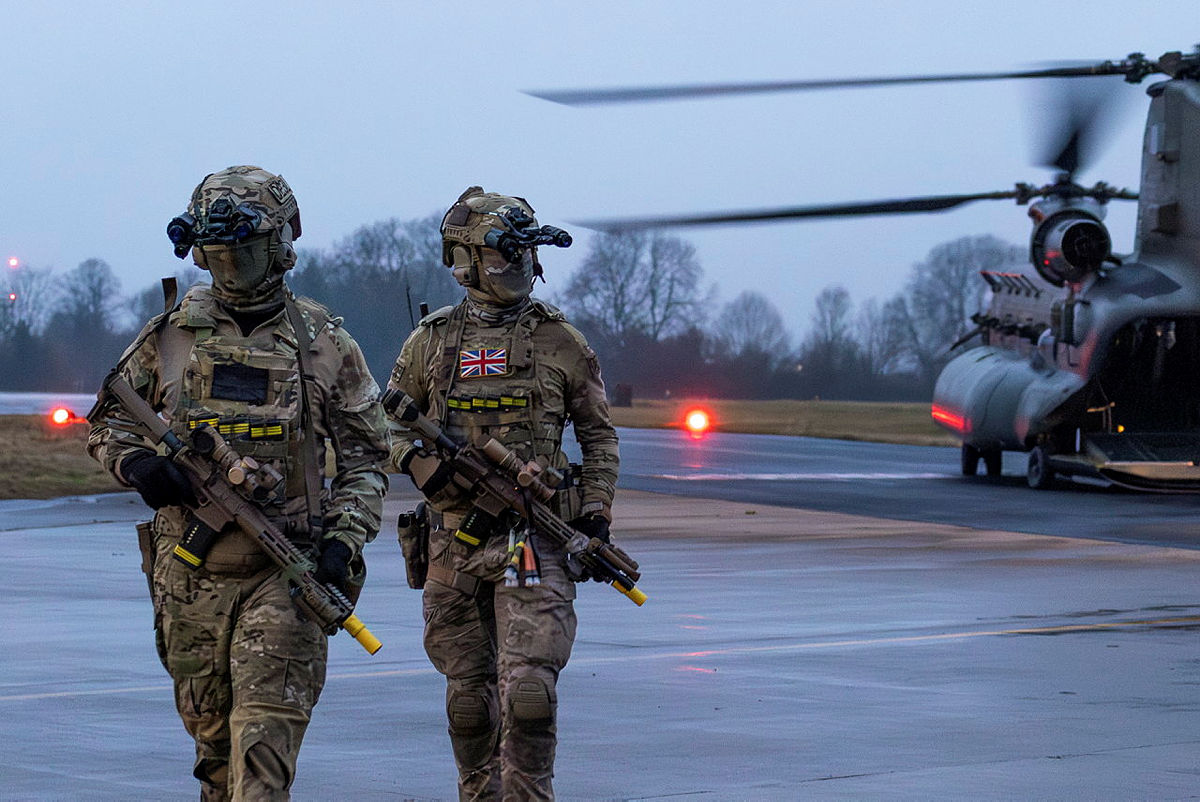
The UK is preparing to assume leadership of the NATO Allied Reaction Force (ARF) Special Operations Component after completing a two-year programme of preparation, training and validation.
The role will see the UK command the Special Operations Component Command (SOCC), a joint headquarters responsible for coordinating maritime, land and air special operations task groups under the ARF framework. The headquarters has now been formally validated by NATO following exercises in Norway, clearing the way for the UK to take on the role during the ARF readiness year from July 2026 to June 2027.
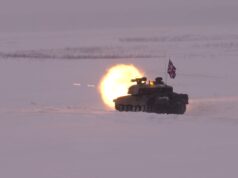
The training programme has included the establishment of a new NATO Joint Operations Headquarters and a series of demanding multinational exercises designed to test interoperability, command and control, and operational readiness. The most recent, Exercise Hyperion Storm, focused on validating the task groups that will fall under UK command.
Hyperion Storm tested the core competencies of the Special Operations Maritime Task Group, Special Operations Land Task Group and Special Operations Air Task Group, including special reconnaissance, direct action and military assistance. Alongside the UK elements, the SOCC will also command a Spanish Special Operations Land Task Group, reflecting the multinational nature of the ARF.
Colonel Phil O’Callaghan, Deputy Commander of the SOCC, said the validation process was extensive and highly demanding. “The evaluation process is exacting and demanding; every detail is scrutinised,” he said, noting that the headquarters had to meet more than 850 individual performance measures to achieve NATO certification.
He added that the exercise marked a significant milestone for UK special operations. “This is the first time we have brought together the UK’s Joint Special Operations Forces for such an important leadership role in NATO,” he said. “It demonstrates the versatility of the UK Commando Force, Ranger Regiment and Royal Air Force, both in support of our NATO Alliance partners and allies across the globe.”
According to Colonel O’Callaghan, working with partner nations is central to the mission. “Leading this NATO Special Operations Force will not only highlight the skills and leadership of the British Armed Forces, but it also reinforces our national commitment to NATO,” he said.
The Allied Reaction Force is NATO’s high-readiness, multinational force designed to deploy at very short notice across a wide range of scenarios, including collective defence, crisis response and hybrid threats. It integrates land, maritime, air, special operations, cyber, space, logistics and strategic communications capabilities, contributed voluntarily by member states. The UK assumption of the SOF leadership role follows commitments set out in the 2020 Integrated Review and subsequent defence planning, which identified the need to deliver a resilient special operations capability by 2030. The offer to lead the ARF Special Operations Component was made in 2023, with validation exercises carried out throughout 2025 and 2026.



On the one hand this is a good news story. Validating NATO validating our SOF is a pretty big check mark for what ultimately is a very new British capability. It also gives 1 UK div, which is aligned to the Land Component of ARF a chance to work out how it might use a SOF component. On the other hand lets not pretend that loosing a Task Group out of the orbat of some very heavily operationally committed units readyness cycle for 2 years (1 for the build up training, 1 on ARF) hasn’t been a heavy burden.
If only the UK would properly fund and equip its SOF forces
Ah the troll rears it’s ugly head, either that or you don’t have any idea what you are talking about.
I suspect it’s a bit of both to be honest.
ASOB, so the UKSOCC, is certainly one area that a lot of work has gone into.
I noted that the JCTTAT also plays a part in the 4 permanently deployed SOTFs.
With 42 Cdo as a part of this, assume as they are the “Maritime Ops Cdo” they are included, and I recall they were also a part of a combined Land / Maritime Force Op a few months ago in the Baltic which I think you commented on
The elements of 2 Sqn RAF Reg I assume comes from their Para qualification and role with SFSG.
There’s no such thing as UKSOCC, SOCC is a NATO command that’s part of the ARF. In this case the SOCC is mostly being provided by the UK, but it’s not exclusively UK; with 3 of the 4 Task Groups coming from us, and the last task group being Spanish.
JCTATT falls under ASOB, but the relationship is opposite, JCTATT doesn’t play much part in any of the SOTF’s missions, but the SOTF’s support JCTATT a lot (much to JCTATT’s chagrin).
Thanks for that.
No UKSOCC? I’ll double check the forces ad I saw for an SO1 at ASOB HQ to see where I went wrong there. I thought it mentioned HQ ASOB effectively doubled as needed as a UKSOCC.
It no doubt meant in the manner you described it, as we now take our turn to lead it, and not in a literal sense.
Whatever, I agree a lot has gone into building up our capabilities here. I see a Signal Sqn has been allocated as well, and 1 Sqn of the HAC, again logical.
Any logistical support or is none needed?
Log support is generally through either contractors or strategic airlift and individual atts and dets, eg a Chef might be trawled for an individual Op. But generally ASOB ops are so light on the ground and so far flung that I don’t see a Logistics Squadron being permanently attached even if the headcount was available.
Yes, makes sense. Though, just occurred to me, I understand a certain unit is used by DSF as logistical back up, and you’d think their ops are just as far flung and also of minimal footprint.
Though their budget is going to be far higher too, and a greater number of units too, so maybe that’s an aspect of it. CMTs as well, SF have their own.
I think in part it is because SF has a different operational mission set to SOF. SF has the full gamut of DA, SR, MA, and PR, while SOF focuses on MA with a small side of DA and SR. I think I know which unit you are on about and for SOF on MA taskings that can be accomplished by chartering freight or tasking a A-400. There’s an image of 2 Ranger “in Africa” of note, that shows a couple of Rangers mounted on Camels watching a Parachute. That image was from a trial where a Ranger Patrol hired a civilian contractor to airdrop a resupply to them halfway through the patrol (not giving much away there it’s fairly obvious what’s happening I think). But that gives you an idea, Rangers have funding to experiment and find logistics solutions, but not a dedicated logistics support unit.
ASOB has their own CMT’s as well. I’d argue that Rangers in fact have some of the best organic Med support anywhere in the Army. What it lacks is a dedicated 2nd line Medical formation, that has to be task organised for specific operations.
Good chat, thanks Dern.
Ok, this passage on the forces job advert was what I was referring to regards a UKSOCC.
“The HQ ASOB Ops cell is a busy, empowered and important interlocker for the delivery of Land Special Operations. Delivering operations across four permanently deployed Special Operations Task Forces, the UKs’ Special Operations Component Command and the Joint Counter Terrorism Training & Advisory Team, the work is engaging and rewarding.”
Implied to me that it was in existence.
The 4 permanent SOTF’s I assume align with each of the 4 Ranger Bns areas of responsibility.
Just badly phrased.
I didn’t know about this SOC, looks like a very useful ENATO force.
Are these task forces taken out of the line, so to speak, and dedicated to the SOC role or are they double-hatted? If the latter, what do we replace them with if they CHOP to SOC command? Given that the task groups are ‘designed to deploy at very short notice’, the former would be better. I wonder what strength SOC has. Are the task groups company size or maybe Ranger regt. size, say 100 – 280, so an overall force of under 1,000? Assume the GOC is a 1 star? Is there a central SOC base somewhere, or are the component parts just called up from wherever when needed?
Well done the UK forces getting trained up and meeting all the criteria for the role.
So the SOCC is part of the ARF, which is an ENATO Multi-Domain Rapid Reaction Force, with Land, Air, Sea and SOF components, and all the roles rotate through NATO. So this year Spain is providing the SOCC, in the Summer we will take it over for a year, and then the year after we will hand it off to someone else.
Can’t speak for other forces but the Ranger Task Group is dedicated to SOCC for the year. As I pointed out in my OP loosing a task group out of the Ranger Orbat has actually put a decent amount of stress on the Brigade. Task Group sizes aren’t in Open Source so won’t be sharing them, but I will say that it’s not the entire Ranger Regiment.
Thanks Dern! I get the impression that you are serving so fully appreciate the constraints on what can be shared.
No worries, I just tend to err on the side of only saying what I know is in Open Source rather than risk saying anything that’s not for public release atm.
After the UKraine there are questions to be asked regarding NATO, European, National forces and the command structure in times of conflict. This is not a paper exercise but also do troops trust their commanders when from another country? Ukraine is on the receiving end of economic and political excuses. A european force will be little different if WW2 is any guide.
The US has demonstrated that reliability cannot be guaranteed. While underspending by europe contributes to the problem I think we have to look deeper. Defense is not a competative activity but an existential necessity – we have to think outside political leanings and national loyalties to have a creditable defense. – Discuss!