

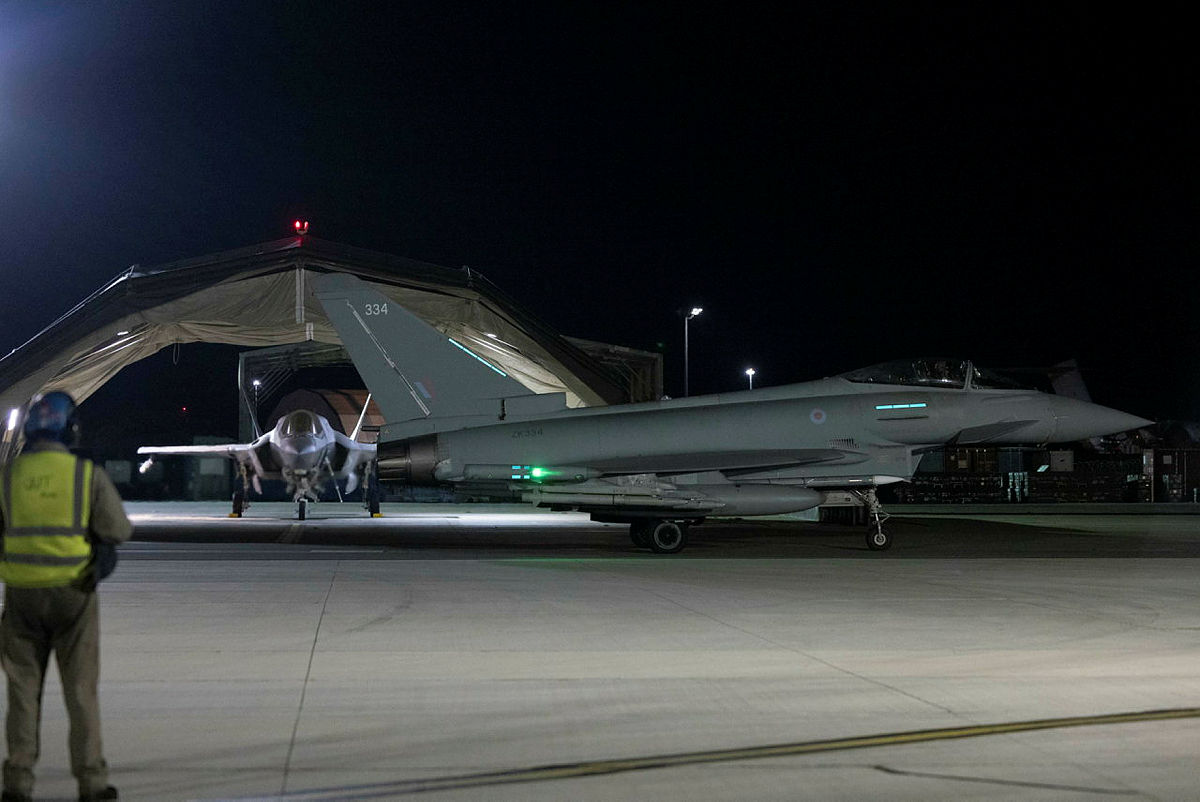
A new Council on Geostrategy paper argues that Britain should use its bases in Cyprus, naval reach and relationships with Greece, Turkey and Egypt to give NATO’s southern flank a more coherent military strategy.
Britain should take a leading role in building a stronger NATO security framework for the eastern Mediterranean, using its permanent military presence in Cyprus and regional defence relationships to address what one analyst describes as a gap in the alliance’s southern strategy.
Writing in Britain’s World, the online magazine of the Council on Geostrategy, open-source intelligence analyst Ethan Gallant argues that NATO’s shift towards its eastern flank since Russia’s full-scale invasion of Ukraine has left the Mediterranean without an equivalent operational framework. He points to the accession of Finland and Sweden, forward deployments in the Baltic states and the development of new structures in northern Europe, while arguing that no comparable doctrine has emerged for the eastern Mediterranean.
The paper identifies Britain as unusually well placed to fill part of that gap because of the Sovereign Base Areas in Cyprus, RAF Akrotiri, its naval presence and its ability to maintain defence relationships with Athens, Ankara and Cairo simultaneously. Gallant argues that Britain has a permanent operational position in the region unmatched by most NATO members, but has not yet brought those relationships together into a single strategic framework.
He proposes a three-part British approach. The first would be a UK-led trilateral framework with Greece and Egypt focused on maritime security stretching from the eastern Mediterranean towards the Suez Canal and Red Sea. Gallant suggests an annual summit, a permanent maritime security working group and joint exercises involving naval and air forces from the three countries.
He writes: “A formal annual trilateral summit, permanent working group on maritime security, and joint exercises drawing on each nation’s naval and air assets would bind these three states into a regional security architecture that none of them can build alone.”
Turkey would remain central to any broader arrangement because it controls the Bosphorus and Dardanelles under the Montreux Convention. Rather than attempting to establish a four-country structure from the outset, Gallant suggests initially developing a UK-Greece-Egypt format and subsequently bringing Turkey into areas including maritime security and the Turkish Straits.
The second pillar would involve deeper British naval cooperation with Greece and Cyprus, including more regular exercises, greater intelligence sharing on Russian and Chinese naval activity and more formalised access arrangements. Gallant argues that existing bilateral defence links provide the basis for this, but that the missing element is sustained operational activity.
He writes: “Bilateral defence relationships already exist. What is missing is the operational tempo that turns bilateral cooperation into regional deterrence.”
The third proposal concerns critical infrastructure and energy security in the eastern Mediterranean. Gallant argues that Britain should treat offshore energy infrastructure, subsea cables and related installations as a strategic security issue rather than principally a commercial one. He points to NATO’s Baltic Sentry mission, established after incidents involving undersea infrastructure in northern Europe, as a potential model for a future Mediterranean effort.
Under that approach, Royal Navy assets could contribute to the protection and monitoring of subsea infrastructure while Britain uses its diplomatic position to encourage security discussions involving regional energy states. Gallant argues that NATO has not yet established an operational equivalent to Baltic Sentry in the Mediterranean despite disputes over maritime boundaries, energy infrastructure and growing military activity in the region.
Gallant concludes that the eastern Mediterranean is likely to become an increasingly important test of NATO’s broader 360-degree defence concept, arguing that Britain possesses a combination of bases, diplomatic access and naval capability that could allow it to take a larger role in shaping the alliance’s southern maritime posture.









In the end the UK cannot do everything.. the eastern Mediterranean is not in reality our primary patch of NATO we need to be focused on where geography has put us and that’s the Northern seas, North Atlantic and supporting the northern flank.. that is also the greatest danger and pressure point.. the Med is profoundly hard for Russia to contest the Black Sea fleet can go nowhere…
In reality if you want a co ordinating power for the eastern med that everyone can work with you have Italy..the sovereign bases on Cyprus means the UK is part of that eastern med team.. but Italy lives there..
Totally agree Jonathan whatever the desirability nothing substantial is currently viable just a trap door into big trouble so one form of insecurity simply replaced with a potentially rather bigger one if things kick off. Ironically the only thing that might bring Countries like Greece and Turkey together in common cause is if something big did kick off that is a threat to them both and bringing in others like Italy and France. Presently France is very much allied to Greece and Greece and Turkey short of an outside threat frenemies in NATO at best. Greece’s connections to France preclude us from any side economic benefits from Greece. What role could we actually play in the protection of cables and pipelines too, we simply don’t have the assets so why take on mythical responsibility? France and Italy as Mediterranean powers, are far better placed (outside of Greece and Turkey) in my view to take on this role. Whether there is opportunity for these States to be given better access to Cyprus bases with British support is perhaps the only question, but even this could aggravate relations with Turkey which is probably a big factor in why no formalised structure of this nature has been attempted.
It’s one of those things that, on paper, makes perfect sense; the historic reason for having Gib and Cyprus was to maintain security in a vital region, and in theory, a naval and air power has exactly the right assets to contribute.
Unfortunately, the assets just don’t exist for us to provide an adequate force both North and South; currently there isn’t really enough for us to do even one. You’d need to double to the RN and RAF frontline combat strength to sustain this.
France and Italy should be shouldering the burden of Mediterranean command. Standing deployments of UK forces would be preferential, and in the case of Cyprus mandatory for defence of some of our most at-risk territory, but that requires actual investment in the forces.
If you want the UK to have greater presence then you might need a few additional T31s if to be in the Med, Gulf, Indo-Pacific, around the UK and Atlantic simultaneously. Maybe a few less drones and a few more ships to pay for ir? Five sounds too lean if you want to uphold freedom of critical international trade lanes.
Agreed. Apart from committments we already have for the likes of Cyprus and Gibralter we should leave the area to the likes of France, Italy and Spain – they can contribute far more than we can to the security of the area while we need to be responsible for and secure the North Atlantic.
Outside of the military there is the diplomatic aspect of Britain being able to use Cyprus to keep Greece and Turkey in the same room and talking without the US.
I agree Jonathan, the eastern Mediterranean is some what of a backwater anyway, the Russian Black Sea fleet is all but gone, Russian bases in Syria are all but gone and China has nothing in the region. The Mediterranean is a NATO lake. It’s full of security challenges but it’s not a prime theatre like the Baltic or North Atlantic.
Farcical. What Royal Navy do the author think it does exists?
UK has no strength for that. Greece is much closer to France and Israel and Turkey is an enemy which is occupying partially Cyprus.
When we had a Royal Navy of strength, maybe, but no longer.
The report neglects to mention the the Turkish claims on Cyprus and after 1974 the longest running UN peace keeping mission. Also the fact that Egypt has an ongoing love affair with cheap Russian equipment along with all of the North African countries. Egypt, Algeria and Tunisia all have Russian equipment and Russian advisers in their respective armed forces.
My own opinion (for what it is worth) the UK would be better off pushing our Commonwealth bothers for closer ties like common ships/submarines/aircraft building and try expanding our co-operation with a commonwealth joint force with UK/Canada/Australia/New Zealand as the back bone. But that would mean more commitment from the UK in the Pacific which we currently would find hard to do given the current state of the UK’s armed forces.
Agree, from here down under. And Anson was deployed to WA for a short while before the Hormuz stuff kicked off, so that is part of the AUKUS agreement lived up to.
None starter that one. Struggling with assets for the high north never mind the eastern med.
We can contribute, and maybe provide niche capabilities, but I think taking a leadership role in the med is beyond the UK for the next decade at least.
No thank you.
Italy should lead.
Our assets are now too few thanks to governments who would happily join such a venture.
Fi e, if we had the assets….
When we withdrew from East of Suez and then the Med, the RN was reduced accordingly.
As such, no expansion of responsibilities should occur without the expansion of resources.
Yeah and the French CSG is based in Toulon and last time I looked Toulon is on the Med.
Is it just me or does every report/paper from this particular group always have grandiose “plans” about what the UK should be doing, leading etc which always seem to be divorced from the actual reality of the UK’s abilities?
No resources for such vague adventures, the authors live in the past
lol
1 base 1 port at gibralter hardy the fleet of old nothing say germany france or clear spanish itallian . y its funny
talking about is iran hasnt the uk involved ground few aa ships sent region worried for shipping both sides pirates africans then random spite missles from the arabian leauge need a far more quicker response options fully cripple navy not that any 1 wants occupy iran control missles take cash but how certain ppl gain support hollywood la alot ppl in northern ireland connected la noticed comment. son dont join army be a hero we dont need 1 more war be a hero unqoute fighting state la la wallet alone im not stupid knuckles funny still sallidin alot of others could be usefull
helicopters for pirates mercs work right stuff boats chopper decks cripple navy still missles to are patrol boats chopper decks and aa capable koninsberg still box in pvt security payment goverments work.
o aye hale bay
proper ju
harry flash bk here doable ships not cheap but they are norweigan
all in countries use the straight trade chip in pot pay pvt security apache try others soviet hind great choppers great speed armour great jobe
Who wrote this paper? Somebody who’s been in a time capsule for the past 80 years? Didn’t know about Jet age AirPower? Didn’t know about fall of the British Empire and the relevance of the Mediterranean strategic for the UK? Didn’t know about the forming of NATO? Didn’t know that Turkey or Romania who are members of NATO and have control of the Bosphorous? Didn’t know about AEW&C and Maritime Patrol Aircraft that can be moved quicker than you can think Naval Armada? Didn’t know about super-sonic anti-ship missiles? Ffs ukdefencejournal just posts stupid crap sometimes? Was this a day where Craig Langford was struggling for this weeks editorial?
No
Italy has been mentioned several times. This matter should be handled by the NATO base there…Allied JFC Naples.
NATO must overmatch Russia everywhere, just as it always has. Why? Deterrence.
Who will take the lead in NATO in Europe, if not the U.S.? Some nation has to step up. Historically, that would have been us. No-one else will do it.
We seem to think taking the lead on ‘net zero’ is important.
The threat from Russia, already at war in Europe, hundreds of thousands dead, millions displaced, is a great deal more immediate…
We need a bigger navy. Get back to 30+escorts & we may have the capability to contribute more than token presence.
No chance of that for many years Frank62, unless a lot more money is put on the table.
On the increased defence spend in the DIP, the RN will manage to get to 19 escorts by 2040, maybe slightly earlier if T26 speeds up. But that is the RN procurement budget at full stretch. It also has to pay for 3 FSSS and 3 Norwegian MHC OSVs, then 4 Amphibious Transport Ships, then this CCV frigate, as well as 4 classes of unmanned vessels. That is the budget spoken for for the next 15 years.