

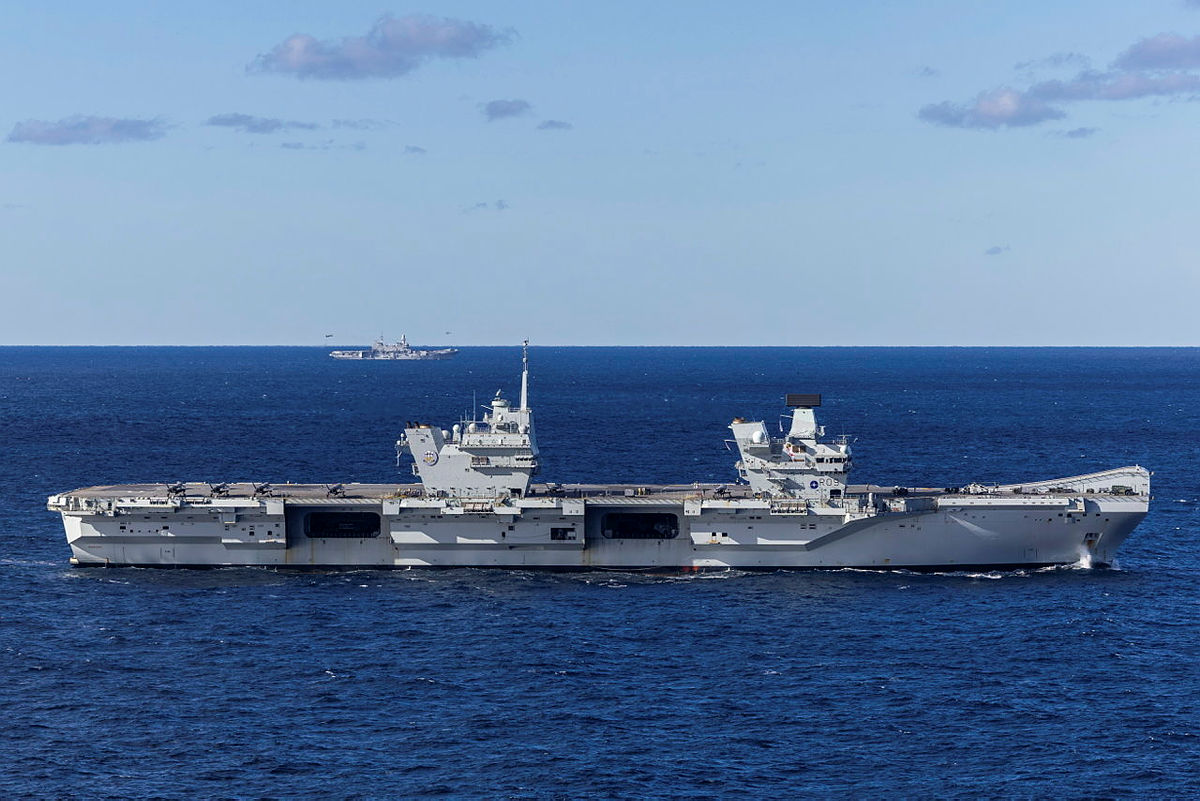
British and Italian carrier air and sea power converged over the Mediterranean on Saturday as Italian and UK F-35B jets, joined by Italian Navy AV-8B Harriers, flew in formation over HMS Prince of Wales and Italy’s flagship Cavour.
The flight followed the conclusion of Exercise Neptune Strike, a core element of Operation Highmast, the UK’s eight-month global carrier deployment. Italian F-35Bs embarked directly on HMS Prince of Wales for the exercise, validating the two nations’ ability to operate a genuinely interchangeable Joint Carrier Air Wing.
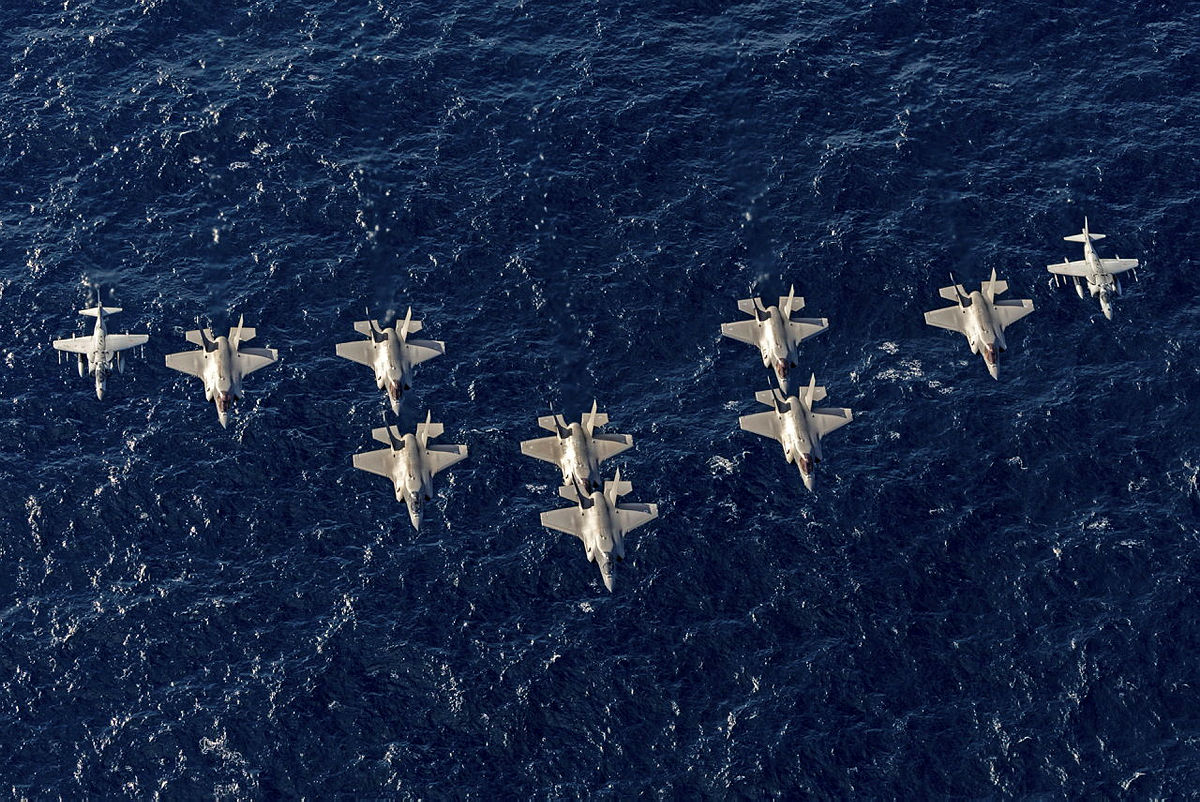
According to the official release, the deployment “proved interoperability and interchangeability between the two nations,” with the combined air wing flying missions on behalf of NATO across the Mediterranean.
Operation Highmast is now entering its final stages. After a five-month sweep through the Indo-Pacific, the UK carrier strike group has re-entered the Mediterranean for a final series of multinational exercises before returning home. The mission has involved around 4,500 British personnel, including nearly 600 RAF aviators, 900 soldiers and 2,500 Royal Navy sailors and Royal Marines.
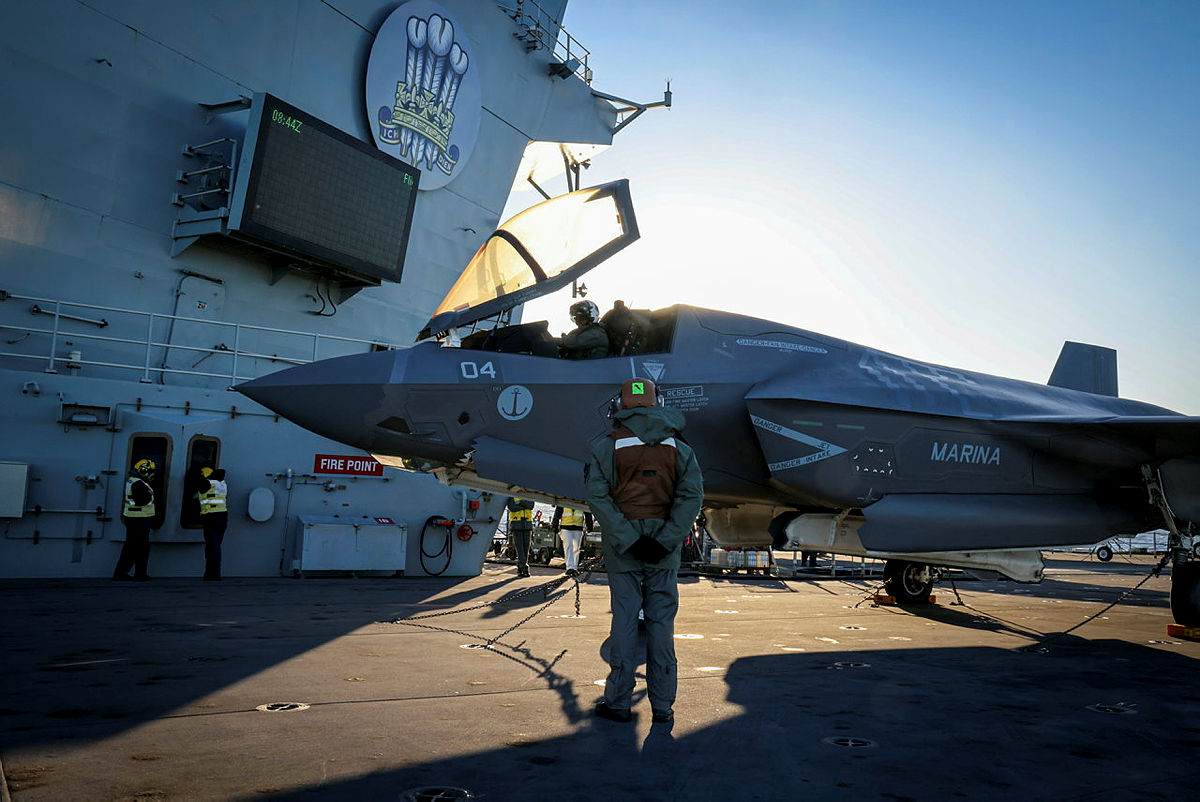
The UK describes Highmast as a strategic signal of long-term commitment to both Mediterranean and Indo-Pacific security. The Italian navy’s integration into the carrier air wing reinforces NATO efforts to standardise operations at sea, creating combined carrier strike groups able to surge at short notice.
Saturday’s fly-past was captured by photographer AS1 Amber Mayall.



How come no one ever counts the planes on Italian carriers?
Because they can fill theirs ?
Forgot the 😁😁
In all fairness it would chokka with half of the frames on PoW.
It has a designed capacity for ~12 F35B and 10-12 cabs.
Guess you’ve not been on any Italian defence websites 😏
The Italians do. Just like how the German defence websites whine about their own problems, as do the Dutch, as do the Norwegians, as do, incredibly given their spending, the Polish.
Same Russian trolls, different names?
Brilliant deduction there 10/10 😁😁😁
Ah the carrot caught one. The one who thinks he’s incredibly funny and smart.
I am. ☺️
You meant to say Am I ? 😂😂👍
Well, I am clever enough not to have a “Cock Ring ” as my Avatar,
What were you thinking Rob Ross ?
Maybe he’s a Hard B’stard ? 💪💪💪😂😂😂
As we now know half the MAGA zealots on X are from various strangely distant Countries who’s first language isn’t English one can rightly presume that is pretty consistent anti Western gibberish wherever you read such loaded commentary.
I’m hoping to see the Italians land a Harrier on PoW before they are gone for good soon, a little taste of what could have been if 2010 SDR hadn’t rushed them out of service (for a short period of time at least).
In another world, there would still be Harriers on the QEs today; the fact that the Italians and Spanish have kept their fleets operational is testament to the feasibility of it. An active squadron of RAF Harriers would’ve given the carriers a modestly capable strike option for doing the primary task Western carriers have been doing for decades: hitting terrorists and insurgents in the desert.
Alas, what might’ve been…
The original out of service date for Harrier GR7/9 was 2018. They were already high maintenance back in 2010 before early disbandment.
The argument also centred around;
– there not being any point in QEC IOC without F35
– QEC was delayed on this basis as a cover for in year accounting
– at the point in time QEC was IOC Harrier would have been EoL.
The Italians are rapidly retiring theirs and the spanish only have them because they cannot afford F35, were past the point of it being a what couldve been argument.
What anti ship missiles do they carry out of interest. Let’s be honest our F-35s will be high maintenance by the time they get any.
I know I go on a bit but what if the Supersonic Harrier had not been cancelled. It had lots of early problems but British engineering ingenuity would have sorted and it, plus son of it, would be filling the carriers of Western Navies today!
Wouldn’t be stealthy of have the fusion. Remember, our only fast jet AESA is still the F35B.
Hi Richard-what is AESA?
To save a load of typing wiki gives a good outline.
Dream on, everyone would be buying F35 and wed have a handful of these supersonic harriers with a high development cost.
Hi Hugo-as below, the Harrier and its American makeover sat on the flat tops of many navies long before the F35B existed. Also the Yanks got into VSTOL via Harrier. British aircraft designers and engineers led the world in the development of military aircraft but fell down due to hopeless marketing, useless Government (notably Harold Wilson) and ruthless American machination of the market.
Another project lost in F-35 development, not that it would have got off the ground. Even with supersonic performance it would have been obsolete now as range and weapon load would still have been somewhat limited along with the avionics, even F-35 is an underperforming maintenance intense an airframe, it just covers it with stealth and sensor fusion, well apart from the range anyway.
..and here is a question for the boffins. There is a clip of a Eurofighter in reheat taking off from a runway in 8 seconds. So , could it take off and up the ramp on the PoW without a catapult and would the ski ramp give it enough lift to get airborne safely? If so, you could navalise the Eurofighter and just fit arrestor wires on the QE class? I pose the question in ignorance but do feel the deck on the QEs would be too short..
Navalised Typhoon has been harped on about for decades, primarily in relation to converting the carriers to CATOBAR a decade or so again. It’s not feasible, and wouldn’t offer the sort of capability the RN is actually after.
Not that simple, the typhoon airframe is not designed for the stress of carrier landings.
I think you just have to take a look at the type of aircraft the Indians, Russians (once did) and Chinese currently fly off theirs. My opinion is Yes they could but It would go against all the current rigid perameters.
Theoretically yes. As a benchmark the MiG-29K used by the Indian Navy for STOBAR from their carriers, has a power to weight ratio at max fuel load of 0.98:1. With a limited weapons load, this drops down to 0.8:1, though this is still quite below the max take-off weight. But it can still launch via the ramp.
A lot will depends on the Typhoon’s weight at take-off. In a clean configuration it has a power to weight ratio of 1.22:1. In an air to air configuration this drops slightly, but is still above 1.10:1. Meaning compared to the MiG-29K, the Typhoon has an excess of power. This is critical as the for the first 100ft or so, the wing won’t be generating sufficient lift after the aircraft leaves the ramp. Therefore the engines thrust must be capable of “carrying”, the aircraft long enough for the wing to develop sufficient lift.
Having a delta wing, the Typhoon will need to adopt a high angle of attack when landing. This higher nose up attitude will block the pilot’s view of the deck. But today as per the F35’s EOTS, a pilot can effectively see through the aircraft. Which would allow them to spot the deck and judge where to touchdown.
To be blunt, the opportunity to redesign Typhoon to a maritime version has passed. There isn’t really enough life in the airframe growth for another 20 to 30 years. Further being a 4th gen jet, it doesn’t have the stealth benefits that the F35 has.
Good read DB, I recall certain aircraft were “Jacked up” when launched off Cat Carriers to give added wing lift angle, I’m assuming a “Sea Typhoon probably would too ?
Feel free to “Educate ” me, I’m not scared !!!😁
For a flat deck carrier with a short catapult like on the old CATOBAR Ark Royal. Both Phantoms and Buccaneers had the noses “jacked up”. This was to increase the wings angle of attack, thereby generating more lift. The shorter catapults didn’t really have the oomph to get them up to flight speed. On the new QE carriers or other STOBAR carriers, the ramp helps to progressively increase the wings angle of attack as it accelerates. Thereby generating enough lift to sustain take-off in to flight.
When you look at the Phantom’s and Buccaneer’s power to weight ratios. Neither have the excess thrust for a STOBAR take-off, even when using a ramp. The Typhoon’s two EJ200s are such a significant leap in performance over the Speys used by the earlier jets.
Thanks Davey and to others for your comments
Well interesting question, Super Hornets have been tested off of carriers with a ski jump I believe and they have a higher empty and gross weight.
I recall the location of the canards obscured the view of the pilot when landing on a carrier!
Ducks should never be allowed on a Carriers deck.
I was told the carriers were themselves lame ducks? What harm could a couple more do?
Ha ha, that’s the spirit !
The French manage with their Rafale’wiith their canards. Are they further back than the Typhoon’s?
Yes, They designed them especially.
Yes take a look at pics very different location, vision over manoeuvrability.
As usual, nice photo Amber 👍
One for the Family Album !
The US navy has just cancelled the Constellation Class Frigate program, would they be better going for the Mogami class frigate instead???
Question then is US look at the Mogami will BAE offer the T26 and Babcock even the AH140?
Good pick up on this BTW. Just seem it reported on Naval News. Hope BAE and Babcock offer. Also a post there on US seeking heavy weight torpedoes. OT but has the UK ever sold its Spearfish to anyone? Might be some opportunities here for 🇬🇧 industry…probably if we buy more US stuff.
Farewell to the Consternation Class frigate.
Zumwalt
LCS
Consternation
A litany of failure.
This makes T45, T26 and T31 look like works of genius.
Thank you, gentlemen for interesting comments. A few things-the Supersonic Harrier was mooted in the early to mid 1960’s-60 years ago! It and its son and even grandson would have progressed very far from the original and also in supersonic and subsonic guise have established a bigger market than the successful Harrier variants did. Remember, the Americans themselves got into the STOVL market via Harrier long before the F35 B existed. Also, I take all your points regarding a seafaring Typhoon, but it is not that dissimilar to the Rafale so a way would have been found to put in on flat tops. Also to my mind the retrofitting of Cats and Traps on the QE2s was a non-starter for several reasons-it would have been hugely expensive and have taken the carriers out of service for a very long time. The Harriers provided several Navies with a good measure of naval fixed wing capability and the F35B is leaps and bounds ahead of the Harrier in every respect-speed, range, payload, stealth, technology etc so gives a big percentage of the F35C capability with the added advantage of VSTOL
MOD statement: “After months deployed, the UK Carrier Strike Group including HMS Prince of Wales and HMS Dauntless will return to HMNB Portsmouth next week for an emotional reunion with families and loved ones.” Anyone know the exact day? I’m guessing Monday 1 Dec. Half her air group is already back in the UK, presumably the other half will disembark over the weekend.